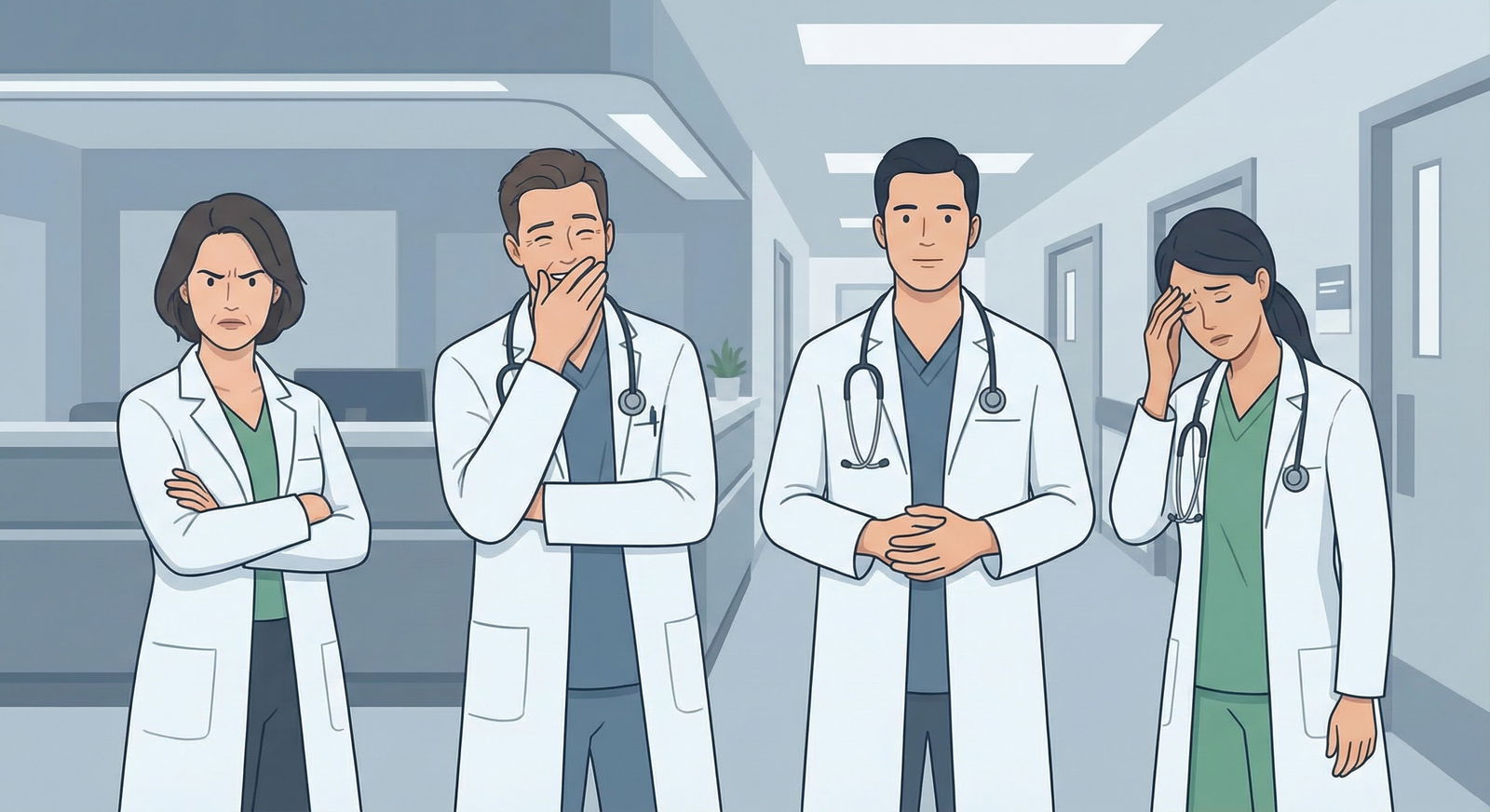
It is 7:57 a.m. You are speed-walking to the conference room, clutching bad coffee, skimming yesterday’s H&P on your phone. The chief resident is at the podium. The title slide says “Morning Report.” People are actually laughing at a joke about SIADH. It feels…safe.
Fast forward to noon. Same room. Lights down. Title slide: “Morbidity & Mortality Conference.” You try a light comment about “the patient not reading the textbook.” Dead silence. Your attending’s jaw tightens. Suddenly you realize: you just used Morning Report humor in an M&M room.
Two conferences. Two expectations. Two very different humor rules.
Let me break this down specifically.
1. What These Conferences Actually Are (And Why Tone Matters)
Before we talk humor, you need the architecture.
Morning Report: The Teaching Sandbox
Morning Report (MR) is the resident playground disguised as an academic conference. Core features:
- Purpose: diagnostic reasoning, management discussion, and teaching.
- Typical vibe: case-based, interactive, mild chaos.
- Participants: residents, students, a few attendings; sometimes subspecialty folks if the case is interesting.
- Stakes: low-to-moderate. No one is assigning legal blame. The worst that happens is an attending says “I would have done this instead” in a slightly judgmental voice.
Morning Report is built around cognitive exploration. Hypotheses are tossed around, wrong answers are normal, and the entire structure implicitly says: you are allowed to think out loud and get things wrong. That environment tolerates—and often benefits from—well-timed, low-risk humor.
Morbidity & Mortality: The Autopsy of Failure
M&M is not a sandbox. It is the institutional memory of harm.
- Purpose: identify system failures, cognitive errors, and process gaps that contributed to bad outcomes (death, serious complications, near-misses).
- Typical vibe: somber, uncomfortable, occasionally tense.
- Participants: a heavier attending presence, program leadership, QI folks, sometimes risk management, sometimes surgery vs medicine turf representation.
- Stakes: high. Cultural, educational, and occasionally legal.
M&M exists to dissect what went wrong without destroying the people involved. Humor in that environment is both powerful and dangerous. Used carefully, it can reduce defensiveness. Used poorly, it trivializes harm or signals that you do not take patient suffering seriously.
That’s the core difference. Morning Report is “how we think.” M&M is “how people got hurt.”
2. The Humor Spectrum: What Flies in Morning Report vs M&M
Let me draw the line clearly. Here is what the humor spectrum usually looks like in each setting.
| Aspect | Morning Report | M&M Conference |
|---|---|---|
| Overall tone | Light, curious, exploratory | Serious, reflective, high-stakes |
| Target of humor | Self, cognitive traps, textbooks | Never the patient, rarely individuals |
| Frequency of jokes | Moderate, sprinkled throughout | Rare, brief, mainly to defuse tension |
| Acceptable sarcasm | Mild, peer-level | Minimal to none |
| Dark humor | Very limited, mostly private asides | Not appropriate in formal discussion |
Morning Report: Where Jokes Teach
In Morning Report, you can often get away with:
- Self-deprecating humor.
- Gentle mocking of the textbook vs real life.
- Light jabs at cognitive biases (“My anchoring bias had a strong morning coffee that day.”)
- Mild, shared misery jokes about call, EMR, or the pager.
Example that works in Morning Report:
“So I confidently presented this as uncomplicated cellulitis…right up until the ED attending gently pointed to the gas on CT and said, ‘that is not the skin infection you are looking for.’”
People chuckle. You de-shame being wrong. Learning happens.
M&M: Where Jokes Can Wound
In M&M, you are dealing with an actual harmed person with a name, a family, a body that did not tolerate your learning curve. Humor that works in MR can feel grotesque in M&M.
Things that almost always land badly in M&M:
- Jokes that frame the patient as difficult, non-compliant, or “the problem.”
- Humor that minimizes a delay, miss, or serious complication.
- “Well, in hindsight we should have done X, but my pager had other plans!” (You just framed system chaos as a punchline to harm.)
- Dark humor about death, codes, or “at least they were DNR.”
Example that will chill a room:
“This was one of those patients where everything that could go wrong did go wrong. So, you know, classic Friday.”
You might think you are commenting on chaos. What others hear: you are normalizing it.
3. Who You Are Changes What You Can Say
This part is uncomfortable, but real. The same joke lands differently based on who says it.
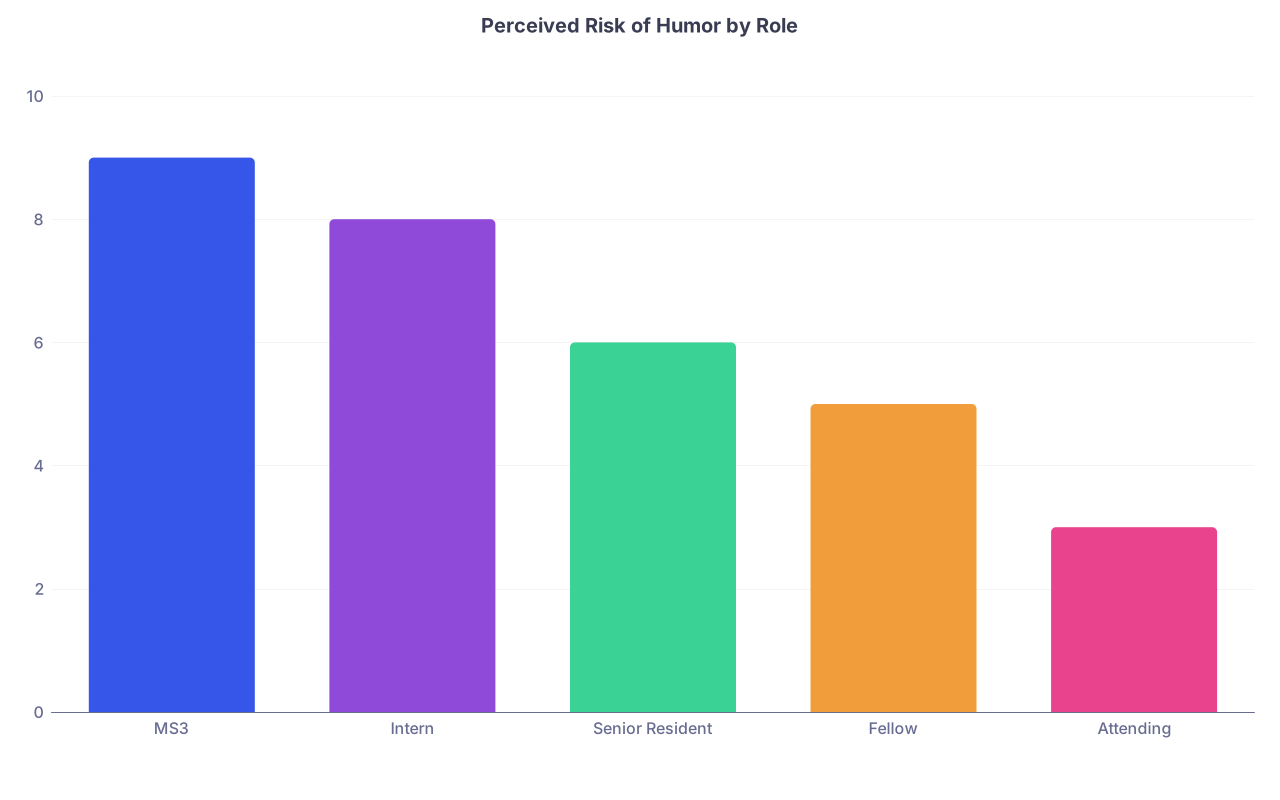
| Category | Value |
|---|---|
| MS3 | 9 |
| Intern | 8 |
| Senior Resident | 6 |
| Fellow | 5 |
| Attending | 3 |
Scale 1–10: higher = riskier to attempt humor in M&M without misinterpretation.
In Morning Report
- MS3 / Sub-I: You are safest staying in “earnest + occasionally self-deprecating” territory. Quick, short comments. Do not try to be the room comedian.
- Intern / Junior: You can use humor about your own thought process, call-night brain, and confusion. Avoid punching up at attendings or down at students.
- Senior / Chief: You set the tone. You can frame a wrong answer empathetically with a joke that normalizes error without mocking the person.
- Attendings: The attending’s humor defines the emotional range allowed. A supportive attending who occasionally laughs at their own past mistakes opens up a healthier space.
Typical safe MR pattern:
“I also guessed PE as an intern for every unexplained tachycardia. So I do not hate that answer at all.”
In M&M
The hierarchy flips in terms of who should be speaking lightly.
- Interns: Your role is clinical honesty, not color commentary. Humor at M&M as a PGY-1 usually reads as “they do not understand how serious this is.”
- Seniors: You can very briefly use self-directed humor to accept responsibility and reduce blame on juniors. But small doses.
- Chief / Program leadership: Occasionally use a careful, understated line to lower the emotional temperature when the room is getting defensive or accusatory.
- Attendings: Any joke that sounds like you are minimizing harm, or deflecting your own decisions, is a disaster. Period.
A line that works from a senior in M&M, if used once and then dropped:
“Looking back, I can see my diagnostic momentum had a stronger spine than I did that night.”
You frame the error, you claim it, you name the bias. The humor is in the wording, not in the harm.
4. What You Can Joke About: The Object of Humor
Strip away style and hierarchy. What matters most is the target of the humor.
Safe-ish Humor Targets in Morning Report
- Yourself: your past misdiagnosis, your flawed initial read, your overconfident differential from PGY-1 days.
- Cognitive biases: anchoring, premature closure, base-rate neglect.
- Textbooks and exams: board-style vs real-life mismatch.
- Process annoyances: pager beeping in step-down, EMR clicks, consult notes written in hieroglyphs.
Landmine Humor Targets (Especially in M&M)
These are nearly always bad ideas, and in M&M they are radioactive:
- The patient’s personality, language barrier, or social situation.
- The family: “demanding,” “difficult,” “Googled everything.”
- Nursing, consultants, other services as punchlines.
- Institutional constraints as a joke (“Welcome to [Hospital Name]” used sarcastically after describing a failure that harmed someone).
You can talk about any of those domains—patient factors, family dynamics, consultant disagreements, system failures—but not with humor at their expense.
Think of it this way: if the patient’s family were sitting in the front row, how would your joke sound? If the answer is “atrocious,” skip it.
5. Case Progression: How Humor Functions Over Time in the Session
Humor is not a single-shot decision. It interacts with the arc of the case presentation.

| Step | Description |
|---|---|
| Step 1 | Opening |
| Step 2 | Early Uncertainty |
| Step 3 | Diagnostic Pivot |
| Step 4 | Outcome Revealed |
| Step 5 | Debrief and Takeaways |
In Morning Report
- Opening: A light, non-patient-targeted joke can work. Example: “This was the moment we learned the power of looking at the med list before presenting.”
- Early uncertainty: Humor is useful to normalize not-knowing. “Raise your hand if lupus has burned you before.”
- Diagnostic pivot: Humor can underline the contrast between the initial and final diagnosis, as long as you are laughing at your own thinking, not the patient.
- Wrap-up: A final, short line reinforcing a takeaway can work: “So, moral of the story: if the sodium is 112, all life decisions get double-checked.”
In M&M
The closer you get to revealing harm, the less humor belongs.
- Opening: Very minimal humor, if any. Maybe a half-sentence acknowledging a shared discomfort about the topic, but no jokes about the event itself.
- Presentation of course: Stay factual, neutral. Humor here looks like minimization.
- Outcome reveal (ICU transfer, code, death, unexpected surgery): No humor.
- Debrief: At most, very light, controlled use of wording that acknowledges how hard this is while emphasizing learning.
A line that might work from leadership in the debrief phase:
“If this case makes you feel a bit sick to your stomach, that is appropriate. These are the ones we remember. And the ones we teach from.”
Not funny. But it releases tension without trivializing harm.
6. Cultural Variants: Medicine vs Surgery, Academic vs Community
Different environments run different software.
, Medicine M&M, ICU Rounds Debrief](https://cdn.residencyadvisor.com/images/articles_svg/chart-informality-level-by-conference-type-2151.svg "Informality Level by Conference Type")
| Category | Value |
|---|---|
| Medicine Morning Report | 8 |
| [Surgery M&M](https://residencyadvisor.com/resources/medical-humor/or-banter-decoded-hierarchy-timing-and-when-not-to-speak) | 3 |
| Medicine M&M | 4 |
| ICU Rounds Debrief | 6 |
Scale 1–10: higher = more informal, more conversational.
Medicine Morning Report
This is usually the loosest. Interactive, Socratic, sometimes borderline stand-up if the chief is charismatic. But even here, the best humor is functional: clarifying a concept, reducing shame, or highlighting a trapping pattern.
Medicine M&M
Often more analytic, algorithm-based. Slightly more room for careful humor than surgical M&M, because the culture often emphasizes systems and cognitive error over individual blame. But again: patient harm is still the center.
Surgery M&M
Historically more brutal, though many places are shifting. Humor here often reads as sharp, gallows, or cynical. But the same rule holds: if it makes the resident look callous about bleeding or bowel injuries, it is not clever, it is professionally dangerous.
Surgery M&M example of acceptable, very carefully framed humor:
“In hindsight, this is the anastomosis that keeps you up at 3 a.m. replaying every stitch.”
The humor is subtle self-torment, not dismissal.
Academic vs Community
In big academic centers:
- More rules about professionalism.
- Risk management sometimes present.
- Official statements about “just culture” and non-punitive learning.
- Jokes are noticed, remembered, and sometimes cited in evaluations.
In some smaller community hospitals:
- More informal relationships.
- Everyone knows everyone.
- Dark humor might be more prevalent behind closed doors.
But let me be clear: “we are a community program” is not a defense when an offhand joke in M&M shows up in a complaint or a legal discovery. The future of medicine is trending strongly toward less tolerance for anything that looks like dismissiveness.
7. Dark Humor: Where It Actually Belongs (And Where It Does Not)
Every resident uses dark humor somewhere. Usually 2 a.m., away from patients, not on a recording.
The function of dark humor among clinicians:
- Blunt the edge of repeated trauma exposure.
- Offer solidarity: “Yes, that was awful, and I saw it too.”
- Signal group membership in a way that feels safe.
But there are three rules if you want a career and not a professionalism hearing:
- Dark humor does not belong in front of patients or families. Ever.
- Dark humor does not belong in recorded, institutional conferences—especially M&M.
- Dark humor should not target vulnerable patients or marginalized groups. If your joke relies on stereotype or punching downward, you are the problem.
Morning Report occasionally tolerates light gallows humor if the case is old, names are changed, and the punchline is your own fear or past ignorance. M&M does not.
Think: “private coping in the call room” vs “public performance in a microphone.” Very different categories.
8. Future Direction: Humor, Psychological Safety, and Just Culture
We are moving—slowly—from “shame and blame” toward “just culture” in medical education. That shift changes how humor is used.
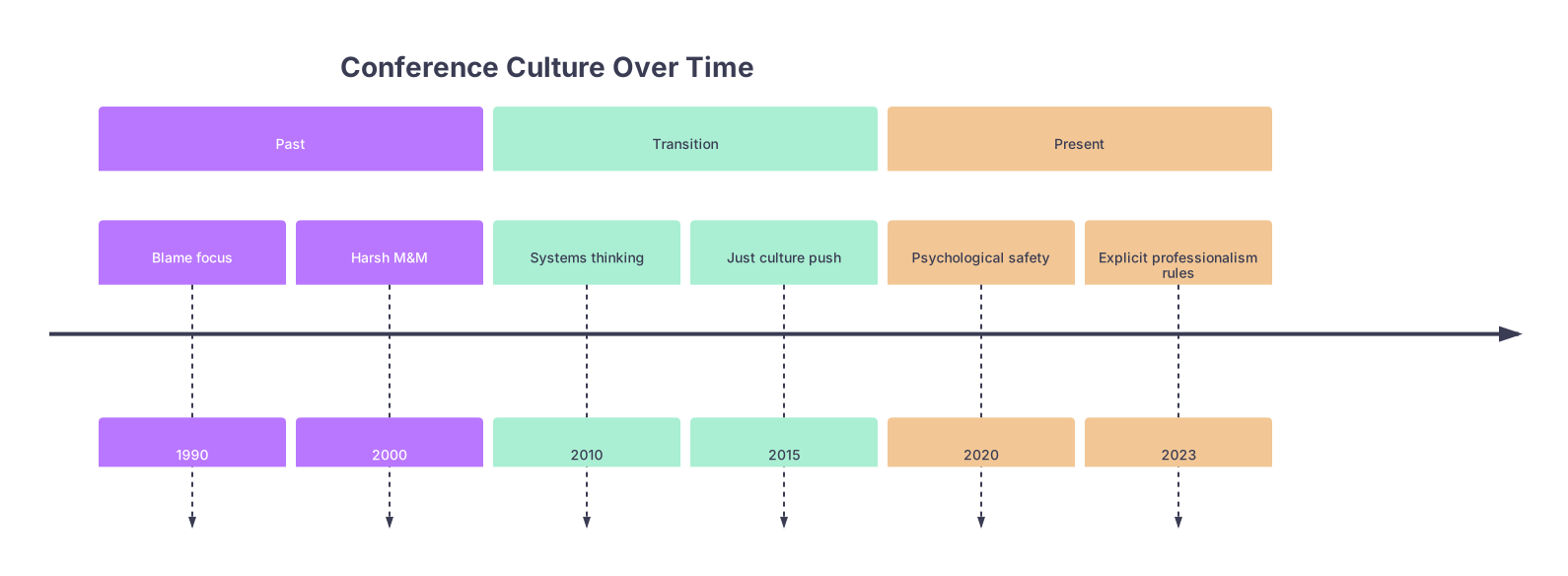
| Period | Event |
|---|---|
| Past - Blame focus | 1990 |
| Past - Harsh M&M | 2000 |
| Transition - Systems thinking | 2010 |
| Transition - Just culture push | 2015 |
| Present - Psychological safety | 2020 |
| Present - Explicit professionalism rules | 2023 |
Humor will survive this transition, because it is wired into how humans learn and cope. But the direction of humor is shifting:
- Away from mocking individuals.
- Away from normalizing bad systems as “just how it is.”
- Toward naming cognitive traps with a human voice.
- Toward destigmatizing error while still taking harm seriously.
A good M&M in 2030 will probably:
- Explicitly outline systematic contributors with data.
- Use careful language to separate error from character.
- Allow a small, respectful amount of levity directed at our shared fallibility, not at the patient or the staff.
Morning Report in 2030 will still have people making jokes about hyponatremia and orthostats. But you will see tighter norms around wording when discussing patients with obesity, substance use, limited English, or housing insecurity. That is not “woke overreach.” That is basic clinical respect.
9. Practical Rules: How Not to Embarrass Yourself
You want something concrete. Here:

Rule Set for Morning Report
You are usually fine if:
- The joke targets your own limitations, not the patient’s.
- You are highlighting a cognitive bias or textbook absurdity.
- Laughter supports learning: people remember the point better.
- You could say the same line in front of the program director without regret.
Examples that are usually safe in MR:
- “At this point in the night, my pretest probability for sepsis was approximately 120 percent.”
- “I applied the always-correct medicine rule: if you do not know what it is, call it a vasculitis.”
Rule Set for M&M
Default stance: serious, respectful, concise.
You are only safe with very minimal humor if:
- It is clearly self-directed.
- It does not appear to trivialize the complication.
- It reinforces the learning point.
- It would not sound horrifying if read verbatim in a legal setting.
If you are an intern, the safest move in M&M is to skip humor entirely.
10. How to Recover If You Misjudge the Room
You will, at some point, say something that dies on impact.
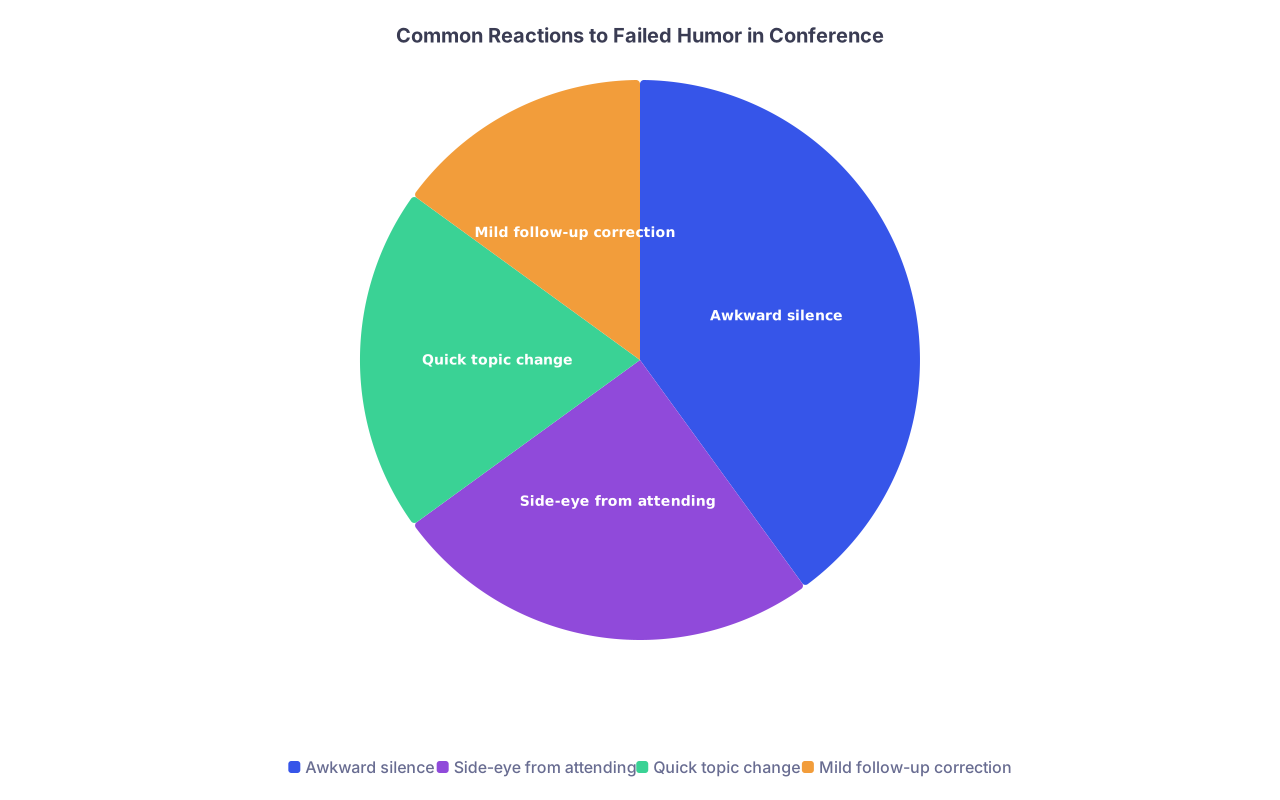
| Category | Value |
|---|---|
| Awkward silence | 40 |
| Side-eye from attending | 25 |
| Quick topic change | 20 |
| Mild follow-up correction | 15 |
If you drop a line in M&M and feel the air change:
- Stop. Do not dig the hole deeper by “explaining the joke.”
- Briefly re-center: “To be clear, I am not minimizing what happened here. This case has stayed with me.”
- Return to facts and reflection. Show that you understand the gravity.
If an attending or chief gently redirects, take the lifeline. The correct response is something like, “Yes, you are right,” and moving on. Not defensiveness.
11. Why This Matters More Than “Don’t Get in Trouble”
This is not just about optics or evaluations.
- Patients do not hear what you say in the conference room, but your tone bleeds into how you think about them.
- Students learn what is “normal” from watching you. Humor that dehumanizes patients recreates the same culture you probably hate.
- The best clinicians I know can hold two truths at once: deep seriousness about harm, and the ability to use lightness to keep teams from emotionally imploding.
Morning Report and M&M are two sides of the same educational coin. One is where you stretch. The other is where you reckon. Both need honesty. Only one really has room for easy laughter.
FAQ (Exactly 6 Questions)
1. Can I ever use humor as a medical student during M&M?
You should be extremely cautious. As a student, your best move at M&M is to observe, learn, and focus on understanding the clinical and systems issues. If you speak, keep it factual and concise. Leave humor to people with more responsibility and standing, and even they should use it rarely.
2. Is it acceptable to use dark humor privately with co-residents about difficult cases?
Clinicians do this all the time as a coping mechanism, but you need boundaries. Keep it off recordings, away from patients and families, and never post it online. And if the “joke” punches down at vulnerable populations, it is not coping, it is cruelty. Choose who you share that side with very carefully.
3. My attending uses harsh or mocking humor in M&M. Does that make it okay for me?
No. Senior people can get away with behavior that will sink you. Also, “we have always done it this way” is not a defense when culture shifts, and it is shifting. You can learn from their clinical expertise without copying their worst habits.
4. Is it better to avoid humor entirely in professional settings?
In Morning Report, no; controlled humor can enhance learning, normalize uncertainty, and build psychological safety. In M&M, for trainees, “almost none” is the right answer. Your default should be seriousness and respect. Add one or two carefully chosen self-directed lines only if you are certain they support the learning point.
5. How do I know a Morning Report joke is going too far?
Run a quick mental filter: Would this sound bad if an audio clip was shared with the patient or their family? Does it rely on stereotypes, weight, substance use, mental illness, or social situation as the punchline? Would I be okay if the program director heard it? If any of those make you hesitate, do not say it.
6. Can humor actually improve the quality of M&M conferences?
Used very sparingly and skillfully, yes. A leader who can name discomfort, acknowledge fallibility, and briefly lighten shame—without minimizing harm—can reduce defensiveness and encourage honest discussion. But that is advanced work. For most trainees, the focus at M&M should be clarity, humility, and respect, not being funny.
Key points:
- Morning Report is a teaching sandbox; light, self-directed humor that supports learning is usually acceptable.
- M&M is about real harm; default to serious, respectful tone, with at most minimal, self-reflective levity.
- When in doubt, skip the joke. You will never be criticized for being too respectful in the room where patients’ worst days are being dissected.