
The worst attendings kill workroom laughter without ever raising their voice.
You will not be that attending.
You are about to set the baseline emotional temperature of every room you walk into. People will still laugh when you leave if you are good. They will only laugh when you leave if you are bad.
Here is how your first year as an attending should unfold, chronologically, if you want a team that works hard, feels safe, and still manages to laugh at 3 a.m.
3–6 Months Before You Start: Decide What Kind of Funny You Are (and Are Not)
At this point you should be shaping your default “workroom persona” before the title hits your badge.
Month −6 to −3: Build Your Internal Rules
On your commute, in the call room, in the shower—start drafting a simple, ruthless code for humor at work. Write it down. Something like:
- No punching down. Ever.
- No jokes about patients, nurses, consults, or other services as targets.
- No mocking accents, bodies, mental health, or social situations. Zero exceptions.
- Self-deprecating first. Situational second. Teammates almost never.
- Never joke to dodge feedback. You are not using humor to avoid hard conversations.
- If one person looks uncomfortable, the joke failed. Own it fast and fix it.
Decide this now, because once you are the attending, your “offhand” comments sound like policy.
Month −3 to −1: Study the Attendings You Liked (and the Ones You Hated)
You have data. Use it.
Make two columns.
| Category | Example Behavior |
|---|---|
| Copy | Attending who gently made fun of themselves for being slow with the EMR while praising others' speed |
| Copy | Attending who used gallows humor about *systems* (EMR crashes, pager chaos) not about *people* |
| Avoid | Attending who joked about “weak” specialties or residents who were not aggressive enough |
| Avoid | Attending whose sarcasm made students terrified to present or ask questions |
| Avoid | Attending who turned debriefs into roast sessions of other services |
At this point you should identify 2–3 concrete phrases you want in your arsenal:
- “I’m joking about me, not you.”
- “This is a safe room for dumb questions. I specialize in asking them.”
- “We are allowed to laugh. We are not allowed to be cruel.”
Memorize them. You will need them day one.
Month 0: The Week Before You Start – Script the First Five Minutes
The tone is set in the first team huddle. Not the first feedback session. The first hello.
7–3 Days Before Start
At this point you should:
- Decide on your opening line for day one.
- Decide on 1–2 safe, small self-deprecating stories.
- Plan how you will explicitly invite laughter without sacrificing standards.
Example opening huddle (abbreviated):
- “I am new as an attending, but not new to how exhausting this place can be.”
- “My priorities: safety first, learning second, efficiency third. Laughter is what keeps those running.”
- “If I say something confusing, I expect you to tell me. If you say something wrong, I will correct the idea, not roast the person.”
Notice what is missing: edgy jokes, fake chattiness, “we’re all friends here.” You are setting up permission for humor, not performing a comedy set.
Week 1: Day-by-Day Tone Setting
Your first week will lock in your reputation for the entire year. Residents will screenshot your quotes into group chats. Assume that.
Day 1: The First Workroom Entrance
At this point you should aim for “calm, warm, structured.”
- Walk in on time. Mildly caffeinated. Phone away.
- Say everyone’s name if you know it; ask and repeat if you do not.
- Make one small, human-level joke that is obviously at your expense.
Example:
- “I am still at the stage where I double-check which drawer has the lab labels, so feel free to rescue me if you see me opening all of them.”
Then, set the social ground rules explicitly:
- “This workroom should be a place where it is okay to ask basic questions and occasionally complain about the printer.
What we will not do is complain about each other. If it starts to drift that way, I will pull it back.”
That last sentence is a promise. You will need to keep it.
Day 2–3: Laugh With the System, Not At the People
At this point you should demonstrate what “acceptable workroom joking” looks like.
Targets you can safely aim at:
- The EMR that freezes exactly when you are about to cosign 23 notes.
- The pager that beeps the moment someone opens their lunch.
- The endless loop of “consult called, consult did not answer, consult called again.”
Targets you absolutely avoid:
- “Surgery is always late with notes.”
- “Nurses never read the orders.”
- “Psych is useless in the ED.”
You laugh with people about shared frustrations. You do not laugh at them as a category.
When residents vent about other services (which they will), model a reset:
- “Yeah, this process is ridiculous. Let’s be mad at the process, not the person who happens to answer the phone.”
Day 4–5: The First Hard Day – Your Real Test
By the end of week one you will have:
- A crashing patient.
- A terrible outcome.
- A night when admissions will not stop.
This is where unthinking gallows humor usually surfaces. At this point you should:
- Stay serious in the room, relaxed in the workroom.
- Signal clearly when humor is off-limits (and when it can resume).
Example sequence:
- In the room: professional, direct, minimal joking.
- Outside, afterwards: “That was rough. Take 5 minutes, grab water. We will debrief in 10.”
- During debrief: “You handled that well. We can talk about the medicine and the logistics. The part we do not joke about is the patient or the family. That part is sacred.”
Later in the shift, when things stabilize, offer a tiny pressure-release:
- “Okay, that was brutal. Whoever invented the ‘stat’ button on the pager clearly hated us. We can be mad at them.”
You are teaching that humor is a safety valve, not a shield against empathy.
Month 1–2: Establishing Daily Rhythm Without Becoming a Cartoon
By now, people have a sense of you. At this point you should be refining your routine so the workroom knows what to expect.
A Typical Day: Time-Stamped
7:00–7:15 – Pre-huddle Presence
- You arrive a bit early. You are visibly reading notes, not doom-scrolling.
- When learners drift in, you give a simple, human greeting:
- “Good morning. How late were you here last night?”
- If someone says “till 11,” acknowledge it seriously: “That is too late. We will try to do better today.”
Save your first joke of the day until you have taken the temperature of the room. If everyone is shell-shocked, leading with banter is tone-deaf.
7:15–7:30 – Team Huddle
At this point you should:
- Clarify priorities (“Two sick patients, a radiology bottleneck, and we are short a nurse.”)
- Add one tiny line of levity after the plan:
- “So the game today is ‘who can win against the CT scanner backlog.’ Spoiler: probably not us, but we will try.”
The order matters: seriousness first, humor second.
10:00–12:00 – Micro-Jokes, Micro-Corrections
Examples:
- Med student presents a rambling SOAP note. You respond:
- “Okay, that was the director’s cut. Give me the 60-second trailer version.” (Said with a smile, then you coach them.)
- Resident is obviously exhausted:
- “Your coffee needs coffee. Once we finish this patient we will take a 5-minute walk.”
If a joke lands wrong, correct immediately:
- “That came out sharper than I meant. Your presentation was fine; I am just trying to trim it for rounds.”
You are showing that you will not hide behind “I was just kidding.”
Month 3–4: Handling Mistakes Without Killing Laughter
By now, someone on your team will have made a serious clinical error. How you respond will echo for months.
The Same-Day Response
At this point you should be very clear and very calm.
- In private:
- Describe the error objectively.
- Tie it to systems and process, not moral failure.
- Never, ever lace it with sarcasm.
Lines that destroy workroom safety:
- “Well that was a rookie mistake.”
- “Guess we will not do that again, right?” with a smirk.
- “I thought we covered this.”
Use these instead:
- “This is a common trap. Let us walk through why it happened.”
- “You are not the first person to miss this; I have done it myself.”
Then, in the workroom, you model how we talk about it:
- “We had a near miss on X. We learned from it. No one is here to gossip about it.”
If someone cracks an inappropriate joke about the incident, you shut it down once and cleanly:
- “No. We are not joking about that one.”
Short. Clear. No explanation needed.
Month 5–6: Calibrating to Different Teams and Services
Rotations change. Your role does not. At this point you should be adjusting your style without abandoning your principles.
Quick Read of a New Team (First 48 Hours)
You walk into a new service or new resident cohort. Here is the 2-day calibration:
Day 1:
- Observe who talks, who stays quiet, who already dominates the laughter.
- Do not try to out-funny the loud intern. Let them burn off energy.
Day 2:
- Start gently edging the culture where you want it.
- Example: if the group routinely trashes consults, you redirect:
- “We are not going to bash people who are not in the room. We can be annoyed at the process, though.”
If you sense the humor is consistently cynical and draining:
- Introduce structured, short “wins” time:
- “Before we wrap up, one win from today. Small is fine. ‘Found the vein on the first try’ absolutely counts.”
Sounds cheesy. Works anyway.
Month 7–9: Resident Evaluation Season – Jokes Get Weaponized
Mid-year evaluations show up. People are tired and edgy. Humor often becomes passive-aggressive. At this point you should tighten your boundaries.
Before Feedback Meetings
Remind yourself: sarcasm during feedback is poison.
Bad habit lines you must kill:
- “Well, obviously you are not going into internal medicine.”
- “You are the most ‘efficient at disappearing’ intern I have had.”
You think you are joking. They write it into the evaluation as gospel.
Use clean, boring sentences in formal feedback. Save humor for after you have delivered the hard message clearly.
Example structure:
- “You are consistently late with notes and sometimes late to rounds.”
- “This affects the team and patient care.”
- “Here is exactly what I expect for the next month.”
- After they process: “You can do this. I remember when I was the intern legendary for unsigned orders; someone finally sat me down and spelled it out.”
Humor as solidarity, not a dodge.
Month 10–11: End-of-Year Identity – The “Quote Sheet” Phase
By now, residents have a mental / literal list of “your lines.” Some will be in a notes app. Some on the resident lounge whiteboard. That is fine. You earned your catchphrases.
At this point you should intentionally reinforce the ones that reflect your values.
Good recurring lines to keep using:
- “We can be tired. We do not get to be cruel.”
- “If you are going to be wrong, be wrong confidently so I can hear it and fix it.”
- “No one drowns alone on this team.”
Bad recurring lines to quietly retire:
- Anything that implies a “dumb” question.
- Jokes that repeatedly target one person’s personality or style.
- Running gags about a specific nurse/service that started “light” and are now corrosive.
If you are not sure how you are perceived, ask a senior resident privately:
- “What do people say my vibe is in the workroom? What do you think I joke about too much?”
Then actually adjust. The fastest way to earn trust is to let residents see you change course.
Month 12: Looking Back and Locking in Your Long-Term Culture
You reach the end of year one. At this point you should take one honest afternoon to audit yourself.
Questions to answer:
- Do people laugh more when I walk in, or less?
- Do students still ask basic questions out loud?
- Have I ever had to apologize for a joke? (If not, you are probably too stiff.)
- Have I stopped joking about certain things because I realized they landed badly? (If yes, you are learning.)
Pull two or three trusted people (one resident, one nurse, one peer attending) and ask for blunt feedback on:
- Times you handled dark humor well.
- Times you made the room too heavy when it did not need to be.
- Any comment they wish you had never said.
Then, build your “Year 2 Humor Charter” from that data. Tighter, cleaner, maybe a bit braver. You are no longer proving you can be in charge; now you are shaping a multi-year culture.
A Quick Visual of Your First-Year Humor Arc
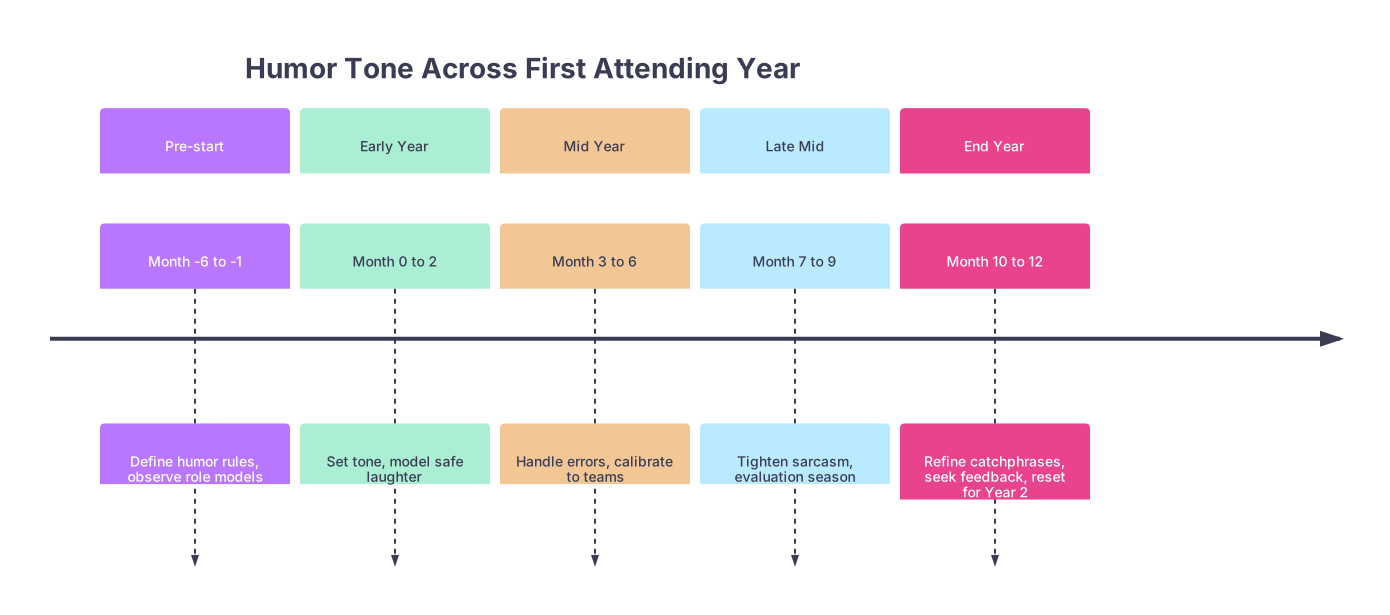
| Period | Event |
|---|---|
| Pre-start - Month -6 to -1 | Define humor rules, observe role models |
| Early Year - Month 0 to 2 | Set tone, model safe laughter |
| Mid Year - Month 3 to 6 | Handle errors, calibrate to teams |
| Late Mid - Month 7 to 9 | Tighten sarcasm, evaluation season |
| End Year - Month 10 to 12 | Refine catchphrases, seek feedback, reset for Year 2 |
Common Traps That Quietly Kill Workroom Laughter
You are not immune to these. No one is. At this point in your development, you should be actively avoiding:

Weaponized “joking” feedback
- “Maybe check UpToDate before rounds next time.” (Said with a laugh.)
Residents do not hear the laugh. They hear the contempt.
- “Maybe check UpToDate before rounds next time.” (Said with a laugh.)
Only joking when things go wrong
- If your laughter only comes out under extreme stress, it feels like emotional whiplash.
The “cool attending” performance
- Trying to match the intern’s meme references or edgy humor. You are the attending. You are funny because you are grounded, not because you are wild.
Roasting absent people
- If you laugh about the fellow once they leave, residents assume you laugh about them when they leave.
Never joking about yourself
- If all your jokes are observational and none are self-directed, you come off as detached or judgmental.
Quick Snapshot: What Your Team Actually Responds To
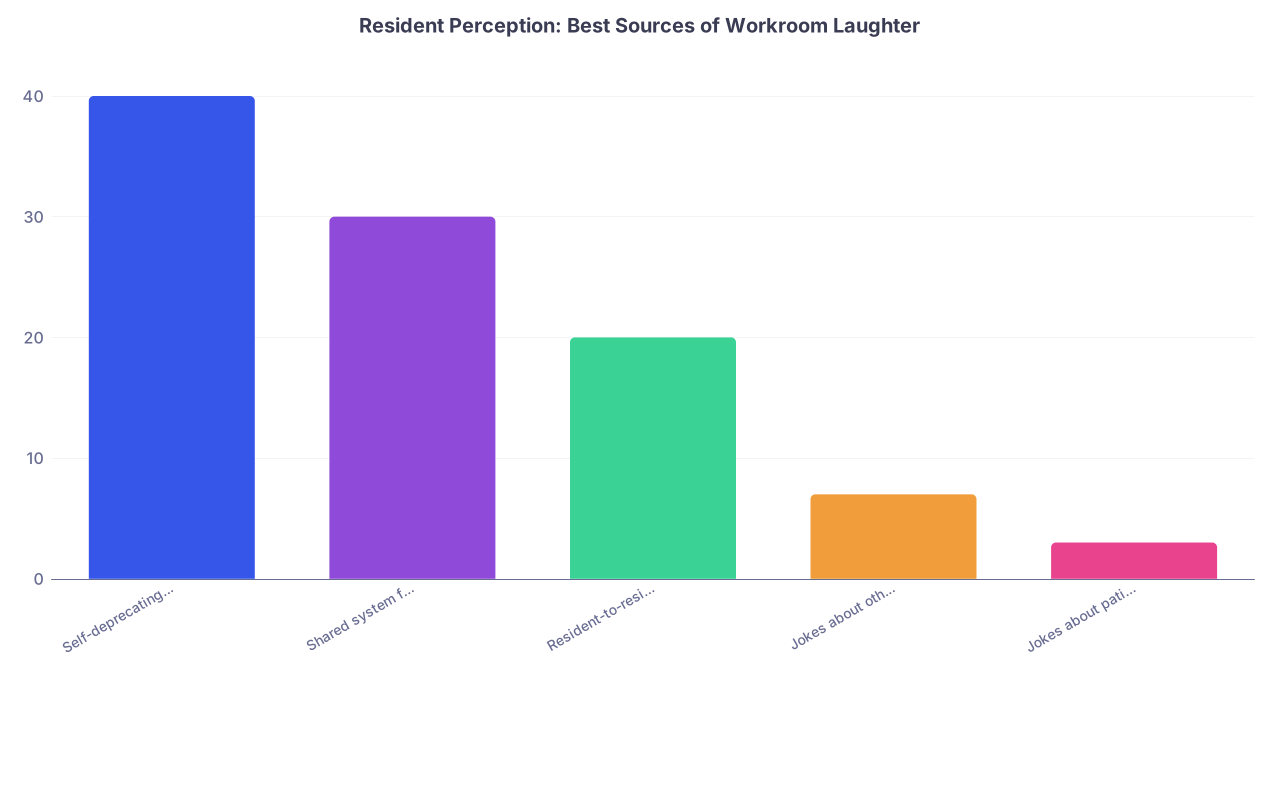
| Category | Value |
|---|---|
| Self-deprecating attending humor | 40 |
| Shared system frustrations | 30 |
| Resident-to-resident banter | 20 |
| Jokes about other services | 7 |
| Jokes about patients | 3 |
The last two categories might get a quick cheap laugh. They also quietly degrade trust. You are in charge of steering away from them.
The Long Game: Humor as Burnout Buffer, Not Distraction
If you do this right in year one, your workroom will:
- Decompress with laughter without losing respect for patients.
- Admit mistakes openly, because they are not afraid of becoming the punchline.
- Feel that dark humor is a shared coping tool, not a weapon.
You will also protect yourself. An attending who cannot laugh at their own missed clicks, wrong-turns on the unit, or ancient pager still going off at 2 a.m. burns out faster. I have watched it happen.
Your Next Step Today
Right now, take 10 minutes and write down five sentences:
- One line you will use on Day 1 to set humor boundaries.
- One self-deprecating story you are willing to tell.
- One phrase you will say when a joke lands badly.
- One sentence you will use to shut down cruelty.
- One line you hope residents are still quoting from you at the end of the year.
Write them. Out loud in your notes app.
Then look at #4. Ask yourself honestly: Would I actually say this in the moment?
If the answer is no, rewrite it until you would. That is where your real workroom culture starts.