
The jokes that make you howl as an MS1 will make you roll your eyes as an attending. And that is exactly how it should be.
Medicine does not just train your hands and your hippocampus. It retrains your sense of humor. Year by year. Rotation by rotation. Code by code.
Below is what actually happens to your humor from MS1 to attending—chronologically, like a call schedule—so you can recognize where you are and where you are headed.
Big Picture: How Your Humor Shifts Over Time
Let me set the arc first.
Early on, you laugh about medicine. By the end, you laugh inside it. The punchlines move from “Wow, gross” to “Wow, that is painfully true.”
Here is the rough progression:
| Stage | Core Humor Style | Typical Target |
|---|---|---|
| MS1 | Meme-based, naive | Exams, anatomy, MCQs |
| MS2 | Darker, board-obsessed | Disease, mnemonics |
| MS3 | Situation-based | Attendings, patients |
| MS4 | Cynical, relief-based | Match, admin |
| Intern (PGY1) | Survival, slapstick | Pages, call, yourself |
| Senior (PGY2-3) | Dry, meta | System, culture |
| Fellow/Attg | Storytelling, wry | The whole profession |
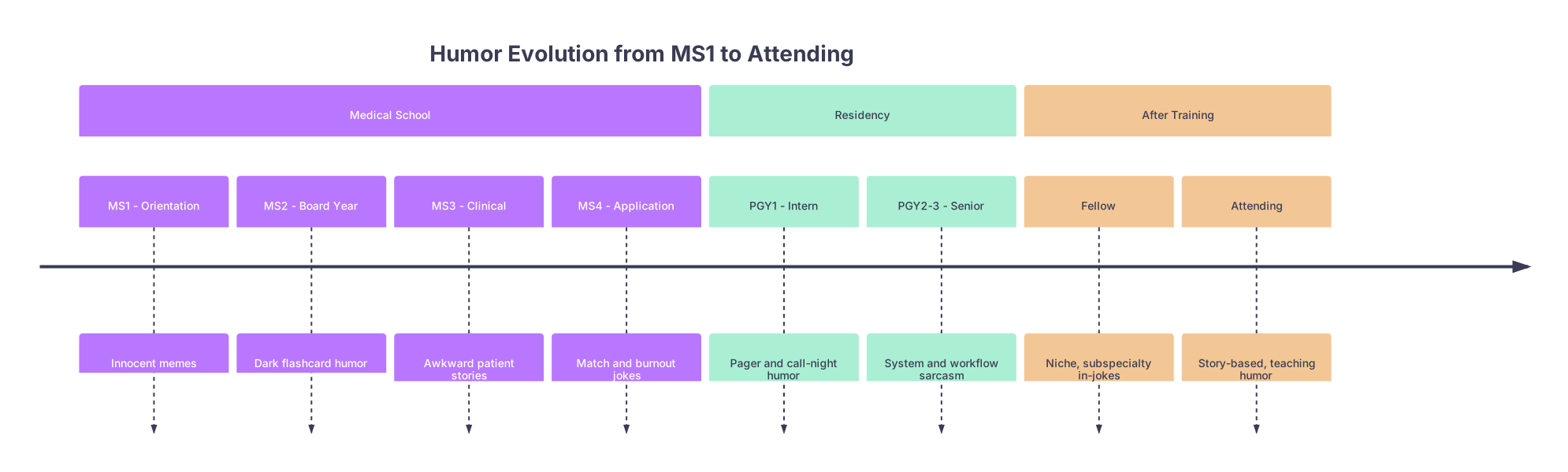
And because we are talking timelines:
| Period | Event |
|---|---|
| Medical School - MS1 - Orientation | Innocent memes |
| Medical School - MS2 - Board Year | Dark flashcard humor |
| Medical School - MS3 - Clinical | Awkward patient stories |
| Medical School - MS4 - Application | Match and burnout jokes |
| Residency - PGY1 - Intern | Pager and call-night humor |
| Residency - PGY2-3 - Senior | System and workflow sarcasm |
| After Training - Fellow | Niche, subspecialty in-jokes |
| After Training - Attending | Story-based, teaching humor |
Now, let’s walk year by year. At each point, I will tell you:
- What you are laughing at
- What you should probably stop laughing at
- What new humor you are allowed to unlock
MS1: Orientation Goggles and Anatomy Lab Jokes
At this point you are:
- Overusing “trust the process”
- Sharing too many AnKing screenshots
- Laughing at anything that includes “step 1” in the punchline
Your humor is mostly external. Memes, tweets, TikToks. You are not actually generating new material yet; you are consuming a shared premed-to-M1 feed.
What you find funny now
- Anatomy lab disasters: “Remember when someone dropped the lung?”
- Overly literal mnemonics: the more absurd, the better
- “My brain after 3 lectures” memes
- Professors using outdated slang or mispronouncing “meme”
You are still innocent. You have not seen a 3 a.m. page yet. Your “dark humor” is pretending to cry over a 73% on a histo quiz.
At this stage you should…
- Laugh at:
- Your own over-preparation (“I made a 9-color system for lecture notes”)
- The absurdity of learning brachial plexus branches for two weeks straight
- Start learning to not laugh at:
- Actual patient cases in small group (they are not fictional, even if anonymized)
- Anything that punches down on vulnerable people (patients, nurses, staff)
Your job in MS1 is to start separating “gross anatomy humor” (fine) from “dehumanizing patient humor” (not fine, ever). This is the first pivot.
MS2: Board Year – Dark Flashcards and Pathology Punchlines
Now you are sleeping next to a pile of flashcards and pretending you still have hobbies.
Your humor shifts from “lol med school!” to “lol I have 4,000 cards due today and might never see sunlight again.”
What you find funny now
- USMLE-style jokes:
- “Guy with blue sclera and brittle bones walks into a bar…”
- Roasting specific path findings:
- “Of course it is sarcoid—if you do not know, it is sarcoid”
- Hyper-specific Step memes:
- “Felt cute, might inhibit dihydrofolate reductase later”
The humor gets darker. Not truly about death yet, but about burnout, performance, and failing NBMEs.
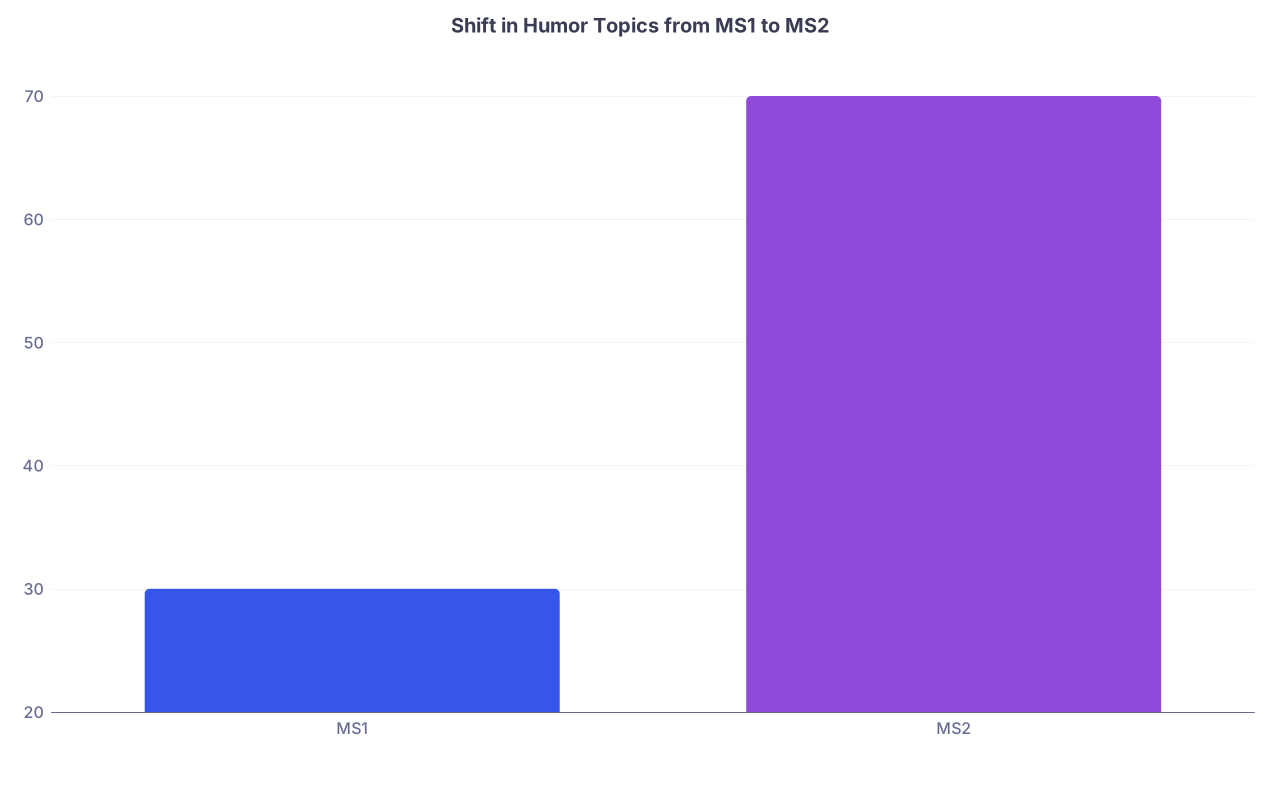
| Category | Value |
|---|---|
| MS1 | 30 |
| MS2 | 70 |
(Think of that as rough humor-percentage tied to pathology/boards. It spikes hard.)
At this stage you should…
- Allow yourself:
- Bonding with friends via “we are all going to fail” jokes. That is normal.
- Laughing at how pharma ads suddenly make more sense than your lectures.
- Start upgrading your filter:
- Do not casually joke about specific diseases in public spaces. People at the coffee shop have family members with those problems.
- Start recognizing that what lives on your group chat should not live on Instagram stories.
By the end of MS2, your humor is more insider. Fewer people outside medicine get your jokes. That is the point—and also the danger. You are building an in-group. Be careful what you exclude.
MS3: The “Oh, This Involves Real Humans” Phase
Welcome to the wards. Your humor now runs into the first hard wall: patients, families, and real suffering.
At this point you:
- Realize half your med school memes do not belong anywhere near a nurses’ station
- Discover that some attendings are unintentionally hilarious
- Start collecting stories that will be told for years
What you find funny now
- Your own awkwardness:
- Calling the attending “Mom”
- Asking the nurse where the “pan-scan” machine is
- Classic clinical phrases:
- “The patient is pleasantly demented”
- “We will watch it overnight” (translation: no idea yet)
- Attending quirks:
- The surgeon who says the same three lines every morning at 5:45
- The hospitalist who calls everything “a touch of” something
This is where your humor needs structure. You are now surrounded by people in pain. The easy joke is almost always the wrong one.
At this stage you should…
- Laugh at:
- Yourself. Your pre-rounding missteps. Your over-documented notes.
- The system glitches: printers that never work, paging loops, “please see note” wars.
- Keep off-limits:
- Patient demographics, diagnoses, bodies. No “funny” photos. No imitations with accents.
- Nurses, techs, and other staff as the butt of your jokes. You will need them more than they need you.
You are building your “professional dark humor” muscles now. The joke should relieve tension without dehumanizing the person generating that tension.
If you get this wrong, people remember.
MS4: Peak Cynicism and “I Am So Over This” Humor
Fourth year is weird. You flip between “this is easy” and “my entire future depends on an email in March.”
Your humor becomes:
- Sharper
- More about institutions and less about individuals
- Heavily flavored by Match stress
What you find funny now
- Application insanity:
- Applying to 60 programs “just in case”
- ERAS asking you to list all extracurriculars since birth
- Rotations where nobody cares:
- “Four people have asked if I am a new intern; nobody knows what an MS4 is”
- Interview clichés:
- “We are like a family”
- “We value resident wellness”
You and your classmates now share a common enemy: opaque processes and fake “we care about you” language.
At this stage you should…
- Lean into:
- Satirizing bureaucracy: pre-auths, duplicated notes, “please fill out this satisfaction survey.”
- Mocking the performative side of applications, not the people trapped in it with you.
- Avoid:
- Turning pure bitterness into your whole personality. If every joke is “this all sucks,” you drag everyone else down.
End of MS4, your humor is a coping mechanism for transition. If it stays locked at this cynicism level, residency will chew you up.
PGY1 (Intern Year): Pager Comedy and Sleep-Deprivation Slapstick
Now it gets real.
At this point:
- Your phone is an anxiety machine
- You laugh or you cry, often both
- Your humor gets darker, but also more practical
What you find funny now
- The pager itself:
- 3 a.m. page: “Patient wants a different flavor of Jell-O.”
- 4 a.m. page: “BP 88/50, patient looks awful.” No in-between.
- Classic intern lines:
- “I will check a lactate.”
- “Can you give a liter of LR?”
- Call room absurdity:
- Falling asleep fully dressed with badge still on
- Getting lost in a hospital you technically work in
Your humor becomes very near the bone. Code situations. Bad outcomes. Death.
This is where some people justify anything as “dark humor.” That is incorrect. There are lines.
At this stage you should…
- Use humor to:
- Decompress after rough nights with co-residents in private, behind closed doors.
- Acknowledge shared incompetence: everyone forgets to unmute at sign-out sometimes.
- Protect yourself from:
- Normalizing cruelty disguised as “we are just blowing off steam.”
- Laughing at the sickest, most vulnerable patients. Especially in front of trainees or students.
Ask yourself: if the family was standing in the doorway, could I repeat this line? If the answer is “absolutely not,” it belongs strictly in your head, if anywhere.
PGY2–3: Senior Resident – Dry, Surgical, and System-Level Sarcasm
Once you are supervising, your humor matures fast. Or it should.
At this point:
- You see the system patterns
- You start repeating your own phrases on rounds
- Interns laugh at your jokes because…well, you write their evaluations
What you find funny now
- The system:
- “We admitted the same patient three times this month for the same preventable reason.”
- Policy emails announcing “new” initiatives that are just rebranded old failures.
- Your predictable habits:
- Saying “what do you want to do?” even when everyone knows the answer.
- Drinking the same terrible coffee every day and pretending it is fine.
- The never-ending loops:
- Consultants recommending things you already did
- EMR “best practice alerts” firing 6 times per note
You start using humor as a teaching tool. A well-placed sarcastic line about anchoring bias sticks in a student’s mind more than a PowerPoint slide.
At this stage you should…
- Deploy humor:
- To normalize mistakes and learning: “Every intern writes a novel for a progress note. You will edit down.”
- To puncture hierarchy gently: “Yes, the labs are back; no, they do not change anything. Medicine, everyone.”
- Watch out for:
- Weaponized sarcasm. If a student leaves a day feeling stupid because of your “joke,” you missed the mark.
- Humor that signals burnout only. “We are all miserable” is not leadership.
By late senior year, your humor should feel more controlled. Less reflex. More intentional.
You are practicing for attendinghood now, whether you like it or not.
Fellowship (Optional Boss Level): Niche Subspecialty Jokes
If you go to fellowship, your humor becomes incredibly specific.
At this point:
- You think a joke about a particular chemo regimen dosing is genuinely hilarious
- Your non-med friends have no idea what you are talking about
- Even other residents in different specialties stare blankly
What you find funny now
- Hyper-niche scenarios:
- “When the referring provider orders every imaging modality except the one we actually need”
- Turf wars:
- “Is this GI or ID or rheum or…let us just all see them”
- Conference culture:
- Grand rounds where the first 20 minutes are just disclosing conflicts of interest
This is specialist stand-up. Very small audience. Very tight in-group.
At this stage you should…
- Keep:
- Jokes aimed at guidelines, protocols, and impossible expectations.
- Camaraderie-building humor with your fellow fellows (yes, the term itself remains funny).
- Retire:
- “We know more than everyone else” specialty arrogance. It is not as clever as people think.
Attending: Storytelling, Wry Smiles, and Teaching Through Humor
You made it. Now your jokes move slower. Less meme, more story.
At this point:
- Your best material starts with “Years ago I had a patient…”
- You use humor to set culture, not just cope
- You can choose to either repeat old toxic patterns or upgrade them
What you find funny now
- Institutional déjà vu:
- “We changed this EMR workflow 4 times and somehow it is worse.”
- Resident behavior:
- The intern carrying 12 colors of pens and 3 pocket guides
- The MS3 carefully writing vitals in a notebook that nobody else will ever see
- Your own former self:
- The attending you swore you would never become, and the ways you still sound like them sometimes
You now have enormous power. A tossed-off “joke” about a patient can shape what trainees think is acceptable for years.
At this stage you should…
- Use humor to:
- Diffuse tension before difficult feedback: “When I was an intern, I once ordered a chest CT for constipation. So let us talk through today’s orders.”
- Model healthy coping: “Yes, this was a brutal case. We are going to debrief, then we are going to go home.”
- Avoid:
- “Back in my day” suffering Olympics disguised as humor.
- Making vulnerable team members (students, new nurses, IMGs) the standard punchline.
The best attendings I have seen can tell a 60-second story that has you laughing and learning and slightly terrified, all at once. That is the final evolution of medical humor: teaching through well-aimed, humane jokes.
How Your Humor Actually Helps (or Hurts) Over Time
To pull this together, your humor is not just background noise. It does real work.

| Stage | Main Function | Risk if Misused |
|---|---|---|
| MS1–MS2 | Bonding, coping | Immature, insensitive jokes |
| MS3–MS4 | Identity, belonging | Dehumanizing patients |
| PGY1 | Survival, venting | Normalizing cruelty |
| PGY2–3 | Leadership, culture | Weaponized sarcasm |
| Attending | Teaching, modeling | Passing down toxic norms |
Your task each year is simple but not easy:
- Keep the bonding and release
- Lose the cruelty and contempt
When people talk about “professionalism,” this is a big chunk of what they actually mean.
What You Should Do Today
Right now—today—look at the last 10 “medical jokes” you shared (texts, memes, group chat screenshots).
Ask yourself, honestly:
- Who is the butt of the joke?
- Would I be comfortable if a patient, nurse, or junior trainee saw this?
- Is this helping me connect, or just helping me numb out?
Pick one joke you would not share again as you advance to your next training year.
Delete it. Then send something better to your group chat—a story about your own mistake, a system absurdity, or a clever, kind observation.
That is how your sense of humor actually evolves: one joke you refuse to tell anymore, and one better one you tell instead.