
The first week of anatomy lab breaks more people with bad coping skills than with bad scalpel skills.
You do not need to be the bravest. Or the smartest. You just need honest coping and a half-decent sense of humor that doesn’t get you fired from medicine. Here’s the timeline for that first week—day by day, almost hour by hour—of how to survive, stay human, and use humor without turning into “that insensitive med student” everyone remembers for the wrong reasons.
Before Day 1: The 24–48 Hours Leading In
At this point you should assume you will be weird about it. Everyone is. The people who claim they are “totally fine” are either lying or haven’t thought about it yet.
The night before:
Decide your ground rules for humor. Write them down if you must.
- Punch up, not down.
- No jokes about the donor’s life, identity, cause of death.
- Body = teacher, not prop.
- No photos. Ever. Not even “lol I’m in lab” selfies. You’re not special.
- If a joke would sound bad on a courtroom transcript, skip it.
Script your default phrases.
You will be awkward. So preload some language you can lean on:- “This is… a lot. But I’m glad we’re learning together.”
- “I’m going to step out for a second.”
- “Thank you for donating your body.” (Yes, you’re talking to a cadaver. That’s normal.)
Prep your “care kit” like it’s a minor procedure:
- Light snack
- Water bottle
- Mints or gum (the smell is real; more on that later)
- Hair tie / headband
- A discreet tissue packet
Sleep. Do not cram anatomy as a distraction until 2 a.m.
Your brain’s about to get hit with sensory overload. You want REM, not more flashcards.
Day 1 Morning: The “Door Handle Pause”
At this point you’re standing outside the anatomy lab door with 20 other people pretending not to be anxious.
You will hear:
- Nervous fake flex: “I dissected in undergrad, I’m used to this.”
- Dark humor overreach: “Well, guess we’re cutting up grandma today.” (Cringe. Don’t be that person.)
- Silent, wide-eyed nodding.
Your job in this hour:
Anchor yourself before you walk in. 30-second reset:
- Feel your feet on the floor.
- Inhale 4 seconds, hold 4, exhale 6. Twice.
- Decide: “I am allowed to feel weird. I’m also allowed to step out.”
When the faculty gives the donor speech: actually listen.
They’ll usually say:- “These donors chose this.”
- “Treat them as your first patient and teacher.”
That’s your moral frame. Humor has to fit inside that.
First visual of the covered tables:
- Your stomach might drop.
- Your brain might go, “Oh. This is real.”
Appropriate internal humor: “Well, anatomy app didn’t prepare me for this patch update.”
Out-loud version: maybe just a tight smile and a nod.
Day 1: First Uncovering and First Cut
This is the big moment. It’s usually slow and oddly quiet.
At this point you should not be trying to be funny. You should be trying to be human.
Minute-by-minute, roughly:
Minute 0–10: Sheets off.
You’ll notice:
- The skin tone is different than you imagined
- Surgical scars, tattoos, age spots, maybe deformities
- The smell is more chemical than “dead body,” but it’s still intense
Healthy inner monologue:
- “Someone loved this person.”
- “They chose to let me learn from them.”
- “I can do this in 30-second chunks.”
What to say out loud:
- “Should we take a moment of silence?”
- “Thank you for your donation.” (Yes, again. Out loud. It helps.)
Minute 10–30: The “I need to do something with my hands” phase.
At this point you should:
- Read the instructions. Actually read them.
- Assign roles without being a hero:
- “Who wants to read, who wants to cut, who wants to reflect tissue?”
You may hear nervous attempts at humor:
- “Guess this is our first patient; they’re very still.”
- “At least they won’t code on us.”
You’re allowed to smile. You are not required to join in.
If you’re the person who does use humor to cope, try:
- “Okay, team, gentle hands. We are not carving a Thanksgiving turkey.”
- “Let’s not name structures after food today. I’d like to eat again someday.”
First incision:
Your hands may shake. Totally normal.
At this point your humor should be task-focused, not donor-focused:
- “If I cut any slower, I think the scalpel will age.”
- “I swear my hand only shakes when someone is watching.”
If you feel lightheaded:
- Drop the tool. Sit. Head between knees.
- Line to use: “I need a quick non-dramatic break. I’ll be back in a minute.”
No shame. I’ve seen residents drop in ORs. Better a seated student than a concussed one.
Day 1 Afternoon: Emotional Hangover + Debrief
After lab, your brain will try to pretend it’s “fine” and then hit you two hours later.
At this point you should plan a structured decompression, not just scroll alone.
1–2 hours after lab:
You might experience:
- Random giggles at nothing (classic pressure valve)
- Unwanted mental replays of the body
- Guilt for having laughed at anything in lab
Use group humor with boundaries:
- Meet a few classmates somewhere neutral (not in the cafeteria staring at chicken legs).
- Safe territory jokes:
- Your PPE: “I’ve sweat less in a sauna than in that gown.”
- Lab directions: “Did they expect us to find that nerve with sonar?”
- Your group dynamic: “We spent 10 minutes arguing over left vs right. Promising start.”
Lines you should avoid:
- Anything about the donor’s appearance
- Joking about specific pathologies you saw on the body (“their lungs were gross haha”)
- Imitating staff who were being solemn
Night of Day 1:
At this point you should:
- Do something deliberately non-medical for at least 60–90 minutes.
- Short, honest check-in with yourself:
- “How did I actually feel?”
- “Did I cross any humor line I regret?” If yes, you can do better tomorrow. Learn and move on.
Sleep may be weird. Dreams may be weirder. That settles in a few days for almost everyone.
Day 2: The “Desensitization vs Dehumanization” Line
Day 2 is when people overcorrect. The initial shock is less. That’s when bad humor shows up.
At this point you should be more guarded with jokes, not less.
Before lab: 5-minute reset
- Ask yourself:
- “What helped me cope yesterday that I want to repeat?”
- “What did not help that I’m going to stop?”
- “Where’s my line between light and disrespectful?”
In lab:
You’ll start recognizing structures. Your brain shifts toward:
- “Cool! That’s the brachial plexus.”
- “So that’s how much fat there really is.”
This intellectual focus is healthy. But it tempts people to forget there’s a person on the table.
At this point, healthy coping humor looks like:
- Self-directed:
- “If memorizing these branches were an Olympic sport, I’d still not qualify.”
- Process-directed:
- “Pretty sure we removed more fascia than the manual intended.”
Unhealthy:
- Anything objectifying the donor (“my cadaver,” “this guy”)
- Nicknames based on appearance or pathology
If your group starts drifting into dehumanizing jokes:
- Simple redirect:
- “Let’s not go there.”
- “I’d want my body treated better than that if I donated it.”
No speech needed. Just a nudge.
Day 3: The Smell, The Fatigue, and the Running Jokes
By midweek, the novelty wears off and the physical grind kicks in.
At this point you should assume your brain is tired and your filter is weaker. So set pre-filtered patterns.
Common issues:
- The smell feels stronger (or it’s just cumulative).
- Gloves sweat, backs ache, everyone is sticky and slightly over it.
Approach:
Normalize body reactions:
- “I’m going to double-mask today.” Totally fine.
- Peppermint oil under the mask? Common trick. Just don’t drown yourself.
Build safe, recurring jokes within your group:
- A running joke about always losing the forceps.
- A “structure of the day” award for the weirdest named thing you find.
- “Welcome back to season 1 of ‘Where Is That Nerve.’”
These recurring bits give your brain release without pushing into disrespect.
After lab:
You’ll be tired and tempted to do one of two dumb things:
- Make edgy jokes to “prove” you’re chill about death.
- Refuse to talk about lab at all and let it stew.
Middle path:
- “Today was rough. The smell really got me, but the teaching was solid.”
- Share one funny-but-safe moment:
- “We accidentally followed the wrong plane and dissected a cul-de-sac.”
Day 4: The Emotional Dip No One Warns You About
Day 4 is when delayed reactions hit a lot of people. The “I should be used to this by now” guilt. The “why am I suddenly sad” thing.
At this point you should accept that coping is nonlinear.
In lab:
- You may find a detail that personalizes the donor:
- A surgical scar that hints at their illness
- A tattoo
- Old injury or joint replacement
You might feel a rush of emotion. Sometimes grief. Sometimes curiosity. Sometimes… nothing.
All of these are valid.
Healthy humor today should be:
- Much lighter
- More about you than the donor
Examples:
- “I think I’ve aged 10 years in this lab and it’s only week one.”
- “My sense of direction is so bad I can get lost in a forearm.”
If someone in your group goes quiet or steps away:
- Do not tease.
- Offer low-pressure support:
- “Want me to take over?”
- “I can ask the TA a question if you want a breather.”
After lab:
- This is the day journaling actually helps. Two paragraphs:
- What was technically cool
- What felt emotionally heavy
You can add a line of humor at the end:
- “Future me: when you’re complaining about charting at 2 a.m., remember this is where it started.”
Day 5: Consolidation, Reflection, and Not Becoming Cynical
By the end of week one, the shock is reduced, the exhaustion is real, and your humor style in lab is basically established.
At this point you should consciously lock in the kind of physician you want to become.
Morning before lab:
- Quick 3-question check:
- “Am I using humor to connect or to avoid?”
- “Would I be okay if my donor’s family heard what I say in lab?”
- “Do I still remember there’s a person here?”
In lab:
- You’ll be more efficient. That means more mental space where jokes can creep in.
- Use that space deliberately:
- Ask your teammates how they’re actually doing.
- Use humor to cut tension, not dignity.
- “Okay, everyone, what is the one structure this week that we will absolutely blank on during the exam?”
If your group has gotten a little too cavalier:
- “Hey, let’s reset for a second. End of week one, but still real people on the table.”
Say it once. Then move on and model better.
After the last lab of week one:
- Take 10 minutes alone or with a trusted friend to zoom out:
- “What surprised me most?”
- “Where did I see the line between healthy dark humor and disrespect—and which side was I on?”
- “What do I want to do differently next week?”
Week 1 Coping & Humor Timeline (Quick Reference)
| Time Point | Main Task | Healthy Humor Focus |
|---|---|---|
| Pre-Day 1 | Ground rules, prep | None or very light, self-focused |
| Day 1 AM | First exposure | Minimal; respect, observation |
| Day 1 PM | Debrief | Process, personal reactions |
| Day 2 | Settling in | Technique, self-deprecation |
| Day 3 | Fatigue | Running safe jokes, lab logistics |
| Day 4 | Emotional dip | Gentle, supportive, minimal |
| Day 5 | Consolidation | Reflective, team bonding |
Visualizing Your Emotional Curve
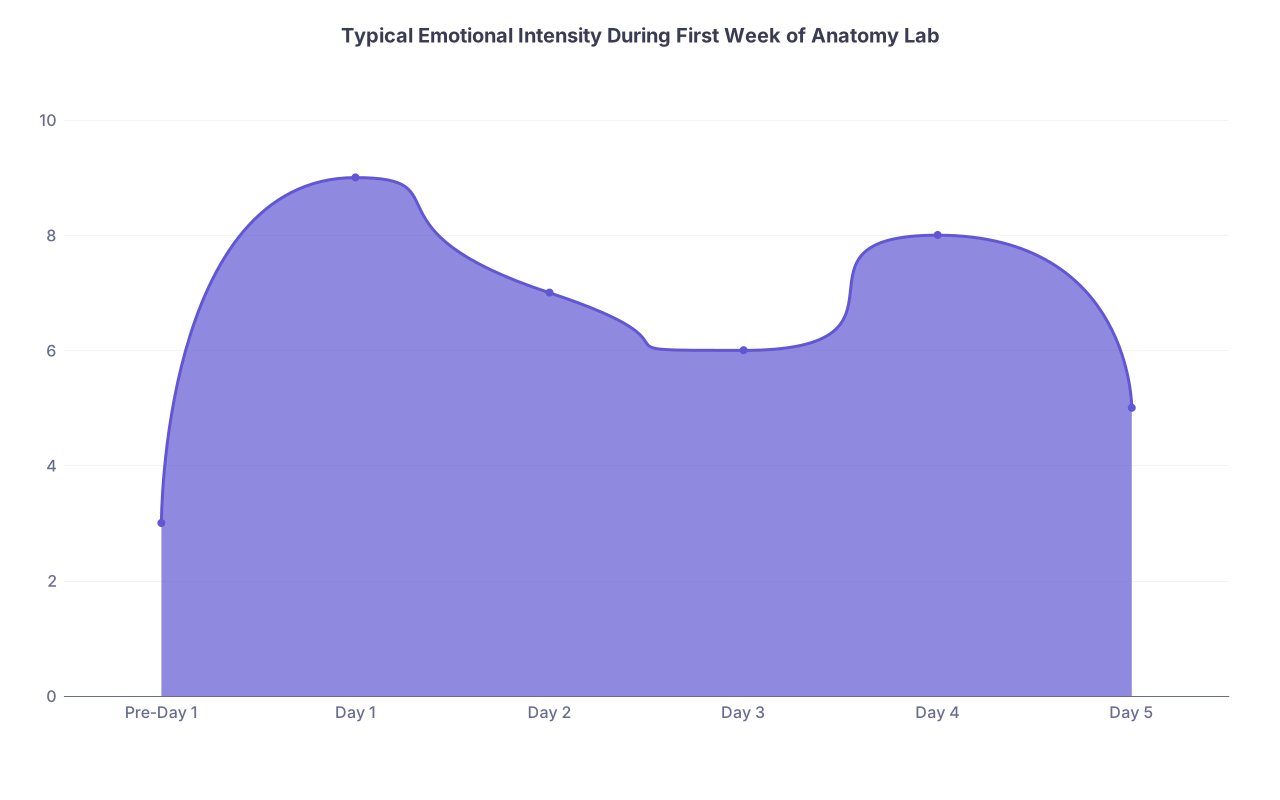
| Category | Value |
|---|---|
| Pre-Day 1 | 3 |
| Day 1 | 9 |
| Day 2 | 7 |
| Day 3 | 6 |
| Day 4 | 8 |
| Day 5 | 5 |
Think of it like this: intensity spikes early, dips, then has a small rebound when the human reality sinks deeper, and finally settles into a sustainable level.
A Week-One Micro-Timeline: From Door to Debrief
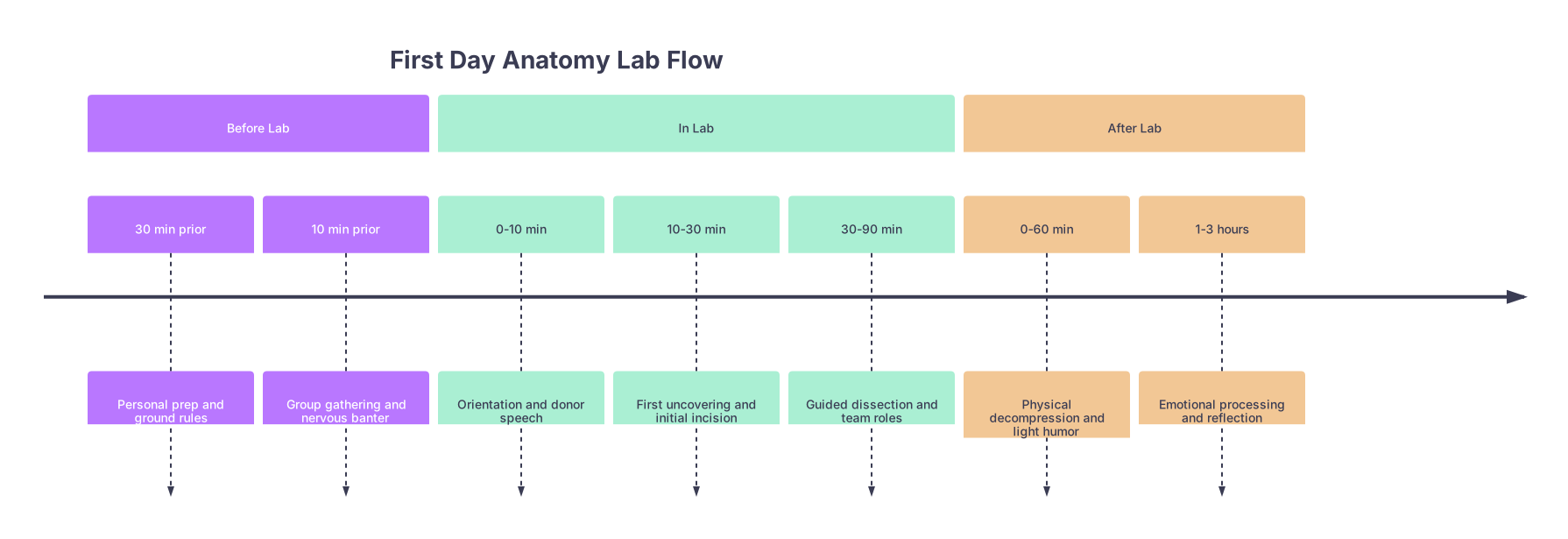
| Period | Event |
|---|---|
| Before Lab - 30 min prior | Personal prep and ground rules |
| Before Lab - 10 min prior | Group gathering and nervous banter |
| In Lab - 0-10 min | Orientation and donor speech |
| In Lab - 10-30 min | First uncovering and initial incision |
| In Lab - 30-90 min | Guided dissection and team roles |
| After Lab - 0-60 min | Physical decompression and light humor |
| After Lab - 1-3 hours | Emotional processing and reflection |
Use this as your mental scaffold. At each stage, ask: “What kind of humor is appropriate here?”
How to Tell If Your Humor Is Actually Coping, Not Avoiding
Here’s the quick test I use with students.
If your humor:
- Makes you more willing to be present with the body → healthy.
- Helps your team talk about discomfort honestly → healthy.
- Targets your confusion, clumsiness, or the absurdity of med school bureaucracy → usually healthy.
If your humor:
- Makes it easier to ignore the donor’s humanity → problem.
- Shuts down serious conversations (“let’s just joke instead of talking about how this feels weird”) → problem.
- Would hurt or offend a reasonable donor family member overhearing it → big problem.
When in doubt, err on the side of restraint. There will be infinite chances in your training to practice gallows humor. You do not need to perfect it in week one.
Three Rules to Carry Out of Week One
By the end of this first week of anatomy lab, lock in these three habits:
Honor before humor.
Take the moment of respect first—silence, gratitude, acknowledgment. Humor follows that, not the other way around.Punch inward or upward, never at the body.
Joke about your confusion, your clumsy technique, the ridiculousness of 8 a.m. labs—never about the donor as a person or object.Use humor as a bridge, not a wall.
If it helps you connect with teammates and stay human while facing something hard, good. If it keeps you from feeling anything at all, rethink it.
Do this for one week, and you’ll come out not just with better anatomy skills, but with the beginnings of a professional spine: able to face death, stay kind, and still laugh without losing your humanity.