

You are 18 months out of residency. Hospitalist job. Decent paycheck. Soul slowly leaking out on night six of seven.
You have a real idea for a medical startup. Not “an app to help doctors communicate better.” Something sharper:
- A workflow tool for infusion centers.
- An AI triage layer for your specialty clinic.
- A remote monitoring service for your own panel.
And here is the real constraint: you cannot blow up your job. Not yet. You have 10–15 hours per week. Max. Some weeks less.
So the question is not “how do I build a startup?”
The question is: what exactly should you be doing each week, and when, to move this from idea to legitimate company without wrecking your clinical performance or your life?
That is what we will map out. A ruthless weekly time map, then detailed week‑by‑week phases across about 6 months.
Step 0: Define Your Available Week (Clinical + Startup)
Before we talk about a startup timeline, I want your calendar in front of you. Because fantasy schedules kill more startups than bad ideas.
At this point you should… block your default week
Pick the most “average” week you have over a 4–6 week stretch. Then block it like this:
- Clinical work (shifts, clinic, OR)
- Commute
- Sleep
- Family / non‑negotiables
- Startup blocks (we will carve these out deliberately)
For most post‑residency docs I work with, the realistic startup band is 8–15 hours per week.
| Category | Hours/Week |
|---|---|
| Clinical work | 40–60 |
| Call/extra admin | 4–8 |
| Commute | 3–6 |
| Family/Personal | 20–30 |
| Sleep | 49–56 |
| Startup work | 8–15 |
Those 8–15 hours are your new “startup bank.” Spend them deliberately or they vaporize into email and LinkedIn wandering.
The Core Weekly Time Map
We will assume 12 hours per week to start. Adjust up or down by 2–3 hours if needed, but keep the structure.
At this point you should… assign recurring blocks
Baseline weekly map (12 hours):
Tuesday early morning – 2 hours
Deep work: market research, product thinking, planning. Brain is fresh.Thursday early morning – 2 hours
Deep work: writing, design specs, or complex problem solving.Saturday late morning – 3 hours
Creation + coordination: build prototypes, write emails, schedule calls, documentation.Sunday early evening – 3 hours
Customer conversations, planning upcoming week, reflections, key decisions.Flexible 2 hours (sprinkled)
Between‑patient micro‑tasks, commute calls, low‑focus tasks: DMs, follow‑ups, reading.
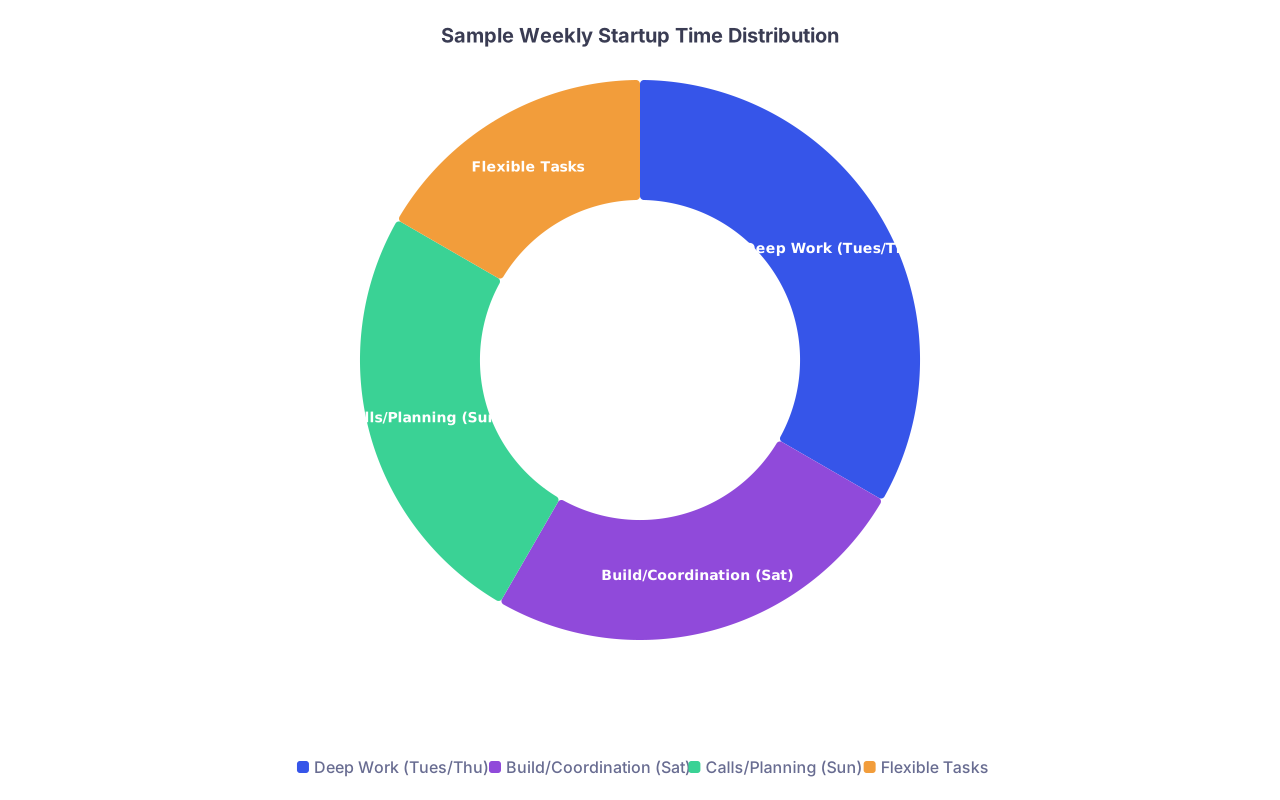
| Category | Value |
|---|---|
| Deep Work (Tues/Thu) | 4 |
| Build/Coordination (Sat) | 3 |
| Calls/Planning (Sun) | 3 |
| Flexible Tasks | 2 |
Non‑negotiable: protect the early morning deep‑work blocks. If you start giving those to the hospital, you are choosing “perpetual job” over “possible company.”
6‑Month Macro Timeline: From Idea to Early Traction
You are not “building a unicorn.” You are trying to prove that:
- The problem is real and painful.
- Your solution actually changes something.
- People will pay, or at least commit pilot time and data.
We will break this into three 2‑month phases:
- Months 1–2: Problem and customer clarity
- Months 3–4: Prototype and first pilot
- Months 5–6: Real‑world usage and validation
Here is the high‑level picture.
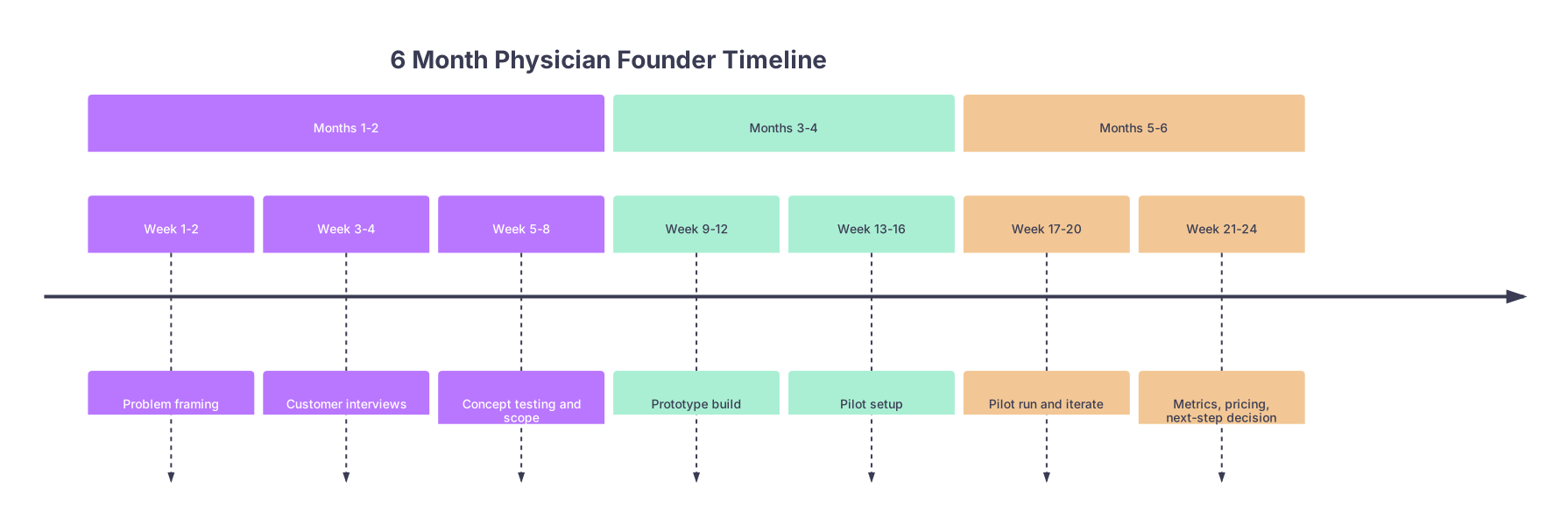
| Period | Event |
|---|---|
| Months 1-2 - Week 1-2 | Problem framing |
| Months 1-2 - Week 3-4 | Customer interviews |
| Months 1-2 - Week 5-8 | Concept testing and scope |
| Months 3-4 - Week 9-12 | Prototype build |
| Months 3-4 - Week 13-16 | Pilot setup |
| Months 5-6 - Week 17-20 | Pilot run and iterate |
| Months 5-6 - Week 21-24 | Metrics, pricing, next-step decision |
Now let us go week by week.
Months 1–2: Problem Clarity and Customer Reality Check
Objective: by the end of Month 2 you should have:
- A sharply defined problem statement.
- 15–30 real conversations with target users.
- A clear sketch of an MVP (minimum viable product) that solves one narrow, painful use case.
Weeks 1–2: Nail the Problem and Decide Whom You Serve First
At this point you should… stop thinking “everyone” is your customer.
Tuesday (2h)
Write a one‑page “problem memo”:
- Who is the user? (e.g., oncology nurse in community practice)
- What is the recurring pain? (e.g., wasted 3–5 hours/week chasing prior auths)
- Current workaround?
- What breaks if this problem goes away?
Force yourself to write 3–5 versions of that memo and pick one.
Thursday (2h)
Build your initial customer list (20–30 people):
- Colleagues in your hospital.
- Residency classmates at other centers.
- People you vaguely know on LinkedIn in your specialty.
Draft a short outreach script for 15‑minute calls. Concrete, not fluffy:
- “I am working on a tool to reduce X. I am not selling anything. I want to understand how you handle Y today. Would you be open to a 15‑minute chat?”
Saturday (3h)
Send 10–15 outreach messages. Track them in a simple spreadsheet:
Name, role, org, date contacted, response, date scheduled.Block interview slots in your calendar for Weeks 2–3 (15–30 minutes each).
Sunday (3h)
- Refine your interview guide: 6–8 questions. No pitching. Just excavation:
- “Walk me through your last week handling X.”
- “What do you hate most about it?”
- “What do you use now?”
- “If this problem was magically fixed, what changes first?”
Weeks 3–4: Customer Interviews and Reality Check
Target: 8–12 interviews minimum.
Tuesday / Thursday (2h each)
- Conduct 1–2 interviews per block. Record (with permission) or take detailed notes.
- Immediately after each call, write a 5‑minute debrief:
- Top 3 pains they mentioned.
- Current tools used.
- What they are already paying for.
Saturday (3h)
Synthesize patterns:
- Which pain points are repeated by at least 4–5 people?
- Where is money already changing hands?
- What workarounds are people proud of? (those are your competitors)
Rewrite your problem memo based on real language you heard. Steal their phrases.
Sunday (3h)
Decide on your first user segment. Example:
- “We will start with independent cardiology practices 3–10 providers, doing in‑house imaging, struggling with X scheduling bottleneck.”
Draft a one‑paragraph “concept blurb” of your solution. Not features. Outcome:
- “A lightweight scheduling layer that reduces no‑shows by 20 percent and frees one MA per clinic day.”
Weeks 5–6: Define the MVP and Test Interest
Now you stop just listening and start lightly pitching.
Tuesday (2h)
- Translate your concept blurb into a one‑page MVP scope:
- User story 1, 2, 3 (e.g., “nurse logs in and sees…”).
- Absolutely necessary features vs nice‑to‑have.
- What you will leave out for version 1.
Thursday (2h)
- Create very ugly mockups:
- Use PowerPoint, Figma, Balsamiq, whatever.
- Goal is to show the flow, not impress a UX conference.
Saturday (3h)
- Go back to 4–6 of your best interviewees.
- Schedule short follow‑ups:
- Show them the mockup.
- Ask “What would you remove? What would you never use? What did I miss?”
Sunday (3h)
- Update mockups based on brutal feedback.
- Identify 3–5 potential pilot partners:
- People who said “if you build this, I want to try it.”
At this point, if nobody is even mildly excited, you have a problem. Better to pivot now than after 200 hours of building.
Months 3–4: Build a Prototype and Lock a Pilot
Now you start turning from “idea” into “actual thing.” You still have the same 12 hours per week. Discipline matters more here than anywhere.
Weeks 7–8: Tech Strategy and Team Decisions
At this point you should… decide how this gets built without quitting medicine.
You have three realistic paths:
No‑code / low‑code yourself
- Tools like Bubble, Glide, Retool, or simple scripts on top of Airtable.
-
- Harder than people admit. Needs strong mutual trust and aligned expectations.
Paid freelancer / dev shop
- You stay product owner. They build. Requires clean specs and ruthless scope control.
| Path | Cash Needed | Speed | Control |
|---|---|---|---|
| No-code yourself | Low | Medium | High |
| Tech cofounder | Low | Medium | Shared |
| Dev shop | Medium–High | Fast | Medium |
Tuesday (2h)
- Decide your path. Seriously decide. Waffling here wastes months.
- If no‑code: select a platform and do 1–2 tutorials.
- If cofounder: make a short “cofounder brief” describing problem, vision, and your expectations.
- If dev shop: draft a 2–3 page product spec from your MVP scope.
Thursday (2h)
- Start building the skeleton (if no‑code)
OR - Start meeting 1–2 potential cofounders or devs (short intro calls).
Saturday (3h)
- Finalize choice of builder: platform, person, or team.
- Define a 4–6 week build plan:
- Week‑by‑week milestones.
- What “done” means for version 0.1.
Sunday (3h)
- Message your 3–5 potential pilot partners:
- “I am building the first version, aiming for [date] to test in a small pilot. Would you still be open to trying it?”
Weeks 9–12: Heads‑Down Build and Pilot Design
Now the weekly map shifts slightly to accommodate coordination.
Tuesday (2h) – Deep build
- Build or review build progress.
- Decide UI flows. Fix one concrete thing per session.
Thursday (2h) – Build + bug bashing
- Clean up, test edge cases, tighten onboarding flow.
Saturday (3h) – Pilot planning
- Design your pilot protocol:
- Duration (4–8 weeks typically).
- Number of users per site.
- Metrics you will measure (pick 2–3, not 10).
Sunday (3h) – Customer alignment
- 1–2 calls with pilot sites:
- Agree on start date.
- Confirm metrics and success criteria.
- Decide who is internal “champion” at each site.
Use the flexible 2 hours mid‑week to handle:
- Quick bug reports.
- Slack/WhatsApp messages with devs.
- Short alignment emails with pilot partners.

By the end of Month 4:
- Your MVP should exist.
- You should have at least 1 pilot site committed, ideally 2.
- You should have a fixed pilot start date on the calendar.
If you are not there, you either:
- Over‑scoped the product, or
- Let clinical chaos eat your startup hours.
Both are fixable, but do not lie to yourself about the cause.
Months 5–6: Run the Pilot, Measure, and Decide Next Moves
The dangerous temptation here is to tinker endlessly with the product and never measure anything real. Do not do that.
Your job now:
- Get people using it in the wild.
- Track what changes.
- Get honest feedback and decide: double down, pivot, or pause.
Weeks 13–16: Pilot Launch and Live Fire
At this point you should… shift some deep work time into support + observation.
Tuesday (2h) – Support and observation
- Onboard new users at pilot sites.
- Watch 1–2 real workflows via Zoom or in person.
- Capture every friction point.
Thursday (2h) – Quick iteration
- Fix the top 1–2 issues that are blocking usage.
- Do not chase every feature request. Prioritize:
- Crashes and data integrity
- Confusing onboarding
- “I cannot complete my task” issues
Saturday (3h) – Metrics tracking
- Update your pilot metrics dashboard:
- Usage: logins, sessions, tasks completed.
- Outcome: time saved, errors reduced, fewer calls, whatever you planned.
- Compare against your baseline before pilot.
Sunday (3h) – Feedback conversations
- Short check‑ins with pilot champions:
- What is working?
- What do users complain about?
- If this disappeared tomorrow, who would be most upset?
Use your flexible 2 hours for emergency issues (downtime, access problems).
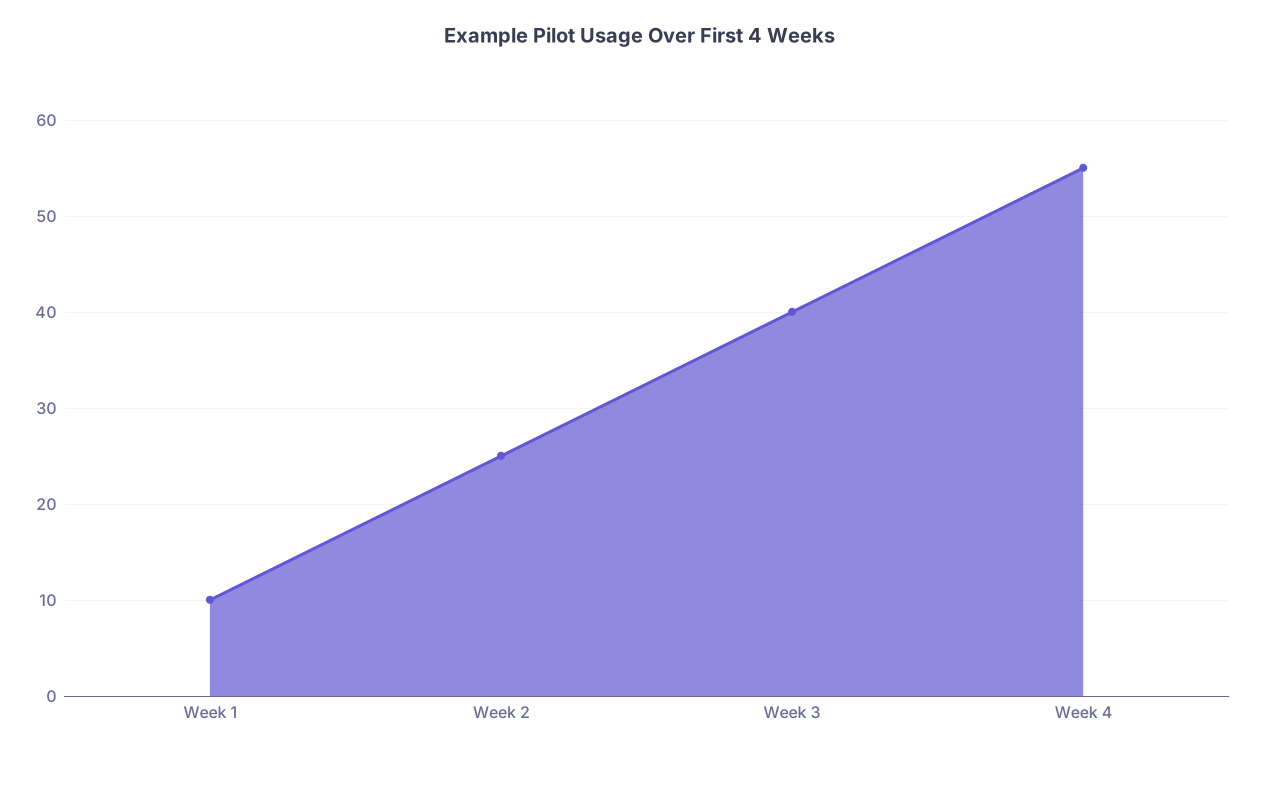
| Category | Value |
|---|---|
| Week 1 | 10 |
| Week 2 | 25 |
| Week 3 | 40 |
| Week 4 | 55 |
If usage is flat or dropping, do not hide from it. That is data. Have the uncomfortable conversations.
Weeks 17–20: Refine, Prove Value, and Talk Money
Now you are asking a different question: is this crossing the line from “interesting” to “valuable enough to pay for”?
Tuesday (2h) – Focused product tightening
- Pick one high‑impact flow and make it smooth.
- Remove steps. Clarify language. Reduce clicks.
Thursday (2h) – Data and stories
- Compile 2–3 specific before/after stories from your pilot:
- “Prior auth took ~4 days; now 2.”
- “Scheduler handled 20 percent more appointments per day.”
Saturday (3h) – Pricing experiments
Draft 1–2 simple pricing models:
- Per‑user per month.
- Per‑site flat fee.
- “Pilot extension” fee for 3 more months.
You do not need perfect pricing. You need a starting figure to test.
Sunday (3h) – Early sales conversations
- With your pilot sites:
- Show them the value stories and usage metrics.
- Ask directly: “If we continue after this pilot, would you pay $X/month for this?”
You are not trying to maximize revenue here. You are trying to see if money can change hands at all.
Parallel Track: Protecting Your Clinical Performance (and Sanity)
You cannot afford to be the “checked‑out” attending. That gets noticed fast.
So each week, you need explicit guardrails.
At this point you should… install three hard rules
No startup work during clinical hours.
Exceptions: a 5‑minute Slack reply while charting is fine. But no product meetings in the middle of clinic.Two protected off days per month.
Truly off. No clinical, minimal startup, family or personal time only. Burnout will kill your startup long before lack of money.Quarterly renegotiation of shifts.
Once you see real traction or real pilot commitments, talk to your group about:- Trading some nights for more predictability.
- Consolidating shifts into blocks to free up longer startup stretches.

You are playing a long game. Do not pretend you can out‑work physiology.
A Concrete Example Week (Mid‑Pilot Phase)
You are in Week 15. Pilot is running at one site, onboarding second. Typical 50‑hour clinical week.
Here is what your actual week might look like:
Monday
- Full clinical. Zero startup.
Tuesday
- 5:30–7:30 am: fix one onboarding bug, test, push update.
- 8–6: clinic.
- 7–7:30 pm: quick WhatsApp check with pilot champion.
Wednesday
- Clinical + family. Maybe 20 minutes of Slack messages to dev.
Thursday
- 5:30–7:30 am: review pilot usage, adjust one workflow screen.
- 8–6: clinical.
Friday
- Clinical, then off. No startup unless emergency.
Saturday
- 9–12: admin day for startup. Update metrics, review tickets, write summary for pilot site.
Sunday
- 5–6:30 pm: 2 feedback calls with pilot users.
- 6:30–7:30 pm: plan next week’s build priorities and messages.

Is it busy? Yes. Is it sustainable for 6 months? For most motivated post‑residency docs, yes, if you respect your off time.
Three Things To Walk Away With
Your startup is built in 8–15 disciplined hours per week, not in vague “when I have time.” Protect those blocks like you protect OR time.
Each 2‑month phase has a clear outcome: clarity of problem (Months 1–2), working MVP + pilot commitments (Months 3–4), real‑world usage and early revenue signals (Months 5–6).
You stay employable by drawing a hard line between clinical hours and startup hours. If your performance at work drops, your runway and credibility vanish.
Follow the timeline. Adjust details, not the structure. You are not trying to be a full‑time founder yet. You are trying to earn the right to become one later.


