
Solo Private Practice Owner: Turning Office Pain Points into Products
Why are you still complaining about the same broken software and workflows in your clinic… while someone else is building a startup to fix them?
You’re a solo private practice owner, post-residency, maybe a few years into attending life. You’ve seen every flavor of inefficiency. Phones ringing off the hook. Prior auths killing your staff’s sanity. Patients lost in follow-up because your EHR’s “task management” is a joke.
You are sitting on a goldmine of problems. Which means you are sitting on a goldmine of products.
Let’s turn those office pain points into something you can actually build, sell, or spin into a real medical startup—without blowing up your practice or your sanity.
Step 1: Stop Vague Complaining and Start Quantifying Pain
You already know the problems. But right now they’re vague: “our EHR sucks,” “referrals are a mess,” “billing is chaos.” That’s complaining, not product discovery.
You need to switch into “founder mode.”
For the next 2–4 weeks, you’re going to systematically capture pain in your practice.
Run a 2-week “Pain Audit” in your practice
Tell your staff you’re doing an “efficiency experiment,” not “I want to build a startup.” Keep it simple.
Give everyone a shared way to log pain points for 2 weeks:
- A physical clipboard at the front desk
- A Google Form on a bookmarked browser tab
- A shared Note on your phone and MA’s workstation
What to log:
- What broke or slowed you down?
- How often did it happen?
- How long did it waste?
- Who was involved? (you, MA, biller, front desk, patient)
You want ugly, specific entries like:
- “Patient portal message about refill answered twice by two staff members — no visibility. 10 minutes wasted.”
- “Faxed referral to ortho. They ‘never received it.’ Called twice. 18 minutes of MA time.”
- “Claim denied for missing modifier, same issue 6 times this month. Biller manually fixed all.”
Now, do a quick, crude tally at the end of 2 weeks.
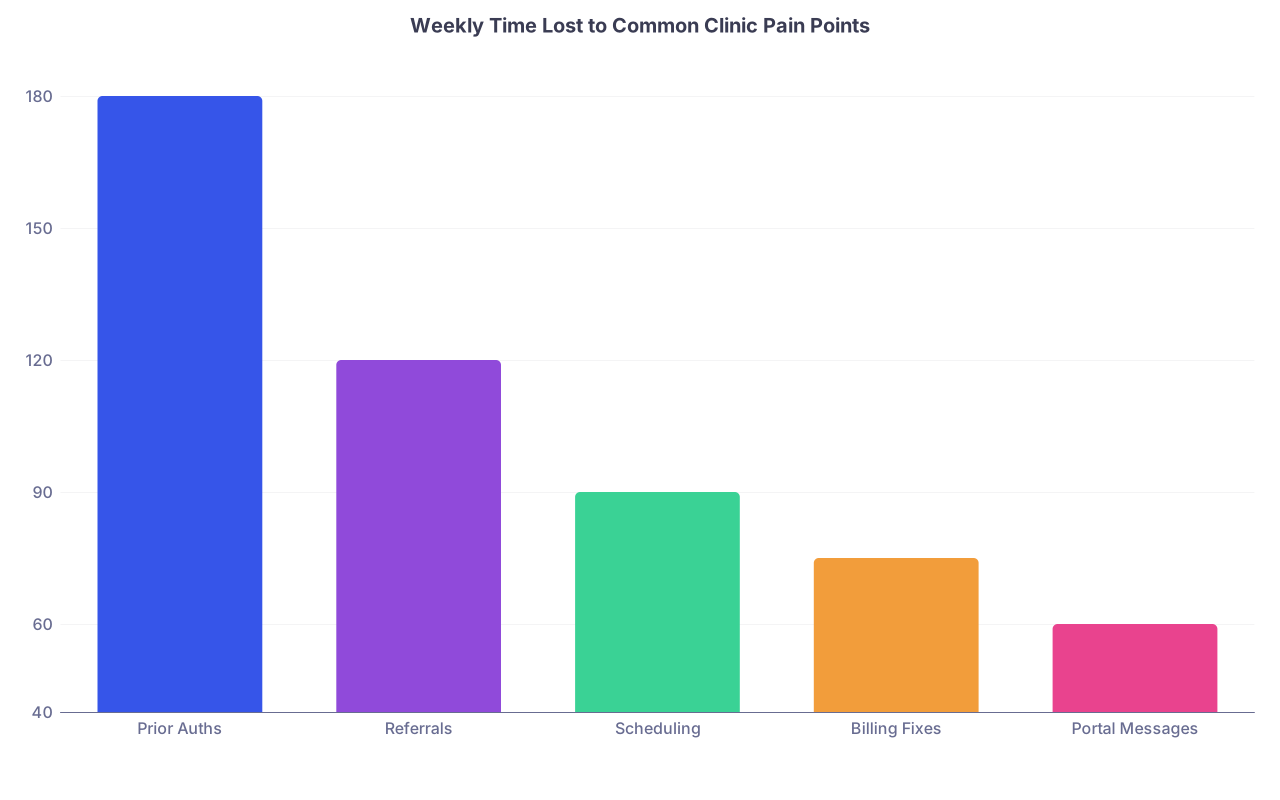
| Category | Value |
|---|---|
| Prior Auths | 180 |
| Referrals | 120 |
| Scheduling | 90 |
| Billing Fixes | 75 |
| Portal Messages | 60 |
You don’t need perfection. You just need enough to say: “This is stealing 3–5 hours/week” or “This problem shows up 10+ times/week.”
That’s product fuel.
Step 2: Separate Problems Into Three Buckets
Not every problem is a startup. Some are just you needing a better template or a different vendor.
Once you have raw pain points, sort them into three buckets:
- Workflow / policy problems
- Vendor / configuration problems
- True product gaps (no good solution exists or current tools fundamentally suck)
If a problem can be solved by:
- Writing a new clinic policy
- Changing how your staff schedules
- Turning on an underused feature in your EHR
…that’s a clinic project, not a startup.
You’re hunting for things like:
- “We’ve tried three referral platforms. All are clunky or don’t integrate with small practices.”
- “Our allergy shot reminder system is 40% no-show because the reminder logic is rigid and generic.”
- “We have to triple-document everything (EHR, billing portal, and separate spreadsheet). No tool handles our subspecialty workflow properly.”
Those are potential product categories.
Make a short list (3–7 items max) of problems that:
- Cost you meaningful time / money
- Happen frequently
- Aren’t easily solved with better operations
That’s your opportunity list.
Step 3: Pressure-Test Each Pain Point As a Product
Before you dream up an app, you have to ask the brutally simple question:
“Would at least 20 other practices pay for a solution to this?”
If the answer is “no, it’s too specific to my weird setup,” move on.
Here’s how you sanity-check quickly.
| Question | Good Sign |
|---|---|
| Other docs complain about this? | Yes, on forums/text threads |
| You'd personally pay monthly to fix it? | Yes |
| Fixing it saves measurable time/money? | At least an hour/day or 5% revenue |
| Existing tools clearly suck? | You’ve tried 2+ and still hate it |
| Easy to explain in 1–2 sentences? | Yes |
If an idea passes 3–4 of these, it’s worth exploring.
Example from real life:
- Problem: Every prior auth vendor your colleagues have tried is either priced for hospital systems or built for pharma, not small independent clinics.
- Translation: “Affordable, small-practice-focused prior auth automator” is a real product category.
Contrast:
- Problem: “My nurse hates how we label vaccine drawers.”
- That’s a process tweak, not a startup.
Step 4: Talk to Other Practices Before You Write a Single Line of Code
The dumbest thing you can do is pay a developer before you’ve talked to 10–20 other practice owners.
You’re not building something “for you.” That’s a hobby. A business needs a market.
Your next move: customer discovery.
Who to talk to:
- 5–10 other solo or small-group private practice owners (within or near your specialty)
- 2–3 practice managers
- 1–2 billers or RCM contractors
- Maybe 1–2 local urgent care or small surgical centers if relevant
What you say:
- “I’m seeing X problem in my clinic [briefly explain]. Are you dealing with anything similar?”
- “How are you handling it now?”
- “What have you tried that didn’t work?”
- “If someone solved this perfectly, what would it have to do?”
- “What would you realistically pay per month for that?”
Do not pitch your solution. Just dig into their pain.
You’re listening for:
- Language they keep repeating
- How much they’d pay to make it go away
- Whether their workflow resembles yours or is totally different
If everyone says:
- “Yeah, that’s annoying, but we just live with it,” and no one mentions money or lost time → weak problem.
- “This is killing my staff. I’d switch tomorrow if someone did this right.” → strong.
Capture exact quotes. Those become marketing copy later: website headlines, sales emails, pitch decks.
Step 5: Decide Your Role — Builder, Partner, or Adviser
You’re a practicing physician. You can’t just become a full-time SaaS founder tomorrow. So you need to choose how deep you go.
Three realistic role models:
Physician-owner/operator (low-medium involvement)
- You identify the problem
- You put in initial capital and time
- You hire dev/ops people to run the thing day to day
- You keep your practice, maybe reduce a clinic session or two later if it takes off
Physician cofounder with technical/ops partner
- You bring the problem, market knowledge, and credibility
- A cofounder (tech/business) builds and runs product
- You split equity, maybe 50/50 or 60/40
- You become product advisor and “designing physician”
Physician advisor / pilot site only
- You don’t own much (or any) of the company
- You act as a design partner and early adopter
- Low risk, low reward, but you still influence the solution
You need to decide which one fits your life. Do not pretend you’re a full stack engineer if you struggle to update your own website. Pick a role that matches your reality.
Step 6: Build the Smallest Possible Version (MVP) That Actually Works in Your Clinic
Here’s where most doctors overcomplicate things. They imagine a mature, polished, feature-loaded product. That’s how you waste $100k and 18 months.
Start with a Minimum Viable Product (MVP): the simplest version that can:
- Actually be used inside a real clinic
- Actually replace some manual work
- Actually collect real feedback
Sometimes your MVP is not software. It can be:
- A shared spreadsheet + Zapier automation
- A lightweight Airtable base with forms
- A simple web form + email routing
- A set of templates/macros packaged intelligently
For many workflow problems, that’s enough to:
- Prove value
- Get 3–5 practices to pay you
- Justify building proper software later
Example MVPs:
- Referral tracking: Google Form for referrals → Google Sheet dashboard → weekly auto-email to referring offices with status. If 10 clinics pay $150/month for that hacky version? Then you have proof.
- Prior auth: Centralized incoming requests through an intake form + standardized scripts for staff + a tracking board. If that moves the needle, then layer on automation.
Step 7: Protect Your Practice While You Experiment
You’re still seeing patients. You cannot blow up your operations in the name of “testing a product.”
So you pilot carefully.
Pick:
- 1–2 half-days/week to test new tools/workflows in a controlled way
- 1–2 specific workflows only (e.g., new-patient referrals, or only asthma follow-ups, etc.)
- 1 staff “champion” who likes new things and doesn’t melt down at change
You say to the team:
- “For all NEW dermatology referrals this week, we’re going to route them through this new form/tracker. Everything else stays the same.”
Then you track:
- Time saved
- Fewer errors/lost referrals
- Staff reaction
- Patient impact (wait times, confusion, etc.)
Don’t yank the whole clinic into your experiment at once. You’re not a health system with a change-management team. You are a small ship. Turn gradually.
Step 8: Price It Like a Business, Not Like a Hobby
If you actually turn this into a product, don’t underprice it because “I’m just trying to help other docs.”
You are a physician. Your time is insanely valuable. Underpricing is how you guarantee you’ll stop caring after 6 months.
For small-practice-facing SaaS, most of the time:
- Under $99/month: nobody believes it’s serious
- $99–$499/month: sweet spot for workflow tools
- $500–$2,000/month: only for tools that directly move revenue (billing, RCM, patient acquisition)
Start with a simple structure:
- Per clinic, not per user (most small practices hate per-seat pricing)
- 2–3 tiers max
- No complex contracts to start — month-to-month is fine at the beginning
Early pilot pricing approach:
- “Pilot price: $99/month for the first 6 months if you give me honest feedback and 2–3 testimonial quotes if it works for you.”
If no one will pay even $99/month? That’s a red flag. Solve something more painful.
Step 9: Use Being a Solo Doc as an Unfair Advantage
You might think: “I’m just one small practice. Why would anyone care?” That’s the wrong frame.
Your solo status is your superpower.
- You can change your workflow in a week. No 12-committee approval process.
- You feel every broken thing personally. You’re close enough to the front line.
- You can say to other docs: “I built this in my practice to fix X. Here’s what changed.” That’s infinitely more credible than generic sales talk.
“Independent internist in Ohio was losing 8 hours/week to prior auths. Built a tool to cut that in half. Now 35 clinics use it.”
That sells itself.
Build your “founder story” while you go:
- Why this pain pissed you off
- What you tried that failed
- The first time your new system clearly made a difference (“we caught 7 referrals that would’ve been lost”)
Use that in:
- A one-page website
- A short email to local practices
- A 2-minute video you send to new prospects
Step 10: Decide How Far You Want to Go
At some point, you’ll hit a fork in the road:
Is this:
- A small side business that brings in $20–100k/year and makes your practice better
- A serious startup you might raise money for
- An asset you want to sell to a larger company later
All three are valid answers.
Just don’t drift. Make an explicit decision when:
- You hit ~10–20 paying practices, or
- You’re debating reducing clinic time to work on it, or
- Investors / acquirers start sniffing around
You can absolutely be:
- A full-time clinician with a small but profitable product on the side
- A part-time clinician with a real startup that employs people
- A serial “problem spotter” who collaborates with tech teams as the physician brain
What you should not be: endlessly “working” on an idea without real users or revenue.
Common Types of Pain Points That Make Real Products
You might still be thinking, “Okay, but what exactly could I build?” Let me give you a few categories I’ve seen solo/private practice docs turn into tangible products.
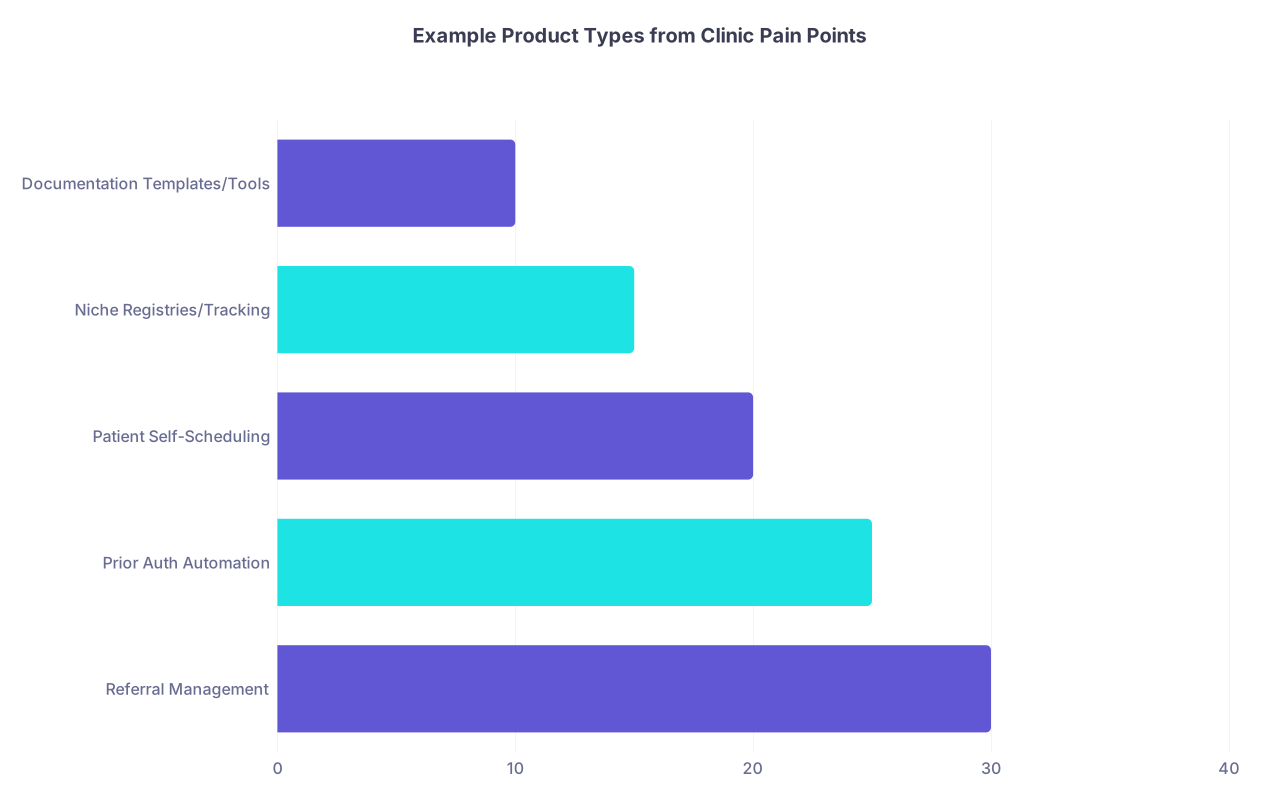
| Category | Value |
|---|---|
| Referral Management | 30 |
| Prior Auth Automation | 25 |
| Patient Self-Scheduling | 20 |
| Niche Registries/Tracking | 15 |
| Documentation Templates/Tools | 10 |
- Referral coordination tools for small practices
- Prior auth and benefits verification tools tailored to independent clinics
- Smart scheduling / waitlist / recall systems that don’t assume you’re a hospital clinic
- Outcome tracking or disease registries for a niche specialty (e.g., biologic therapies, ADHD med monitoring)
- Documentation toolkits (not just templates, but semi-automated workflows) that plug into existing EHRs
None of these are hypothetical. Variants already exist. But most of them ignore small independent practices or are priced impossibly.
You don’t have to invent a new category. You just have to serve an under-served segment better.
Rough Roadmap: From Pain Point to Product Launch
Let’s put all this in a loose timeline so you can see it as a path, not a vague dream.

| Step | Description |
|---|---|
| Step 1 | 2 week pain audit |
| Step 2 | Sort problems into 3 buckets |
| Step 3 | Pick 1 strong problem |
| Step 4 | Talk to 10 to 20 practices |
| Step 5 | Decide your role and partners |
| Step 6 | Build simple MVP |
| Step 7 | Pilot in your clinic |
| Step 8 | Onboard 3 to 5 external clinics |
| Step 9 | Refine, price, and decide scale |
Timeline if you’re not dragging your feet:
- Month 1: Pain audit + problem selection
- Month 2: Conversations with other practices
- Months 3–4: MVP build and internal pilot
- Months 5–6: 3–5 external clinics paying something
In under a year, you can know if you have a real business, not just an idea.
Two Realistic Example Scenarios
Scenario 1: The Overloaded Allergy/Immunology Doc
Pain point: Biologic therapy follow-up is a mess. Different payers, different labs, different intervals. Your MA keeps a color-coded Excel sheet and still misses follow-ups.
You:
- Audit: See 4–5 “near-miss” follow-ups/month, 3–4 hours/week of chasing labs and renewals.
- Talk: 8 other allergists say, “Oh my god, yes, we hack this together.”
- MVP: Simple web-based tracker + standardized protocol templates + reminder system for labs and visits.
- Pilot: Your practice first → no missed follow-ups for 2 months.
- Launch: Onboard 5 other allergists at $199/month.
Now you have a “Biologic therapy management platform for independent allergists.” Is it epic? Not yet. Is it real? Yes.
Scenario 2: The Primary Care Soloist with a Referral Nightmare
Pain point: Referrals to specialists disappear into a fax void. Patients blame you. Specialists blame missing info.
You:
- Log: Spot 10–15 “lost” or delayed referrals/month. Staff spends 3–4 hours/week on “did you get our fax?” calls.
- Talk: 6 other PCPs and 3 practice managers echo the exact same problem.
- MVP: Shared referral form → auto-email to specialist office → status board that your front desk updates in 10 seconds. Weekly auto-generated “referral status” email that your MA sends to patients.
- Pilot: In your clinic, complaints about “no one called me” drop by half.
- Launch: You clean it up, put it behind a simple login, charge $129/month to small practices, free for specialists.
Is it fancy tech? No. Does it solve a real headache in a way people will pay for? Yes.
Quick Reality Check: Things That Will Kill Your Product Early
Let me be blunt about a few failure patterns I’ve seen over and over:
- Building alone in a vacuum with no outside clinics testing it
- Refusing to charge money because you’re “not ready yet”
- Trying to copy hospital-scale platforms into a solo practice world
- Outsourcing everything to a dev shop with no ongoing product owner
- Waiting for “spare time” to work on it (you do not have spare time; you must carve time)
If you notice yourself doing any of that, correct early. Or stop and treat it as a hobby.