

The first 100 days after you raise seed funding will decide whether you build a real medical company or a well-funded science project.
You’ve already done the hard thing: survived residency, navigated the job market, scraped together a founding team, and convinced investors to wire money. Now the clock starts. Your burn is real, your runway is finite, and your clinical credibility no longer excuses fuzzy execution.
I’ll walk you through those first 100 days—month by month, then week by week—so you know exactly what you should be doing when.
Day 0–3: Right After the Wire Hits
At this point you should shift from “fundraising mode” to “company-building mode” immediately. No victory laps. No long vacations.
Core actions in the first 72 hours
Confirm the money and the cap table
- Verify funds received in the company bank account.
- Lock your final cap table:
- Founders
- Early employees / advisors
- Seed investors (institutional + angels)
- Make sure everyone has signed:
- SAFEs / preferred stock purchase agreements
- Option pool documents
Freeze your story
- One-page company narrative:
- Problem: e.g., “Hospital readmissions for CHF patients cost $XB/yr.”
- Solution: “AI-enabled virtual clinic layered on top of existing cardiology practices.”
- Who you serve: “Regional cardiology groups; not hospital systems yet.”
- Business model: “Per-patient PMPM via payers,” or “B2B SaaS to clinics,” etc.
- This becomes the reference for:
- Hiring
- Sales conversations
- Regulatory strategy
- Product decisions
- One-page company narrative:
Tell your inner circle
- Notify:
- Key clinical mentors
- Former program directors (you’ll want them as references later)
- Early design partners (clinics, hospitals, practices)
- Emphasize:
- You’re funded
- You’re still focused on outcomes, not hype
- You’re looking for X (pilot sites, medical advisors in Y specialty, etc.)
- Notify:
Week 1–2: Foundations and Non-Negotiables
At this point you should build the boring-but-critical backbone of a regulated healthcare startup. If you skip these, it will bite you later—usually right before a big contract or trial.
Corporate & financial setup
- Finalize:
- Board structure (who sits on it, how often you meet)
- Option pool size (you’ll need this for key hires soon)
- Implement:
- Accounting system (QuickBooks, Xero, or a real fractional CFO)
- Basic financial controls:
- Two-signature rule for large expenses
- Monthly burn and runway report
- Create a 12–18 month budget:
- Salary bands (founders, first hires)
- Product/engineering
- Regulatory / legal
- Pilots / clinical validation
- Minimal marketing
| Category | % of Seed Round |
|---|---|
| Product & Engineering | 35% |
| Founder & Early Salaries | 25% |
| Regulatory & Legal | 10% |
| Clinical Pilots / Studies | 15% |
| GTM (sales/marketing) | 10% |
| Contingency Buffer | 5% |
Healthcare-specific compliance skeleton
You’re not a generic SaaS. You’re a medical startup, post-residency, dealing with protected data and real patients.
In the first 2 weeks, you should:
- Choose your regulatory posture:
- Is your product a medical device (SaMD)?
- Are you clinical services (telehealth / virtual clinic)?
- Are you “clinical decision support” that might become regulated later?
- Start:
- HIPAA compliance framework (BAAs, data handling, vendor selection)
- Security basics:
- SSO, 2FA
- Encrypted storage
- Role-based access
- Find:
- A regulatory consultant with specific experience:
- “FDA SaMD submissions for cardiology AI” is better than “healthcare consultant”
- Or at least someone who’s taken a digital health product through IRB + pilots
- A regulatory consultant with specific experience:
Do not try to DIY all compliance from Reddit threads and blog posts. That’s how you stall a payer contract or get your pilot shut down by legal.
Weeks 3–4: Define the Next 18 Months (Before You Hire)
At this point you should translate your seed deck into an execution roadmap. Not fluffy OKRs. Actual milestones that unlock the next round or real revenue.
Build your 18-month roadmap
Backward-plan from two hard points:
- Your runway end date (e.g., 18 months from now)
- Your next major funding or revenue milestone
Ask: What has to be unquestionably true by then for a serious Series A or sustainable business?
Common medical startup milestones:
- For a digital therapeutics or SaMD company:
- Completed prospective pilot with N ≥ 50–200 patients
- Primary clinical endpoint improvement with p<0.05
- Clear FDA path identified, maybe pre-sub meeting done
- For B2B SaaS into clinics/hospitals:
- 3–5 paying logos (not just pilots)
- Case studies showing:
- Reduced documentation time
- Fewer denied claims
- Shorter LOS, etc.
- For virtual care / telehealth:
- Defined protocols
- Provider network standing up
- Reimbursement pathways tested (CPT codes, value-based, etc.)
Now turn those into a timeline.
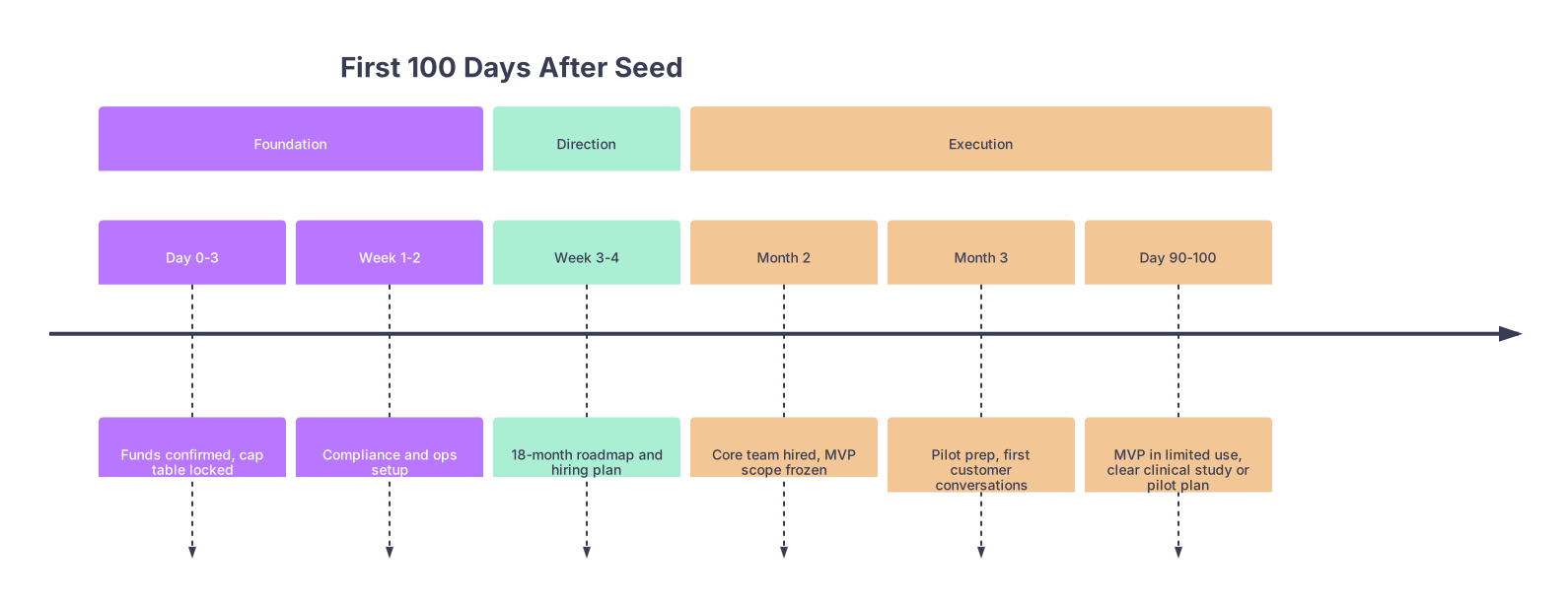
| Period | Event |
|---|---|
| Foundation - Day 0-3 | Funds confirmed, cap table locked |
| Foundation - Week 1-2 | Compliance and ops setup |
| Direction - Week 3-4 | 18-month roadmap and hiring plan |
| Execution - Month 2 | Core team hired, MVP scope frozen |
| Execution - Month 3 | Pilot prep, first customer conversations |
| Execution - Day 90-100 | MVP in limited use, clear clinical study or pilot plan |
Convert roadmap → hiring plan
Before you post a single job:
- List the non-founder work in the next 12 months:
- Backend / frontend
- Data / ML
- Clinical ops
- Sales to practices or health systems
- Regulatory / QA
- Label each as:
- Founder-owned
- First hire
- Contractor / fractional
Do not hire for prestige. Hire for the work that must be done in the next 6–12 months. I’ve seen too many ex-residents bring in a big-name “Chief Medical Officer” in month 1 and then have nobody actually writing code or calling practices.
Month 1 (Days 1–30): Lock Direction, Start Hiring, Freeze MVP
By the end of Month 1 you should have: a clear plan, real roles defined, and an MVP scope you’re not changing every week.
Weeks 1–2 recap (you’ve done this if you followed above)
- Money confirmed, cap table done
- Compliance baseline started
- 18-month roadmap
- Budget and hiring plan
Weeks 3–4: Start targeted hiring
Focus on 2–4 critical roles depending on your company type.
Typical early team for a clinical founder-led medical startup:
- Technical:
- Founding engineer or CTO (if no strong technical cofounder)
- Full-stack engineer
- Clinical:
- Part-time clinical specialist (0.1–0.3 FTE) in your domain:
- Example: cardiologist for CHF platform, orthopedic surgeon for post-op rehab
- Part-time clinical specialist (0.1–0.3 FTE) in your domain:
- Ops / product:
- Product-minded operations person who understands healthcare workflows
- Or a product manager with prior healthcare experience (Epic, Teladoc, etc.)
Avoid this common trap: hiring a salesperson in Month 1 for a product that barely exists. In healthcare, you first need:
- A credible prototype
- A clear value proposition
- A pilot structure
Freeze your MVP scope (for the next 90 days)
Decide exactly what you will ship into a pilot within ~3 months.
For example, for a chronic disease virtual clinic:
- MVP includes:
- Patient app: symptom tracking, medication reminders
- Clinician dashboard: risk stratification, simple notes, triage flags
- Basic integrations: secure messaging, PDF export for EMR
- MVP does not include (yet):
- Full EMR integration
- Multi-language support
- Automated billing workflows
Write this down in one living document. Pin it. Share it with every hire and every advisor. Any feature request that doesn’t serve MVP → parking lot.
Month 2 (Days 31–60): Build Team, Build Product, Build Pilots
At this point you should be shifting from “planning the company” to actually building and lining up clinical validation.
Weeks 5–6: Onboard early hires and set operating rhythm
When the first team members join, don’t wing onboarding. You’re still a clinic-minded founder; structure will keep you from falling into residency-level chaos again.
In their first 2 weeks, each hire should get:
- The company narrative (problem, solution, target user)
- The MVP scope doc
- The 18-month roadmap and where the next 90 days fit
- Exposure to real users:
- Shadow calls with clinicians
- Time in clinic (if possible)
- Listening to recorded consults (de-identified)
Set your cadence:
- Weekly:
- Product / engineering standup (what shipped, what’s blocked)
- Founder leadership sync (metrics, hiring, runway)
- Monthly:
- Board or at least investor update email
- KPI review:
- Product progress vs plan
- Customer conversations count
- Any early pilot contacts
Weeks 7–8: Aggressive customer discovery & pilot design
You’re fresh out of residency or early-career clinical practice. Use that proximity. You know how hospitals stall. You know which clinic managers actually move.
Your goal in Month 2: lock at least 1–2 serious pilot partners.
Steps:
- Build a short pilot deck (5–7 slides):
- Problem, solution
- Specific proposed pilot:
- Patient cohort (e.g., 50 CHF patients in one cardiology practice)
- Duration (3–6 months)
- Data collected
- Success metrics (readmissions, no-show rate, time saved, etc.)
- Required resources from them
- Talk to:
- Former attendings
- Clinic administrators you know by first name
- Hospital innovation / digital health offices (if they’re not painfully slow)
- Decide:
- Will pilots be paid or free?
- Free is sometimes faster but lower commitment
- Paid (even a token amount) gets much better engagement
- Will pilots be paid or free?
Start simple: a high-urgency problem in a setting you understand (e.g., outpatient follow-up rather than massive health system deployment).
Month 3 (Days 61–90): Ship, Test, Prepare for Real-World Use
By Day 90 you should have a working MVP in the hands of either test users or a limited pilot, and a concrete plan for clinical validation.
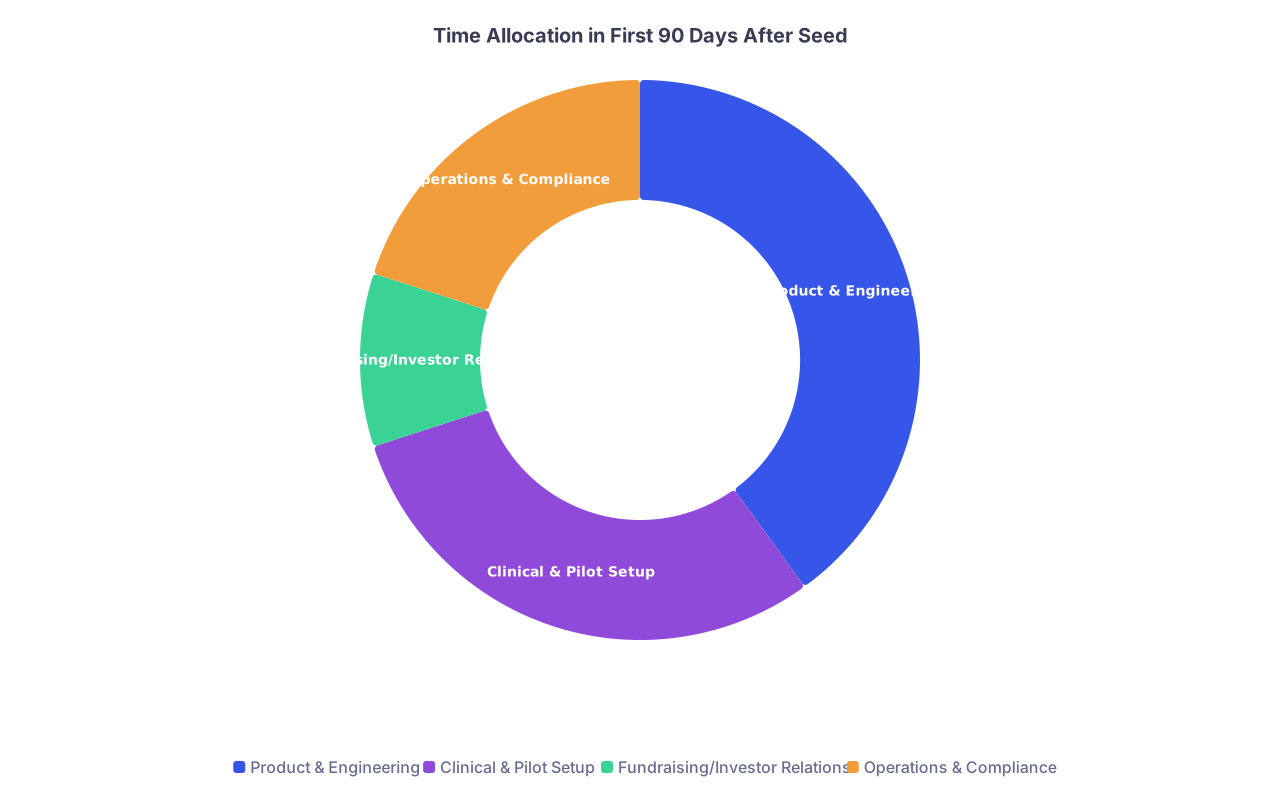
| Category | Value |
|---|---|
| Product & Engineering | 40 |
| Clinical & Pilot Setup | 30 |
| Fundraising/Investor Relations | 10 |
| Operations & Compliance | 20 |
Weeks 9–10: MVP in internal testing
At this point you should:
- Have an MVP that:
- Loads reliably
- Handles basic use cases end-to-end
- Respects security and privacy baselines
- Run through:
- Internal “tabletop” scenarios:
- A heart failure patient with decompensation signals
- A post-op ortho patient with pain score spikes
- Edge cases:
- No internet
- Incorrect patient data
- User entering obviously wrong values
- Internal “tabletop” scenarios:
As a clinician-founder, you must be the harshest tester. Ask yourself:
- Would I trust this in my own clinic?
- Where could this cause clinical harm or delay?
Document known limitations clearly for pilot sites. You’re not selling fantasy.
Weeks 11–12: Pilot logistics & clinical validation planning
By the end of Month 3 you should have:
- At least one signed pilot LOI or agreement
- Even if it’s small
- Define:
- Start date
- Patient inclusion criteria
- Primary and secondary outcomes
- A draft clinical validation plan:
- Is this:
- Quality improvement project within a practice?
- Prospective observational study?
- RCT down the road?
- Do you need IRB review?
- Many QI projects may be exempt, but get real guidance.
- Is this:
If you’re in a space likely requiring FDA down the line (diagnostic AI, digital therapeutics):
- Have a call with:
- Regulatory consultant
- Or do an early FDA pre-sub planning discussion
- Map your product to a regulatory framework (SaMD, device class, etc.)
Days 90–100: Reset, Recalibrate, and Set the Next 100 Days
These final 10 days of the “first 100” are for one thing: brutally honest assessment and adjustment.
At this point you should stop, zoom out, and answer:
- Are we on track to hit the milestones that make the next round or real revenue possible?
- Is our burn aligned with progress, or do we have “nice-to-have” hires chewing runway?
- Is our clinical story getting sharper or fuzzier?
Run a 100-day retrospective
Do this with your core team and maybe one trusted external advisor.
Ask:
- What did we actually accomplish vs. what we said in Week 1?
- Product shipped?
- Pilots lined up?
- Key hires made?
- What pleasantly surprised us?
- Faster pilot commitment than expected?
- Stronger early engagement from clinicians?
- What was slower or harder than we thought?
- IT/security reviews at clinics?
- EMR integration?
- Data labeling, if you’re AI-heavy?
Turn this into a concrete next-100-days plan with:
- 3–5 measurable objectives
- Clear owners
- Updated budget and runway check
Common Failure Patterns in the First 100 Days (And When They Appear)
Here’s the reality: most medical startups don’t fail because the idea is bad. They fail because the first 100 days are spent on the wrong things.
Watch for these, when they usually show up:
| Timeframe | Pattern | Consequence |
|---|---|---|
| Weeks 1–4 | Endless strategy, no roadmap | Team confusion, drift |
| Month 2 | Hiring prestige over execution | High burn, low output |
| Month 2–3 | Ignoring compliance/regulatory | Blocked pilots, delays |
| Month 3 | Building for everyone, not a niche | No compelling use case |
You’re coming from residency or the clinical job market. You already know how systems waste time on the wrong problems. Don’t recreate that in your own company.
A Quick Visual: Your First 100 Days as a Gantt Chart
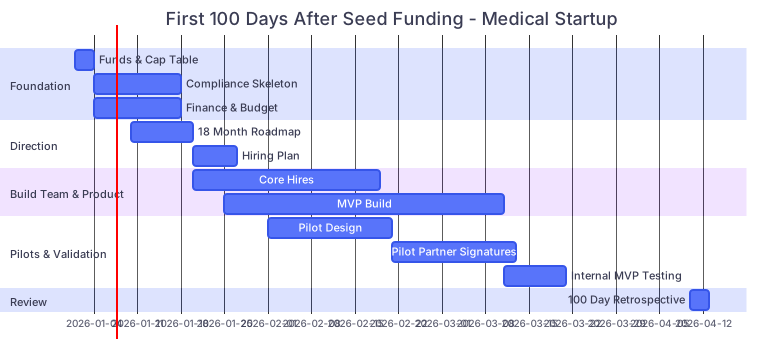
| Task | Details |
|---|---|
| Foundation: Funds & Cap Table | a1, 2026-01-01, 3d |
| Foundation: Compliance Skeleton | a2, after a1, 14d |
| Foundation: Finance & Budget | a3, after a1, 14d |
| Direction: 18 Month Roadmap | b1, 2026-01-10, 10d |
| Direction: Hiring Plan | b2, after b1, 7d |
| Build Team & Product: Core Hires | c1, 2026-01-20, 30d |
| Build Team & Product: MVP Build | c2, 2026-01-25, 45d |
| Pilots & Validation: Pilot Design | d1, 2026-02-01, 20d |
| Pilots & Validation: Pilot Partner Signatures | d2, after d1, 20d |
| Pilots & Validation: Internal MVP Testing | d3, after c2, 10d |
| Review: 100 Day Retrospective | e1, 2026-04-10, 3d |
What You Should Do Today
You don’t need a 40-page plan to start. You need one concrete move.
Today, open a fresh doc and write three things:
- Your single most important milestone to hit by 12–18 months (e.g., “Complete 100-patient CHF pilot with 20% readmission reduction”).
- The three milestones you must hit in the next 100 days that make that possible.
- The one hire or partner you need to start moving on this week to get there.
Then block 60 minutes on your calendar to send the first three emails or messages to move that hire or pilot conversation forward. No more theory. Start the clock.


