
I Hate PowerPoint—Can I Still Build a Career in Medical Education?
What if everyone else in medical education lives in PowerPoint, and you’re the only one who wants to grab a marker and run to the nearest whiteboard—does that secretly mean you’re not cut out for this?
Short answer: no. Longer, more honest answer: the system will try very hard to make you think yes.
Let’s unpack that.
The Ugly Truth: Medical Education Looks Like a PowerPoint Factory
You’re not imagining it. Academic medicine is obsessed with slides.
Everywhere you look:
- Noon conference? Slides.
- Grand rounds? 60 slides in 45 minutes.
- M&M? Slides with 8-point font because “we had to include all the data.”
- CME talk? Branded template slides.
- Fellowship teaching? “Can you send your slide deck ahead of time?”
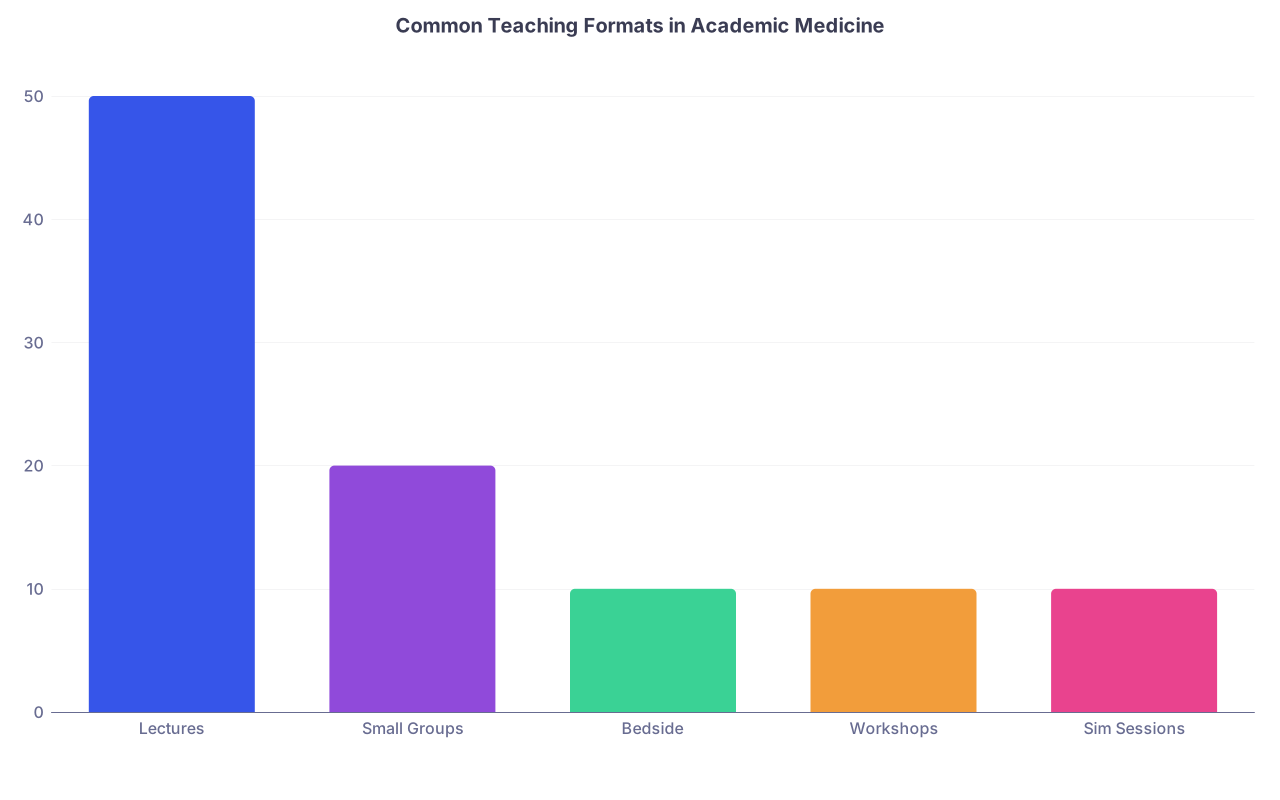
| Category | Value |
|---|---|
| Lectures | 50 |
| Small Groups | 20 |
| Bedside | 10 |
| Workshops | 10 |
| Sim Sessions | 10 |
So if you’re sitting there thinking, “If I have to make one more PowerPoint, I’ll quit medicine and open a bakery,” that feels like a career-ending problem.
Here’s the key distinction I want you to hear really clearly:
You don’t hate teaching.
You hate being forced into a boring, bloated, corporate-tool version of teaching.
I’ve seen fantastic educators who were terrible with slides. Some never used them. One of the best renal path teachers I know literally said, “If my promotion depends on my PowerPoint skills, I’ll go be a barista.”
She’s a full professor now.
So yeah, PowerPoint is everywhere. But it’s not the essence of medical education. It’s just the default tool that got way too powerful.
What Actually Matters for a Career in MedEd (Spoiler: It’s Not Slides)
Let me be brutally practical for a second. When people say “career in medical education,” they’re usually talking about some combination of:
- Being recognized as a strong teacher
- Getting teaching awards
- Holding formal roles (course director, clerkship director, program leadership)
- Getting promoted on an education track
- Being paid or protected for your teaching work
- Having some scholarship in education (papers, workshops, curricula)
Nowhere in there is “must love PowerPoint” or “must produce 50-slide decks weekly.”
What they actually care about is whether you can:
- Help learners understand hard things.
- Do it consistently.
- Contribute to educational systems (curricula, courses, assessments).
- Show some scholarship: publish, present, evaluate something you built.
Slides are just one way to deliver content and one way to show “I did a teaching thing.” But they’re not the only way—and in many settings, they’re not even the best way.
I’ve watched residents who couldn’t design a “pretty” slide to save their lives still become the go-to teachers on their teams because:
- Their chalk talks were clear.
- Their bedside mini-lessons were concise.
- Their teaching made people less confused, not more.
That’s what gets remembered. Not whether your title slide had a gradient.
Reality Check: Where You Can Dodge PowerPoint (And Where You Can’t)
You’re probably not asking, “Is it theoretically possible to avoid slides?”
You’re asking, “Am I going to tank my career if I keep hating them?”
So let’s be specific.
| Setting | Slide Pressure |
|---|---|
| Bedside teaching | Very low |
| Small group/PBL | Low–Moderate |
| Morning report | Moderate |
| Noon conference | High |
| Grand rounds | Very high |
| Workshops | Moderate |
Places where you can basically ignore PowerPoint
Bedside teaching / rounds
You can build an entire education-focused career as “the amazing clinical teacher” with almost zero slides. Evaluations, teaching awards, and “every learner loves them” reputations come from here. Not from a perfect template.Small groups / PBL / case-based discussions
Many schools explicitly want these to be non-slide-heavy. A printed case, a whiteboard, maybe a shared document. The art is in guiding discussion, not slide transitions.Coaching / advising / mentoring
Educational careers built around being the person who develops learners one-on-one are very real. No slides. Lots of trust, strategy, reflective conversation.
Places where slides are harder to avoid (but still negotiable)
Noon conference / core curriculum
Most residents are told “prepare a PowerPoint.” But I’ve seen people run insanely good sessions with:- One summary slide and the rest whiteboard
- A single-page handout and case discussion
- Live drawing/flowcharts instead of a deck
Grand rounds / department-wide talks
These basically expect formal slides. You don’t have to love it. You just have to be…competent. Clean, readable, not flashy. Think “minimalist functional,” not “TED Talk produced.”Workshops at national meetings
Here you usually need something visual, but you can use:- A 3–5 slide skeleton and heavy audience participation
- Handouts, role-plays, small-group tasks that do most of the work

The issue isn’t “PowerPoint or no PowerPoint.” It’s “Do I need to build my whole identity around lectures and slide decks?” And you absolutely do not.
How to Build a MedEd Career If You Hate PowerPoint
Here’s the part you probably care about most: concrete ways to lean into a career in education while keeping your slide exposure as low as realistically possible.
1. Brand yourself around formats that don’t revolve around slides
You can quietly decide: “I am not going to be the ‘big lecture’ person. I’m going to be the ‘small-group and bedside teaching’ person.” Then you back that up with what you say yes and no to.
You aim for:
- Course roles that focus on small groups or case discussions
- Clerkship leadership focused on clinical teaching
- Simulation-based roles (these use scenarios, not slide dumps)
- Coaching/advising roles for students or residents

| Step | Description |
|---|---|
| Step 1 | Interest in MedEd |
| Step 2 | Focus on clinical teaching |
| Step 3 | Small group and PBL roles |
| Step 4 | Coaching and advising |
| Step 5 | Clerkship or residency roles |
| Step 6 | Love bedside? |
| Step 7 | Like groups? |
You’re not announcing “I refuse to ever use PowerPoint.” You’re just tilting your career toward environments that don’t demand it constantly.
2. Develop teaching skills, not slide skills
You know what’s actually rare? Someone who can:
- Translate a mess of guidelines into a clear mental map
- Read the room and change course when learners are lost
- Ask questions that aren’t just “so…what do you think?”
- Explain something hard in two minutes while walking between patients
Those people become indispensable educators, even if their slide design is…let’s say “basic.”
Your priority list should look more like:
- Learn how to run a focused chalk talk
- Practice case-based discussions with clear takeaways
- Use the one-minute preceptor, SNAPPS, or similar models on rounds
- Get good at explaining the why behind decisions
None of that requires a single animation.
3. Learn “good-enough” slides so you don’t sabotage yourself
Harsh but true: you can hate PowerPoint, but you can’t be terrible at it if you want an education career. You just need to be functionally competent.
That means:
- High-contrast, readable font
- One key idea per slide
- Minimal text, clear images when needed
- No insane transitions, sounds, or rainbow gradients
You don’t have to be a design guru. You just have to not hurt people’s eyes.
Think of it like this: you hate EMR documentation too, but you learned to do it decently because the job requires it. Same thing.
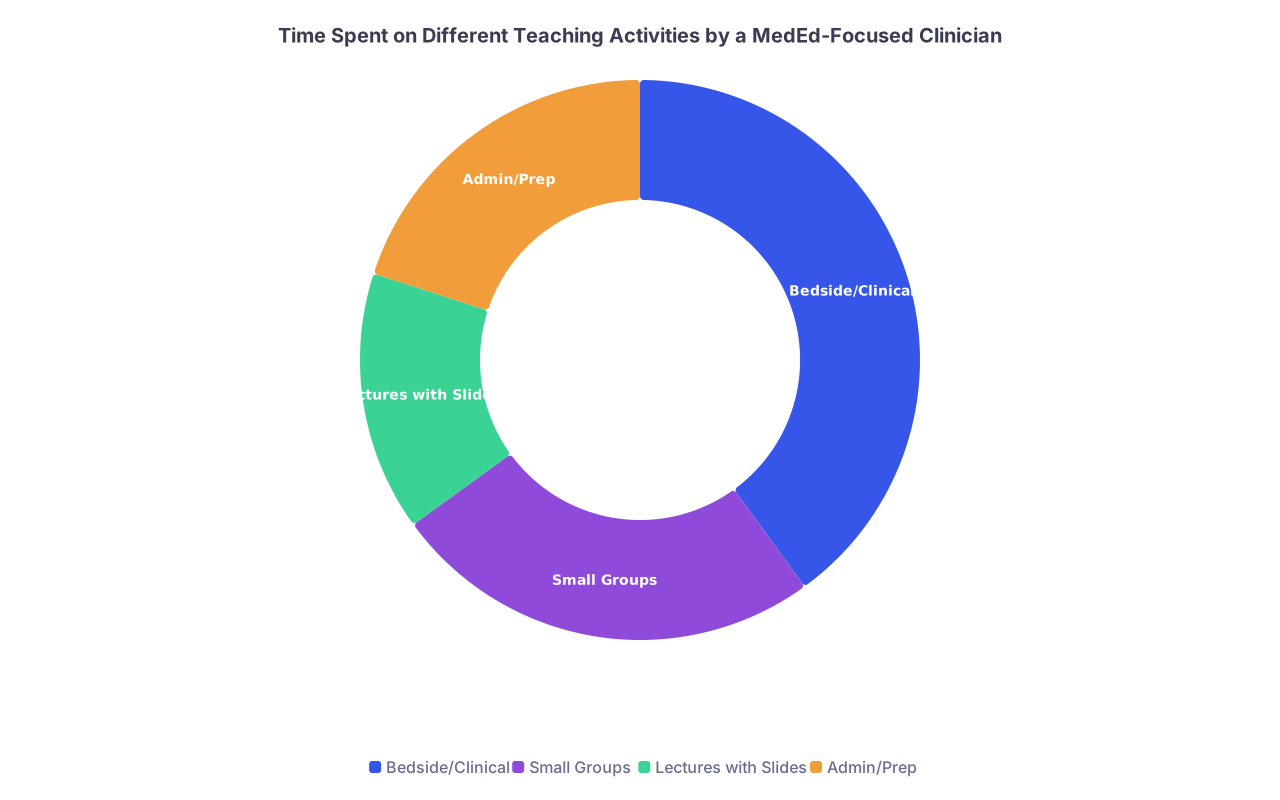
| Category | Value |
|---|---|
| Bedside/Clinical | 40 |
| Small Groups | 25 |
| Lectures with Slides | 15 |
| Admin/Prep | 20 |
If lectures with slides are, say, 10–20% of your teaching life, and the rest is stuff you actually enjoy, that’s a pretty good compromise.
4. Do education scholarship that doesn’t revolve around lectures
You might be worrying, “Okay, but I need education scholarship for promotion—doesn’t that mean designing big lecture series with fancy decks?”
No. Some of the strongest med ed projects I’ve seen had nothing to do with big, flashy presentations. Examples:
- Studying the impact of bedside feedback tools
- Creating a structured teaching script for interns on rounds
- Designing a coaching program for struggling students
- Building a simulation curriculum with standardized patients
- Implementing a new assessment tool in a clerkship
None of that requires a slide deck to exist. If you present it at a conference, sure, you’ll probably make a 10-slide summary. But that’s just the wrapper, not the core work.

5. Use alternatives intentionally so you’re seen as “innovative,” not “difficult”
If you just say “I hate PowerPoint” and refuse to use it, people will label you as high-maintenance. If you say, “I’d like to make this session more interactive—can I run it case-based with a whiteboard instead of slides?” you sound like an educator.
Same preference. Different framing.
Good alternatives you can propose:
- “Instead of 40 minutes of slides, can we do a 10-minute overview and then three short cases?”
- “For this topic, I think a handout and structured discussion might stick better than a deck.”
- “I’d like to try a chalk-talk format; I’ll still give you a one-page summary to share with learners.”
You’re still doing your job. You’re just nudging the format away from what drains you.
The Fear Underneath: “If I Don’t Play the Game, I’ll Be Left Behind”
Let’s name the real anxiety:
“If I don’t become a slide-making machine, I’ll never get promotions, never be taken seriously, never get leadership roles.”
I get that fear. Because institutions really do reward visible, countable things. And “gave 20 noon conferences with 40-slide decks” is easy to count.
But here’s what I’ve seen over and over:
The people who actually rise in medical education:
- Consistently get glowing learner evaluations
- Are known by name when people say, “Who’s a really good teacher here?”
- Take responsibility for parts of the curriculum or assessment
- Produce a few solid scholarly products (which may involve slides for presentation, not for the work itself)
None of those require you to derive joy from sitting at a laptop tweaking bullet points at midnight.
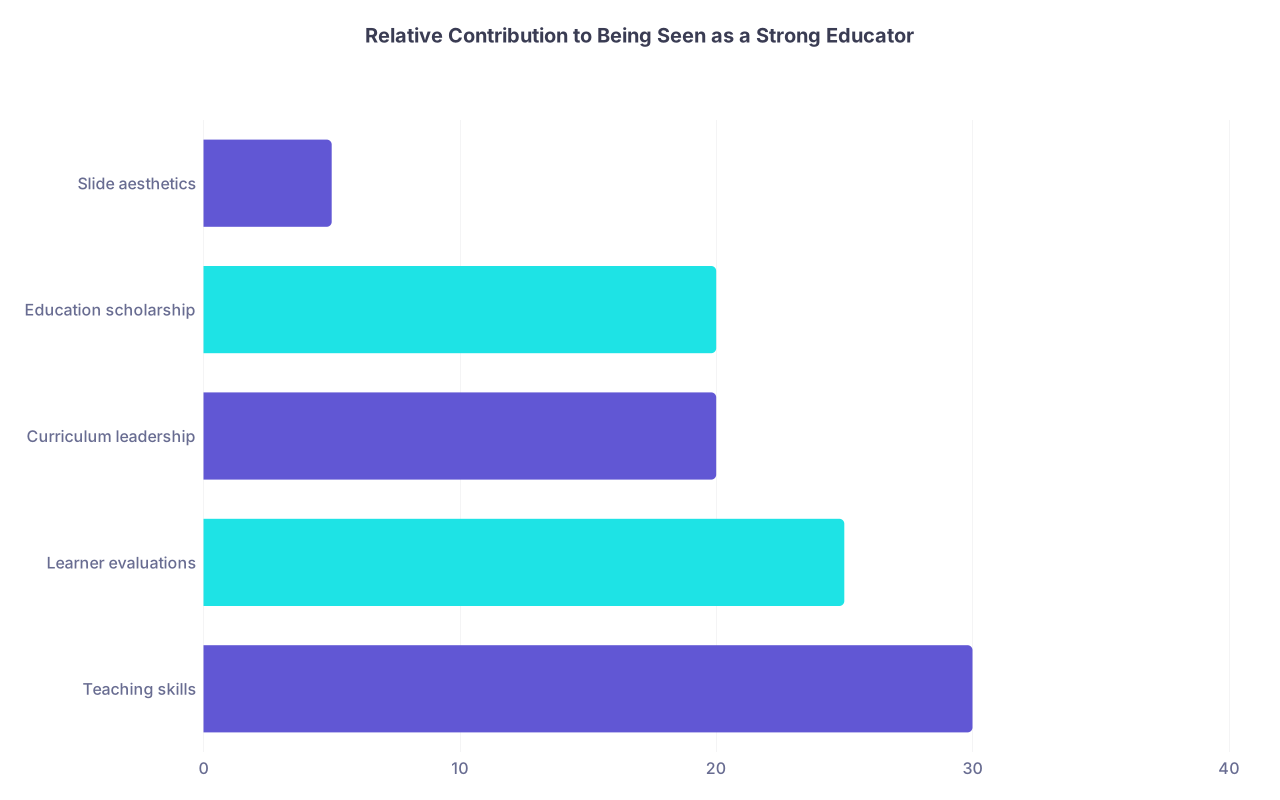
| Category | Value |
|---|---|
| Teaching skills | 30 |
| Learner evaluations | 25 |
| Curriculum leadership | 20 |
| Education scholarship | 20 |
| Slide aesthetics | 5 |
Slide aesthetics are about 5% of the equation. Maybe less. Don’t let them feel like 90%.
How to Survive Training When Everything Is “Make a Presentation”
You might be in med school, residency, or fellowship, where the default request for any teaching is, “Can you prepare a short PowerPoint?”
And you’re burned out just hearing the word.
Some ways to make this bearable without destroying your future self:
Build 2–3 “template” decks you reuse
Same skeleton, different content. Introduction, 3–4 case slides, 1–2 summary slides. Done. You’re not designing from scratch every time.Sneak toward interactivity
Even if they demand slides, you control what’s on them. Case prompts. Questions. “Stop here and think.” Minimal text. That feels way less soul-sucking.Ask for permission to experiment
“Would you be okay if I did this as a case-based chalk talk instead of a standard slide lecture?”
People say yes more often than you think—especially if you sound prepared, not lazy.Treat it like a language you’re just functional in
You don’t need to be fluent. You just need to be good enough that people don’t remember your slides for the wrong reasons.

FAQs
1. Can I be promoted on an education track if I don’t give lots of big slide-based lectures?
Yes. Promotion committees care about impact and scholarship, not the exact teaching format. If your dossier shows strong teaching evaluations, meaningful curriculum work, and some scholarship (papers, workshops, innovations), the fact that most of your teaching is bedside or small-group doesn’t hurt you. Just document it well.
2. What if I’m actually bad with PowerPoint—like technically incompetent?
Then aim for “baseline competence” and move on. Learn how to make a simple, readable deck: a clean template, large font, minimal clutter. Ask a colleague for their basic template and reuse it. You’re not being evaluated as a graphic designer; you just need your slides to not be a distraction.
3. Will refusing to use PowerPoint hurt my reputation?
Flat refusal probably will. Strategic redirection won’t. If you say, “I don’t do slides,” you sound inflexible. If you say, “I’d love to run this as an interactive case session or chalk talk; here’s my plan,” you sound like someone who cares about effective teaching. Same end result. Very different vibe.
4. Are there med ed fellowships or roles that fit people like me?
Yes. Programs heavy on bedside teaching, small groups, simulation, assessment, and coaching are perfect. Look for fellowships that emphasize clinical teaching skills, curriculum design, and mentoring over “large-group didactics.” Ask how much of the work is lectures vs other formats before you commit.
5. How do I build an education portfolio without tons of slide-based lectures?
Document every kind of teaching: bedside sessions, small groups, workshops, mentoring programs you helped design, assessment tools you created. Save schedules, feedback, emails, and any materials (handouts, cases, checklists). Write up and present (yes, sometimes with slides) the outcomes of these projects. That becomes your portfolio.
6. What if my institution is obsessed with PowerPoint and won’t budge?
Then you have two options: tolerate a basic level of slide use while building more satisfying teaching on the side, or eventually move to a place that values different formats. In the short term, stop aiming for “perfect slides.” Do clean, minimal decks, protect your energy, and invest your creative teaching effort where you actually feel alive—small groups, bedside, coaching, simulation.
Key points so you don’t spiral: You absolutely can build a serious, respected career in medical education even if you hate PowerPoint. Focus on real teaching skills, steer your roles toward bedside and small-group formats, and aim for functional—not fancy—slide competence when you have to use them. Slides are a tool, not a personality test.