

What actually happens if you “harmlessly” tell a program they’re your top choice when they aren’t? Or a PD hints you’re ranked to match and you play along? Nothing… right?
That’s the myth. “NRMP won’t bother with small stuff.”
And it’s wrong.
The Myth: “They Only Care About Big, Obvious Cheating”
Here’s the story people trade in group chats and resident lounges:
- “Sanctions are only for rank list fraud and SOAP scams.”
- “Everyone says ‘you’re my top choice’ – NRMP isn’t going to hunt that down.”
- “They’re not policing emails or Zoom calls. They don’t have time for that.”
- “As long as you don’t document it, you’re fine.”
I’ve seen med schools quietly advise: “Just don’t put promises in writing.”
I’ve heard PDs say, “We all bend the rules a bit; NRMP only goes after egregious stuff.”
Now look at what the NRMP actually publishes every single year: violations reports with names of institutions, types of violations, and specific penalties. A lot of them? “Minor” things. Individual contracts. Match communications. Not huge elaborate conspiracies.
You know who gets hit more often than students expect? Applicants.
Let’s walk through what the data actually shows, not the hallway folklore.
What NRMP Really Enforces (And How Often)
Let me ground this with real numbers first. NRMP releases a public “Violations Report” every cycle. Those reports are not empty.
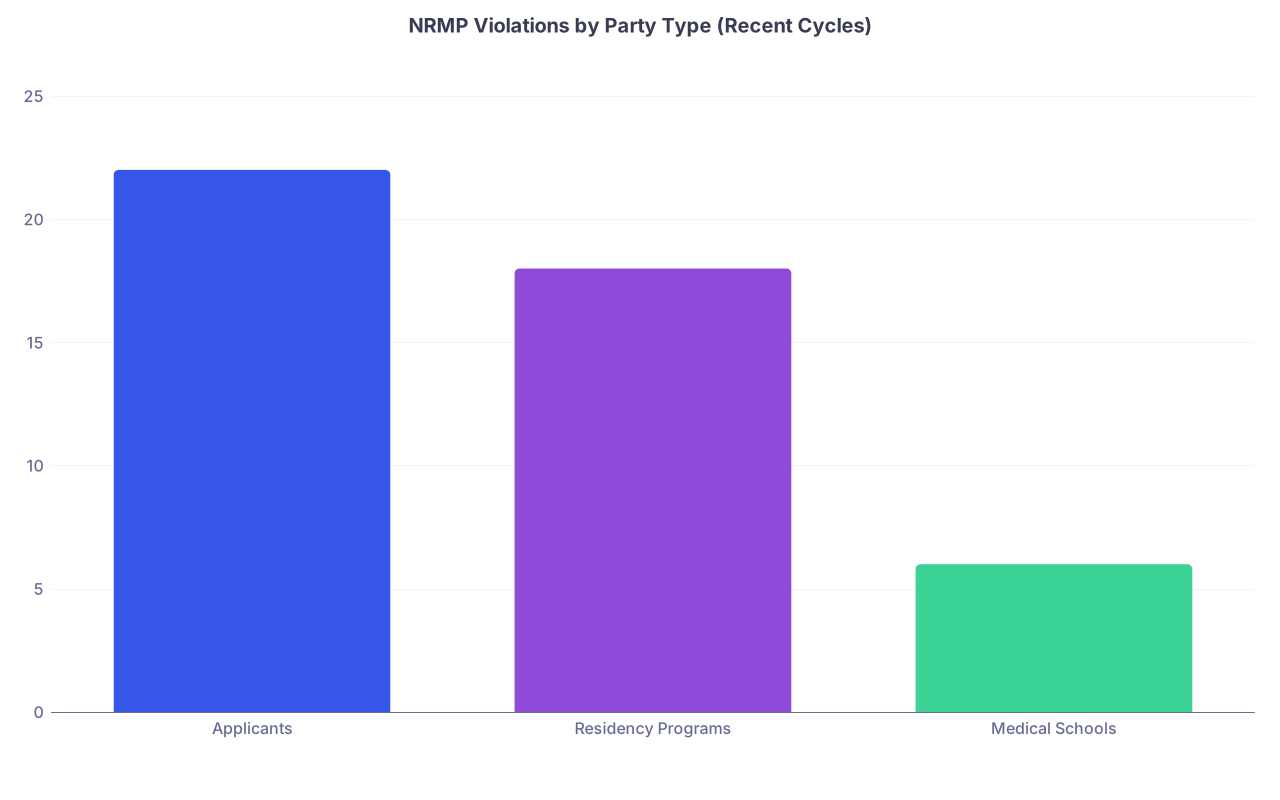
| Category | Value |
|---|---|
| Applicants | 22 |
| Residency Programs | 18 |
| Medical Schools | 6 |
Those are representative magnitudes from recent years (exact counts vary year to year, but the proportions look like this). So no, enforcement is not theoretical.
What do they actually go after?
- Dishonoring a match commitment (you match, then bail to a “better” offer).
- Programs offering off-cycle positions to matched or applying applicants outside NRMP rules.
- Improper communications about ranking (“We will rank you to match if you rank us first,” etc.).
- Side contracts or offers that undermine the match.
- Interview and ranking coercion.
Notice that “improper communications” is right there. The stuff your friend told you “doesn’t count.”
And no, NRMP doesn’t need to pull your emails off a server. Most cases arise because:
- A student files a complaint.
- A program files a complaint.
- A dean’s office notices something and alerts NRMP.
- A pattern emerges with multiple reports about the same program.
You’re not invisible. You’re surrounded by stressed people with something to lose and screenshots on their phones.
The Core Rule Everyone Underestimates: The Match Participation Agreement
If you’re in the Match, you agreed to a contract. Not metaphorically. Legally.
You clicked through and accepted the NRMP Match Participation Agreement (MPA). It’s long. You probably skimmed. That doesn’t matter. You’re bound by it.
Here’s what the MPA essentially says on three points students keep trying to “hack”:
- You must provide complete, honest, non-misleading information.
- You may not solicit or offer statements about rank order lists.
- You must honor your match if you match.
That “non-misleading information” part is exactly where “minor” lies live.
Telling three programs “You’re my number one” isn’t just cringe. It’s a clear misrepresentation that falls under “accurate and complete information.” And if someone reports it and can document it? You’ve given NRMP a clean, easy case.
Same for programs saying:
“We are ranking you to match.”
“If you rank us first, we’ll rank you high.”
“We don’t usually tell people this, but you’re in our top 3.”
NRMP explicitly bans soliciting or giving information about your rank list. Programs are supposed to say they are “very interested,” not “You’re ranked to match.” There’s a reason they train GME offices on that phrasing.

What Actually Happens If There’s a “Minor” Violation
Let’s say you’re an applicant. You tell Program A they’re your top choice, but you tell Program B the same thing in an email that gets saved. After the Match, they compare notes or someone forwards your messages to a dean. A complaint goes to NRMP.
Here’s the rough path from “small” lie to big problem:

| Step | Description |
|---|---|
| Step 1 | Alleged Violation |
| Step 2 | NRMP Receives Report |
| Step 3 | NRMP Initial Review |
| Step 4 | Case Closed |
| Step 5 | Formal Investigation |
| Step 6 | Requests for Documents |
| Step 7 | Interviews with Parties |
| Step 8 | Findings & Ruling |
| Step 9 | Sanctions Imposed |
This is not a “warning email and we’re done” system. NRMP has:
- A Violations Review Committee
- Formal processes
- Published sanctions
What can they actually do? Quite a bit.
| Sanction Type | Typical Impact |
|---|---|
| Public listing of violation | Your name and violation on NRMP site |
| Match participation bar | You’re banned from future NRMP Matches |
| Constraint on program | Program restricted from future Matches |
| Mandatory ethics/education | Required remediation before future participation |
| Report to med school or licensing bodies | Creates long-term paper trail |
That “public listing” part is the career equivalent of a tattoo on your forehead. Programs can and do look at those lists. Imagine sitting in fellowship interviews explaining why your name is on the NRMP Violations page.
You will not win that narrative.
“But Everyone Does It” vs Who Actually Gets Caught
This is the laziest justification on earth: “Everyone lies a little in the Match.”
No. Everyone spins a little. That’s different.
Typical spin that does NOT violate NRMP rules:
- “I’m very interested in your program.”
- “You’re one of my top choices.”
- “I’d be thrilled to train here.”
- “I feel like I’d fit well here and hope we can work together in July.”
Sloppy, risky behavior that can cross into violation territory:
- “You are my #1 and I will rank you first.” (When it’s not true.)
- “If you rank us first we will rank you to match.”
- “Do you plan to rank us first?” (Programs asking this.)
- “I won’t honor my match if I don’t get my city.” (Said to another program or a dean.)
I’ve seen cases where students blew themselves up with screenshots of DMs or emails. They thought they were just playing the game: overselling interest, trying to “lock in” a program.
Then somebody got annoyed. Or felt misled. Or lost out to that applicant. And hit “forward.”
NRMP doesn’t need to monitor your messages. Your competitors will do it for them.
The “I’ll Just Break My Match If I Hate It” Fantasy
Here’s the nastiest myth:
“If I match somewhere I hate, I can just refuse and enter next year. No big deal.”
Read the MPA. If you match:
- You are contractually obligated to start that position.
- Dumping your matched spot without proper NRMP release is a textbook violation.
- Programs are discouraged and often essentially blocked from offering positions to applicants with an active NRMP bar.
Think about the optics:
You bailed on a match commitment. Then you expect another program to trust you for 3–7 years of training?
NRMP has repeatedly sanctioned both applicants and programs for post-Match side deals. Things like:
- Applicants quietly accepting non-match positions after matching somewhere else.
- Programs recruiting matched applicants into unfilled or off-cycle slots.
That “I’ll just reapply somewhere better” plan? It often ends with “barred from future participation.”
Program Side: Why You Actually Should Report Violations
Students think: “I’ll never report a program; they have all the power.”
Programs think: “We’ll never report an applicant; it’s more hassle than it’s worth.”
And NRMP keeps posting 20+ violations a year anyway. Somebody’s reporting.
If you’re an applicant, here’s the uncomfortable truth: reporting a clear violation from a program protects students behind you more than it hurts you. NRMP has no interest in punishing good-faith applicants for calling out real misconduct.
Examples I’ve seen get reported and sanctioned:
- Programs telling multiple applicants, “We guarantee you’ll match here if you rank us high.”
- Requiring applicants to state whether they’re ranking another program higher.
- Trying to sign pre-Match contracts for categorical positions in an NRMP specialty.
- Pressuring an applicant to reveal rank list details “off the record.”
Do all of these explode into official sanctions? No. But enough do that programs pay attention when NRMP calls. The fear that “NRMP doesn’t enforce anything” is outdated, especially in the last decade.

How to Be Aggressive Without Being Stupid
You’re trying to match. You want every edge. That doesn’t require breaking rules.
Here’s the line you actually have to stay on the right side of:
Do not explicitly lie about ranking.
You can say “very interested,” “strongly considering,” “you’re one of my top choices.”
Don’t say “I’m ranking you #1” unless it is absolutely, literally true.Do not ask a program how they will rank you.
You can ask: “Are there any aspects of my application I can clarify?”
You can’t ask: “Where do I stand on your list?” or “Will I match here if I rank you first?”Don’t promise to break the rules later.
Saying “If I don’t match where I want, I’ll just bounce” is not edgy. It’s documented intent to violate the MPA if anyone saves it.If you’re pressured to break the rules, document it.
Save the email. Jot down date, time, person, and exact words after a sketchy phone call. If it escalates, you actually have something.
The myth is you need to bend the rules to succeed. The reality: the people who get hammered are usually the ones trying to “outsmart” a system that’s been doing this for decades.
, Improper contracts, Other](https://cdn.residencyadvisor.com/images/articles_svg/chart-types-of-applicant-violations-in-nrmp-reports-2407.svg "Types of Applicant Violations in NRMP Reports")
| Category | Value |
|---|---|
| Breaking Match commitment | 45 |
| [Misleading communication](https://residencyadvisor.com/resources/nrmp-match-rules/7-innocent-sounding-phrases-that-count-as-nrmp-match-violations) | 25 |
| Improper contracts | 20 |
| Other | 10 |
Notice that chunk labeled “misleading communication.” That’s the supposedly “minor” stuff.
The Long Memory of Paper Trails
NRMP is not your only problem if you get flagged.
If you’re sanctioned, NRMP can:
- Notify your medical school.
- Notify the program involved.
- Maintain a permanent public record of your violation and sanction period.
Your med school’s promotions or professionalism committee might take that further. Some states’ licensure forms ask explicitly about disciplinary actions or match violations.
Years from now, when you’re applying for:
- Fellowship
- Hospital privileges
- A new state license
You’ll be filling out forms asking some version of:
“Have you ever been sanctioned, disciplined, or restricted in connection with training or matching?”
Lie again, and now you’re into fraud territory. Tell the truth, and you’re explaining your “small” NRMP issue over and over to people who weren’t there and don’t care how you rationalized it at the time.
All because someone told you: “NRMP doesn’t enforce minor stuff.”
The Boring, Effective Way to Navigate NRMP Rules
If you want a practical rule set that keeps you aggressive but safe, it’s this:
- Be honest, but not over-specific, about interest.
- Never discuss rank lists as lists. Not yours, not theirs.
- Treat the Match Participation Agreement like the contract it is.
- If something feels like cheating, assume NRMP has already seen it before and written a rule against it.
- Assume anything you type, text, or say on Zoom could be screen-recorded and sent to NRMP.
On the program side (if you’re reading this as a chief or junior faculty):
- Stick to “we are very interested” language.
- Let your GME office vet any written communications templates.
- Do not promise ranking outcomes. Ever.
- If you screw up, stop, document internally, talk to GME, and course-correct before it becomes a pattern someone will report.

The Real Myth
The real myth isn’t just “NRMP won’t enforce minor violations.”
It’s that any violation is “minor” when your entire career pipeline runs through this system.
Three points to walk away with:
- NRMP absolutely enforces what applicants like to call “small” violations—especially misrepresentation, improper communication, and dishonoring matches.
- You do not need to break rules to maximize your chances; you need to understand where the line actually is and stop playing amateur loophole games.
- A single “minor” sanction can follow you for years: public listing, explanations on every application, and a permanent professionalism question mark you could have avoided.


