

Last week, a fourth-year stood outside the workroom after rounds, staring at her phone. A senior resident had just told her, “Look, everyone breaks the rules. Just email the PD your rank and ask where they’ll put you. That’s how it’s done if you want to match here.” She smiled and nodded in the moment. Then walked out and thought: “If I say no, do I tank my chances? If I say yes, do I screw my career?”
Here’s how to handle that exact situation — and every variation of “everyone breaks the rules” — without blowing up your Match or your integrity.
First, understand what game you’re actually playing
Let me be blunt: the NRMP is not guessing. They’ve seen every flavor of “everyone does it” behavior you’re hearing about in the hallways.
The moment you enter the Match, you agree to a contract. Not “guidelines.” A contract. That contract governs what you, programs, and institutions can and cannot do around ranking, pressure, and side deals.
Key reality: individual residents do not speak for the NRMP. Or for the program’s legal risk. Or for your career. Residents say reckless things all the time: “We always pre-round without logging it,” “Just backdate your note,” “Nobody reports that.” That doesn’t make it safe.
So if you’re hearing:
- “Everyone tells programs how they’ll rank them”
- “Just ask them where they’ll rank you, they’ll tell you if you’re safe”
- “We can do an informal commitment, that’s not the same as a contract”
- “The NRMP never enforces this stuff”
You need a simple frame:
- What does the NRMP actually prohibit?
- Who has real power to hurt you?
- What’s my script to shut this down without burning bridges?
We’re going to walk through all three.
What “breaking the rules” really means (the NRMP view)
Let’s translate the NRMP policy into actual situation-based language.
The NRMP Match Participation Agreement focuses heavily on coercion and soliciting commitments about rank lists.
Here are the common problem areas:
Asking or pressuring you to reveal your rank list
Example: “So, are we your number one?”
Or worse: “We really need to know if you’ll rank us high before we decide about you.”Suggesting you must rank a program a certain way to match
Example: “We only rank people who commit to putting us first.”
This is pure violation territory. Programs are not allowed to demand or condition ranking on your commitments.Offering guarantees outside the Match
Example: “If you tell us we’re #1, you’re basically guaranteed a spot.”
No, you are not. And they’re not allowed to make verbal promises that circumvent the algorithm.Pressuring you for post-interview contact that feels like a test
Example: “If you’re really serious about us, you’ll email the PD and say we’re your first choice.”
That’s exactly the kind of thing NRMP policies try to prevent.Trying to get you to coordinate rank lists
Example: “We’ll rank you to match if you rank us to match.”
That’s not “networking.” It’s undermining the Match process.
Now, what is not automatically a violation?
- A program saying, “You are a highly ranked candidate.”
- A program saying, “We are very interested in you.”
- You saying, “I really enjoyed your program; you’re one of my top choices.”
The line is crossed when there’s pressure, conditional promises, or attempts to coordinate ranks.
So when someone shrugs off NRMP rules and says “everyone breaks them,” they’re usually talking about exactly the thing the NRMP will punish if it’s blatant or documented.
Scenario 1: A resident says, “Everyone tells the PD how they’re ranking programs”
You’re on a second-look or on interview day, chatting with a resident you like. They say:
“Hey, if you really want to come here, you should email the PD and tell them we’re your #1. Everyone does that. It helps them decide who to rank high.”
Here’s what you do.
Step 1: Protect yourself in the moment
You don’t need to educate them on NRMP policy during your visit. Your job is to exit without committing.
Simple neutral responses:
- “I’ll definitely reach out to thank them for the interview.”
- “I’m still finalizing my list, but I really enjoyed this program.”
- “I appreciate the advice, I’ll think about it.”
Then change the subject. Ask them about schedule, research, call, whatever. You’re allowed to dodge.
What you do not say:
- “Yeah, I’ll definitely tell them you’re my #1.”
- “Sure, I can tell them how I’m ranking you.”
Do not create written evidence later of a coordinated rank commitment.
Step 2: Decide if this changes your view of the program
One resident being loose with advice doesn’t mean the whole program is corrupt. But patterns matter.
Red flags:
- Multiple residents repeating the same “everyone breaks the rules” message
- Faculty or PDs suggesting you must declare them #1
- Coordinated pressure: “Did you email the PD? They really care about that.”
You’re not required to report this. But you should at least ask yourself: do I want to train in a place where bending rules is normalized?
Step 3: Choose a safe post-interview communication strategy
You can still send a thank-you email. You can even express genuine enthusiasm.
Safe phrases:
- “Your program remains one of my top choices.”
- “I could see myself thriving in your program.”
- “I particularly appreciated [specific thing] and will keep your program highly in mind as I create my rank list.”
Avoid:
- “I will rank you #1” (especially if it’s not true)
- “If you rank me to match, I’ll rank you to match”
- “I promise I will come here if I match” combined with rank coordination talk
Is the NRMP going to show up at your door for one ill-phrased email? Probably not. But you don’t need the risk, and you don’t need to get into any “you promised” drama later.
Scenario 2: A resident says, “Ask the PD where they’ll rank you”
This one is both common and ugly.
You hear:
“You should email Dr. X and ask where you stand on the rank list. They’ll usually tell you if you’re high.”
No. You shouldn’t.
Programs are not allowed to tell you how they will rank you or request that information from you. You asking them to violate that boundary doesn’t help anyone, including you.
Here’s how to handle it.
Your immediate reply
In person:
- “I’d feel more comfortable just letting the Match process work as intended.”
- “I don’t want to put anyone in a weird position with the NRMP, so I’ll probably just stick to a thank-you note.”
That’s it. Calm, neutral, non-accusatory.
If they push:
“Really, everyone does this, it’s not a big deal.”
You can say:
- “I get that people do, but I’ve heard enough NRMP horror stories that I’d rather not.”
Then redirect.
What to do instead of asking about your rank
You want information? Fine. Ask for things that are actually helpful:
- Clarify schedule structure
- Ask about fellowship placement
- Ask how they support remediation or leave
- Ask if they’ve historically had trouble filling
Those questions respect the boundaries and still give you real data.
Scenario 3: Thinly veiled pressure or conditional ranking
This is where I’ve seen people get into actual trouble.
You hear from a resident or faculty:
“Between us, we only rank people high who show they’re committed. If you really want to come here, you need to tell us we’re #1.”
That sentence is a walking NRMP violation.
But you can’t control what they do. You can only control your response.
Here’s how to handle a high-pressure moment on the spot:
- “I really appreciate how strongly you feel about fit; I’m still finalizing my list, but I left very impressed with your program.”
- “I don’t want to say anything that conflicts with Match rules, but I can say I had a very positive experience here.”
If they’re persistent — and some are — remind yourself: someone who will pressure a medical student like this isn’t going to turn into a model mentor on July 1.
Should you report it?
You have three channels:
Do nothing
Completely allowed. Protect yourself, rank how you want, move on.Quiet internal feedback
If you trust someone (APD, faculty mentor in another department), you can say:
“I got some mixed messages from residents about NRMP-related conversations and pressure to declare them #1. I thought you’d want to know.”NRMP violation report
The NRMP has an anonymous reporting system. They do investigate. They especially care about patterns, not one awkward comment.
If it was one panicked resident on a bad day, I’d probably let it go. If it’s coordinated messaging from multiple people, that’s different.
What if you already said something you regret?
Let’s say you panicked and already emailed a PD:
“You are my #1 program and I will rank you first if you rank me highly.”
Now you’re reading this and your stomach drops.
Breathe. Here’s what matters:
- The NRMP is not reading your email in real time.
- The main risk is drama if you match somewhere else and they feel misled.
- The legal / rules risk is higher if there was explicit coordination: “If you rank me to match, I’ll rank you to match.”
If you truly want to clean it up, send a calmer follow-up later:
“As I continue to learn more about programs and reflect, I’m focusing on finding the best mutual fit. I remain very interested in your program and appreciate the opportunity to have interviewed.”
You don’t need to explicitly say, “Sorry I broke the rules.” Just walk it back into normal enthusiasm territory.
And going forward, do not repeat that mistake with other programs.
How to balance honesty, enthusiasm, and rules
Some students overcorrect and become robotic: “Per NRMP policy I cannot disclose any feelings whatsoever.” That’s not necessary.
You can be genuine without promising rank order.
Here’s a quick comparison of safe vs risky phrases:
| Situation | Safer Phrase | Risky Phrase |
|---|---|---|
| Expressing strong interest | "You are one of my top choices." | "You are my guaranteed #1." |
| Appreciating the program | "I could see myself training here." | "I promise I will come if I match." |
| Following up with PD | "Thank you again for the interview." | "If you rank me to match, I will too." |
| Asking for more info | "Can you share more about X?" | "Where will I be on your rank list?" |
| Responding to their enthusiasm | "I’m glad to hear I’m a strong fit." | "Ok, I’ll rank you first then." |
If you want to send one truly explicit “I will rank you #1” email, some students do it. The NRMP hasn’t banned that sentence outright. The problem is when it becomes widespread and conditional: you only tell that to places that pressure you.
My stance: You don’t need that drama. Programs should rank you based on your application and interview, not how aggressively you cheerlead afterward.
Quick mental checklist when someone says “everyone breaks the rules”
Use this simple internal script.

| Step | Description |
|---|---|
| Step 1 | Resident suggests breaking rules |
| Step 2 | Probably social advice - use judgment |
| Step 3 | Gray area - respond vaguely |
| Step 4 | Do not agree - use neutral phrases |
| Step 5 | Change subject and exit |
| Step 6 | Is it about rank lists or commitments |
| Step 7 | Are they asking you to reveal or coordinate ranks |
If the topic is rank lists, commitments, or guarantees, your default answer is: no commitments, neutral enthusiasm, change topic.
How NRMP actually enforces this (and why the myth persists)
You’ll hear, “Nobody gets in trouble for this, the NRMP doesn’t care.” That’s not true. They care a lot when:
- There’s documentation (emails, texts, recorded calls)
- There’s a pattern (multiple students reporting the same pressure)
- There’s clear harm (students misled, spots manipulated)
Penalties can include:
- Public listing of program violations
- Program ineligibility for future Matches
- For individuals: barred from future participation, professional consequences later
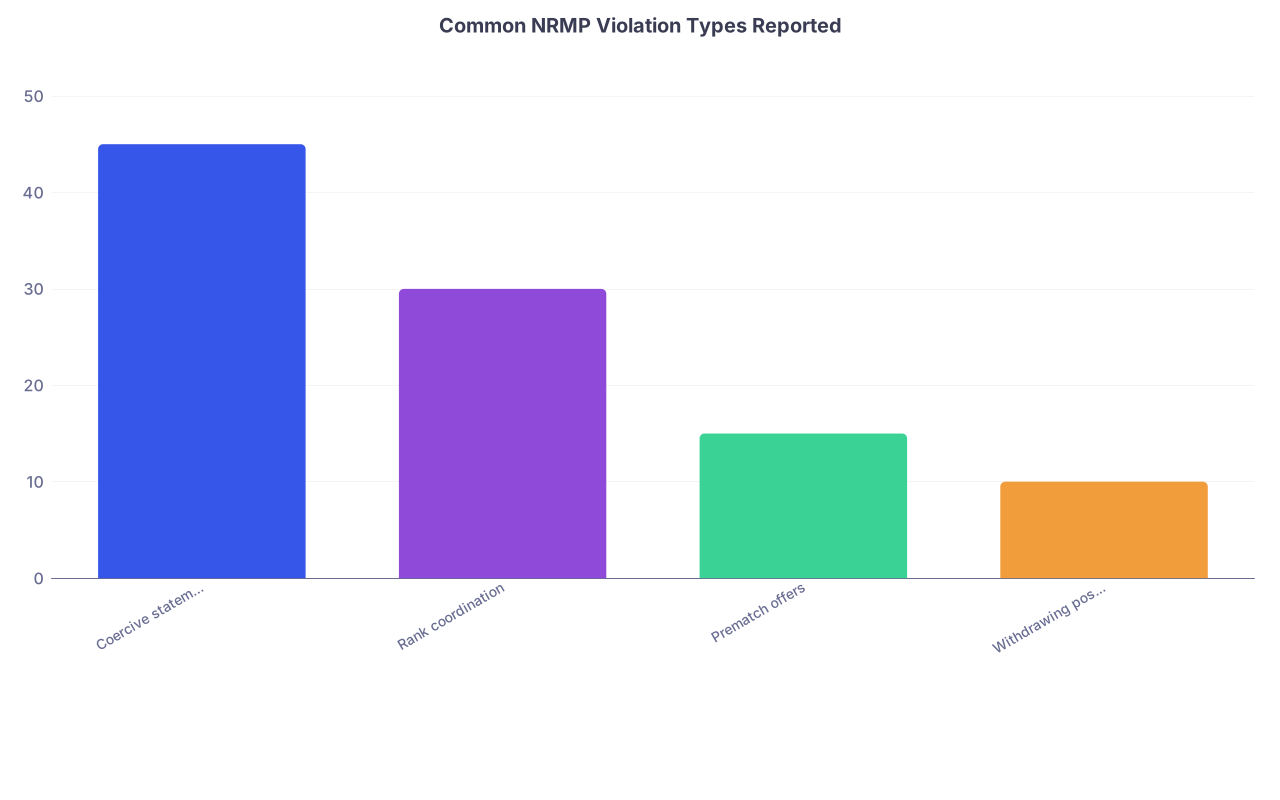
| Category | Value |
|---|---|
| Coercive statements | 45 |
| Rank coordination | 30 |
| Prematch offers | 15 |
| Withdrawing post-Match | 10 |
Why do residents still say “everyone breaks the rules”? Because:
- They matched years ago and never read the actual agreement
- They’re repeating what was said to them
- They confuse “I sent a strong interest email” with “I coordinated rank lists”
- They haven’t personally seen a program disciplined, so they assume it doesn’t happen
You are the one whose name is on the Match agreement. You’re the one whose future depends on this. Do not outsource your ethics or your risk tolerance to a random PGY-2.
Scripts you can actually use
Keep these in your back pocket.
When a resident says: “You should tell the PD we’re your #1.”
You say:
- “I’ve been told to be careful about NRMP stuff, but I’ll definitely let them know how much I liked the program.”
When someone asks directly: “Are we your first choice?”
You say:
- “I’m still finalizing my list, but your program is one I’m seriously considering.”
- “I’m keeping an open mind until I’ve seen all my options, but I had a very positive impression here.”
If a PD or faculty says: “We only rank people highly who commit to us.”
You say:
- “I respect that you want people who really want to be here. I also want to respect the Match process, but I can say I’d be excited to train here.”
If they keep pushing, that’s a character reference on them, not you.
When you might actually need outside help
If you encounter:
- A program requiring you to sign something rank-related
- Repeated messages about conditional ranking
- Threats (“If you won’t tell us we’re your #1, we can’t rank you”)
Loop in someone:
- Your dean’s office or student affairs
- A trusted faculty mentor outside the program
- NRMP’s policy office or violation reporting system
You’re not “being dramatic.” You’re protecting yourself and future applicants.
Tiny but important point: do not lie
Even if you ignore the NRMP for a second, remember this: medicine is a small world.
I’ve seen PDs compare notes at national meetings: “She told us we were her #1, then she said the exact same thing to my friend across the country.” You do not want to be that story.
You’re allowed to keep your rank list private. You’re allowed to say nothing. You’re not required to lie to make someone feel special.
FAQ (exactly 3 questions)
1. Is it ever okay to tell a program they’re my #1?
You can do it; it’s not automatically an NRMP violation to express that. The risk isn’t the sentence itself, it’s when it drifts into coordination (“If you rank me to match, I’ll rank you to match”) or when you say it to multiple places and people feel misled later. My advice: if you say it at all, say it once, mean it, and keep everything else in the “top choice” / “strong interest” category.
2. What if a program outright asks, “Where are you ranking us?”
You don’t have to answer. Safer responses: “I’m still finalizing my list, but I really liked your program,” or “I’ve been advised not to share specific rank order, but you’re under strong consideration.” If they push beyond that, it’s their problem, not yours, and you’re well within your rights to mention this to your dean or the NRMP if it’s persistent or coercive.
3. Can I be punished by the NRMP if I go along with what a resident suggests?
Yes, in extreme cases. The NRMP can sanction applicants for clear, documented violations of the Match Participation Agreement. Realistically, they focus more on programs and on serious patterns rather than a single awkward email. But you do not want to be the test case. The cleaner path is simple: don’t coordinate ranks, don’t ask about your position on their list, don’t make conditional promises. Show interest, then trust the algorithm.
Key things to remember:
- Residents saying “everyone breaks the rules” are not the ones who will absorb the consequences if things go sideways — you are.
- You can be genuinely enthusiastic without committing to rank positions or participating in side deals.
- Neutral scripts, a bit of backbone, and trusting the Match algorithm will serve you far better than trying to “game” a system that’s designed to ignore that gaming.


