
It’s 7:45 pm. You’ve just finished clinic, you’re microwaving leftovers, and you’re skimming an article about a proposed sugar tax in your city. Data look good for reducing diabetes and obesity. Then you hit the criticism: it disproportionately hurts low‑income families.
You freeze a bit.
Here’s the dilemma in your head: “I want to support population health. I also don’t want to be the person who shrugs and says ‘some people will be harmed, oh well.’ How do I make an ethical call on this?”
This is that question:
Can you ethically support policies that improve population health while predictably harming some individuals or groups?
Yes. Sometimes you can. Sometimes you absolutely should not. The difference is not vibes, and it’s not “more benefit than harm” hand‑waving. There’s a clear way to think this through.
Let’s walk it.
1. Start with the uncomfortable truth: almost all real policies hurt someone
If you’re waiting for a policy that helps everyone and harms no one, you’re waiting for a unicorn.
Public health policies usually do things like:
- Restrict: taxes, bans, mandates, zoning laws
- Redistribute: money, attention, services, power
- Re‑prioritize: more for prevention, less for rescue care; or vice versa
All of that creates winners and losers.
Seatbelt laws inconvenience people. Quarantine policies confine some people for the safety of others. Vaccination requirements can exclude some from schools or workplaces.
So no, “this hurts some people” is not itself a decisive objection. If that’s your stopping point, you’ll never support anything meaningful.
The real ethical question is more specific:
Under what conditions is it ethically acceptable to support a policy that predictably harms some for the sake of population benefit?
That’s what you need a framework for.
2. The core ethical frameworks you’re actually using (whether you admit it or not)
You don’t need a PhD in philosophy, but you do need names for the instincts already bouncing around in your head.
Here are the three big ones in health policy:
Utilitarianism (consequences focused)
Aim: maximize total good outcomes.
Translation: “If this policy prevents 1,000 serious illnesses at the cost of mild harms to 100 people, we should probably do it.”Deontology (rules and duties)
Aim: respect rights and duties, regardless of outcomes.
Translation: “Even if it saves lives, we cannot violate basic rights or treat people as expendable tools.”Justice frameworks (who bears the burden)
Aim: fairness, equity, protection for the vulnerable.
Translation: “We can’t keep designing ‘good overall’ policies that repeatedly dump the worst burdens on the same marginalized groups.”
Here’s the important point:
Ethically supporting a “net good but partly harmful” policy usually requires all three:
- Good outcomes
- Within acceptable moral rules
- With a just distribution of benefits and burdens
If one is wildly off, you’ve got a problem.
3. A practical test: 7 questions before you support the policy
You want a test you can actually use when reading about sugary drink taxes, isolation policies, opioid prescribing limits, climate regulations, anything.
Use these 7 questions. If you can’t answer “yes” (or at least “solidly defensible”) to most of them, be very cautious.
| # | Screen Question |
|---|---|
| 1 | Is the population benefit real, significant, and evidence-based? |
| 2 | Are the harms to individuals/groups clearly identified and honestly acknowledged? |
| 3 | Are those most harmed already vulnerable or marginalized? |
| 4 | Can harms be meaningfully mitigated or compensated? |
| 5 | Are there less harmful alternatives that achieve similar benefit? |
| 6 | Were affected communities meaningfully involved in design/decision? |
| 7 | Are power, accountability, and benefits shared fairly? |
Let’s break these down quickly and concretely.
1. Is the population benefit real, significant, and evidence-based?
“Probably helps” is not enough when real people will be hurt.
You want:
- Strong data or plausible, well‑supported modeling
- Clear definition of benefit (e.g., reduced mortality, fewer hospitalizations, reduced exposure)
- Magnitude that isn’t trivial
Example: A city bans leaded gasoline and removes lead pipes. Clear evidence base, major long‑term benefit. Yes, the costs land on some businesses and landlords. But the cognitive and developmental benefits to children are huge and well‑documented. This passes the benefit test easily.
2. Are the harms clearly identified and honestly acknowledged?
Red flag: policy advocates who say, “This policy is good and basically harmless.” That’s almost never true.
You want:
- Clear articulation of who is harmed and how
- Quantification where possible (financial cost, risk increase, autonomy loss, stigma)
- No euphemisms (“minor inconvenience” when it’s actually job‑threatening)
If harms are being minimized, hand‑waved, or ignored in the documentation, don’t support it yet. You’re flying blind.
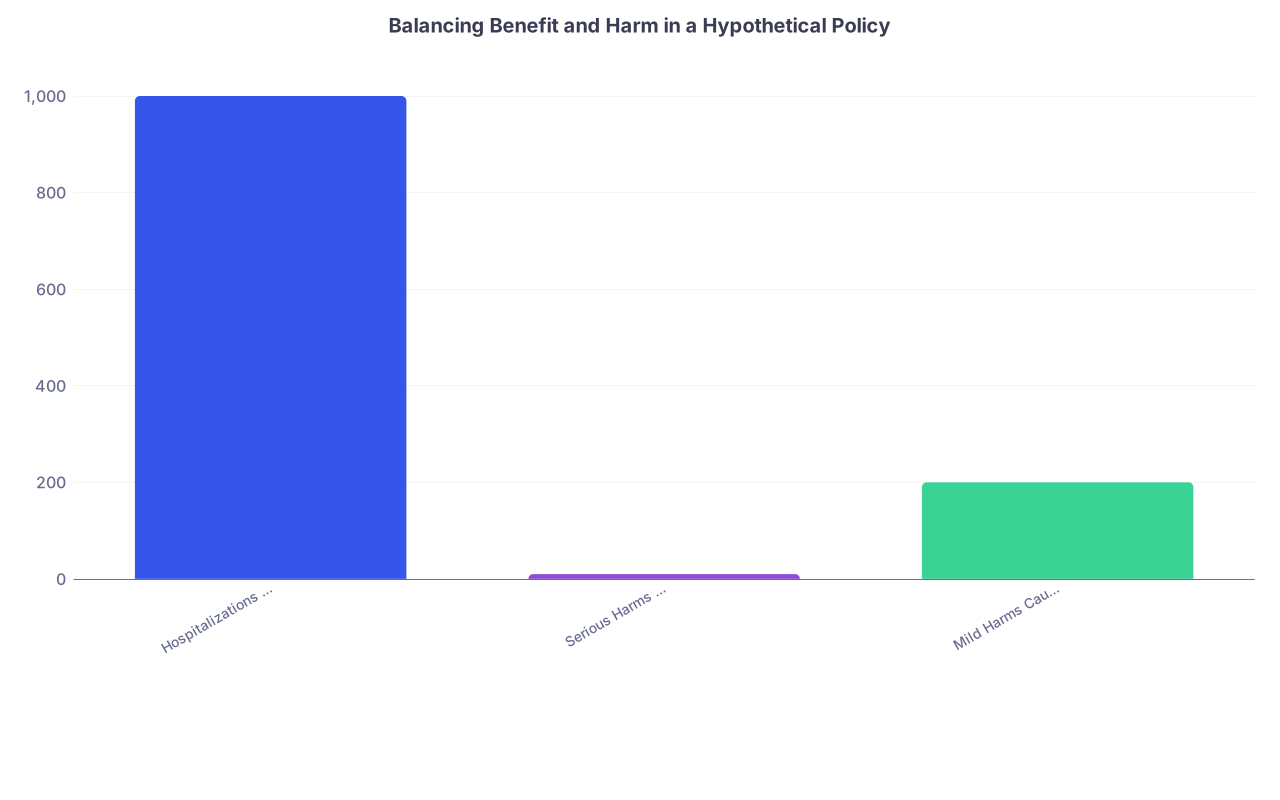
| Category | Value |
|---|---|
| Hospitalizations Prevented | 1000 |
| Serious Harms Caused | 10 |
| Mild Harms Caused | 200 |
3. Are those most harmed already vulnerable?
This is one of the most ethically loaded pieces. Because in public health, the harmed group is very often the same set of people who always pay the price:
Low‑income communities. Racial minorities. Disabled people. Immigrants. People with unstable work.
Example: A high flat fee for emergency department use to “reduce unnecessary visits.”
Who feels that the hardest? Not the well‑insured. Not the hospital execs. The poor and medically vulnerable who now delay coming in with serious symptoms because of cost.
If a policy:
- Saves money overall
- But does so by pushing risk onto those with the least power and resources
…that’s not just “regrettable side effects.” That’s bad policy ethics.
It doesn’t mean you abandon any policy that touches vulnerable groups. But it means you ask the next question.
4. Can harms be mitigated or compensated?
Some harms are preventable with design changes. Others can be cushioned.
Good policy design:
- Builds in exceptions or protections for those at highest risk
- Provides financial support, alternatives, or phase‑ins
- Offers appeals or case‑by‑case review where rigid rules would be cruel
Example:
A sugary drink tax can be structured as:
- A simple regressive tax that hikes prices and hits low‑income households hardest
vs. - A tax that’s paired with:
- Free water fountains, subsidized healthy drinks in low‑income neighborhoods
- Revenue earmarked for obesity prevention and diabetes care in those same communities
One version is lazy utilitarianism. The other takes justice seriously.
If policy advocates have not even tried to mitigate foreseeable harms, they’re telling you exactly how much they value those harmed groups. Believe them.
4. When “net benefit” is not enough: hard lines you should not cross
There are situations where “but it helps more people than it harms” is not a valid defense. Here are bright lines I’d treat as near‑non‑negotiable.
A. Policies that instrumentalize specific groups
Using one identifiable group as a tool for others’ benefit is ethically rotten.
Examples:
- Intentionally exposing prisoners to infectious disease trials because they are “easier to monitor”
- Severely limiting reproductive autonomy for disabled people “for social good”
Rule of thumb:
If a policy treats a group more as a means than as people with their own rights and dignity, walk away.
B. Policies that entrench or worsen structural injustice
If a policy:
- Repeats known patterns of racial, economic, or geographic injustice
- Deepens a gap you already know is harmful
…then “net benefit” doesn’t rescue it.
Classic example:
Locating all hazardous waste facilities in poor, minority neighborhoods because it’s “cheaper” and politically easier. You can’t ethically defend that with, “It’s more efficient overall.”
C. Policies that coerce without real consent or voice
Public health sometimes uses coercion (quarantine, mandates). But for ethical support, you want:
- Strong justification (high risk, serious harm, few alternatives)
- Transparent criteria
- Limited duration
- Legal safeguards and oversight
Long‑term, broad coercion of powerless groups for the “comfort” of others is ethically fragile at best.
5. So can you support it? A simple decision tree
Here’s a stripped‑down way to think about your answer in practice.

| Step | Description |
|---|---|
| Step 1 | Proposed Policy |
| Step 2 | Do not support |
| Step 3 | Demand better analysis |
| Step 4 | Oppose or push major redesign |
| Step 5 | Advocate for alternative |
| Step 6 | Support, with monitoring and advocacy for those harmed |
| Step 7 | Evidence of meaningful population benefit? |
| Step 8 | Harms clearly identified and transparent? |
| Step 9 | Harms concentrated on vulnerable groups? |
| Step 10 | Less harmful options available? |
| Step 11 | Mitigation or compensation built in? |
| Step 12 | Violates basic rights or entrenches injustice? |
Notice the last box. Even when you support, you don’t wash your hands of those harmed.
Ethical support means:
- You argue for the policy’s overall benefit
- You simultaneously advocate for relief, adjustment, or repair for those experiencing the downsides
If your support sounds like, “Well, there will be casualties,” you’ve become what people fear in “population health” advocates.
6. Your role as a clinician or health professional: what you’re actually responsible for
You’re not a philosopher in an armchair. You’re (likely) someone who will sign letters, testify, or at least vote.
Here’s what I’d say you are responsible for:
Knowing the trade‑offs, not pretending they don’t exist.
Don’t parrot press‑release language. Read the actual impact analysis when you can.Naming the harmed groups out loud.
Not “some individuals.” Say: “This will hit undocumented workers / people with severe mental illness / home health aides.”Insisting on mitigation.
Support the policy conditionally:
“Yes to this, only if we also fund X, carve out Y, or monitor for Z.”Being honest with patients and communities.
If your community asks, “Will this hurt people like us?” your answer cannot be, “No, it’s all good.”
It can be, “Yes, it has costs. Here’s why I still believe the overall impact is better, and here’s what I’m fighting for to protect people in your position.”
7. Concrete examples so this isn’t theoretical
Let’s run two quick case studies and call it.
Case 1: A strict opioid prescribing limit law
- Intended benefit: Reduce new opioid addictions and overdose deaths
- Harms:
- Patients with chronic pain abruptly cut off
- Clinicians punished for complex judgment calls
- Vulnerable harmed group: Often low‑income, disabled, rural patients
Ethical stance I’d defend:
- Support targeted, nuanced controls (e.g., prescription monitoring, education, high‑dose review)
- Oppose blunt, one‑size‑fits‑all hard caps that predictably abandon legitimate pain patients
- If a cap passes: publicly call out and work to fix the suffering it creates. Don’t hide behind “it reduces overdose deaths.”
Case 2: A mask mandate during a severe respiratory virus surge
- Benefit: Fewer infections, protected hospitals, fewer deaths in older and high‑risk groups
- Harms:
- Mild discomfort/autonomy loss for most
- Communication barriers, especially for the hard‑of‑hearing
- Economic impact if enforcement is aggressive
Ethical stance I’d defend:
- During a true surge with serious risk: yes, a time‑limited mask mandate can be ethical
- But:
- Provide free masks
- Make accommodations for those with disabilities (e.g., clear masks, exemptions with alternatives)
- Tie duration to clear metrics
- And admit openly: this is a real burden for some. Then actually help those people.
FAQ (exactly 7 questions)
1. Is it ever unethical not to support a policy that harms some people?
Yes. If a policy prevents massive, preventable harm with relatively modest, mitigable downsides, refusing to support it can itself be unethical. Classic example: refusing to back vaccination campaigns because a small number of people might have side effects, when thousands will die without high coverage. Standing aside while preventable harm occurs is not neutral.
2. How do I talk about these trade‑offs without sounding cold or utilitarian?
Name individuals, not just numbers. Say, “This policy will save hundreds of lives, especially among people with diabetes and heart disease. But it will also financially strain some families already living on the edge. I support it only if we pair it with targeted support for those families.” Acknowledge both truths in the same breath.
3. What if the evidence for benefit is shaky but the harms are clear?
Then you should not be enthusiastically supporting the policy. At best, you might advocate for small‑scale pilots, careful monitoring, or time‑limited experiments with explicit stop‑rules. Large, coercive policies with weak evidence and clear harms are ethically weak territory.
4. Do I have to reject every policy that is regressive (hurts the poor more financially)?
No—but you do need a plan to offset that regressivity. A regressive tax that funds highly targeted services for the same low‑income group it burdens can be defensible. A regressive policy that just balances the books on the backs of the poor is not.
5. How do I handle it when colleagues say, “You’re overthinking it; the net benefit is huge”?
Push back gently but firmly: “Net benefit matters, but who pays the cost also matters. Our job is not just to count lives; it’s to prevent policies that repeatedly dump the worst burdens on the same communities. We can design this better.” If they can’t answer for distribution and justice, their argument is incomplete.
6. Can I support a policy publicly while privately feeling uneasy about the harms?
Yes, if your unease is not ignored but channeled into how you support it: conditionally, with explicit advocacy for mitigation and ongoing evaluation. If you’re so uneasy that you couldn’t explain your support to an affected patient with a straight face, you either need more evidence, a better design, or a different stance.
7. What’s one sentence I can use as a default ethical position on these issues?
Try this: “I support public health policies that provide strong, evidence‑based population benefits, but only when we also acknowledge, minimize, and actively address the harms and burdens they create—especially for those who already have the least.”
Here’s your next step:
Pick one real policy you’ve recently read about—mask mandates, sugar taxes, vaping restrictions, syringe exchange, whatever. Write down, in plain language, who benefits most, who is harmed most, and how the policy could be adjusted to reduce those harms. If you can’t answer those three things, you’re not ready to say whether you ethically support it yet.