
It’s 8:30 p.m. You just finished a string of admissions, scarfed down half a sandwich, and now you’re staring at an email: “We’d love for you to join our statewide advisory group on Medicaid reforms.”
Your first thought isn’t pride. It’s panic.
Can I actually do this on top of full‑time clinical work without burning out or phoning it in?
Here’s the answer you’re looking for:
Yes, you can combine full‑time clinical work with serious policy engagement.
No, you cannot do all policy things, at all levels, all the time, while working full‑time, and still have a life.
The trick is being ruthlessly clear on scope, level, and time horizon.
Let’s break it down.
First: What Do You Mean by “Serious” Policy Engagement?
You don’t need to be Surgeon General for this to “count.” But “serious” does mean more than liking health policy threads on Twitter.
Serious policy engagement usually looks like one or more of these:
- You’re in the room when rules or laws are drafted, interpreted, or implemented.
- Your work changes how care is delivered or financed for more than just your own patients.
- You have a recurring seat at a table (committee, board, task force, coalition), not just a one‑off consult.
- People depend on you for consistent input, not just signature on a letter.
Here are concrete examples that count as “serious” even if they’re not glamorous:
- Serving on a hospital or system quality, ethics, or utilization committee and actually driving changes.
- Being part of a city or state task force (e.g., overdose prevention, maternal mortality review).
- Doing regular work with a professional society advocacy committee (ACP, AAFP, APA, etc.).
- Providing technical input on payment models, clinical guidelines, or public health protocols.
- Partnering with a community organization to shape local health policy (zoning, harm reduction, housing).
These are compatible with full‑time clinical — if you’re disciplined.
The Core Reality: You Get to Pick Two
There’s a simple triangle here:
- Full‑time clinical work
- Serious policy engagement
- A sustainable, non‑miserable life
You can absolutely have two of the three at high intensity. You can touch all three, but only one or two can be turned up to 10 at any given time.
If you try to:
- Work 1.0 FTE clinically
- Sit on three major external committees
- Do a big research/policy project
- And also be present for family, friends, or your own brain
You’ll either burn out, do mediocre policy work, or both.
So you need to define:
- What “full‑time” really is (more on that below — it’s not sacred).
- What “serious” means for your stage of career.
- How much of your life you’re actually willing to trade.
Step 1: Get Honest About Your Clinical FTE
Most people hide behind “I’m full‑time” as if that’s an unchangeable identity.
Full‑time is a contract number, not a moral value.
Common patterns I’ve seen that actually work:
| Model | Clinical FTE | Policy Time | Typical Stage |
|---|---|---|---|
| Pure Clinical + Light Policy | 1.0 | 2–4 hrs/week | Early career |
| 0.8 Clinical + Structured Policy | 0.7–0.8 | 1 day/week | Mid-career |
| Split Career | 0.5–0.6 | 2 days/week | Senior / academic |
| Bursts Model | 1.0 | Short sprints | Any stage |
Here’s my blunt advice:
- In your first 1–3 years out of training, stay close to 1.0 FTE clinically and choose one meaningful policy lane (internal or external).
- If you’re mid‑career and certain policy is more than a hobby, seriously consider 0.8–0.9 FTE. That “lost” day of billing often buys you 50–100x impact.
If your employer equates anything less than 1.0 FTE with disloyalty, that’s not a policy‑friendly environment. You either accept that or plan your exit over a 2–3 year horizon.
Step 2: Pick Your Level – Institutional, Local, State, or National
Trying to play at all four levels is how you end up doing a million Zooms and moving nothing.
Think in layers:
- Institutional (hospital, health system, clinic)
- Local (city, county)
- State
- National / international
You can be aware of all four. You can be active in maybe two. You can be serious in one.
Here’s how they compare:
| Level | Time Burden | Access | Impact Scope |
|---|---|---|---|
| Institutional | Low–moderate | Easiest | System patients |
| Local | Moderate | Good | City/county residents |
| State | Moderate–high | Harder | Millions of residents |
| National | High | Hardest | Broad but diffuse |
For someone working full‑time clinically, the most realistic combos are:
- Institutional serious + Local light
or - Local serious + Institutional light
State and national roles are doable, but then you have to either:
- Work less clinically, or
- Stay strictly in short, time‑boxed roles (task forces, comment letters, targeted projects).
Step 3: Decide What Kind of Policy Work You Actually Want
Policy isn’t one job. It’s a cluster of very different activities:
Advising and governance
Committees, boards, task forces, working groups.Advocacy and politics
Testifying, lobbying days, op‑eds, organizing professional peers.Implementation and operations
Turning policy documents into workflows, protocols, training, and metrics.Research and analysis
Evaluating programs, writing white papers, doing health services research.
Full‑time clinicians tend to be most effective in:
- Advising/governance
- Implementation/operations
Because those tap directly into your lived experience and can be integrated with your day job.
You have less time to:
- Shepherd legislation for a year
- Run big, grant‑funded research projects
- Operate as a frontline political organizer
…unless your clinical FTE drops.
So pick a primary mode. Something like:
- “I’m a hospitalist doing 0.9 FTE. I’ll be serious at the institutional level in implementation (sepsis pathways, readmission reduction).”
- “I’m an outpatient psychiatrist full‑time. I’ll do local and state advisory work on mental health crisis systems, with clear time caps.”
Once you name it, it’s much easier to say no to everything else.
Step 4: Structure Your Time Like It’s a Second Job (Because It Is)
“Serious” policy engagement means you stop treating it as volunteering you squeeze in “whenever.”
Bare minimum structure if you’re full‑time clinical:
Fixed weekly block
A recurring 2–4 hour policy block, same time every week, protected.Quarterly planning hour
You ask, “What am I trying to move in the next 3 months?” and cut out the noise.Project cap
Hard limit: no more than 1–2 active policy projects at a time.Role clarity
For every committee / task force ask: “Am I here as:- Clinician floor voice
- Technical expert
- Chair/leader
- Token warm body?”
Say no to the last one.
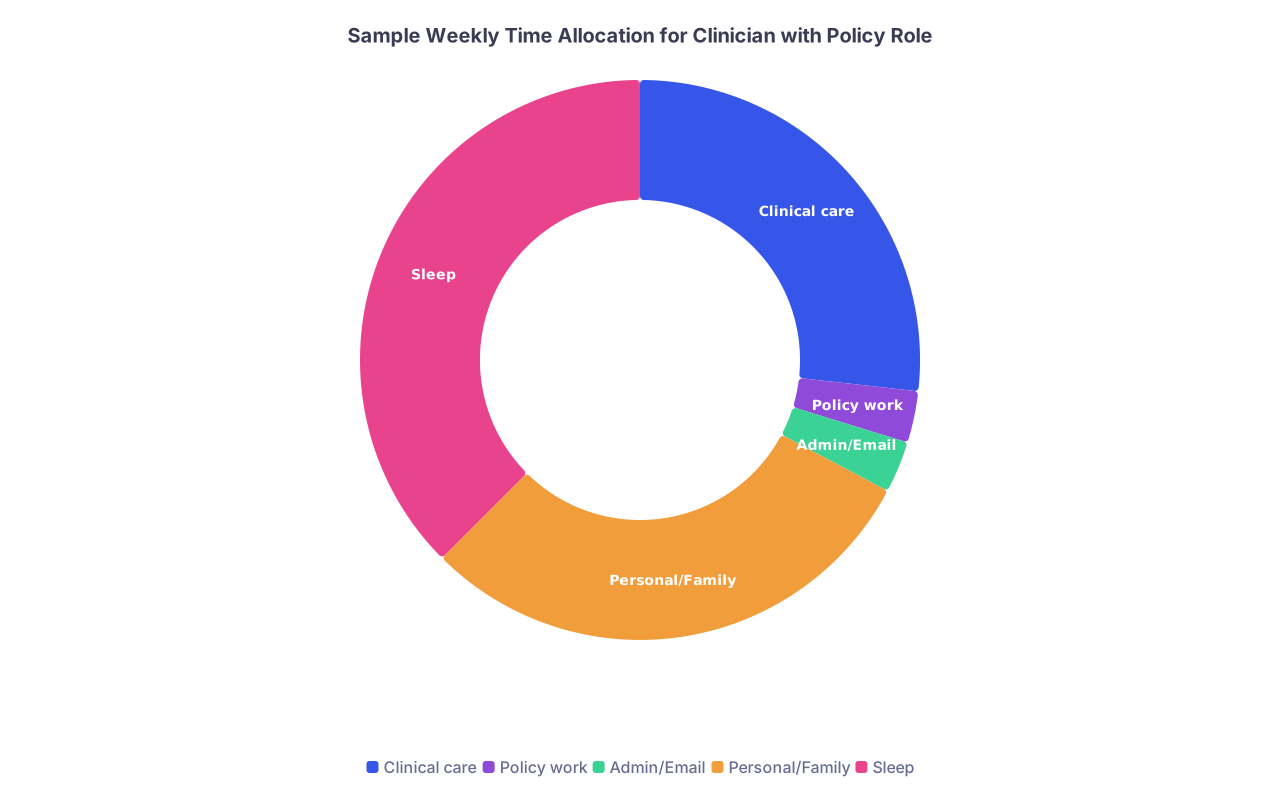
Here’s what a feasible week might look like for a 1.0 FTE clinician with one serious policy role:
| Category | Value |
|---|---|
| Clinical care | 45 |
| Policy work | 5 |
| Admin/Email | 5 |
| Personal/Family | 50 |
| Sleep | 63 |
This is tight but doable. Once policy work starts creeping to 10–15 hours weekly on top of 45+ clinical, something will crack unless you reduce clinical load or intentionally let something else go.
Step 5: Protect Your Ethics and Your Energy
There’s a reason you’re asking this under “Personal Development and Medical Ethics.”
The overlap is where things get tricky.
Here are the big ethical and personal traps I see:
Trap 1: Becoming the rubber stamp “clinician on the panel”
Red flag phrases you’ll hear:
- “We just need a clinician in the room.”
- “It won’t be much work.”
- “We’d love your perspective” (with no clarity about decisions, power, or scope).
Ask three blunt questions before you say yes:
- What decisions will this group actually make or influence?
- Who has final authority, and how is dissent handled or documented?
- What resources (staff support, data, time, reimbursement) are attached?
If the answer to #1 is “advisory only,” #2 is “leadership will consider,” and #3 is “none,” it’s probably not “serious” engagement. It’s optics. You can still do it, but call it what it is and don’t over‑invest.
Trap 2: Ethical distress from policies you help implement
Common pattern: You help create or refine a utilization management policy, triage protocol, or allocation guideline — and then you’re the one enforcing it on the front line.
This can eat you alive if you don’t:
- Make the process transparent and inclusive (nurses, social work, community reps, not just MDs and MBAs).
- Build in explicit “ethics off‑ramps” — defined exceptions processes and review.
- Document dissent and limits. “I voted no on this provision; here’s why; here’s how we’ll monitor harm.”
You’re allowed to say: “I’ll work on improving this framework, but I won’t be the public face of enforcing parts I find ethically unacceptable.”
Trap 3: Trading all your nonclinical time for “impact”
Policy can be ego‑stroking. Media mentions, briefings, people copying you on important emails. Feels great. Until you realize you haven’t had an actual day off in weeks.
Rule I recommend:
- At least one true day off per week: no clinic, no policy, no “just one email.”
- One season a year (2–4 weeks) where you go quiet on new policy commitments.
The people who last in this space think in decades, not months. Longevity beats intensity.
Step 6: Build Leverage, Not Just Hours
The way to make this sustainable is to stop thinking “more hours → more impact.” That’s residency thinking. Policy is about leverage.
You build leverage by:
- Platforms – Write one high‑quality, reusable policy brief instead of 20 bespoke emails.
- Positions – Chair one influential committee rather than sitting on five weak ones.
- People – Mentor and empower others so you’re not the only clinician voice in every room.
Example:
Instead of personally attending every city council meeting on housing and health, you:
- Help create a 4‑page evidence summary linking housing and ED use.
- Train a small group of clinicians and community members to testify using that material.
- Show up only for the highest‑impact hearings or private briefings.
You’re still full‑time clinical. But your policy work scales beyond your own calendar.
Step 7: How to Choose Your First (or Next) Serious Commitment
If you’re standing at the edge and trying to pick something concrete, use this filter:
- Proximity – How close is this to the patients and communities you actually see? Closer is easier and more grounded.
- Authority – Does this group/program have real decision‑making or implementation power?
- Fit – Does this align with what you actually know and care about, or are you stretching to seem impressive?
- Time bound – Is there a clear term (e.g., 1–2 years, specific deliverable) instead of endless meetings?
- Support – Is there staff, data access, and at least minimal recognition or compensation?
If it scores high on 3–4 of those, it’s worth real consideration.
And one hard rule: for every serious new policy commitment you accept, you drop or sunset something else. No net additions.
A Few Realistic Pathways That Actually Work
To make this concrete, here are patterns I’ve seen succeed for full‑time clinicians:
The Institutional Reformer
- Works: 0.9–1.0 FTE in a hospital or large clinic system.
- Policy lane: Quality, safety, ethics, or equity initiatives inside the system.
- Examples: Sepsis bundle rollout, maternal hemorrhage protocols, language access policy, ED diversion policy.
- Why it works: Meetings are during work hours, impact is clear, hospital has built‑in infrastructure.
The Local Public Health Partner
- Works: Full‑time in outpatient or hospital setting.
- Policy lane: City/county public health projects.
- Examples: Syringe programs, heat‑wave response planning, school health, crisis response.
- Why it works: Discrete task forces, clear community partners, time can be batched.
The State Advisor in “Bursts”
- Works: 1.0 FTE clinical with some scheduling control.
- Policy lane: Short, high‑impact state roles (guideline panels, time‑limited task forces).
- Examples: State opioid task force for 12 months, COVID‑era clinical advisory groups.
- Why it works: Intense, but time‑bound; between bursts, you go back to low‑level engagement.
FAQ – Exactly 7 Questions
1. Is it realistic to stay 1.0 FTE clinical and do serious state or national policy work?
Yes, but only in short, defined bursts or in tightly scoped roles. Examples: a 6–12 month task force, a guideline panel, or episodic testimony/briefings. Long‑term, ongoing heavy state/national engagement usually requires reducing clinical FTE or accepting that your policy work will remain secondary and slower.
2. Should I get an MPH / MPP / JD if I want to do real policy work?
Not as a first move. Start with doing actual policy work: committee service, local projects, advocacy with your specialty society. If, after 1–2 years, you see a clear gap (e.g., you’re leading program evaluations and need methods training), then consider a degree. Degrees are multipliers for existing engagement, not magic keys.
3. How do I talk to my employer about protecting time for policy work?
Be concrete and aligned with their interests. Walk in with:
- A clear proposal (“0.9 FTE clinical, 0.1 FTE as X role”).
- Specific deliverables (reduced readmissions, improved quality metrics, reputation benefits).
- Examples from peer institutions.
Don’t make it about your “passion” alone; make it about value to the organization.
4. What if I’m early in my career and feel totally underqualified?
You’re not underqualified to talk about what you actually see: access problems, discharge failures, medication barriers, insurance headaches. Start with institutional committees and local projects. You don’t need a 20‑year CV to say, “Here’s where this breaks down for my patients.”
5. How do I avoid tokenism as the only clinician or only person of color in a policy group?
Ask for structural changes up front: add more clinicians, include community representatives, clarify decision‑making power. If a group resists broader representation, that’s a sign they want cover, not input. You can explicitly condition your participation on them expanding the table over a defined timeframe.
6. What’s the biggest sign I’ve taken on too much policy work?
You’re regularly:
- Doing policy tasks late at night or on “days off.”
- Rescheduling or cutting corners on clinical prep or follow‑up.
- Feeling resentful before every meeting.
That means capacity is exceeded. Drop or delegate one commitment within 30 days. If you can’t, your structure is wrong.
7. If I had to do just one thing this year to move toward serious policy engagement, what should it be?
Pick one concrete problem you see all the time (e.g., discharge meds unaffordable, no safe discharge for unhoused patients) and join or start one group that’s actually trying to fix it — at your hospital or in your city. Show up consistently for 12 months. That’s more “serious” than scattering yourself across five panels that never ship anything.
Here’s your next step for today:
Write down three policy issues that genuinely bother you from this week’s clinical work. Circle one. Now open your email and schedule a 20‑minute conversation with one person (quality lead, public health contact, community partner, or mentor) who’s close to that issue. That’s the first real move from “interested in policy” to “actually doing policy” while you keep your clinical job.