
You’re on a 24‑hour call, scrolling your specialty society’s website between pages, and you see it: “Join our PAC. Protect your patients and your profession.” Your co‑resident says, “Oh yeah, I give $10 a month. You should too.”
You’re thinking:
Is this ethical for me as a trainee?
Does it actually do anything?
Is this just a way to squeeze more money out of residents?
Here’s the answer you’re looking for.
The Short Answer: Should You Join?
If you want a direct recommendation:
As a medical student or resident, I’d say:
- It’s ethically acceptable to join your specialty society’s PAC.
- It can be strategically smart if the PAC’s agenda actually matches your values.
- You should not feel pressured or guilted into donating, and you absolutely don’t need to give a lot.
- If money is tight (it usually is) or you’re not aligned with their politics, skip it and focus on cheaper, higher‑impact advocacy.
So no, you’re not a “bad future doctor” if you don’t join. And no, you’re not selling your soul if you do.
The real work is deciding whether this PAC is worth your limited money and political capital.
Step 1: Understand What a PAC Is Actually Doing
Forget the vague “advocacy” buzzword. A PAC (Political Action Committee) has a very specific function: it raises money from members and uses that money to support or oppose political candidates.
Your specialty society probably has two separate arms:
- The professional/advocacy arm: writes policy papers, does lobbying, organizes Hill Days.
- The PAC: gives money (and sometimes bundled donations) to campaigns.

| Step | Description |
|---|---|
| Step 1 | You donate to PAC |
| Step 2 | PAC bank account |
| Step 3 | PAC board reviews candidates |
| Step 4 | Decide who to support |
| Step 5 | Campaign donations and events |
| Step 6 | Access to legislators |
| Step 7 | Policy conversations on your specialty issues |
Key point:
Lobbying and advocacy can happen without a PAC. The PAC just adds money + access to that effort.
So when you give $5, you’re not buying “awareness.” You’re contributing to a pot of money that will be strategically deployed to influence elections and shore up relationships with lawmakers.
That’s not automatically bad. But it’s concrete, not abstract. And you should treat it that way.
Step 2: The Ethical Question – Is This Okay as a Trainee?
Here’s the usual internal monologue I see from thoughtful trainees:
- “Isn’t this basically paying for influence?”
- “Am I supporting stuff I don’t know about?”
- “Does this conflict with my duty to patients?”
Let’s break that down.
Is it inherently unethical to give to a PAC?
No. You’re a citizen. You’re allowed to participate in the political process. A PAC is just one (very American) mechanism to do that.
It crosses the line ethically if:
- You’re coerced by attendings, program leadership, or society officers.
- Your participation is tied to evaluations, leadership positions, or grades.
- You don’t know what you’re supporting and you refuse to look.
If your program chair says, “Everyone in this department should be giving $25 a month; this is how we see who’s serious about the specialty”—that’s a problem. And you should mentally mark that as inappropriate pressure.
The big ethical tension: patients vs profession
Specialty PACs often push for:
- Higher reimbursement for their procedures
- Malpractice reform
- Scope‑of‑practice restrictions on other professionals
- Specific regulatory tweaks that help their members
Some of that aligns with patient care. Some of it is naked self‑interest. A lot is mixed.
Ethically, you should ask:
- Does this PAC’s record suggest patient benefit or just income protection?
- Are they supporting policies that worsen inequity or access?
- Are you okay with some “profession‑first” advocacy if you think it ultimately helps patients (e.g., workforce sustainability, burnout, rural access)?
If their public positions make you cringe, don’t try to rationalize it. That’s your answer: don’t join.
Step 3: What’s In It For You (Honestly)
You’re not going to change your life with a $10 donation. So what do you possibly get?
Potential benefits
Voice in the room
PACs help your specialty get meetings with people who actually write the laws. When they can say, “Even our residents are engaged,” that matters symbolically. Some societies really do bring trainees into advocacy days, legislative visits, and discussion.Early exposure to policy
If you want any future role in organized medicine or health policy, getting involved early—with the PAC or advisory committees—gives you a front row seat to how cynical or effective this world is.Networking and leadership opportunities
Many societies track “PAC supporters” when selecting committee members, speakers, or rising leaders. It’s not always explicit, but I’ve seen leadership quietly say:
“We want people who also support our advocacy financially.”
Fair? Debatable. Real? Yes.Small leverage for issues you actually care about
If your specialty PAC has been on the right side of something that matters to you—gun violence research funding, prior auth reform, GME expansion, telehealth access—then your donation amplifies work you already like.
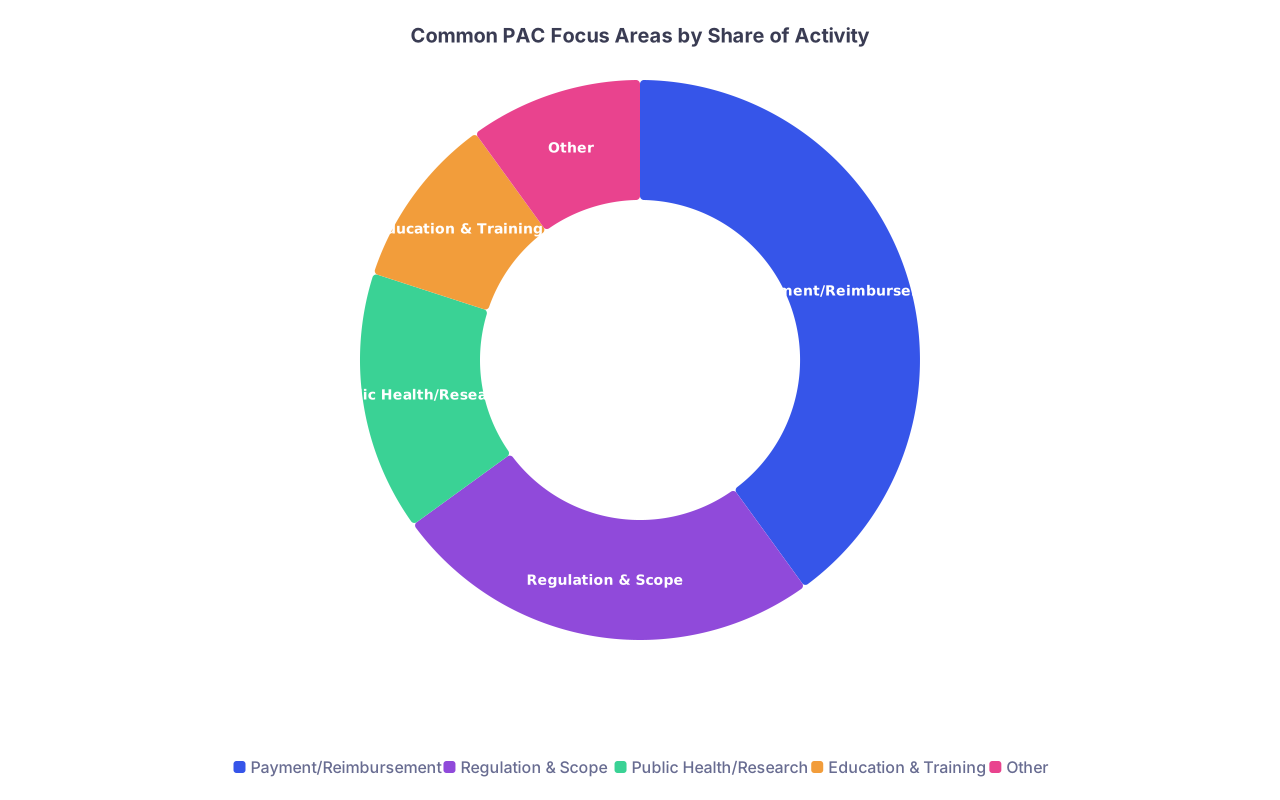
| Category | Value |
|---|---|
| Payment/Reimbursement | 40 |
| Regulation & Scope | 25 |
| Public Health/Research | 15 |
| Education & Training | 10 |
| Other | 10 |
Downsides and real trade‑offs
Financial pressure in a low‑income phase
You’re probably making $0 (med student) or $60–70k while working 80 hours (resident) and dragging a six‑figure loan balance. Being guilted into giving monthly is garbage. That $10–20 may not break you, but it’s not nothing.Reputational risk by association
If your PAC backs candidates who are publicly hostile to marginalized groups, public health, or basic science, you’re complicit in that support, whether you like it or not.Opportunity cost
You can donate to direct‑service orgs, legal aid, abortion funds, gun violence prevention groups, housing organizations—things with clearer, measurable impact. A PAC is one option, not the default “most ethical” one.
Step 4: How to Decide – A Simple Framework
Here’s a quick decision tree you can run through in 10–15 minutes.

| Step | Description |
|---|---|
| Step 1 | Curious about joining PAC |
| Step 2 | Check PAC transparency |
| Step 3 | Do not join - lack of transparency |
| Step 4 | Review policy history and endorsements |
| Step 5 | Do not join - misaligned values |
| Step 6 | Assess your finances |
| Step 7 | Skip for now, maybe engage non financially |
| Step 8 | Join at low, sustainable amount |
| Step 9 | Clear info on donations and positions? |
| Step 10 | Mostly aligned with your values? |
| Step 11 | Can you give without stress? |
Step A: Check transparency
Go to your specialty PAC’s page and try to find:
- “Who we support” or “past contributions”
- “Policy priorities” or legislative agenda
- Any explanation of criteria for choosing candidates
If they’re vague to the point of opacity—“We support friends of medicine”—that’s a red flag.
If they list detailed priorities and past legislative wins, that’s better.
You can also look them up in FEC or state databases for actual contribution history.
Step B: Look at what they’ve actually done
Don’t read just their marketing. Look at their track record:
- What bills did they publicly support/oppose?
- Which campaigns do they donate to—across parties?
- Have they taken stands on controversial public health issues (abortion, gun safety, LGBTQ+ rights, public insurance expansions)?
If 2–3 things jump out as deeply wrong to you, that’s usually enough to decide.
Step C: Check your own finances and stress level
Blunt rule of thumb:
- If you’re stressing about groceries, rent, or childcare → do not give to a PAC. Full stop.
- If you’re okay financially, but not flush, cap it at something truly negligible (like $5–10/month).
Residents who regret joining usually made a big recurring pledge during a high‑pressure conversation they didn’t actually want.
Step 5: How Much (If You Do Join)?
If you’ve decided you’re comfortable in principle and the PAC isn’t a disaster, the next question is: how much?
Here’s the hierarchy that makes sense for most trainees:
| Priority Order | Destination Type |
|---|---|
| 1 | Essential living needs |
| 2 | Emergency savings |
| 3 | Direct-aid charities |
| 4 | Advocacy/public interest |
| 5 | PAC and political giving |
So PAC giving should be near the top of the “optional” pile, not your primary good‑in‑the-world mechanism.
Practically:
- Start low: $5–10/month if you care a lot and can afford it.
- Avoid high‑pressure asks like “Gold level” or “Capitol Club” tiers. Those are for attendings making 4–10x your salary.
- Keep it flexible: no shame in canceling if your finances change.
Remember: PACs like lots of small donors because it shows “breadth of support,” even if individual amounts are small. You don’t need to be a hero.
Step 6: What If You Don’t Want To Join?
You might read all this and land on: “No thanks.” That’s a perfectly respectable answer.
Here’s how to handle it without drama.
If you’re asked directly
When an attending or society leader corners you at a meeting:
You: “I’m really committed to advocacy, but at this stage I’m focusing my limited resources on direct‑service and public health groups that match my specific priorities. I’m glad the PAC exists; I’m just not in a position to contribute financially right now.”
That’s polite, honest, and hard to argue with.
If they push: “We all have to sacrifice…”
You: “Totally agree on sacrifice. For me, that’s time and direct advocacy work, not PAC dollars right now.”
Then stop explaining.
How to stay involved without writing a check
You can do a lot of advocacy without joining the PAC:
- Volunteer on your specialty’s advocacy or policy committees
- Participate in virtual Hill visits or legislative days
- Write op-eds or policy briefs with attendings
- Join cross‑specialty groups like AMA or state societies when they run campaigns you like
- Work with non‑PAC orgs (e.g., ACP, APHA, local public health coalitions, reproductive justice groups, harm reduction groups)
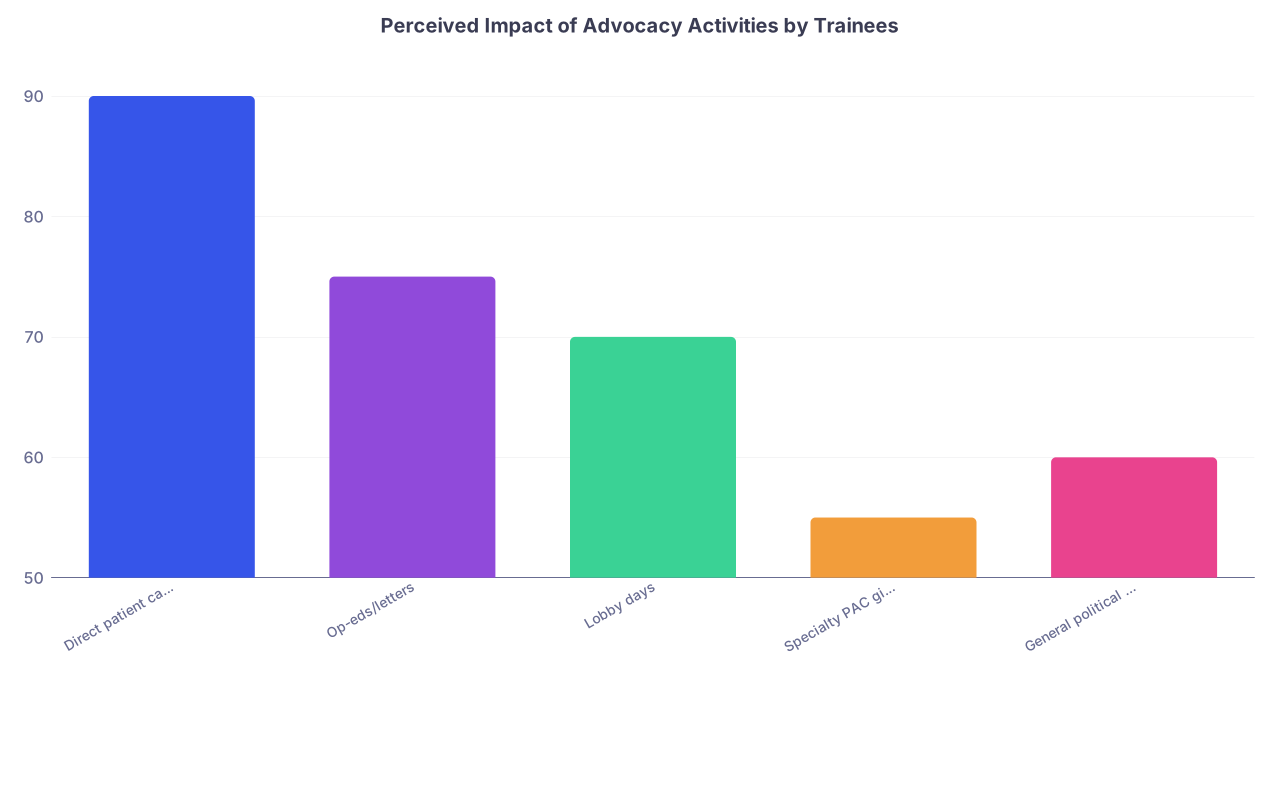
| Category | Value |
|---|---|
| Direct patient care advocacy | 90 |
| Op-eds/letters | 75 |
| Lobby days | 70 |
| Specialty PAC giving | 55 |
| General political donations | 60 |
A lot of trainees I respect do exactly this: heavy involvement in policy and organized medicine, zero PAC donations while they’re broke.
Step 7: Common Scenarios and How I’d Call Them
Let’s run a few realistic situations.
Scenario 1: Resident with strong public health values, shaky finances
You’re a PGY‑2 in pediatrics, passionate about child poverty and gun safety, carrying $250k in loans, barely saving.
Your pediatric society PAC supports expanded CHIP, vaccine funding, and some gun safety work—but also backs a few candidates you find problematic.
My call:
Skip the PAC for now. Put $10–20/month into a direct‑service org for kids or a gun violence prevention group whose positions you love. Engage in your society’s advocacy days instead of its PAC.
Scenario 2: Senior resident planning a policy‑heavy academic career
You’re a PGY‑4 in OB/GYN aiming for academic MFM with a health policy focus. You’re decently stable financially. Your specialty PAC has a mixed record, but on the core reproductive health issues, they’re aligned with you and fight hard.
My call:
Join at a low level. Not because your dollars are magical, but because your visible engagement signals you’re serious about the specialty’s advocacy ecosystem. Pair it with real policy work so you’re not just a name on a donor list.
Scenario 3: Med student early in training, unsure of politics
You’re MS2, not sure about your specialty or where you fall politically. Your society (if you even joined one) keeps sending PAC invites.
My call:
Do not donate yet. You don’t need to. Use your time to learn how health policy actually works, read candidate stances, and see what your future specialty societies stand for. You can always start giving later when you know what you’re endorsing.
Step 8: Red Flags You Shouldn’t Ignore
There are some situations where I’d say flat out: do not touch this PAC as a trainee.
Red flags:
- Leadership linking PAC giving to leadership roles, awards, or evaluations
- Aggressive shaming language—“If you’re not giving, you’re not committed to patients”
- PAC backing candidates or policies that blatantly conflict with core ethical principles (racist, misogynistic, anti‑science, explicitly anti‑patient)
- Zero transparency about contribution history or decision criteria
If you see 2–3 of those, the problem isn’t you. The problem is the culture around that PAC.
The Bottom Line
Joining your specialty society’s PAC as a trainee is optional, ethically permissible, and sometimes strategically smart, but it’s not a moral obligation and certainly not the main way you’re going to “help patients” right now.
Use a simple rule:
- If the PAC is transparent, mostly aligned with your values, and you can afford a small amount → fine to join at a low level.
- If any of those pieces fail → skip it and put your advocacy energy somewhere else.
You don’t owe anyone a donation just because you chose a specialty.
FAQ: Trainees and Specialty PACs
Will not joining my specialty PAC hurt my career?
For almost everyone, no. Most program directors and department chairs don’t know or care who gives to the PAC. In some heavily political specialties or societies, high‑level leadership roles might tilt toward people visibly involved in advocacy, including PAC supporters, but as a trainee you won’t be punished for opting out. Your clinical performance and professionalism matter far more.Is it legal for residents on visas (e.g., J‑1, H‑1B) to donate to PACs?
Non‑US citizens and non‑permanent residents face restrictions on political donations. Many PACs specifically require donors to attest they’re US citizens or green card holders. If you’re on a visa, check the PAC’s rules and federal law before giving. When in doubt, choose non‑political advocacy (like professional society advocacy committees) instead.What’s the difference between my specialty PAC and the AMA PAC or state medical society PAC?
Specialty PACs focus tightly on issues affecting one field—like cardiology reimbursement, anesthesia staffing models, or surgical scope. AMA or state medical society PACs cover the broader house of medicine and general health policy. If you care more about big system issues (coverage, public health) than narrow specialty fights, a broader PAC may align better—though the same ethics and money questions apply.Can I earmark my PAC donation for specific issues only?
Usually no. PACs don’t let you restrict your dollars to, say, “only candidates who support gun safety” or “only GME expansion.” Your money goes into a general pot used according to the PAC’s criteria. If you want precise control over what you’re supporting, direct political donations or issue‑based organizations are a better fit.What’s a reasonable donation size for a resident if I decide to give?
Think “symbolic support,” not “major funder.” For most residents, $5–10/month is plenty. You’re showing engagement without wrecking your budget. Ignore the “gold/silver/bronze” donor levels aimed at attendings with significantly higher income. If a PAC makes you feel like $5/month is embarrassing, that says more about them than about you.
Today’s next step:
Take 10 minutes, pull up your specialty society’s PAC page, and actually read their issue priorities and past contributions. Then write down, in one sentence, your gut answer: “Given what I see here and my current finances, I [do / don’t] want to support this PAC right now.”
That sentence is your starting point.