
The worst way to explain a career change to medicine is to sound like you just woke up one day and “followed your passion.”
You chose the hardest possible field. During a residency interview, nobody wants to hear a vague story about “helping people” and “always loving science” if you already had another career. They want to know: Are you stable? Are you going to stick? Do you understand what you signed up for?
If you are walking into residency interviews as a career changer, let me be blunt: this will come up in almost every single interview. Sometimes as a direct question. Sometimes as a skeptical eyebrow raise when they say, “So you were a [teacher/engineer/lawyer/consultant/artist] before this… tell me about that.”
You need a tight, honest, tested explanation that:
- Makes your path look intentional, not impulsive
- Shows you understand the reality of residency and medicine
- Turns your past career into an asset, not baggage
Let’s build that.
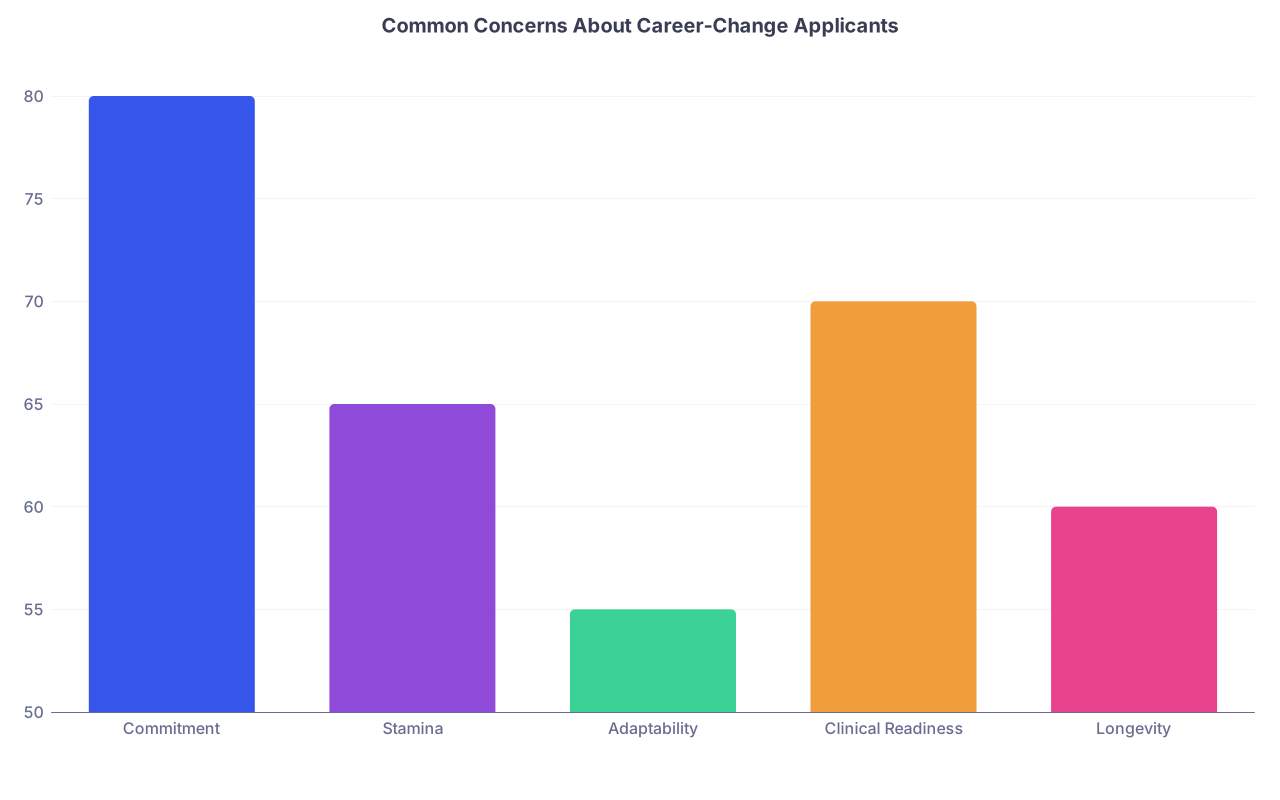
| Category | Value |
|---|---|
| Commitment | 80 |
| Stamina | 65 |
| Adaptability | 55 |
| Clinical Readiness | 70 |
| Longevity | 60 |
Step 1: Understand what they’re really asking you
When programs ask about your prior career and why you switched to medicine, the surface question is “Why the change?”
The real questions underneath are much harsher:
- Did you fail at your last career and are you running away from something?
- Are you going to burn out or bail when this gets ugly?
- Do you actually know what residency looks like at 2:37 a.m. on your 9th straight day?
- Can we trust you with responsibility, patients, and our team culture?
If your answer sounds like:
- “I just realized I wanted to help people more directly.”
- “Medicine combined my love of science and service.”
- “My previous career didn’t feel fulfilling.”
…it sounds generic. And generic answers trigger every concern above.
Your job is to answer two questions clearly:
- Why did you leave your old career?
- Why did you choose medicine in particular—and this specialty, specifically?
You don’t have to give them your entire life story. You need a short, specific narrative that makes sense.
Step 2: Build a clear, credible core story
You need a “core story” you can flex for different questions, but the skeleton should be the same every time. Aim for 60–90 seconds.
Use this structure:
- Where you started (your prior field, level, and what you were doing)
- The few specific moments that shifted you toward medicine
- The deliberate steps you took to test that interest
- Why medicine (and your specialty) fits you better than your old path
- How your previous career helps you as a resident
Let me give you three quick examples so you see what “specific” sounds like.
Example – Former Engineer → Internal Medicine
Bad: “I was an engineer for a few years but realized I wanted more human interaction and to help people more directly.”
Better:
“I worked as a mechanical engineer for 5 years in the automotive industry, mostly on failure analysis and system reliability. I liked the problem-solving, but the work was abstract and distant from real people. Two things shifted me: first, I volunteered at a free clinic doing intake, and I realized I was more energized after 3 hours of talking with patients than after a full week at my desk. Second, my father’s hospitalization for heart failure exposed me to inpatient medicine—I was that family member asking daily questions on rounds.
I didn’t apply to medical school right away. Over 18 months I took post-bacc science courses at night, shadowed an internist weekly, and worked as a clinical research coordinator. The more I saw, the more internal medicine matched how my brain works: complex diagnostic puzzles, longitudinal relationships, coordinating care. My engineering background has been surprisingly useful on the wards—thinking in systems, anticipating failure points, and communicating clearly with teams. Medicine isn’t a 180-degree turn for me; it’s the most direct version of what I was trying to do as an engineer—solve complex problems that actually matter to people, in real time.”
Notice: timelines, details, deliberate steps. Not a whim.
Do the same work for your path. If you cannot explain what concretely changed—an experience, a set of months, a specific patient or role—your story will sound thin.
Step 3: Script and tighten your “Why the change?” answer
Sit down and write your answer out. Yes, write it. Out loud in your head is not enough. You’re too close to your own story and you’ll ramble.
Here’s a simple 5-sentence template you can adapt:
- “I started my career as a [role] at [place/industry], where I spent [X years] doing [brief description].”
- “Over time, [specific experiences] made me realize that what I found most meaningful was [specific aspect that points toward medicine].”
- “Instead of jumping in blindly, I [post-bacc/volunteered/shadowed/worked in healthcare] for [time period], where I [what you actually did].”
- “Through that, I saw that medicine—and particularly [specialty]—matches my strengths in [X, Y, Z] far more than my previous career.”
- “My background in [prior field] gives me [2–3 concrete skills] that I’ve already used in medical school and on rotations, and I’m excited to bring that to residency.”
Then:
- Read it out loud.
- Cut every extra word.
- Replace clichés (“passion,” “calling,” “journey”) with real language and examples.
- Make it sound like you talk, not like your personal statement.
You should be able to say this calmly, without sounding like you memorized it, in under 90 seconds.

| Step | Description |
|---|---|
| Step 1 | Write full story draft |
| Step 2 | Cut to 60-90 sec core |
| Step 3 | Identify 2-3 key experiences |
| Step 4 | Link to chosen specialty |
| Step 5 | Add 2-3 transferable skills |
| Step 6 | Practice out loud with feedback |
Step 4: Turn your previous career into a feature, not a flaw
Interviewers are trying to decide if your past is a liability or an asset.
You have to frame it as an asset. And that means translating your old world into residency language: patient care, team function, reliability, teaching, leadership, efficiency.
Here’s how to think about it by background:
- Education/Teaching: You already know how to explain complex ideas, manage groups, handle difficult learners/parents. That’s gold for patient education, supervising students, and interdisciplinary communication.
- Engineering/Tech/Data: You bring systems thinking, comfort with complexity, quality improvement mindset, and maybe data literacy. Program directors love residents who can actually improve workflows instead of just complaining.
- Business/Consulting/Finance: Project management, communication with stakeholders, strategic planning, handling stress and high expectations—these all translate directly to running services, QI projects, and eventually leading teams.
- Nursing/Allied Health: You understand hospital culture, workflow, and what nurses/RTs/PTs actually do. That can make you a better intern from day one and a better team player.
- Arts/Humanities: You can connect, listen, tell stories, and see the person behind the diagnosis. On psych, peds, family med, and honestly anywhere, that’s a serious advantage.
Be ready with 2–3 specific examples of how your previous career has already shown up in clinical settings:
- “On my surgery rotation, I used my project management experience to create a simple pre-op checklist that cut our delays.”
- “As a former teacher, I found I could quickly gauge what level of explanation a patient needed and tailor my language.”
- “On ICU, my engineering habit of mapping systems helped me think more clearly about ventilator settings and hemodynamics.”
Programs are constantly filtering for, “Will this person make our lives easier or harder?” Your old career is a cheat code—if you can translate it.
Step 5: Handle the skeptical follow-up questions
If you have a nontraditional path, you’ll get harder follow-ups. If you sound shaky or defensive, it only confirms their fear that you might not stick.
Here are the classic landmines and how to walk through them.
“Why now? Why not earlier?”
They’re testing whether you’re impulsive or late to the party.
You:
“I didn’t grow up around physicians and I honestly didn’t see medicine as an option early on. My first career taught me a lot, but as I took on more responsibility I realized the parts I enjoyed most were [X and Y] that lined up more with medicine. It took a few years—and some deliberate testing through [post-bacc, volunteering, whatever you did]—to be sure this wasn’t a phase. I’m glad I came in later; I’m more grounded, and I know exactly what I’m signing up for.”
Tone: calm, matter-of-fact. No guilt, no apology.
“Do you see yourself practicing long term, or is this another stepping stone?”
They’re asking: are you going to quit at PGY-2?
You:
“I see myself practicing [specialty] long term. My previous career already went through the early exploration phase—this move was not casual. It took [X] years of planning, going back to school, and a lot of sacrifice financially and personally. I wouldn’t have done that for a stepping stone. My goal is to build a career in [clinical niche/academic focus/whatever you envision], and residency is the training I need for that.”
If it’s true that you plan to combine both careers somehow (e.g., tech + medicine, policy + medicine), that’s fine—but anchor it in clinical practice first. Programs do not want a resident whose main focus is their startup.
“What did you dislike about your previous career?”
This is a trap. They’re checking your professionalism. If you rant about your old job, they’ll imagine you ranting about them next.
You:
“I appreciated [X and Y] about my previous field—[teamwork, intellectual challenge, whatever is true]. What I struggled with was [one or two concrete things]: for example, the distance from the people we were supposedly helping, and the fact that my impact was hard to see day-to-day. Medicine gives me that immediate, human-facing work and a clearer sense of meaning. I don’t regret my first career; it gave me skills I use every day. It just wasn’t where I wanted to stay long term.”
Respectful. Mature. No bitterness.

Step 6: Connect your career change to your chosen specialty
If your explanation stops at “Why medicine?” and never lands on “Why this specialty?”, you’ll sound half-baked.
You need a clear line from your previous life → your core strengths and values → your specialty.
Examples:
Former teacher → Pediatrics or Med/Peds:
“Teaching taught me patience, communication at a child’s level, and working with families. On my peds rotation, that felt very natural—explaining asthma to a child and then to their parents feels a lot like parent-teacher conferences, but with higher stakes.”Former software engineer → Radiology / EM / Anesthesiology / IM:
“Writing and debugging complex systems trained me to stay calm with uncertainty, track many variables, and think in algorithms. In EM, I’m constantly triaging inputs and running decision trees under time pressure—that feels like a more meaningful version of my old work.”Former nurse → Family Med / IM / ICU:
“As a nurse, I saw fragmented care and how much continuity and communication matter. That’s why I was drawn to internal medicine—I want to be on the side coordinating that care, using my nursing experience to understand what actually happens at the bedside.”
Do not leave them to guess why you chose this particular specialty. Spell it out.
Step 7: Practice without sounding robotic
Career-changers often overprepare this answer and then sound like they’re reciting a monologue. That’s almost as bad as rambling.
Here’s how to practice the right way:
Record yourself answering:
- “Tell me about your path to medicine.”
- “Why did you leave [prior career]?”
- “Why now?”
- “Why [specialty] after [old field]?”
Listen once for content: Did you actually answer the question? Were you specific? Any clichés?
Listen again for tone: Do you sound defensive? Overly apologetic? Too rehearsed?
Then practice with:
- A friend outside medicine → They’ll tell you when you sound fake.
- A classmate / mentor in medicine → They’ll help you tighten the medically relevant parts.
Aim for:
- Same structure every time
- Slightly different wording each time
If you can’t explain it naturally without the exact same script, you don’t understand your own story well enough yet.
Step 8: Avoid the most common career-change interview mistakes
I’ve seen these over and over:
Over-sharing personal drama.
You don’t need your entire trauma file on the table. If a personal event influenced your decision (illness in family, your own diagnosis), mention it briefly and focus on how you responded, not the gory details.Trashing your old career or colleagues.
It makes you look immature and high-risk. Always acknowledge what your old field gave you.Sounding like you “wasted time” before medicine.
If you frame it as wasted, they’ll wonder if you’ll say the same about medicine in 10 years. Instead: “This was a valuable phase that clarified what I wanted and gave me skills I bring into medicine.”Acting like medicine is purely noble, unlike your old field.
Interviewers know medicine has its own bureaucracy, politics, and ugly sides. If you idealize it, you signal naiveté.Not knowing your own timeline cold.
If your ERAS timeline has a few years between careers, you’d better be able to explain where you were, what you were doing, and how that led you here—without confusion.
| Element | Weak Version | Strong Version |
|---|---|---|
| Reason for leaving | “I wasn’t fulfilled.” | “I missed direct human impact and daily face-to-face work.” |
| Testing medicine | “I thought about med school.” | “I did a 1-year post-bacc and volunteered 6 hrs/week in clinic.” |
| Specialty link | “I like variety.” | “I like longitudinal relationships and complex problem-solving, which I found in IM.” |
| Using old skills | “It taught me discipline.” | “Project management prepared me to run multi-patient care tasks on busy services.” |
| Long-term plan | “I’ll see where things go.” | “I see myself as a [hospitalist/psychiatrist/etc] with a focus on [niche].” |
Step 9: Read the room and close your answer confidently
During your interview, watch how they react when you start talking about your prior career:
- If they lean in and ask specifics → they’re curious and likely positive.
- If they ask rapid-fire, skeptical questions → they’re testing for stability.
- If they smile and say “Oh, interesting…” → that’s often genuine, not sarcastic. Use it.
End your answer on a forward-looking note, not stuck in the past.
For example:
“…All of that has made me very deliberate about being here. I’m not exploring anymore. I’m committed to building a long-term career in [specialty], and I’m excited about the chance to train here because of [1–2 program-specific reasons].”
You’re closing the loop: yes, I changed careers. No, I’m not still wandering.
Your move today
Open a blank document and write, in full sentences, your 60–90 second answer to this exact question:
“Walk me through your path from your previous career to applying for residency in this specialty.”
Then read it out loud once and cut 30% of the words. Replace every vague phrase with a concrete action, experience, or example.
That trimmed, specific version? That’s the story you start practicing for your next interview.