Most applicants handle specialty change conversations badly—and it costs them interviews and rank spots.
You can do this right. But you cannot wing it. If your interests shifted between submitting ERAS and interview season, you’re in a politically sensitive zone. Programs worry about one thing: “Is this applicant actually going to come here and do this specialty?”
I’m going to walk through exactly what to say, what not to say, and how to clean up the mess if your ERAS and current story don’t match.
1. First, get brutally clear on your actual situation
Before we talk wording, you need to know where you actually stand. There are a few distinct scenarios. They’re not all the same, and interviewers smell nonsense fast if you blend them together.
| Scenario Code | What Changed | Interviews You’re Attending |
|---|---|---|
| A | Mild shift in interest within same specialty | Same specialty only |
| B | True switch before ERAS but ERAS doesn’t reflect it well | New specialty only |
| C | Genuine change after ERAS submission | New specialty only |
| D | Dual applying (two specialties at once) | Both specialties |
| E | Pivoting away from original specialty mid-season | New specialty only (late apps) |
Let’s put real language on these.
You changed focus within a specialty
Example: You applied Internal Medicine broadly. Late M4 you realize you’re strongly pulled toward heme/onc instead of cards. Your ERAS still looks IM-focused, but your narrative is more specific now. Easy situation. Low risk.You changed specialties before ERAS, but your ERAS is a little messy
You decided to switch from surgery to anesthesia in August, rewrote your personal statement, got one anesthesia letter, but half your experiences still scream “surgery.” Common. Fixable.You changed specialties after submitting ERAS
You applied family medicine in September. In October, a dream psych rotation changes everything. You add psych programs late or you’re now interviewing at psych programs with an FM-heavy ERAS. Higher risk, needs careful messaging.You’re dual applying on purpose
EM + IM. Neurology + Psychiatry. IM + Anesthesia. Programs know this is common right now. The danger is sounding flaky or like you’re “collecting” interviews rather than honestly managing risk.You’re jumping ship mid-season from one specialty you applied to, to another you applied late
This happens more than people admit. Burnout, miserable sub-I, mentor disaster, or you realized you’ll never be competitive in your original choice. This is the most politically sensitive.
Figure out where you are. Do not treat a scenario 5 like a scenario 1. Interviewers notice the gap between your ERAS story and what you say in the room.
2. What programs are actually afraid of when they see a specialty change
They’re not mad you changed your mind. They’re scared of three very practical things:
- Commitment: “Will they leave our program after a year?”
- Fit: “Are they truly interested in our specialty, or are we the backup?”
- Insight: “Do they understand what this specialty really is, or are they chasing a fantasy?”
Your job in every answer is to calm those fears.
If your explanation:
- Sounds impulsive
- Blames other specialties (“surgery is toxic,” “family medicine is boring”)
- Or makes your new specialty sound like the easy way out (“better lifestyle,” “less stressful”)
…you just confirmed their worst fears.
You need a story that shows:
- Thoughtful exploration
- Real, specific understanding of the new specialty
- A track record of behavior that fits this new direction
We’ll build that next.
3. The core structure of a good “I changed specialties” story
Don’t memorize a script. Memorize a structure.
Your specialty-change story should hit four beats, in roughly this order:
- Where you started and why (briefly)
- What changed your mind (specific triggers, not vague “I realized…”)
- How you explored and confirmed the new direction
- Why this new specialty fits you better—with evidence
Let’s go line by line with examples.
1) Where you started and why (keep this short)
Bad:
“I always wanted to be a surgeon but then I realized I liked sleep.”
Good:
“I initially oriented toward surgery. I liked procedures, the clear goals, and I had early role models in that field.”
You’re giving them a rational starting point without sounding flaky or immature. One or two sentences. Then move.
2) What actually changed your mind
This is where most people go vague and lose credibility. Interviewers hate vagueness.
Bad:
“Then third year I realized it wasn’t for me.”
Good:
“On my surgery sub-I, I found myself much more engaged with the complex pre-op medicine and post-op management than with the OR itself. Around the same time, I had a month on the MICU where I loved coordinating care, thinking through physiology, and working with a multidisciplinary team.”
Or for psych from FM:
“I went into third year set on family medicine. Then my psych rotation was surprisingly the place I felt most useful—especially with patients with trauma histories or complex mood disorders. I noticed I was looking forward to those longitudinal psych clinic days more than anything else.”
Specific. Concrete. Shows self-observation.
3) How you explored and confirmed the new specialty
Programs want to hear that you did not turn your life upside down after one good week on a rotation.
Bad:
“So I decided to switch to anesthesia.”
Good:
“Once I noticed that, I deliberately added an ICU elective and an anesthesia rotation. I met with our anesthesia clerkship director twice to talk about the training path and lifestyle in a realistic way, and I spoke with three residents about their day-to-day. After that, the decision felt much more grounded.”
Now you look like an adult making a considered decision, not a panicked shopper.
4) Why the new specialty fits you better—with evidence
Here’s where you sell fit. Not lifestyle. Not prestige. Fit.
Bad:
“I think anesthesia is a better lifestyle and more flexible.”
Good:
“I’ve realized I’m at my best in acute, physiology-heavy situations where there’s a defined role and I can respond quickly with clear interventions. I like procedures, but I also like stepping back and thinking about the whole patient—cardiac function, volume status, airway risk. Anesthesia lets me combine that acute physiology focus with the team-based OR environment I enjoyed from surgery, without losing the patient safety mindset I developed on ICU.”
That sounds like someone who knows what anesthesia actually involves.
Put all four beats together, and you’ve got a 60–90 second story that works in almost any specialty-change conversation.
4. How to handle the obvious question: “So… why does your ERAS look like X?”
If your ERAS reflects your old specialty heavily, you have to address it directly. Quietly hoping no one notices is childish. They notice.
Here’s the formula I’d use:
- Acknowledge the mismatch plainly
- Contextualize the timing
- Emphasize what you did after the switch
- Highlight what’s still relevant from the old path
Example: Surgery → Anesthesia, psych-heavy or surgery-heavy ERAS
“On paper, my application still shows a strong surgery focus—most of my early research and letters are from surgery faculty. I made the decision to switch to anesthesia in late August after my ICU and anesthesia rotations, which was fairly close to ERAS season. Given the timing, not everything could be updated.
Since then, I’ve made a point to build more anesthesia-specific experience: I completed a second anesthesia elective, joined Dr. X’s QI project on intra-op hypotension, and I’ve been meeting monthly with our anesthesia mentorship group. Even from my surgery experiences, a lot carries over: comfort in the OR, procedural skills, and a real understanding of the surgical side of perioperative care.”
You didn’t apologize. You didn’t make excuses. You just laid out the sequence like an adult.
5. Dual applying: what to say when you’re interviewing in one of the two specialties
Here’s the uncomfortable truth: programs know you’re dual applying more than you think, especially in EM, IM, prelims, anesthesia, psych, and FM. The danger isn’t that they find out. The danger is that you sound like you’re trying to hide it.
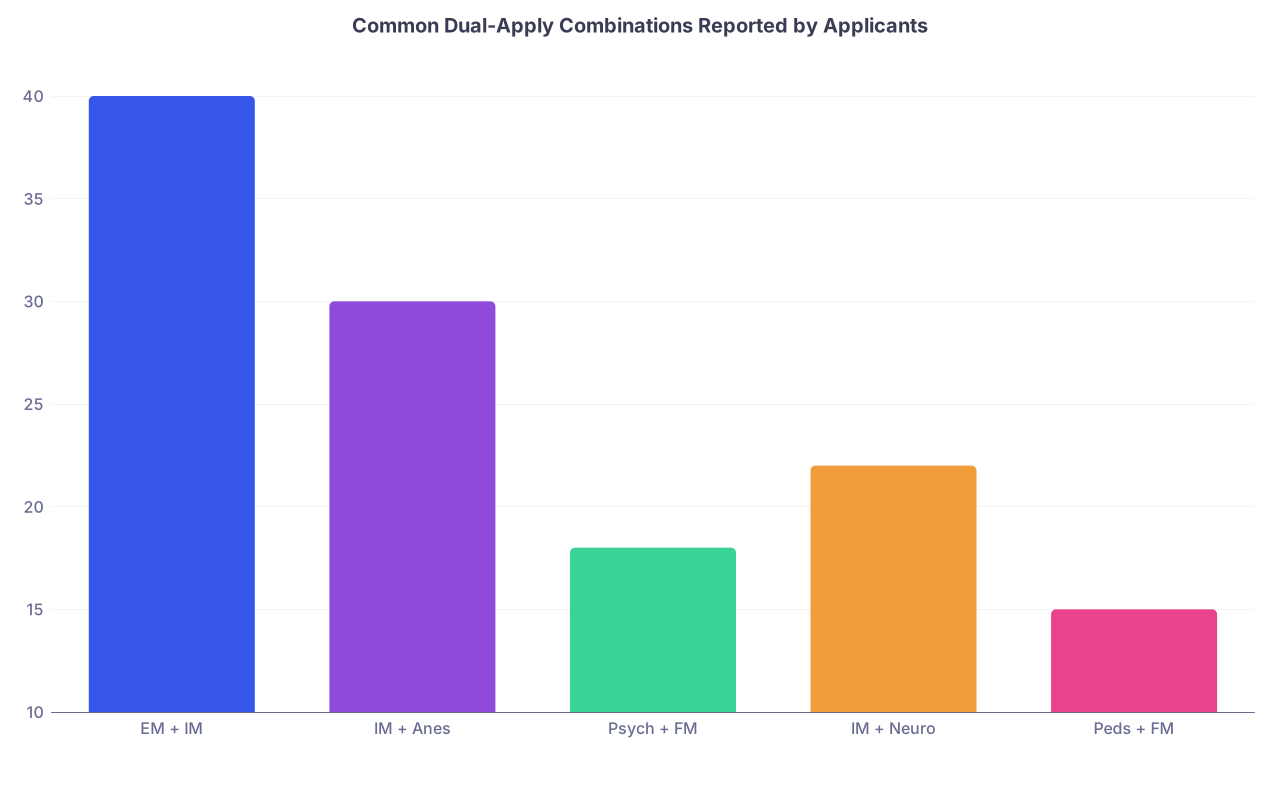
| Category | Value |
|---|---|
| EM + IM | 40 |
| IM + Anes | 30 |
| Psych + FM | 18 |
| IM + Neuro | 22 |
| Peds + FM | 15 |
If they directly ask, “Are you applying to other specialties?” you have three options:
- Lie. (Do not do this.)
- Evade. (They’ll notice.)
- Answer honestly—but strategically.
Use this structure:
- Acknowledge yes/no
- Emphasize they’re related in a meaningful way
- Make clear why you’re genuinely excited about this specialty at this program
Example: EM + IM, in an Internal Medicine interview
“Yes, I’m also applying to Emergency Medicine. The common thread for me is front-line care with high acuity and broad undifferentiated pathology. I could see myself very happy in either path. What pulls me strongly toward Internal Medicine—and specifically programs like yours—is the chance to build longer-term relationships and manage complex chronic disease over time, not just the acute presentation. I’ve structured my rank list planning around where I think I’ll grow most as a clinician, and categorical IM programs like this one are very high on that list.”
Notice: you didn’t say, “You’re my top choice.” You didn’t overpromise. But you clearly respect IM as a primary option, not a backup.
In an EM interview, you’d flip the emphasis:
“Yes, I’m also applying to Internal Medicine. Both align with what I like: high-acuity patients and broad differential diagnosis. What pulls me strongly toward EM—and especially your program—is the chance to stay at the front door of the hospital, make decisive interventions, and work in a tight team in time-sensitive situations. That environment fits my temperament extremely well.”
You give each specialty its own honest, positive rationale. Without trashing the other.
6. Scripted examples for common switches
You’re probably here for this part. Let’s hit several realities I’ve seen repeatedly.
Surgery → Anesthesia
“I went into third year convinced I’d be a surgeon. I liked procedures, the intensity of the OR, and I had strong mentors there. On my surgery sub-I, I realized that the parts of the day I looked forward to most were the complex pre-op discussions and the immediate post-op management—thinking through hemodynamics, analgesia plans, and high-risk patients.
Then I did an ICU month and an anesthesia elective. I loved managing physiology minute-to-minute, handling the airway, and coordinating with the surgical team from a different angle. I met with our anesthesia program director, spoke with several residents, and did a second elective to make sure it wasn’t just a ‘honeymoon’ effect.
The more time I spent, the more it felt like the right match: procedural work, intense focus, and real responsibility for patient safety, but anchored in physiology and critical thinking. That’s why I decided to move toward anesthesia, even though my earlier experiences and letters are largely from surgery.”
IM → Psych (after ERAS)
“I started fourth year planning on Internal Medicine, and that’s what my initial ERAS application reflects: IM letters, IM sub-I, IM research. Then I had a psychiatry sub-I in October that honestly forced me to reevaluate. It wasn’t just that I enjoyed it; it was that the work felt more like the kind of doctor I want to be.
I found myself deeply engaged in longer conversations, thinking about trauma, social context, and behavior change in ways I hadn’t before. I stayed after clinic to read more about psychotherapy approaches. I asked to sit in on consult-liaison rounds on my days off. That level of engagement was different.
Because this realization came after ERAS, my application still looks heavily IM-focused. Since then, I’ve taken a second psych elective, joined Dr. Y’s project on reducing antipsychotic polypharmacy, and I’ve been meeting regularly with psych faculty to understand the reality of the field. The more I learn, the more convinced I am that psychiatry is the right long-term fit.”
EM → IM (market reality pivot)
“I was initially drawn to Emergency Medicine. I like undifferentiated complaints, quick decisions, and acute care. I did two EM rotations early and loved them. Then, as I went through my IM and ICU months, I realized I also valued the depth of diagnostic workups and the longitudinal connection—seeing patients more than once, following their course, taking responsibility over time.
Separately from that, I’ve been paying attention to the current EM job market and shifts in practice environments. That pushed me to seriously reassess. I spent time talking with IM hospitalists and intensivists, did an additional IM sub-I, and shadowed in an academic ED side-by-side with the admitting IM team. I found that many of the things I like about EM—acute presentations, broad differentials, critical care—are very present in IM-based careers like hospital medicine and critical care.
So yes, my early application has a strong EM flavor, but the direction I’m committed to now is Internal Medicine and a career centered around inpatient and critical care.”
Notice I put market realities in there, but as one part of a larger, thoughtful process—not as “EM jobs are bad, so I ran.”
7. How to answer THE question: “So why this specialty now?”
Interviewers will sometimes compress everything into: “So why did you choose X specialty?”
If you’ve had a change, your answer should subtly incorporate that shift without making the whole thing a therapy session.
Use a slightly tweaked version of the four-beat story:
- 1 sentence on your broader exploration
- 2–3 sentences on what consistently appealed across rotations
- 2–3 sentences on what felt different and right about this specialty
- 1–2 sentences connecting that to your experiences and this program
Example for IM after a prior flirt with EM and anesthesia:
“I’ve been most engaged on rotations where I’m handling complex, undifferentiated problems and coordinating care—ICU, wards, and ED. Over time, I noticed I enjoy thinking through multi-system disease, following patients over several days, and adjusting management as new information comes in. Internal Medicine is where that work lives.
Experiences like my MICU month and my general wards sub-I showed me that I enjoy being the team that carries the full picture for the patient—not just one encounter or one procedure. Your program’s strong ICU exposure and the way residents take ownership of complex patients are exactly the environment where I see myself growing.”
You answered the “why this specialty” question honestly, without rehashing “I once thought I’d do X, then Y, then Z” unless they ask explicitly.
8. How to fix your ERAS before interviews (if you still can)
If you’re reading this before interviews really ramp up, there are some quick, concrete repairs you can make:
- Update your ERAS experiences descriptions slightly to highlight skills relevant to the new specialty (teamwork, communication, critical care, continuity—whatever fits).
- Add an extra short experience if you did a late rotation in the new specialty.
- Ask for at least one letter from the new specialty, even if it’s coming in late.
- Adjust your personal statement (if SOAP or late applications are still in play) to reflect the new story clearly.
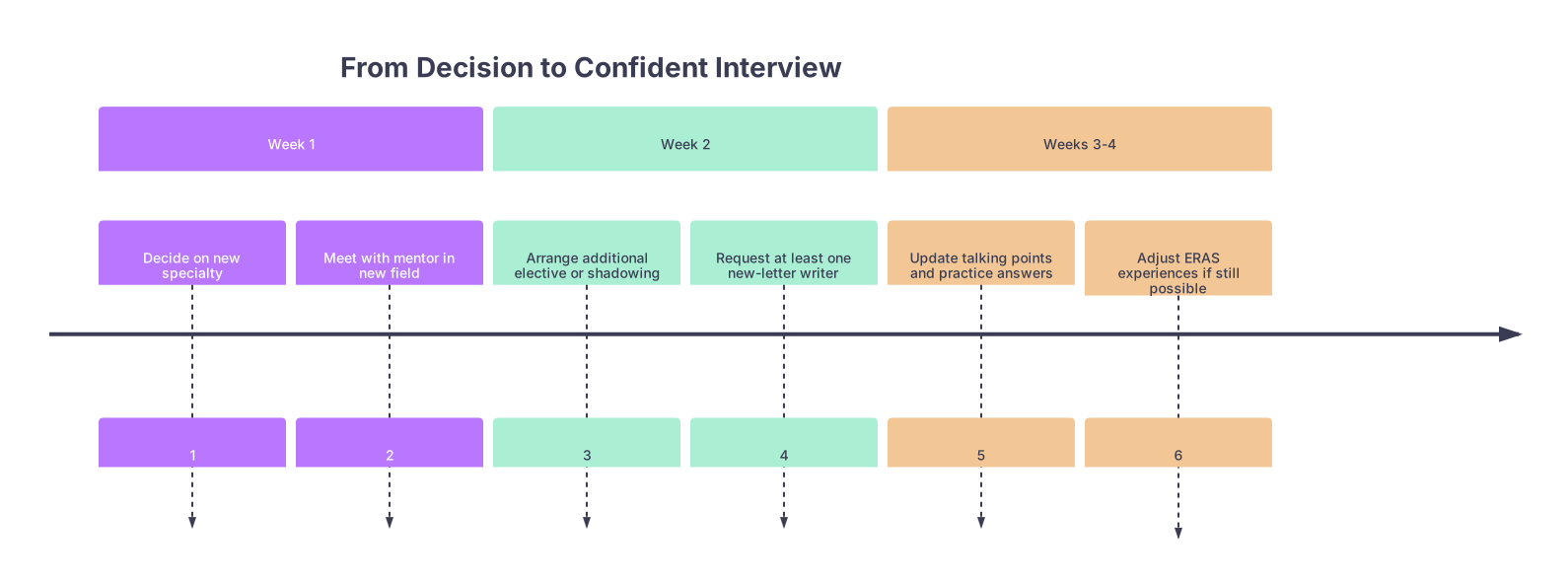
| Period | Event |
|---|---|
| Week 1 - Decide on new specialty | 1 |
| Week 1 - Meet with mentor in new field | 2 |
| Week 2 - Arrange additional elective or shadowing | 3 |
| Week 2 - Request at least one new-letter writer | 4 |
| Weeks 3-4 - Update talking points and practice answers | 5 |
| Weeks 3-4 - Adjust ERAS experiences if still possible | 6 |
If you can’t change anything on paper, that’s fine. You just lean more heavily on your in-person narrative.
9. How to practice this without sounding rehearsed
You need to say this story out loud. Multiple times. With another human.
Here’s how I have students do it:
- Write your four-beat story in bullet form, not as a script.
- Record yourself answering: “I see you were initially heading toward [old specialty]. Can you tell me about your shift toward [new specialty]?”
- Listen once for content: Did you hit all four beats?
- Listen again for tone: Do you sound defensive, apologetic, or angry at your old specialty?
- Practice until you can tell the story in 60–90 seconds, conversationally, without exact memorization.
Then get a peer, resident mentor, or faculty mentor to listen and manually try to poke holes:
- “That sounds impulsive—what else did you do to explore?”
- “This sounds like you just wanted better lifestyle. Is that true?”
- “I still don’t understand why this specialty over that one.”
Refine until your answers stand up to that level of interrogation.
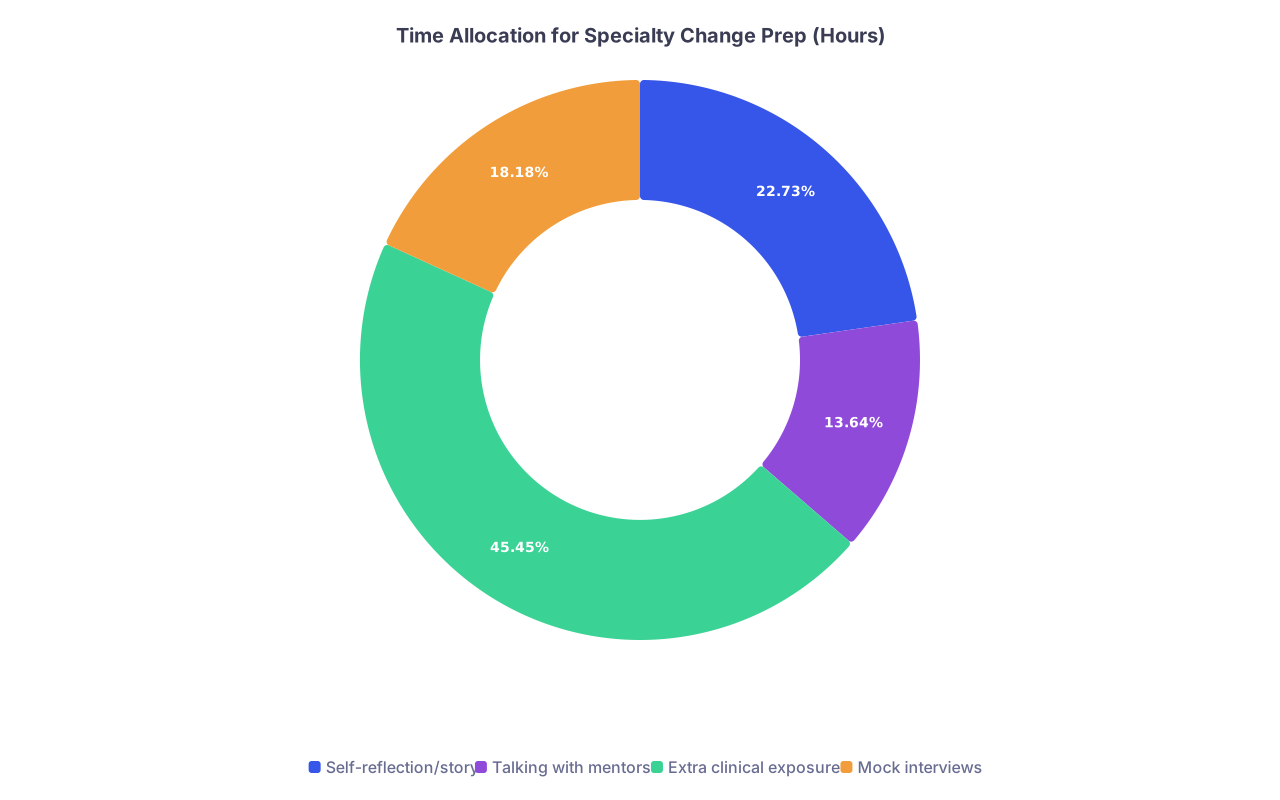
| Category | Value |
|---|---|
| Self-reflection/story | 5 |
| Talking with mentors | 3 |
| Extra clinical exposure | 10 |
| Mock interviews | 4 |
10. Quick landmines that will sink you
Let me be blunt about a few things that cause programs to quietly move you down the rank list.
Trashing other specialties or specific departments
“Surgery is toxic.” “EM is dying.” “Primary care is boring.”
You sound immature. You also forget that half the faculty interviewing you have friends or partners in those fields.Blaming everything on “bad people”
“I would’ve done surgery, but my chair is terrible.”
Interviewers think: and what will you say about us when things are hard?Making lifestyle the main headline
Everyone cares about lifestyle. But if you center your whole explanation on “better hours,” programs question your commitment when things inevitably aren’t cushy.Being cagey about dual applying
If they ask directly, don’t dance. Answer honestly, succinctly, and then pivot to why you’re serious about them.Overcompensating with fake certainty
“I realized psychiatry is my one true calling and I can’t imagine anything else.”
No one believes that after 4–8 weeks of exposure. It’s okay to say, “There are a few things I’ve liked, but this is where the fit feels strongest.”
FAQ (exactly 3)
1. Should I proactively bring up my specialty change in every interview, or only if asked?
If your ERAS and your current story are clearly misaligned (e.g., 3 ortho letters and now you’re interviewing for PM&R), you should briefly address the change early—usually when they ask, “Tell me about yourself,” or “Walk me through your path to this specialty.” You don’t need to open with, “So I changed specialties,” but your origin→turning point→confirmation→fit story should naturally include the shift. If the mismatch is mild (e.g., still within Internal Medicine), you don’t need to flag it as a “change”—just describe your current focus and how it developed.
2. Do I need a letter from the new specialty to be taken seriously?
It strongly helps, but it’s not an absolute requirement if the timing is tight. One solid letter from the new specialty signals, “People in this field have actually seen me and think I belong here.” If that’s impossible, you compensate by: getting strong narrative support from mentors in related fields; clearly describing your clinical experiences in the new specialty; and having a clean, thoughtful verbal explanation. Many programs will understand late shifts—especially in psych, IM, FM, and anesthesia—if your story and behavior make sense.
3. What if I’m still genuinely undecided between two specialties during interviews?
Then you need to be honest with yourself first. You can be undecided and still be professional. When asked, you might say: “I’m seriously considering both X and Y; they each match different parts of what I enjoy. When I’m at an X interview like today, I’m focused on understanding how I would grow as an X physician here. I’m paying attention to which environment feels like the best fit for my skills and personality.” Programs dislike deception more than undecidedness. Just avoid using interviews to “figure it out” from scratch—do that work before and between interview days, not on their time.
Key takeaways:
- Your specialty-change story must be concrete, calm, and structured: where you started, what changed, how you explored, why this new field fits.
- Do not hide obvious mismatches between your ERAS and your current path; address them briefly and like an adult.
- Programs are mainly worried about commitment and fit—everything you say should lower their anxiety on those two fronts.