
It's November 20th. You’ve done 6 residency interviews already. You keep getting the same weird half-smile from interviewers when you answer “Tell me about yourself.” One faculty literally said, “You might want to tighten that up for future interviews.”
You’re mid-season. You’re not starting from scratch anymore. At this point, you should not be giving the exact same answers you used on Interview #1. If you are, you’re wasting the best data source you have: live, real-time feedback from actual programs.
Here’s how to evolve your interview answers week-by-week, using what you’re hearing and seeing in real rooms (or Zooms), without spiraling or rewriting your entire personality every three days.
Week 0–1: Capture What’s Actually Happening (Not What You Think Happened)
Right now you’re early- to mid-season. Maybe 2–3 interviews in, maybe 10. At this point, your only job is to start collecting data like a grown-up instead of “vibes.”
Within 30–60 minutes after each interview
At this point, you should:
Do a 10-minute brain dump Sit somewhere quiet—car, library, coffee shop. Phone on airplane mode. Then write:
- Every question you remember (no matter how basic)
- The gist of what you said
- Any moment where:
- You rambled
- You froze
- They raised eyebrows, leaned in, or lit up
- They checked the clock
Do not trust yourself to “remember later.” You won’t.
Tag each answer with a quick score (1–3) Fast, not perfect:
- 3 = Nailed it (felt smooth, they engaged, follow-ups were positive)
- 2 = Meh (serviceable but forgettable)
- 1 = Yikes (awkward, rambling, or clearly didn’t land)
You’re not grading your worth as a human. You’re grading how effective a script was.
Write down their feedback, not your interpretation If someone said:
- “That was a really thoughtful answer” → write the exact phrase
- “You could probably shorten that” → write that too
- “Interesting path, tell me more about X next time you talk about it” → gold
Verbatim comments matter because you’ll start seeing patterns by Week 2–3.

| Step | Description |
|---|---|
| Step 1 | Finish Interview |
| Step 2 | 10-min Brain Dump |
| Step 3 | Score Answers 1-3 |
| Step 4 | Note Verbatim Feedback |
| Step 5 | Identify 1-2 Weak Spots |
Capture your physical/mental state One line each:
- Sleep last night: X hours
- This was interview #__ this week
- Energy level during interview: low/ok/high
You’ll find patterns like: “Every Monday zoom at 7am PST, my ‘Why this program?’ answer crashes and burns.”
End of Week 1: Build Your “Question Map”
By now, you should have at least 2–3 interviews done and a growing pile of notes. Time to organize before this becomes chaos.
At this point, you should:
- Create a simple question → answer map
Build a table or doc with columns like:
| Question Type | Your Current Core Answer Summary | Avg Score (1–3) | Notes/Feedback Pattern |
|---|---|---|---|
| Tell me about yourself | Long chronological story | 1.8 | Told to “shorten,” residents tune out |
| Why our program? | Generic strengths + location | 2.0 | No follow-up questions |
| Biggest weakness | “Too detail-oriented” cliché | 1.5 | Smiles but feels fake |
| Conflict with colleague | Vague med school group project | 2.2 | Asked for “more specifics” |
| Case you’re proud of | Clear, structured clinical story | 2.8 | Attendings visibly engaged |
Be honest. If “Tell me about yourself” is a 1.5, call it a 1.5. That’s how you fix it.
- Flag your top 3 “high-yield broken” answers
High-yield broken = questions you get almost every time + performance is mediocre or bad.
Usually this is:
- “Tell me about yourself”
- “Why this specialty?”
- “Why our program?”
These are the ones you’ll iterate aggressively over the next 1–2 weeks.
- Identify one answer that’s already working
You need at least one “anchor” answer you don’t keep tinkering with:
- Maybe your “challenging patient” story is consistently a 3.
- Keep that structure and energy. That becomes your template for improving weaker answers.
Week 2: Micro-Edits, Not Reinventions
By Week 2–3 of interviews, you should not be burning everything down. You should be doing controlled experiments.
At this point, you should pick 1–2 answers per week to consciously evolve, not 10 at once.
Step 1: Shorten the monsters
If any answer is consistently >2 minutes, that’s a problem. Interviewers won’t tell you “I checked out at 1:30,” but you’ll see it on their face.
Focus first on:
- “Tell me about yourself”
- “Walk me through your CV”
- “Why this specialty?”
Your timeline this week:
Day 1–2 (early week): Rewrite the spine of the answer
For each long answer:
- Write what you currently say. Actually write it out.
- Underline:
- 1 sentence that truly matters (the thesis)
- 2–3 supporting beats (max)
Then rebuild:
Target length: 60–90 seconds for common questions
Structure “Tell me about yourself” like:
- 10–15 sec: Quick identity snapshot (where you are now)
- 30–45 sec: Focused path (2–3 beats that point toward your specialty)
- 20–30 sec: Where you’re headed / what you’re looking for
You’re not giving an autobiography. You’re giving a movie trailer.
Day 3–4: Test the new version out loud
At this point, you should:
- Record yourself (voice memo is fine)
- Listen once with a timer
- Ask:
- Do I answer the question directly in the first 2–3 sentences?
- Could a tired PD summarize my answer in one line? (If not, it’s muddy.)
- Do I sound like I’m reading a script? If yes, loosen the wording, not the structure.
Make 1–2 small tweaks. Then stop.
Next interview this week: Live test
You’re now in live A/B testing territory.
In that interview:
- Use your revised “Tell me about yourself” version
- Afterwards, in your brain dump, note:
- Did they ask a follow-up about something specific you said?
- Did they pivot quickly to another topic (often a good sign—you answered clearly)?
- Any visible shift—leaning in, nodding, writing something down?
You’re watching for direction, not perfection.
Mid-Season (Weeks 3–5): Pattern Recognition and Targeted Evolution
By this point, you’ve probably done at least 6–8 interviews. You now have enough data to stop guessing.
At this point, you should spend 30–45 minutes once a week doing a “mid-season review.”
Mid-Season Weekly Review
Block one protected session (no pager, no group chat) and:
- Scan all your notes for repeated feedback phrases
Common ones I see all the time:
- “You can probably shorten that.”
- “Interesting, I didn’t see that in your application.”
- “What was going through your mind at that moment?”
- “Can you give a more specific example?”
Each of those is telling you exactly what your answers are missing:
- “Shorten” → too much context, not enough punch
- “Didn’t see that” → your answer doesn’t connect to your written app
- “What was going through your mind” → you’re reciting events, not reflection
- “More specific” → your story is vague, generic, or abstract
- Do a content vs. delivery audit
Use a simple grid:
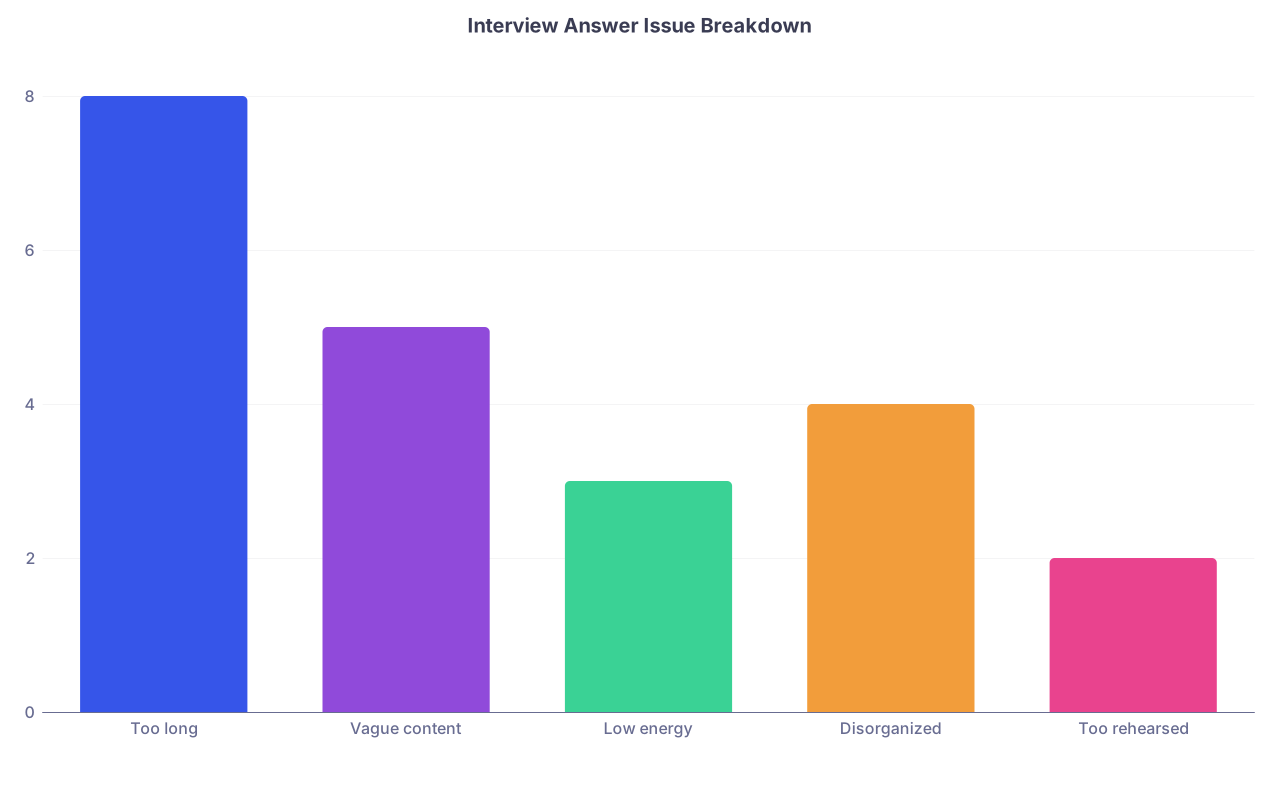
| Category | Value |
|---|---|
| Too long | 8 |
| Vague content | 5 |
| Low energy | 3 |
| Disorganized | 4 |
| Too rehearsed | 2 |
If most of your “bad” answers cluster in:
- Length → focus on trimming and structuring
- Vagueness → add specifics: names, details, what you actually did
- Energy → you’re tired, monotone, or bored of your own stories
Behavioral = “Tell me about a time when…”
At this point in the season, you should not be inventing entirely new stories. You should be:
- Cleaning up the arc
- Sharpening the reflection
- Making the “so what” unmistakable
Take one weak behavioral answer (e.g., conflict, failure, mistake) and run it through a tighter structure like:
- Setup (1–2 sentences)
- Your role (not the team, you)
- What you did (actions, decisions)
- Outcome (concrete)
- Takeaway (what you’d do differently now)
Do not spend 90 seconds on the setup and 10 seconds on the takeaway. Flip that.
Specialty- and Program-Specific Tweaks (Mid to Late Season)
By Week 4–6, you’re starting to see how different programs react.
At this point, you should have two layers of evolution:
- Global improvements: Core answers that work anywhere
- Local tweaks: Small edits based on region, program type, or audience
Step 1: Build a quick “program reactions” log
Keep a running list after each interview:
Academic powerhouse (e.g., MGH, UCSF IM):
- Lit up at: research, QI, teaching
- Glazed over at: long patient anecdotes with no systems/teaching angle
Community-heavy programs:
- Lit up at: continuity, underserved, workload realism
- Glazed over at: your bench research from M1
You’re not faking a new persona. You’re choosing which side of your real self to put in the foreground.
Step 2: 10-minute pre-interview “angle” adjustment
The night before or morning of each interview, at this point you should:
- Re-open your “Why this program?” and “Why this specialty?” answers
- Ask: for this program, should I:
- Emphasize teaching and academics?
- Emphasize hands-on autonomy?
- Emphasize specific patient populations?
- Emphasize location/family only as a secondary factor?
Make 1–2 sentence swaps:
- Replace “I’m broadly interested in research” with “I’m specifically interested in [X area] and was really drawn to your [Y project/faculty].”
- Swap a generic “I value teamwork” line with a concrete micro-example from a sub-I or away that matches their vibe.
That’s enough. You’re not rewriting your soul for each Zoom block.
Late Season (Last 3–4 Interviews): Polish and Cutting, Not Adding
By the final stretch, your problem isn’t usually lack of material. It’s clutter.
At this point, you should be cutting more than you’re creating.
1. Identify and retire any “dead” stories
If a story:
- Never generates follow-up questions
- Feels stale to you
- Does not differentiate you at all from the average applicant
Retire it. Replace with:
- A fresher patient encounter from a recent rotation
- A non-clinical leadership story that actually shows something unique
- A briefer, sharper example that highlights the same trait
Late-season rule: if a story annoys you when you tell it, the interviewer can feel that.
2. Tighten your openings and closings
By now, the middle of your answers is probably okay. Where people stay sloppy is the first and last 2–3 sentences.
At this point, you should:
Rewrite the first sentence of your 3–5 most common answers so they:
- Directly answer the question
- Set the frame quickly
Example:
- Weak: “That’s a good question, and there are a lot of things that drew me to internal medicine…”
- Strong: “I chose internal medicine because I like being the person who holds the whole case in my head.”
Sharpen the last sentence with a clear takeaway:
- Weak: “So that was an interesting experience.”
- Strong: “Since then, I’ve been much more proactive about clarifying roles at the start of a code or high-acuity situation.”
You want interviewers to remember the frame and the lesson, not the rambling middle.
What to Do When Feedback Is Confusing or Contradictory
Mid-season, you’ll get this:
- One interviewer: “You’re very concise. That’s great.”
- Another: “Feel free to expand more with details.”
So which is it?
At this point, you should stop chasing individual opinions and watch patterns:
- If only one person says it once → ignore
- If three different people, across different programs, hint at the same thing → adjust
And when feedback contradicts?
- Default to clarity + specificity + brevity.
- If you’re naturally long-winded, “concise but clear” is better than “vivid but endless.”
- If you’re naturally very short, practice adding one extra beat of detail or reflection.
You’re tuning toward the middle, not trying to hit every individual preference.
Practical Time Blocks: How to Fit This Into a Brutal Schedule
You’re not on a meditation retreat. You’re on rotations, traveling, and answering “So what do you like to do for fun?” for the 40th time.
Here’s a realistic cadence that works mid-season:
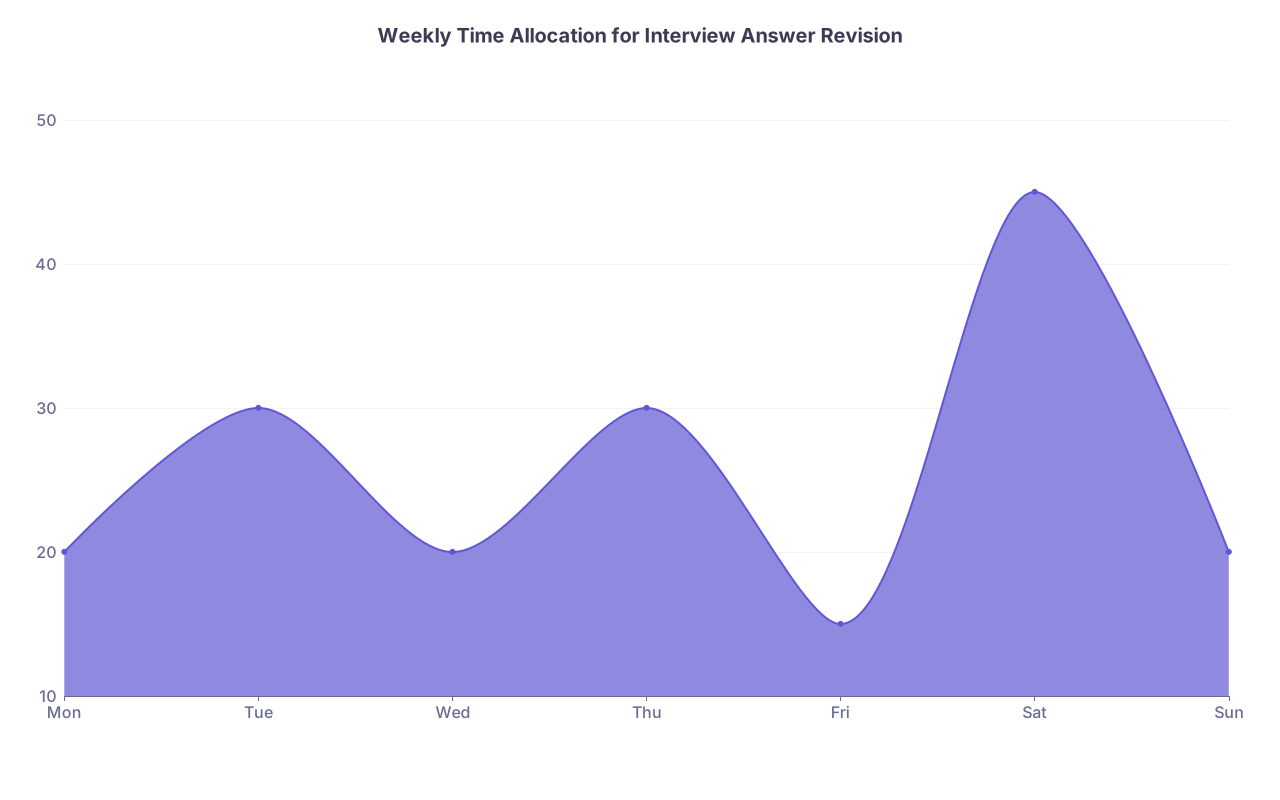
| Category | Value |
|---|---|
| Mon | 20 |
| Tue | 30 |
| Wed | 20 |
| Thu | 30 |
| Fri | 15 |
| Sat | 45 |
| Sun | 20 |
After each interview (15–20 min)
- Brain dump
- Score answers
- Note any explicit feedback or strong reactions
-
- Review patterns across all interviews that week
- Choose 1–2 answers to refine
- Do one out-loud practice run
Night before interview (10–15 min)
- Skim your “program reactions” log
- Nudge “Why this program?” and “Why this specialty?” toward their strengths
- Glance at your 3 weakest answers so they’re not rusty
You do not need two-hour rehearsal sessions. You need short, focused, repeated tweaks.
Signs You’re Evolving in the Right Direction
By later mid-season, you should start noticing:
- Interviewers ask fewer clarification questions and more “building” questions (“Tell me more about that project,” not “Wait, what were you doing there?”).
- You feel like you’re reusing the same skeletons of answers, but they land better and faster.
- Comments shift from “You can shorten that” and “Can you be more specific?” to “That’s a really insightful reflection.”
If things are not improving by Interview 6–8:
- Your changes are probably too big and too frequent (you’re reinventing, not iterating).
→ Slow down. Pick one answer to refine per week. - Or you’re not actually practicing out loud, just “fixing in your head.”
→ Say it. Record it. The difference is huge.
Your Next Step Today
Do this right now, before your next interview invite hits:
- Open your notes from your last two interviews.
- Pick one high-yield question you got both times—likely “Tell me about yourself” or “Why this specialty?”
- On a blank page, write:
- What you actually said (as best you remember)
- One thing you will cut
- One specific detail or reflection you will add
- Record yourself answering the revised version once. Just once.
That’s the whole assignment for today. One answer, one iteration, one recording. Then use that new version at your very next interview and see what changes.