
The way most applicants drift through residency interview season is a disaster. You do not “fit prep in when you can.” You run interview season on a calendar, like a project, or it runs you.
You’re in the weird middle zone now: ERAS is out, invites are trickling (or flooding) in, and you’ve got a moving target of dates, programs, and Zoom links. This is exactly where people lose control—double-booked days, half-prepped programs, generic answers, and burnout by December.
Let’s fix that with a time-based plan: what to do each month, each week, and even the day before and after every interview.
Big Picture: Your Interview Season Timeline
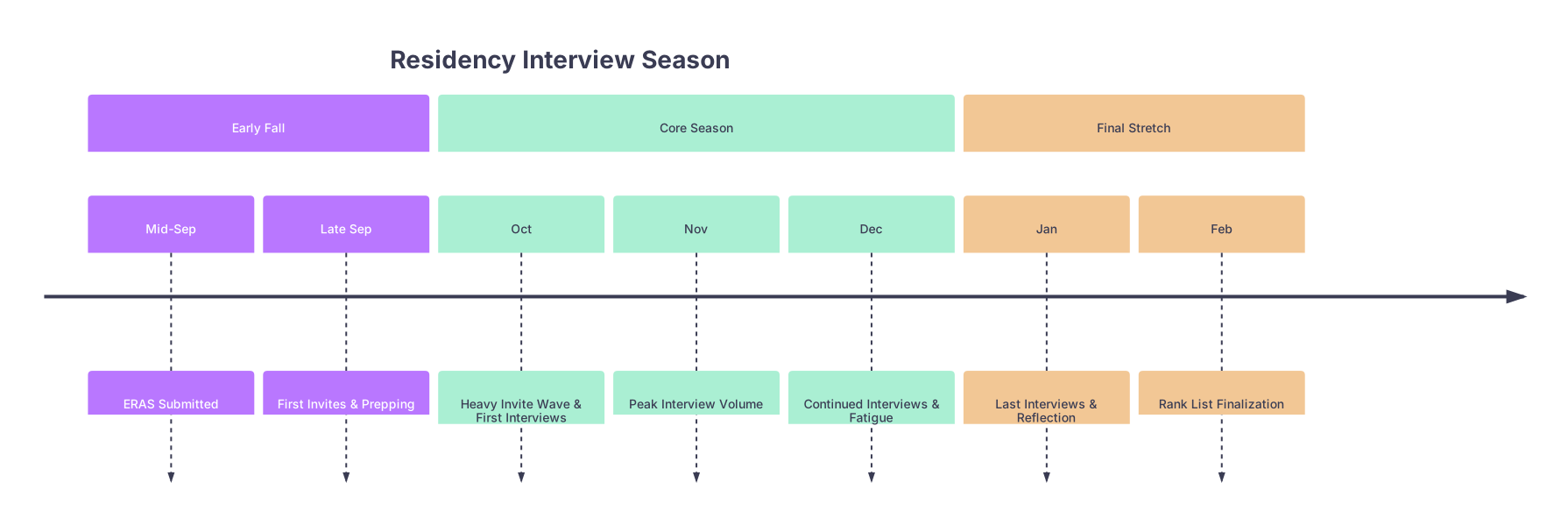
| Period | Event |
|---|---|
| Early Fall - Mid-Sep | ERAS Submitted |
| Early Fall - Late Sep | First Invites & Prepping |
| Core Season - Oct | Heavy Invite Wave & First Interviews |
| Core Season - Nov | Peak Interview Volume |
| Core Season - Dec | Continued Interviews & Fatigue |
| Final Stretch - Jan | Last Interviews & Reflection |
| Final Stretch - Feb | Rank List Finalization |
At this point in the year (post-ERAS, pre-Match), your life breaks into three overlapping layers:
- Macro (by month) – capacity planning, travel/Zoom load, big picture strategy
- Meso (by week) – batching prep, follow-ups, adjustments
- Micro (by day) – what you do right before, during, and right after each interview
We’ll walk that in order. But first you need a control center.
Week 0: Set Up Your Interview Command Center
Do this now, before you accept one more invite.
Build your tracking system (1–2 hours)
Use a spreadsheet, Notion, or even a well-designed paper planner, but it must be centralized and updated daily.
At this point you should create a table with at least:
| Field | Purpose |
|---|---|
| Program name | Obvious but people still typo it |
| Specialty / track | Categorical (e.g., categorical IM, prelim, TY) |
| Location & time zone | Vital for virtual interviews |
| Interview date & time | Start and end time |
| Format | Virtual vs in-person, MMIs, half vs full day |
| Status | Invite received / scheduled / completed / thanked |
| Priority tier | High / medium / low for your rank list |
Then add columns for things you’ll keep updating:
- “Thank-you sent?” (Y/N + date)
- “Program notes” (anything meaningful from the day)
- “Impression score” (1–10, gut feel immediately after)
- “Red flags?” (short phrases, not essays)
You’ll be shocked how fast programs blur together by mid-November. This table saves you.
Pre-build your core prep templates (2–3 hours)
At this point you should prep these before the first interview:
- A 1-minute personal intro (your “Tell me about yourself” anchor)
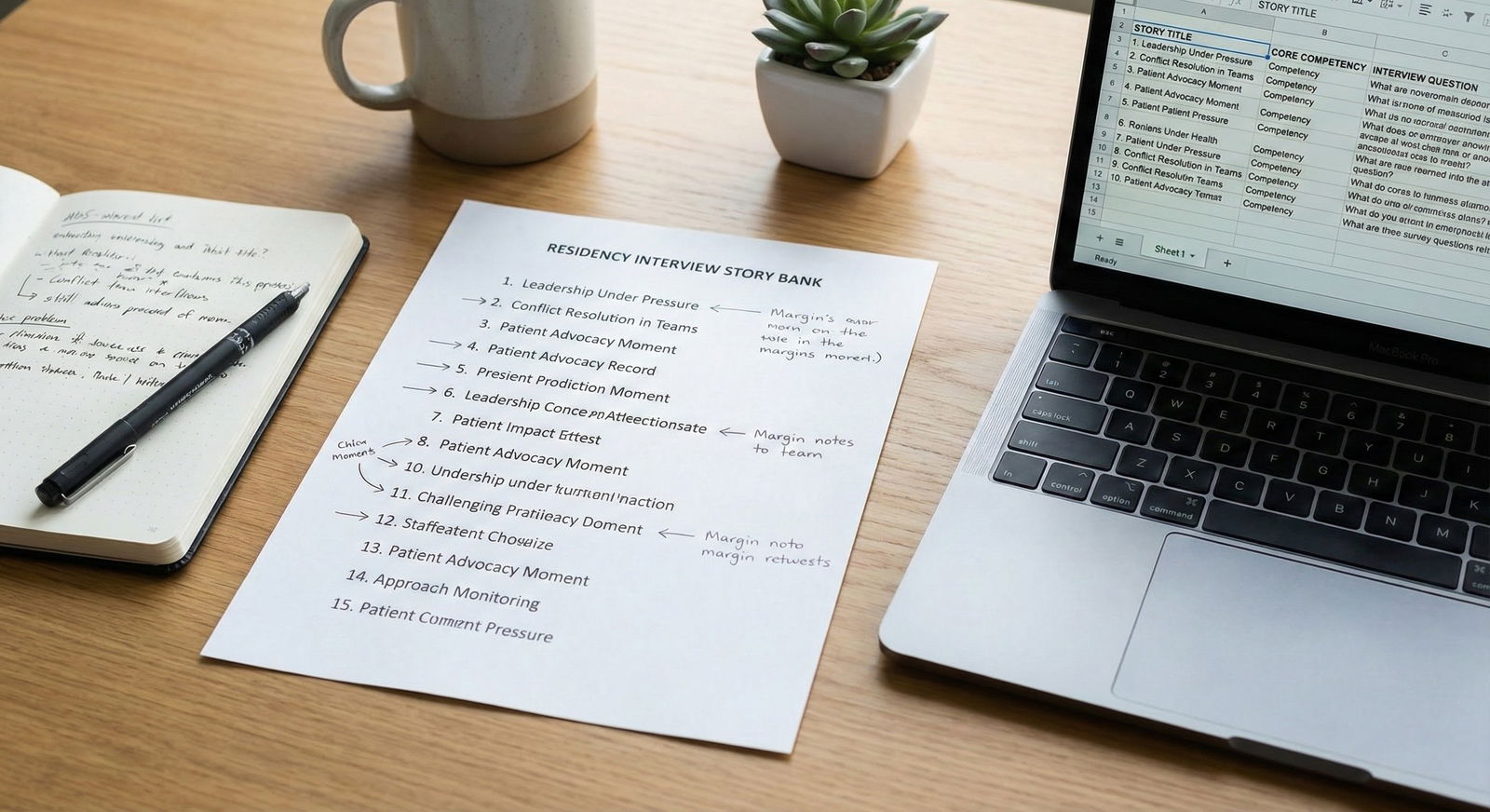
- A 3–4 bullet story bank for:
- Leadership
- Conflict / difficult teammate
- Failure / setback
- Ethical challenge
- Proudest clinical moment
- A questions-to-ask list by category:
- Program culture
- Education/teaching
- Resident wellness
- Research / fellowship
- City / lifestyle
Don’t fully script. Bullet phrases you can riff on. Scripts sound fake and you will forget them under stress.
Month-by-Month: From First Invite to Final Interview
Late September – Early October: Stabilize & Set Capacity
This is when the first wave of invites hits. People panic and accept everything. That’s a mistake.
At this point you should:
Decide on your max interview load
- Competitive specialty (e.g., derm, ortho): maybe you take more
- Less competitive or you’re geographically flexible: 12–15 solid interviews often suffice
- Use a rough cap:
- 3–4 interviews per week max
- No more than 2 full days back-to-back if they’re in-person and involve travel
Block your calendar
- Mark:
- Exam dates
- Required rotations / clinic days
- Family events you truly can’t move
- Add buffer days after heavy travel or back-to-back interview days as “soft hold”
- Mark:
Build your program research template For every program, you’ll fill in the same framework so you’re not re-inventing the wheel:
- Program highlights (3 bullets)
- Concerns / questions (2–3 bullets)
- People: PD name, APD, chief residents
- Unique strengths (e.g., global health track, ICU exposure)
- Why you fit (3–4 bullet alignment points)
Do one “deep dive” on a sample program now so you can time how long you realistically need. Usually 20–30 minutes per program once you’re in a groove.

October – November: Peak Interview Volume & System Maintenance
This is when your calendar gets loud. If you don’t set rules, programs will set them for you.
At this point you should:
- Apply a clear triage system to invites
| Tier | Description | Action |
|---|---|---|
| Tier 1 | Dream or high-fit programs | Accept quickly, protect these dates |
| Tier 2 | Solid options | Accept unless major conflict |
| Tier 3 | Backup / low interest | Accept only if under target count |
If you’re approaching your target number of interviews and a Tier 1 invite arrives on a conflict date for a Tier 3, you drop the Tier 3. Do it politely, but do it. Loyalty to a backup over a dream program is irrational.
- Standardize your weekly prep routine (more on that next section)
- Watch for fatigue patterns
- If your performance drops (rambling answers, forgetting questions to ask, camera fatigue), you reduce load the following week.
- This isn’t optional. A tired, flat version of you does worse than a slightly under-booked but sharp version.
December – Early January: Late-Season & Reflection
By December, you’re better at interviewing than you were in October. The problem isn’t skill. It’s stamina and lazy thinking.
At this point you should:
- Re-rank your programs weekly (informally)
- Use your impression scores and notes
- Start grouping them into “definite high,” “middle,” and “safety-ish”
- Tighten your narrative
- You’ll hear yourself repeat stories. That’s fine. But sharpen them.
- Cut weak examples. Upgrade with better rotations or more recent moments.
- Schedule breaks intentionally around the holidays
- If family chaos will destroy your prep, block a couple of quiet “no interview” days; you’re allowed to protect your performance.
Week-by-Week: How to Prep Between Invites and Interview Days
Let’s say you’re in the thick of it: it’s October or November, and you’ve got 3–5 interviews spread over the next 10–14 days.
Here’s what your weeks should look like.
Weekly Structure Overview
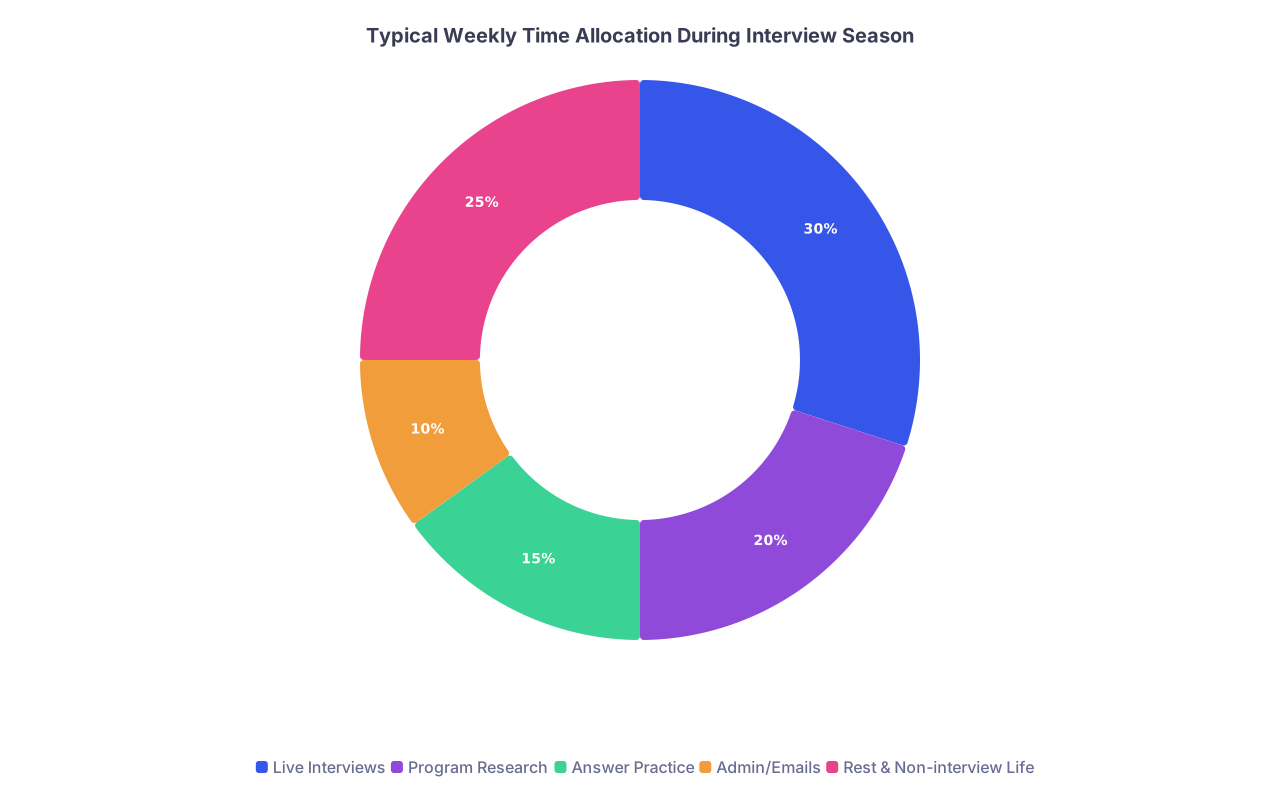
| Category | Value |
|---|---|
| Live Interviews | 30 |
| Program Research | 20 |
| Answer Practice | 15 |
| Admin/Emails | 10 |
| Rest & Non-interview Life | 25 |
This is reality: you are not spending 80% of your week “prepping interviews.” You’re splitting time between actual interviews, preparation, admin chaos, and the rest of your life.
Every Sunday (or one fixed planning day)
At this point you should:
Review the upcoming 2 weeks
- List:
- Which days you have interviews
- Which programs
- Virtual vs in-person
- Start times & time zones
- List:
Assign prep blocks For each specific program, schedule:
- One deep dive block (30–45 min) earlier in the week
- One light review block (15–20 min) the day before
Assign generic practice blocks
- 1 session for behavioral / classic questions (30–45 min)
- 1 session for specialty-specific / clinical talk (30–45 min)
Write those blocks into your calendar like appointments. “If I have time” equals “won’t happen.”
Midweek (Tue–Thu): Execution & Adjustments
This is where you live during the season.
At this point you should:
Confirm logistics for the next 2 interviews
- Links, passwords, times, platform (Zoom, Thalamus, proprietary garbage system x)
- For in-person: flight times, hotel, parking, what time breakfast starts
Do 1–2 short, focused mock segments
- 15 minutes: 2–3 questions out loud
- Record yourself once a week. Painful but revealing.
Send any overdue thank-you emails
- If you’re >72 hours out from an interview and haven’t sent thanks, do it now.
Program-Specific Prep: 36–72 Hours Before Each Interview
You do not need 10 hours per program. You need focused, repeatable steps.
2–3 Days Before: Deep Dive (30–45 minutes)
At this point you should sit down with:
- The program’s website
- Your tracking spreadsheet
- Any notes from residents / mentors who know the program
Do this:
Fill your program template
- 3 concrete strengths (“4+ months ICU,” “strong cardiology fellowship match,” “residents seem genuinely happy in photos and videos”)
- 2–3 QUESTIONS you truly care about
- 2–3 reasons it fits you personally (tie to your story, not generic fluff)
Find actual human names
- PD full name and basic background
- Chief residents’ names
- Any faculty whose work overlaps your interests
You are not memorizing their CVs. You’re just avoiding calling the PD “Dr. uh…” on Zoom.
Pre-draft 3–4 program-specific questions
- Avoid: “So what makes your program unique?” (lazy)
- Use:
- “How do residents here get involved in X interest area?”
- “How has the program changed in the past 3 years?”
- “What differentiates residents who thrive here from those who struggle?”
Day Before: Light Review (15–30 minutes)
At this point you should:
- Re-read:
- Your own ERAS personal statement
- Your experiences section (so you actually remember what you claimed)
- Skim your program notes
- Decide:
- 1 story you’ll probably use for “Tell me about yourself”
- 2 backup stories you can adapt to several questions
Then stop. Over-cramming the night before makes you sound rehearsed and stiff the next day.
Day-by-Day: Before, During, and After Each Interview
The Day Before an Interview
Your checklist:
-
- Test platform (Zoom, etc.) on the actual device you’ll use
- Check camera framing, audio, background
- For in-person: confirm alarm, transportation, address, building entry instructions
Clothes ready
- Full outfit laid out (top to shoes even for virtual—trust me, people stand up accidentally)
- Backup top in case of coffee, sweat, or video weirdness
Time zone sanity check If you’re interviewing with a program in another time zone, convert the time yourself and add local time next to it in your calendar.
Interview Day: Morning Routine (30–45 minutes)
At this point you should not be “learning” anything new. You’re simply bringing your brain online.
Quick routine:
10–15 minutes: Warm-up answers out loud
- “Tell me about yourself”
- “Why this specialty?”
- One behavioral question (“Tell me about a conflict…”)
5–10 minutes: Quick program review
- Glance at your 3 strengths / 3 questions list
- Look at the PD’s name once more
5 minutes: Physical reset
- Walk, stretch, shake out some nerves
- Water nearby, not three giant coffees
Then log in 10–15 minutes early. Early is calm. Logging in 1 minute before start with a Zoom update running is chaos.
After Each Interview: 24-Hour Debrief
This is the part people skip. Then they regret it in February when all the programs blend together like one long hallway.
Within 24 hours, at this point you should:
Update your spreadsheet immediately
- Impression score (1–10)
- 3 quick bullets:
- What you liked
- Any red flags
- How you felt about the residents’ vibe
Jot specific details Random snippets that only make sense now:
- “PD talked about new night float system starting next year”
- “Resident mentioned high autonomy on night shifts”
- “Fellowship match heavy in cards & GI, weak in heme/onc”
These are gold when building your rank list.
Send thank-you emails (same day or next morning) Short. Specific. Human.
Format:
- Thank them for time
- One specific thing you appreciated or learned
- Reiterate a fit point or interest
- Don’t grovel or sound desperate
Between Interviews: Skill Building vs. Burnout Prevention
You can’t prep every waking moment. You also can’t treat this like a vacation. There’s a balance.
Weekly Skill Reps (60–90 minutes total)
At this point you should be doing:
- One focused practice block (30–45 min)
- 5–7 questions, out loud, ideally with:
- A friend, resident mentor, or career advisor
- Or recorded on your phone if no one’s available
- 5–7 questions, out loud, ideally with:
- One reflection block (15–20 min)
- Listen to a few minutes of your recording
- Notice: Are you rambling? Using too much filler? Talking over people?
Burnout Prevention Habits (daily-ish)
- Hard stop time most evenings (e.g., no interview prep after 9 pm)
- One set “off” block each week: no interview anything (half-day minimum)
- Keep one non-medical thing: gym, running, reading, whatever actually relaxes you
You’re about to start residency. You need to practice not erasing your own life for your job.
Late Season: January & Pre-Rank List Clean-Up
Once most interviews are done, you switch from “perform” mode to “synthesize” mode.
At this point you should:
Do a first-pass ranking from your spreadsheet
- Group:
- Top tier
- Solid middle
- Would-rather-not-unless-I-have-to
- Group:
Fill in missing data
- If your notes on a program are thin, email a resident with 3–4 pointed questions
- Revisit their website once. No rabbit holes.
Watch out for recency bias
- Last 2–3 programs tend to feel artificially better just because they’re fresh
- Compare your notes and scores, not just your memory
Decide if any follow-up emails are appropriate
- Some specialties/programs appreciate a courteous “continued interest” note, some don’t care
- Keep anything you send short and non-manipulative
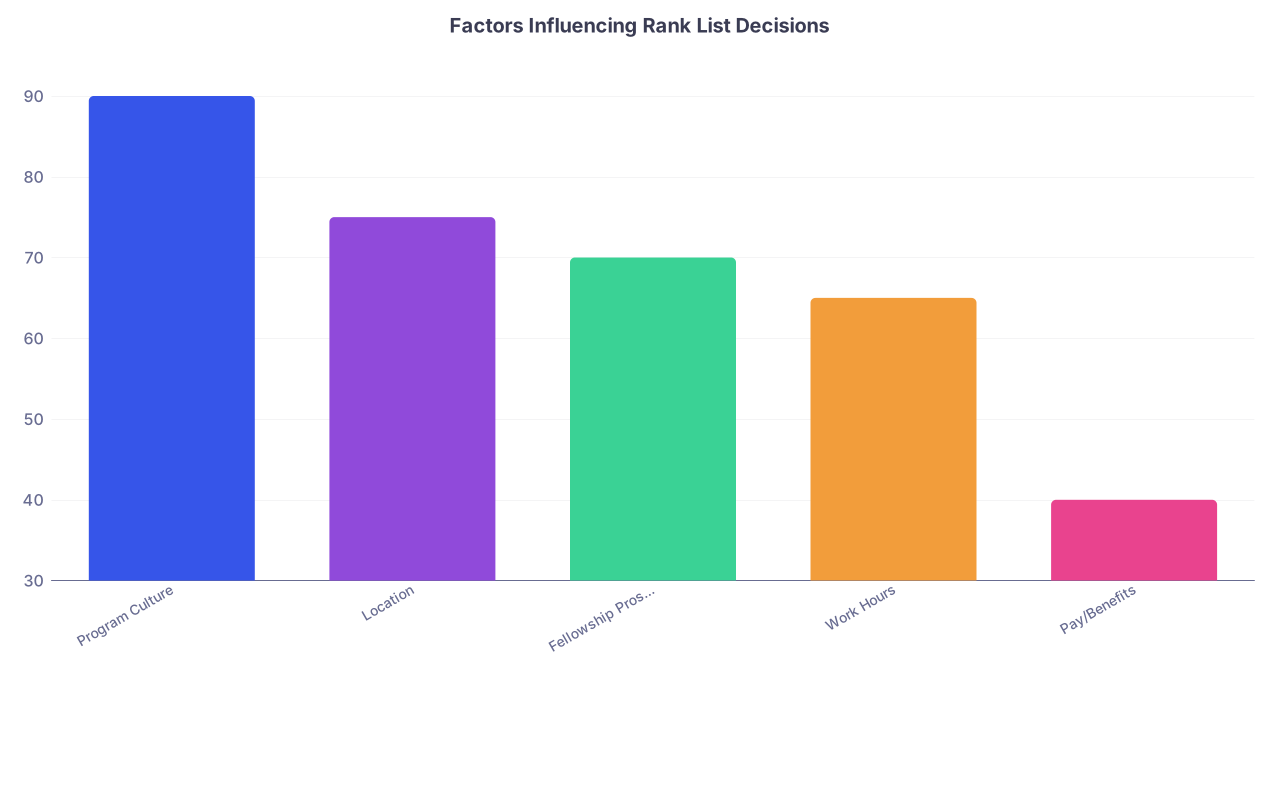
| Category | Value |
|---|---|
| Program Culture | 90 |
| Location | 75 |
| Fellowship Prospects | 70 |
| Work Hours | 65 |
| Pay/Benefits | 40 |
This is how people actually weigh decisions (roughly). Not every line item is equal for you, but pretending they are is how you end up miserable.
Quick Reference: Your Core Weekly Checklist
Print this or recreate it in your own words.
Every Week During Interview Season:
- Review next 2 weeks’ interviews (dates, times, time zones, virtual vs in-person)
- Schedule program deep-dive blocks (30–45 min each)
- Schedule program review blocks (15–20 min each, day before)
- 1 generic practice session (30–45 min, out loud)
- Confirm logistics for this week’s interviews (links, travel)
- Send any overdue thank-you emails
- Update spreadsheet after each interview with scores & notes
- One half-day with zero interview tasks
You’re not going to “feel ready” for every interview. Nobody does. The people who look ready are the ones who ran a system instead of winging it.
Open your calendar and your tracking sheet right now and block out the next 7 days: deep dives, reviews, and one practice block. If it is not on your calendar by the end of today, it will not happen.