
You’ve just finished residency, signed your first attending contract, and you’re finally serious about launching your own practice. You’re staring at spreadsheets, pro formas, and a half-finished LLC operating agreement. And now the big operational question hits you:
Should you build your team with W‑2 employees… or keep it “lean” with 1099 contractors?
Let me be blunt: if you get this wrong, the IRS and your state labor department won’t care that you’re a brand‑new practice owner. Misclassification penalties are brutal. So this isn’t just a “strategy” question—it’s a risk management question.
Let’s walk through how to think about it like a real owner, not a confused new doc.
The Short Answer: For Core Roles, Use W‑2. Contractors Are For Truly Independent Work.
If you only remember one thing, make it this:
- Anyone who is part of your day‑to‑day operations, works set hours, uses your tools, and answers to you? That’s almost always a W‑2 employee.
- 1099 contractors are for narrow, specialized, independent work: e.g., billing company, part‑time marketing consultant, one‑off telehealth coverage, IT support.
If you try to make your front desk “1099 to save on payroll taxes,” you’re asking for an audit and back taxes.
So the real question isn’t “Which is better overall?”
It’s: “For this specific role, is it legitimately an employee or a contractor—and what does that do to my cost, control, and risk?”
Core Differences: Control, Cost, and Risk
Here’s the reality breakdown without legalese.
1. Control: Who’s Really the Boss?
The IRS and states look at behavioral and financial control:
- Do you set the schedule?
- Do you tell them how to do the job?
- Do they use your EMR, your phone system, your medical supplies?
- Can they work for others freely without your permission?
- Are they building their own business or just working for your practice?
If you’re saying “I want them to be 1099 but I’ll tell them when to show up, how to answer the phone, what scripts to use, and they can’t work for competitors”…
That’s not a contractor. That’s a misclassified employee.
Contractors:
- Decide their own methods.
- Often bring their own tools/software.
- Can work for other clients.
- Bill you for services, not hours in a tightly controlled schedule.
Employees:
- You control schedule, process, and training.
- You provide equipment and systems.
- You evaluate performance and can discipline or fire.
In medical practice land, your MAs, front desk, nurse, office manager, and most employed physicians in your own group structure = W‑2. Full stop.
2. Cost: What You Actually Pay (Not Just Salary)
Everyone loves to say “1099 is cheaper.” Sometimes true. Often not when you factor in the full picture.
With W‑2 employees, you pay:
- Employer payroll taxes (~7.65% for Social Security/Medicare up to the wage base)
- Unemployment insurance (state and federal)
- Workers’ comp
- Possibly:
- Health insurance
- Retirement match
- PTO
- CME/training
With 1099 contractors, you:
- Don’t pay payroll taxes, unemployment, or benefits.
- Pay a higher hourly or flat rate that bakes in what they cover themselves.
- Often pay for less time, because they’re doing focused tasks (e.g., billing, legal, consulting, coverage shifts).
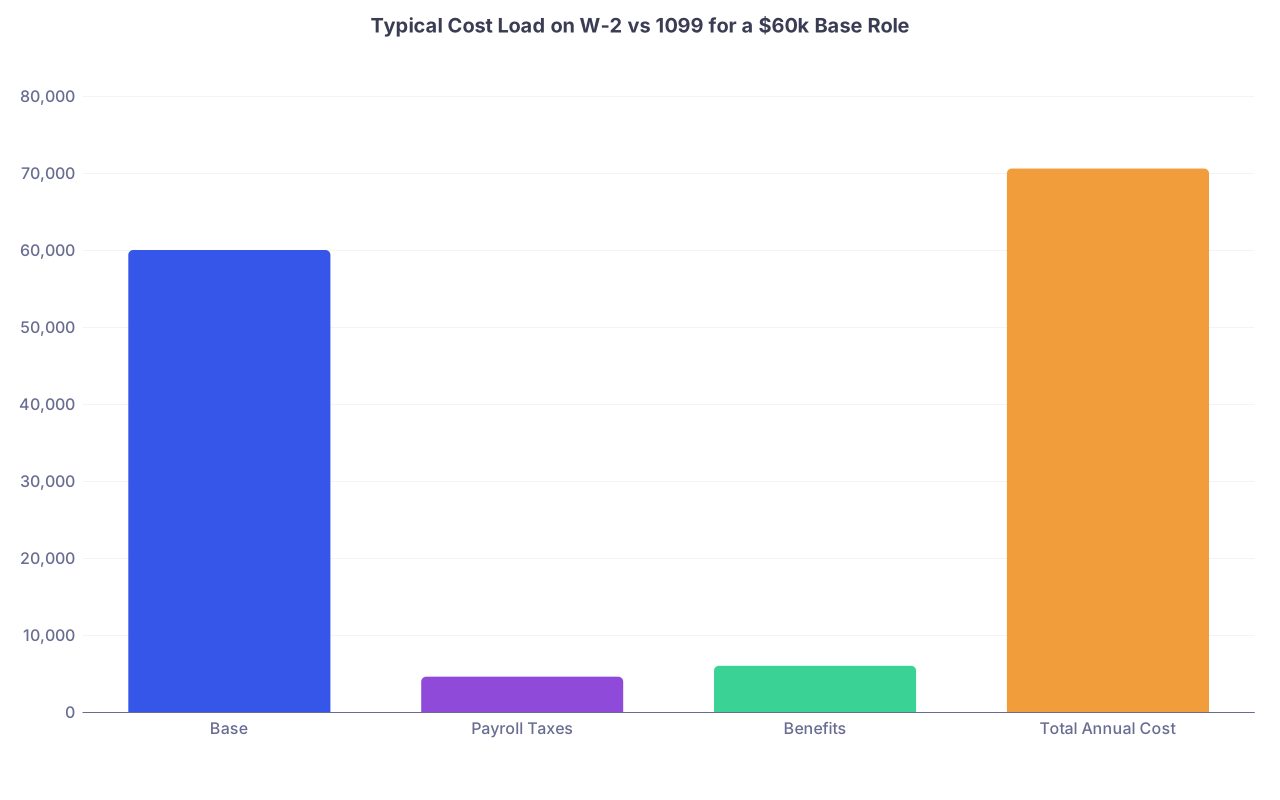
| Category | Value |
|---|---|
| Base | 60000 |
| Payroll Taxes | 4590 |
| Benefits | 6000 |
| Total Annual Cost | 70590 |
Real‑world: that $20/hr front desk person is not $20/hr. After payroll taxes and modest benefits, you’re closer to $24–26/hr.
For a contractor billing company:
- You might pay 4–7% of collections.
- Zero payroll admin.
- No training, no supervision, no benefits.
- If they suck, you fire the company, not lay off an “employee.”
3. Risk: Misclassification Is Where People Get Burned
You can’t just “decide” someone is 1099 because it’s convenient or cheaper.
If the IRS or your state decides you misclassified:
- You pay back payroll taxes.
- Possible penalties and interest.
- Liability for unpaid overtime if they should’ve been non‑exempt W‑2.
- Exposure for unemployment claims and workers’ comp disputes.
I’ve seen brand‑new practices get hit for tens of thousands for making their front desk and MA “1099 to keep it simple.” It’s not simple. It’s stupid.
Role‑By‑Role: What Should Be W‑2 vs 1099 in a Typical Practice?
Here’s how I’d break it down for a small outpatient practice (primary care, psych, derm, etc.).
| Role | Usually Best As |
|---|---|
| Front desk / receptionist | W‑2 employee |
| Medical assistant / nurse | W‑2 employee |
| Office manager | W‑2 employee |
| Staff physician in your group | W‑2 employee or owner-partner |
| Locums / coverage doc | 1099 contractor |
| Billing company | 1099 contractor |
| IT support | 1099 contractor |
| Marketing / web design | 1099 contractor |
| After‑hours answering service | 1099 contractor |
If you’re thinking about making any of the left‑hand side jobs a contractor, get a lawyer or CPA involved before you do something you regret.
When W‑2 Employees Are Clearly Better
You go W‑2 when you care about:
- Culture and consistency
- Long‑term loyalty
- Full control over hours, process, and training
- Protecting your license and patient experience
Front Desk, MA, Nurse, Office Manager
These people are the spine of your practice. They:
- Touch PHI all day.
- Set the tone with patients.
- Control your schedule and flow.
- Need to be trained exactly how you want things done.
Trying to “1099” them is like trying to 1099 your lungs. They’re not external vendors; they’re core infrastructure.
W‑2 advantages here:
- You can set exact hours and coverage.
- You can require staff meetings, training, and performance reviews.
- You can enforce policies (HIPAA, scripting, cancellations, no‑show handling).
- You build continuity; patients know the staff.
Downside? Yes, you carry:
- Payroll obligations
- Benefits complexity
- HR headaches (write‑ups, terminations, PTO tracking)
But that’s part of owning a real practice, not a hobby.
Employed Physicians in Your Group
If they’re:
- Working only (or mainly) for your practice
- On your schedule
- Using your staff and systems
- Under your protocols
Then 99% of the time they’re W‑2 employees. You might structure them as partners/owners later, but that’s an equity question, not a tax classification question.
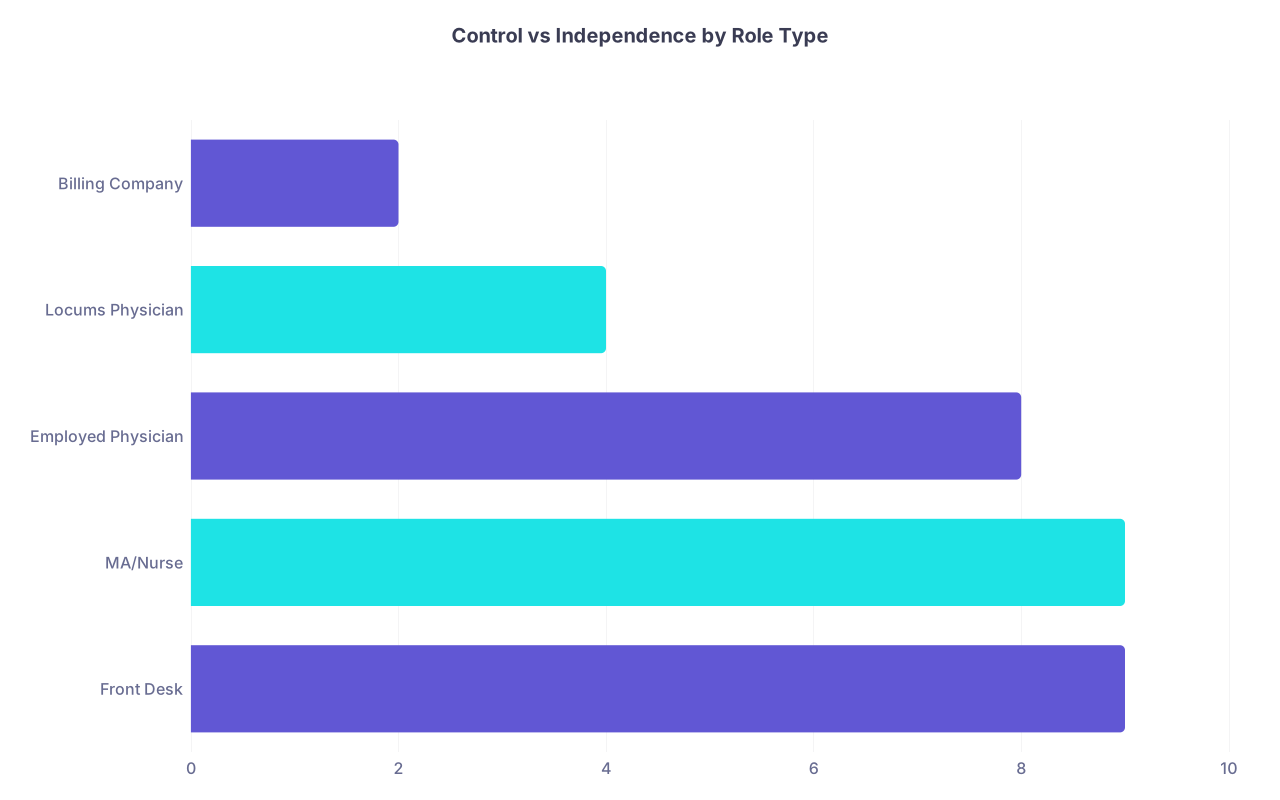
| Category | Value |
|---|---|
| Front Desk | 9 |
| MA/Nurse | 9 |
| Employed Physician | 8 |
| Locums Physician | 4 |
| Billing Company | 2 |
(Scale 1–10: 10 = you fully control; roles near 10 should be W‑2.)
When 1099 Contractors Make Sense
Contractors shine when:
- You don’t need them full time.
- You need specialized skills.
- You want clean, defined deliverables, not “show up daily.”
Classic 1099 Use Cases in a Practice
Billing company
They handle claims, denials, posting, maybe patient statements. They:- Use your EMR or theirs.
- Work off a contract.
- Get a % of collections or a flat fee. That’s textbook contractor.
Locums / PRN coverage physician
You need:- Vacation coverage
- Maternity leave coverage
- Part‑time telepsych visits They’re running their own business, maybe covering at multiple sites, setting their availability. That’s a good 1099 argument, if structured right.
IT, website, marketing, bookkeeping
These are not daily in‑office roles. They have multiple clients, their own systems, and deliver outcomes, not attendance. Perfect contractor territory.After‑hours answering service / call center
Again—independent company, multiple clients, service agreement. 1099.

How This Plays Into Starting a Practice Right After Residency
You’re not a hospital system. You don’t need a 40‑person org chart from day one. You need a lean, legal, scalable setup.
Phase 1: Solo or Near‑Solo Practice (0–2 FTE Staff)
Minimal viable team usually looks like:
- You (physician)
- 1 front desk / MA hybrid (W‑2)
- 1 billing solution (likely 1099 company)
- Maybe virtual admin support (e.g., phones, prior auths) as 1099
In this phase:
- Don’t over‑staff W‑2s you can’t afford.
- But don’t cheat and call your daily in‑office person “1099.”
- Push non‑core functions (billing, marketing, IT) to contractors.
Phase 2: Growing to 3–6 FTE Staff
As volume picks up:
- Add:
- Dedicated MA or nurse (W‑2)
- Office manager (W‑2)
- Keep:
- Billing as 1099 unless you’re huge and want it in‑house.
- IT/marketing/etc. as 1099.
At this point, the culture and reliability from W‑2 staff start to really matter. Constantly rotating contractors at the front desk is a fast way to destroy patient trust.
Phase 3: Multi‑provider Group
Once you add:
- Second physician
- NP/PA
- Behavioral health, etc.
You want:
- Clear employment agreements (W‑2) or partnership tracks.
- Minimal “sort of 1099” gray zones. Those will bite you during an audit or when someone files for unemployment.

| Step | Description |
|---|---|
| Step 1 | Start Practice |
| Step 2 | Phase 1 - Solo |
| Step 3 | W-2 Hybrid Front Desk/MA |
| Step 4 | 1099 Billing and IT |
| Step 5 | Phase 2 - Growing |
| Step 6 | Add W-2 MA/Nurse |
| Step 7 | Add W-2 Office Manager |
| Step 8 | Phase 3 - Multi Provider |
| Step 9 | Add W-2 Physicians/NPs |
| Step 10 | Keep 1099 Specialists |
Practical Steps: How to Actually Implement This
You don’t need to become an HR expert. But you do need a basic checklist.
1. For Every Role, Answer: “Could I Defend This as 1099?”
Ask:
- Do they work for multiple clients?
- Do they set their own schedule?
- Do they use their own tools?
- Are they truly independent in how they deliver results?
If most answers are “no,” that’s a W‑2. Stop trying to make it something else.
2. Get the Right Documents in Place
For W‑2 employees:
- Offer letter and/or employment agreement
- Employee handbook (even a lean one)
- Job descriptions
- Payroll system set up (Gusto, ADP, QuickBooks Payroll, etc.)
- I‑9, W‑4, direct deposit forms
For 1099 contractors:
- Written contract specifying:
- Scope of work
- Payment terms
- Independent contractor status
- Responsibility for their own taxes and insurance
- HIPAA BAAs where needed (billing, IT touching PHI)

3. Use Professionals Early
Minimum team you should have before you hire anyone:
- CPA who understands medical practices
- Healthcare attorney or at least a solid small‑business attorney
Run your proposed staffing plan by them. It’s a 1–2 hour consult that can save you years of pain.
Common Myths You Should Ignore
Let’s knock out some bad advice you’ll hear in Facebook groups and from “that one doctor friend.”
Myth: “Just make everyone 1099. It’s cheaper and easier.”
Reality: It’s cheaper until the audit, lawsuit, or workers’ comp issue. Then it’s a disaster.
Myth: “If they sign a contractor agreement, the IRS will respect it.”
Reality: The IRS doesn’t care what you call it. They care what it is in practice.
Myth: “Part‑time staff can be 1099.”
Reality: Part‑time vs full‑time has nothing to do with classification. A 10‑hour/week front desk with fixed shifts and your workflow is still W‑2.
Myth: “Everyone else in my specialty does it this way.”
Reality: I’ve seen entire local “norms” that are blatantly illegal. Don’t follow the herd off a cliff.
Quick Decision Framework
When you’re stuck, run this in your head:
- Is this role part of the daily operations of my practice?
- If yes → probably W‑2.
- Do I want to control schedule, process, and training?
- If yes → W‑2.
- Does this person/company provide similar services to other clients using their own tools?
- If yes → good 1099 candidate.
- Could I explain to an IRS auditor why this person is truly running their own business, not just working for me?
- If no → W‑2.
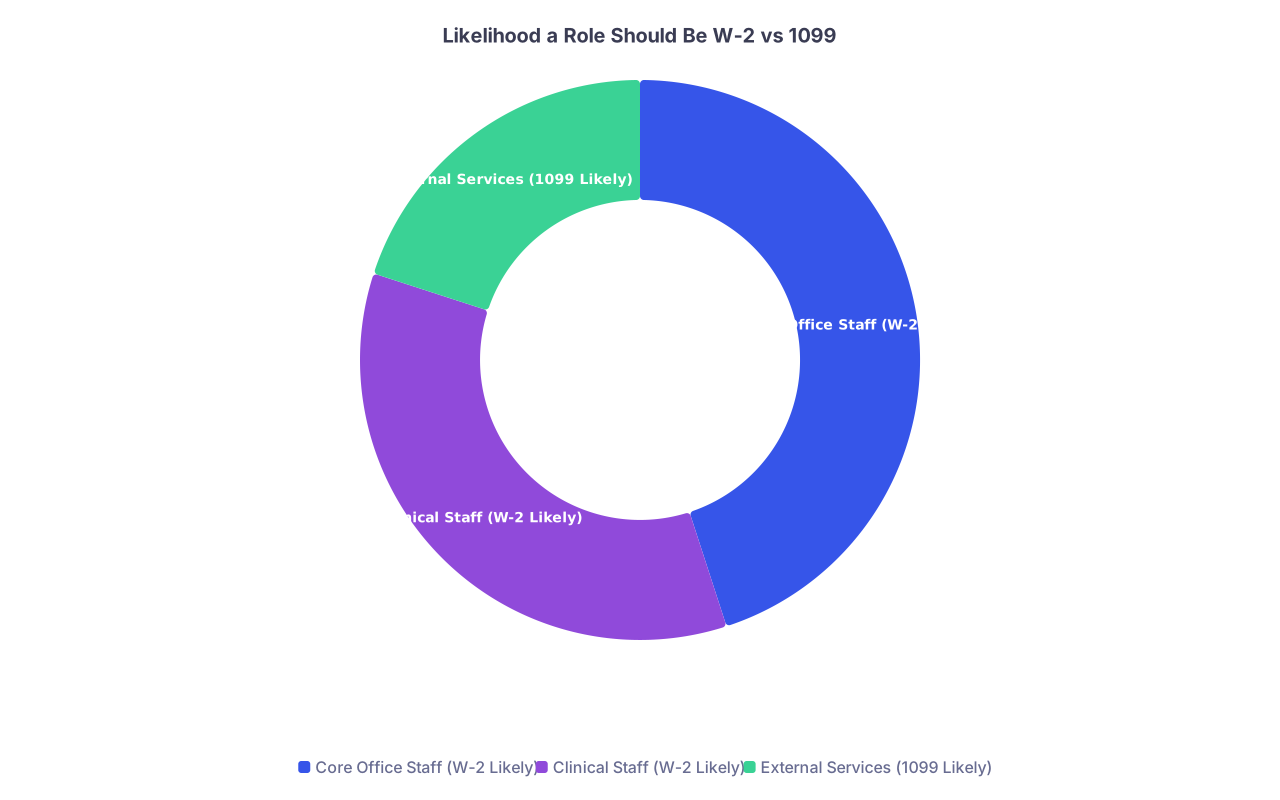
| Category | Value |
|---|---|
| Core Office Staff (W-2 Likely) | 45 |
| Clinical Staff (W-2 Likely) | 35 |
| External Services (1099 Likely) | 20 |
FAQs
1. Can I start by making staff 1099 and convert them to W‑2 later when I’m more established?
You can, but if the role is really a W‑2 from day one, you’re just misclassifying them until you “fix it.” There’s no grace period because you’re new. If you know the role should be W‑2, start it as W‑2.
2. Is it ever legit to have a 1099 front desk person?
Almost never. Only if they’re a true virtual service company that works for multiple practices, uses their own systems, and you’re basically a client—not a boss. Anyone sitting in your office, on your schedule, using your workflow? That’s W‑2.
3. What about NPs and PAs—W‑2 or 1099?
If they’re integrated into your practice, using your staff and schedule, and you’re directing their work, they’re usually W‑2. Locums‑style part‑time independent roles can sometimes be 1099, but that needs careful legal structuring.
4. Do I need to offer benefits to W‑2 employees right away?
No. You can absolutely start with:
- Hourly wage or salary
- No health insurance initially
- Simple PTO policy As you grow and can afford it, you layer in benefits. Classifying someone as W‑2 doesn’t force you to offer a full benefits suite on day one.
5. Who should I talk to before finalizing my staffing plan?
At minimum:
- A CPA who understands small medical practices
- An attorney familiar with employment and healthcare law
Bring them your specific roles and how you plan to use them. Ask directly: “Is this defensible as 1099, or should this be W‑2?” Pay for clear answers now, not damage control later.
Key takeaways:
- Core, day‑to‑day roles in your practice (front desk, MA, nurse, office manager, integrated clinicians) should almost always be W‑2 employees.
- 1099 contractors are best for external, specialized, or part‑time services where they truly operate an independent business.
- Don’t play games with classification to “save money.” Build a lean, legal structure from the start, and you’ll sleep a lot better owning your practice.