
The default instinct most new practice owners have about outsourcing is wrong. They either try to outsource everything (and lose control), or they keep everything in-house (and burn out in six months). Year one is about survival and leverage, not perfection.
You’re just out of residency or leaving an employed position. You want your own practice, not a second full-time job running an office. So here’s the real question: which tasks must you own, and which should you pay someone else to deal with?
Let me walk you through what actually works in year one, based on what I’ve watched dozens of physicians do right—and wrong.
First Principle: Your Job in Year One Is Capacity, Not Control
You are the revenue engine. Every hour you’re not seeing patients or building referral relationships is expensive.
That means you evaluate every task on two axes:
- Does this task require you (clinical judgment, strategic direction, compliance-risk decisions)?
- Is this task a mature, commoditized service that experts can do faster, better, and cheaper than you or a brand-new staffer?
If it needs your brain or sets the long-term direction of your practice → you keep it in-house (or at least under your direct control).
If it’s repeatable, process-driven, and others already do it at scale → you seriously consider outsourcing.
Let’s get specific.
What You Should Almost Always Outsource in Year One
These are the tasks I’d tell a new solo or small-group practice owner to outsource unless they have a very specific, compelling reason not to.
1. Medical Billing and Claims Management
If you try to DIY billing in year one, you will bleed cash and time. I’ve seen smart, detail-oriented physicians lose 15–20% of revenue because they underestimated how intricate payer rules are.
Outsource full-service billing to a reputable medical billing company. Not a random freelancer. A real firm with:
- Specialty experience (e.g., cardiology vs psychiatry vs dermatology)
- Strong denial management and appeals processes
- Transparent reporting (collections by payer, denial rates, days in A/R)
- Clear fee structure
Typical model: 4–8% of net collections. You only pay if they collect.
What you must keep in-house: oversight and accountability. You should:
- Approve coding policies (with input from the biller and maybe a coding consultant)
- Review monthly reports
- Set targets: days in A/R, clean claim rate, denial rate
If your biller resists giving you data, you picked the wrong vendor.
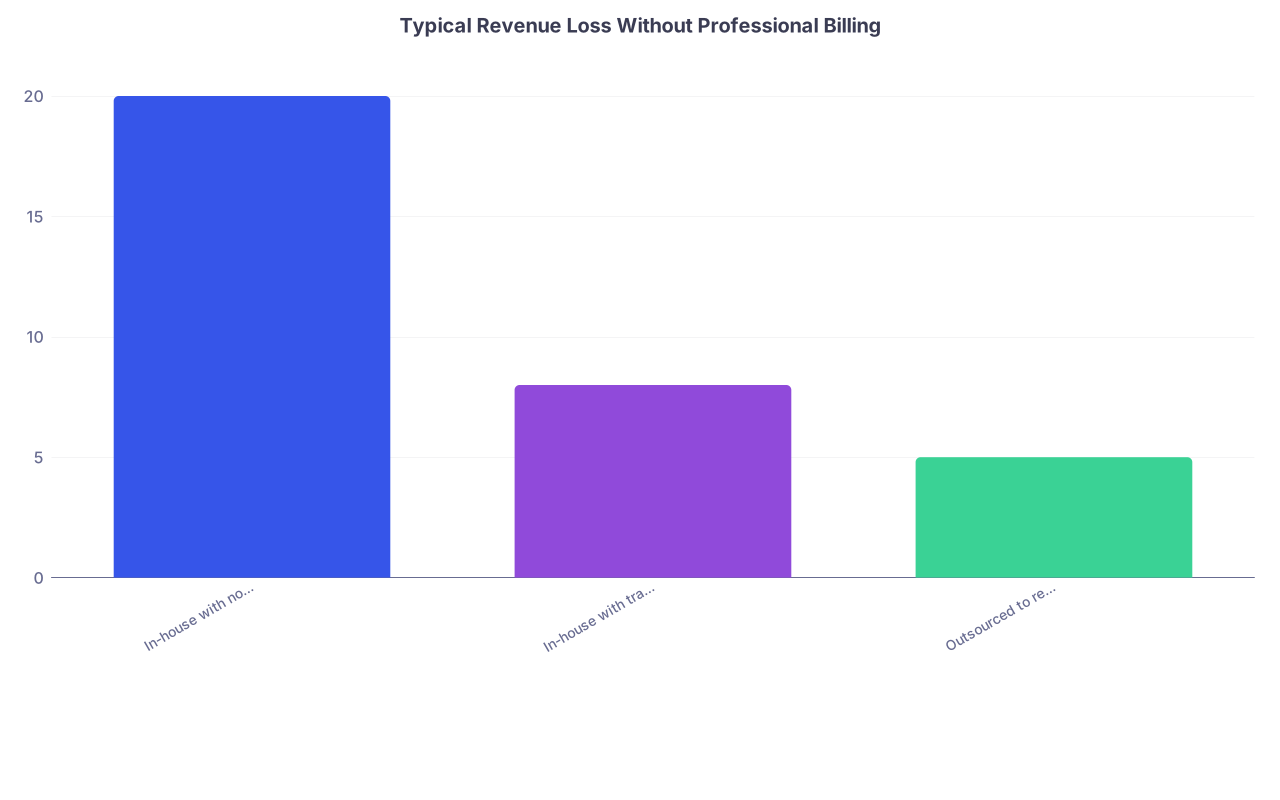
| Category | Value |
|---|---|
| In-house with no experience | 20 |
| In-house with trained coder | 8 |
| Outsourced to reputable billing firm | 5 |
2. Payroll and Basic HR Administration
Running payroll “manually” or via spreadsheets is a fast way to make tax and compliance mistakes. The IRS does not care that it’s your first year.
Outsource payroll to a reputable service (Gusto, ADP, Paychex, Rippling, etc.). They handle:
- Tax withholdings and filings
- Direct deposits
- W-2s/1099s
- Some HR documentation support
You do not want to be on hold with a state labor department over a filing error you made at 10 p.m. between chart notes.
What you must keep in-house: hiring and culture. You still:
- Decide who joins and who goes
- Set expectations and job descriptions
- Deal with performance issues (no vendor can fix a toxic MA for you)
3. IT Infrastructure and Cybersecurity
You’re a physician, not a sysadmin. Running your own servers or DIY’ing network security in 2025 is asking for a breach.
Outsource to a healthcare-focused managed IT provider who can:
- Set up secure Wi-Fi, firewalls, and device management
- Configure backups and disaster recovery
- Manage antivirus, patches, and encryption
- Support staff with tech issues
Pair this with a cloud-based, HIPAA-compliant EHR/practice management system. You do not want to self-host your EHR in year one.
What you must keep in-house: policies and habits. You still:
- Enforce password hygiene and 2FA
- Decide who has access to what
- Make decisions about PHI handling and workflows
4. Website Development and Basic Online Presence
Building your own website is a poor use of your time. It’s not 2005 and your Weebly template will look like it.
Outsource to a small agency or freelancer who:
- Builds a simple, fast site (4–6 pages) with clear calls to action
- Makes it mobile-friendly
- Includes basic SEO setup for your local area
- Integrates online forms or patient request tools if needed
This is a one-time (or low-recurring) expense that’s worth doing right. You don’t need a $20k brand project. But you do need something that doesn’t look like a student project.
What you must keep in-house: the message. You should:
- Decide the positioning: who you serve, what makes you different
- Provide or at least edit the content so it sounds like you, not generic fluff
What You Should Usually Keep In-House (At Least Initially)
These are the functions where outsourcing too aggressively in year one usually backfires.
1. Patient Scheduling and Front Desk Operations
Your front desk is your practice’s nervous system. It controls first impressions, schedule density, and a ton of revenue leakage.
I’ve seen practices outsource scheduling to a call center and watch new patient conversion tank. Why? Because those reps:
- Don’t understand your clinical nuances
- Can’t flex intelligently when the schedule gets tight
- Give robotic, script-based answers that scare away anxious patients
In year one, you want:
- A real human (or small team) who sits in your practice
- Cross-training: phones, check-in, basic insurance verification
- Direct feedback loops with you about what patients are asking and where they’re confused
You can outsource overflow calls or after-hours answering. But core scheduling and patient communication should stay close.
2. Clinical Workflows and Protocol Design
Outsourcing “clinical workflow design” is how you end up with a generic, irritating process that doesn’t match how you actually practice.
Examples:
- Rooming workflows
- Refill protocols
- Lab result handling and messaging
- Follow-up scheduling rules
- Intake forms and visit templates
Vendors and consultants can give you starting templates, but you should own the decisions. This is your practice DNA.
You can (and should) involve your staff heavily. But do not abdicate this to your EHR rep or a generic consultant who has never watched you see patients.
Somewhere in the Middle: It Depends on Your Risk Tolerance and Budget
These areas are more nuanced. You might outsource parts and keep parts close.
1. Bookkeeping vs. Full Accounting
Bookkeeping is a commodity. Tax strategy is not.
Here’s a sane division for year one:
- Outsource bookkeeping:
- Daily/weekly transaction categorization
- Bank/credit card reconciliations
- Basic financial statements (P&L, balance sheet, cash flow)
- Hire a CPA (medical or small business focused):
- Entity structure (S-corp vs LLC, etc.)
- Tax planning and quarterly estimates
- Compliance with state and federal tax rules
What you keep in-house: basic financial literacy and cash awareness. You should:
- Review financials monthly (at least revenue, expenses, and cash runway)
- Understand your major cost centers
- Be able to answer: “What’s my average revenue per visit? Per day?”
| Task | Recommended Approach |
|---|---|
| Daily bookkeeping | Outsource |
| Tax planning | CPA (external) |
| Payroll processing | Outsource |
| Financial strategy | You + CPA (shared) |
| Cash flow monitoring | You (in-house) |
2. Marketing and Patient Acquisition
This is where many new practices burn cash. They hire a marketing agency to “build the brand” before they have their operations dialed in. Huge mistake.
In year one, your marketing should be simple and close to you:
You keep in-house (or at least directly drive):
- Referral relationships (PCPs, specialists, therapists, etc.)
- Community presence: talks, local events, networking
- High-level positioning: what type of patients you want more of
You outsource selectively:
- Website build (as above)
- Google Business Profile optimization and basic local SEO
- Optional: small, controlled paid ad campaigns (e.g., Google Ads) managed by someone who understands healthcare rules
Do not sign a 12-month high-fee agency contract in year one. If an agency starts talking about “funnels” and “omnichannel strategy” before asking about your payer mix and schedule capacity, pass.
3. Compliance and HIPAA
You cannot outsource liability. But you can (and should) outsource expertise.
Use outside help for:
- HIPAA risk assessment and security evaluation
- Policy and procedure templates
- Staff training modules
- OSHA training and documentation
Keep in-house:
- Enforcement of policies
- Day-to-day decisions (e.g., how you handle family members asking for info)
- Incident response if something goes wrong
Technology Stack: What to Buy vs What to Build
Some physicians get tempted to “customize” everything. Or worse, build tools themselves. Do not do this in year one.
You should buy (i.e., outsource development/maintenance to a vendor):
- EHR and practice management system (cloud-based)
- e-Prescribing, e-labs, e-fax solutions
- Patient portal and basic messaging (through your EHR)
- Online intake forms and e-signature tools
- Telehealth platform (if you offer telehealth)
You should keep in-house:
- How you configure templates and order sets in your EHR
- Your scheduling rules and visit types
- What gets automated vs what stays manual

| Step | Description |
|---|---|
| Step 1 | Start Practice |
| Step 2 | Select cloud based system |
| Step 3 | Integrate billing company |
| Step 4 | Hire front desk |
| Step 5 | Outsource payroll |
| Step 6 | Launch website |
| Step 7 | Start seeing patients |
| Step 8 | Choose EHR |
A Quick View: What Most Smart New Practices Do
This is the pattern I see in practices that don’t crash and burn in year one:
| Area | Typical Year One Choice |
|---|---|
| Billing | Outsource to specialty firm |
| Payroll | Outsource to payroll service |
| Bookkeeping | Outsource, with external CPA |
| Scheduling | Keep in-house |
| Front desk | Keep in-house |
| IT & cybersecurity | Outsource to healthcare IT |
| Website | Outsource simple build |
| Marketing | Mixed: some in-house, some light outsourcing |
Red Flags When You’re Choosing Vendors
You will be aggressively pitched by vendors the minute you file your LLC and grab an NPI. Some are good. Many are mediocre. A few are outright predatory.
Walk away if:
- They refuse to provide references from similar-sized practices in your specialty
- They push long-term contracts (12+ months) with high termination fees
- Their reporting is opaque (“we’ll send you a summary” instead of giving dashboard access)
- They promise “guaranteed” increases in revenue or new patients without seeing your current numbers
On the flip side, good vendors:
- Ask detailed questions about your processes before selling
- Talk honestly about tradeoffs and limitations
- Give you sample reports and clear SLAs (e.g., average days to submit claims, support response times)

| Category | Value |
|---|---|
| Clinical care | 70 |
| Admin tasks | 20 |
| Business strategy | 10 |
How to Decide for Your Specific Practice: A Simple Test
For any task you’re debating, run this quick filter:
- Is this directly tied to patient care quality, clinical outcomes, or your professional reputation?
- If yes, heavily bias toward keeping in-house or under tight control.
- Is this highly regulated, with big downside risk if mishandled (HIPAA, taxes, payroll)?
- If yes, outsource expertise but keep policy-level control.
- Is this a mature, high-volume, process-driven area where specialists exist (billing, bookkeeping, IT)?
- If yes, strongly consider outsourcing execution.
- Would you be embarrassed if a patient, referring physician, or auditor saw how this is handled?
- If yes, either fix it yourself or pick a strong vendor—no half measures.
You’ll notice one pattern: in year one, you should almost never be the primary “doer” for anything non-clinical. Decision maker, yes. Implementer, rarely.

Two Common Bad Strategies (Do Not Copy These)
The “I’ll Just Do Everything Myself” Model
This is the physician answering phones between patients, doing payroll on Sundays, and manually sending claims in the evening. They save a few thousand dollars and lose tens of thousands in lost visits, denials, burnout, and sloppy errors.The “I’ll Outsource My Brain” Model
This is the doctor who lets their billing company decide coding practices, their marketing agency define their brand, and their EHR rep define workflows. They lose control of their own practice identity and often have no idea why their numbers look the way they do.
You want the middle path: outsource execution, retain judgment.

Bottom Line: What To Remember
Three key points:
- In year one, you should outsource billing, payroll, IT, basic bookkeeping, and website build—while keeping front desk, scheduling, and clinical workflows in-house.
- You can’t outsource responsibility. You can outsource execution, but you must still set direction, monitor performance, and understand the basics of your numbers.
- Any vendor that makes your life more confusing instead of simpler is the wrong vendor. The right partners free up your time to see patients, think clearly, and actually build the practice you wanted in the first place.