
The default advice about hiring a practice manager from day one is wrong for most new clinics.
You probably do not need a full-time practice manager when you open. You need just enough staff to see patients, get paid, and not drown. That is a much lower bar than what big hospital systems make you think.
Let me walk you through what actually makes sense, based on clinic size and growth stage—not consultant fantasy.
The real answer: when you do and do not need a practice manager
Here’s the blunt version:
- Solo clinic, 0–20 patients/day: You do not need a full-time practice manager. You might need someone part-time handling “manager-type” tasks.
- Small clinic, 20–40 patients/day or 1–2 providers: You still probably do not need a traditional practice manager title, but you need a lead staff member with some extra admin hours baked in.
- Growing group, 3+ providers or 50+ patients/day: You should strongly consider at least a part-time manager. Full-time once your time starts getting eaten by HR, payor issues, and operations.
- Multi-site or >5 providers: Not a debate. You need a practice manager (and probably a billing lead and front-desk lead too).
The key point: “practice manager” is a function, not a mandatory day-one role. On day one, the practice manager might be you plus a very capable front desk person.
The three jobs every clinic must cover on day one
Before talking titles, get clear on the work. Every outpatient clinic—family med, derm, psych, whatever—has three buckets of work:
Clinical care
See patients. Chart. Refill meds. Procedures. Everything only licensed clinicians can do.Front-end operations
Phones, scheduling, check-in/out, verifying insurance, collecting copays, prior auths, basic patient communication.Back-end operations & management
Billing follow-up, A/R, payroll, staff schedules, supply ordering, vendor contracts, compliance, reporting, dealing with payors, policy setting.
Hospitals shove bucket 3 into a “Practice Manager” role. Small practices mix buckets 2 and 3 into one or two smart staff people…plus the owner-doctor, at least early on.
Your job starting out is to cover all 3 buckets without overhiring and killing your margin.
Baseline staffing by clinic size
Use this as a starting point, then adjust for your specialty, procedures, and visit length.
| Clinic Size / Volume | Front Desk / Admin | Clinical Support | Management Need |
|---|---|---|---|
| Solo, 8–12 pts/day (months 1–3) | 0.5–1.0 FTE | 0–0.5 FTE | Physician + outside vendors |
| Solo, 12–20 pts/day | 1.0 FTE | 0.5–1.0 FTE | Lead admin (no manager) |
| 1–2 providers, 20–40 pts/day | 1–2 FTE | 1–2 FTE | Part-time manager or lead |
| 3–5 providers, 40–80+ pts/day | 2–4 FTE | 3–5 FTE | Dedicated practice manager |
| Multi-site / >5 providers | 4+ FTE front, 5+ clinical | 1+ manager, 1+ billing lead | Full management structure |
FTE = full-time equivalent.
So no, you do not walk in on day one and drop $80–120K on a full-time manager if you’re seeing 5 patients a day and building volume.
What a practice manager actually does (and why it matters later)
You need to know what you’d be paying for before you decide when to hire.
A competent practice manager usually owns:
- Staff hiring, onboarding, and discipline
- Scheduling templates, clinic hours, provider templates
- Payroll, time-off tracking
- Supply and vendor management (from exam table paper to EHR contracts)
- Revenue cycle oversight (denial trends, A/R reports, working with billers)
- Payor contracting updates and renegotiations
- Policy writing (no-shows, refill protocols, phone rules)
- Compliance basics (OSHA, HIPAA training logs, incident documentation)
- Handling patient complaints before they become legal problems
Could you, the physician-owner, do all of that at the beginning? Yes.
Should you do all of that forever? No. At some point your hourly value seeing patients will wildly exceed the cost of a manager.
But in month 1–6, with partial schedules and uncertain cash flow, it often makes more sense to:
- Outsource billing to a revenue cycle company instead of hiring in-house
- Use a fractional bookkeeper and payroll service
- Take 2–4 hours/week yourself to review KPIs and put out fires
- Upgrade one front desk person into an “office coordinator” who gets a bit more pay and responsibility
That’s your bridge between “I do everything” and “we have a real manager.”
Solo practice: what to hire on day one (and what to delay)
Let’s be concrete. Imagine:
- You’re a family med doc opening a solo clinic.
- Hours: 4 days/week, planning for 8–12 patients/day initially, aiming for 18–20/day by 6–9 months.
Here’s a sane staffing plan that does not include a practice manager at launch.
Day-one minimum
You need:
- You (physician)
- One very capable full-time front desk / admin hybrid
They handle: phones, check-in/out, insurance verification, prior auths, basic referral coordination, uploading documents, scanning, and being the sane voice on the phone. - Optional: Part-time MA or nurse
If you’re low-volume you can technically room and draw labs yourself early, but this gets old fast and looks bad once you’re at 12–15/day.
Who’s the “manager” in this scenario?
- You, plus:
- Your billing company’s account manager
- Your bookkeeper
- Your front desk person who becomes the de facto office lead
No “Practice Manager” title. No extra $80–120K payroll burden.
When to add management support
Watch for these signs:
- You spend more than 4–5 hours/week on staff issues, scheduling changes, vendor calls, payor complaining, and non-clinical decisions.
- You’re regularly staying late for admin that’s not clinical (not charting, but operations).
- Revenue is stable and you’re booked out 2–4 weeks.
At that point, you’ve got two smart options:
Give your strongest admin staff member 4–8 protected hours/week as “office coordinator” with a small raise.
They:- Run supply orders
- Chase vendor quotes
- Keep a checklist for compliance tasks and reminders
- Help with basic HR docs, schedule, and staff meetings
Hire a part-time remote or local practice manager (10–20 hours/week)
Plenty of experienced managers are happy to do fractional work. They can:- Set up your SOPs, policies, and HR basics
- Build simple reporting dashboards
- Oversee your billing company and payor issues
- Coach your staff lead
You still avoid a full-time manager until you truly need one.
When a full-time practice manager becomes non-negotiable
Here’s the inflection point where you stop being clever and just hire the manager.
You’re likely there if:
- You have 3+ providers (MD/DO/NP/PA) generating full schedules
- You’re consistently at 40–50+ patient visits per day across the clinic
- Staff: 3+ front desk/admin and 3+ clinical (MAs, nurses)
- Problems:
- You’re fielding regular “we’re short-staffed” or “the schedule is chaos” complaints
- Denials and A/R are creeping up and nobody really “owns” fixing them
- You haven’t renegotiated contracts or systematically reviewed payor mix in 2+ years
- Onboarding a new employee is an ad hoc mess every time
At this stage, not having a manager is expensive. You’re leaking money through:
- Inefficient schedules
- Poor denial follow-up
- Staff turnover from lack of structure
- You being pulled into every micro decision
That’s when:
- A $90–120K manager who tightens operations and grows volume by even 10–15% more than pays for themselves.
- You free up 1–2 clinic sessions per week that you can now fill with revenue-producing visits.
How staffing changes as your clinic grows
It helps to see the evolution, not just the endpoints.

| Step | Description |
|---|---|
| Step 1 | Stage 1 - Solo Launch |
| Step 2 | Stage 2 - Busy Solo |
| Step 3 | Stage 3 - Small Group |
| Step 4 | Stage 4 - Multi Provider |
| Step 5 | Stage 5 - Multi Site |
| Step 6 | You + admin hybrid |
| Step 7 | Add MA or nurse |
| Step 8 | Lead admin or part-time manager |
| Step 9 | Full-time practice manager |
| Step 10 | Manager + department leads |
Stage by stage:
- Stage 1: You do most of the “manager” work yourself. Outsource billing and bookkeeping, keep staff lean.
- Stage 2: You add an MA/nurse and upgrade your best admin to an informal coordinator.
- Stage 3: You bring in another provider; you either promote a staff lead or hire a part-time manager.
- Stage 4: Full-time manager with clear authority over non-physician staff.
- Stage 5: Layered management—practice manager, billing supervisor, front-desk lead.
Notice: the title “Practice Manager” doesn’t seriously show up until Stage 3–4.
Typical staff-to-provider ratios that actually work
This is where people under or over-hire. Here’s a clean baseline.
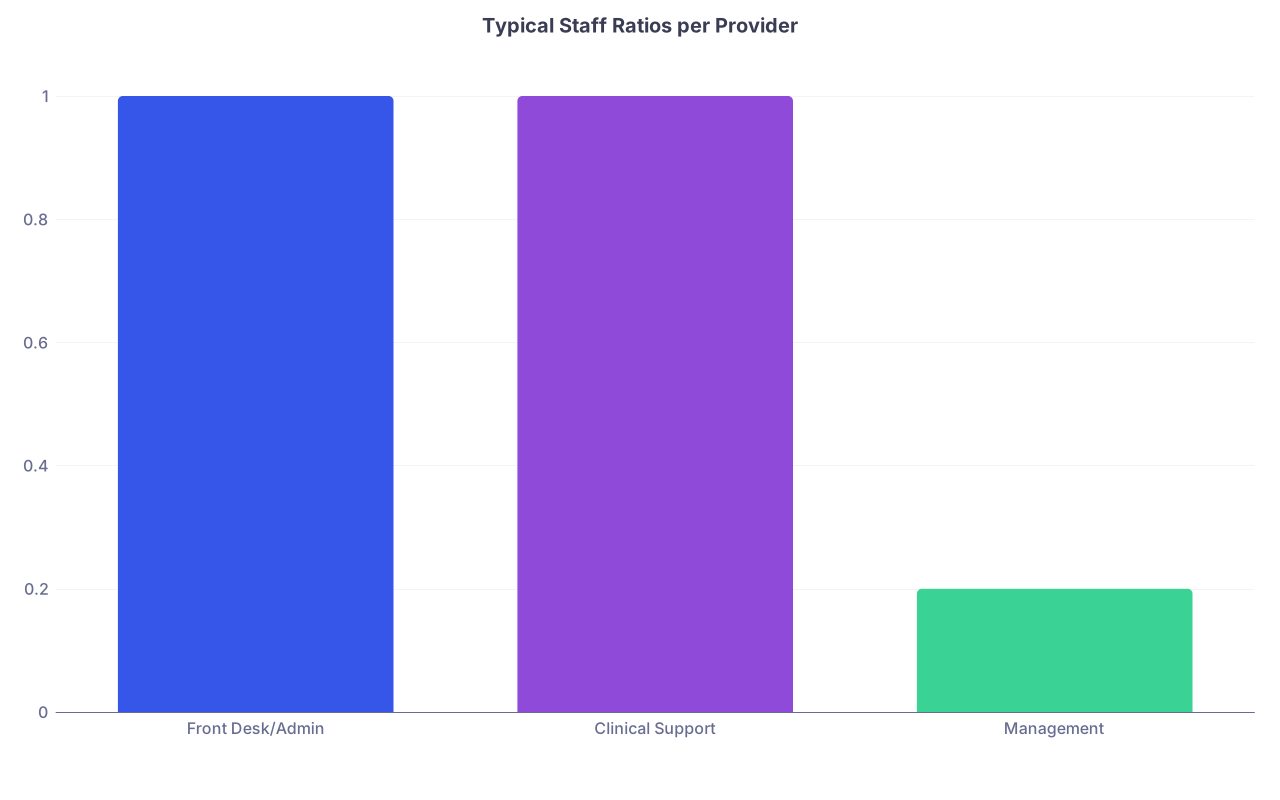
| Category | Value |
|---|---|
| Front Desk/Admin | 1 |
| Clinical Support | 1 |
| Management | 0.2 |
Per full-time provider (once you’re busy):
- About 1.0 front-desk/admin FTE
- About 1.0 clinical support FTE (MA/RN)
- About 0.2 management FTE (i.e., 1 manager per 4–5 providers)
You can flex these slightly:
- High-procedure specialties (derm, pain, GI) may need more clinical staff.
- Telehealth-heavy or psych practices can sometimes get by with fewer front-desk staff.
- Very complex multi-specialty clinics may need more management earlier.
But if you’re at 1 provider, 1 MA, 1 front desk, and a full-time manager from day one, you better be doing boutique concierge or very high reimbursing work—or your margins will be ugly.
Practical decision framework: do you hire a manager now?
Make this ruthless. Ask yourself:
What is my average revenue per clinical hour?
If you can generate $400–700/hour in collections, and you’re doing 4–5 hours a week of management work that a competent manager could do at $45–65/hour, you’re eventually burning money by not delegating.Is my schedule full or close to it?
If you’re still building volume, keep overhead low. If you’re booked solid and turning patients away, your problem is capacity and efficiency—classic management territory.Where are the fires?
- Constant staff drama, turnover, or errors → you need structured leadership.
- Denials, A/R, and cash flow issues → you need someone to own the revenue cycle.
- You’re behind on compliance, policies, and HR paperwork → you’re exposed.
Can I start part-time?
Hiring a practice manager does not need to be a binary 0 or 1.- Start with 10–20 hours/week
- Define 3–5 clear projects (improve A/R, standardize onboarding, rewrite policies, restructure schedule templates)
- See if that materially improves your life and the clinic’s performance
If the answer to most of those is “yes, I’m underwater and yes, my volume supports it,” you’re ready.
If not, you need better systems and stronger staff leads more than you need a titled manager.
Common mistakes to avoid
A few patterns I see over and over:
Hiring a “practice manager” who is really just an overpaid front-desk lead
Fancy title, no real operational or financial skill set, does not manage metrics, just runs the schedule and covers phones. Waste of money.Delegating everything without oversight
You go from micromanaging to total abdication: no dashboards, no KPIs, no monthly review. That’s how billing disasters and embezzlement happen.Underinvesting in your best staff member
Your sharp front-desk person or MA who naturally organizes things? That’s your future coordinator or manager. Give them training, a bit more pay, and clear responsibility.Thinking “I’m a doctor, I don’t do business”
You own a business. Early on, you are the de facto practice manager. Act like it. Learn enough to supervise whoever eventually holds that title.
FAQ: Do You Need a Practice Manager on Day One?
1. Should I hire a practice manager before I open my clinic?
Usually no. For a solo or small new clinic, you can manage launch with:
- You as clinical lead and temporary manager
- One strong front-desk/admin hire
- A part-time MA or nurse as volume grows Add a fractional manager later if admin work starts to exceed 4–5 hours/week and your schedule is full enough to support the cost.
2. What’s the minimum staff I need to open a private practice?
For most outpatient specialties:
- You (physician)
- 1 full-time front-desk/admin hybrid
Optional but highly recommended once you hit ~10+ patients/day: - 0.5–1.0 MA or nurse FTE
You can add complexity and management roles only after you’ve proven patient demand and cash flow.
3. At what point is a full-time practice manager financially justified?
Typically when:
- You have 3+ providers or regularly see 40–50+ patients/day
- Admin chaos, staff issues, and billing problems are pulling you away from patient care
- Your collections per clinical hour significantly exceed a manager’s hourly cost, and you’re consistently booked Below that threshold, part-time management or a strong lead staff member is usually enough.
4. Can my front desk person act as a practice manager?
They can act as an office coordinator or lead, not a full-scope manager, unless they have real experience with:
- HR, hiring, and staff supervision
- Revenue cycle oversight and reporting
- Vendor contracts and compliance
Promote them gradually: give them defined responsibilities and 4–8 protected hours/week for “management” tasks before slapping on a manager title.
5. How do I know if I’m under-staffed vs over-staffed?
You’re under-staffed if:
- Phones go unanswered
- Check-in/out is slow
- Clinical staff are constantly “putting out fires”
You’re over-staffed if: - Staff are idle for long stretches
- Payroll feels crushing relative to collections
- You hired roles (like a manager) before there’s enough work or revenue to justify them
6. Should I outsource billing instead of hiring a manager or biller?
In the first 1–3 years, yes, outsourcing billing usually beats hiring an in-house biller or leaning on a manager to “do billing.” A good billing company:
- Handles claim submission, denials, and posting
- Provides basic reporting
- Lets you stay flexible as volume grows
Your manager (when you have one) should oversee the billing company, not replace it early on.
7. What’s one thing I should do now if I’m unsure about hiring a manager?
Track your time for two weeks.
Write down:
- Every non-clinical task you do
- How long it takes
At the end, tally how many hours/week you spend on management-type work. If it’s under 3–4 hours and you’re not constantly behind, keep leaning on staff and systems. If it’s 5+ hours and you’re still drowning, it is time to explore a part-time or full-time manager.
Open a blank page right now and map your first year’s staffing by quarter: who you need on day one, who you’ll add at 6 months, and when a manager might realistically enter the picture. If you cannot write down a concrete trigger for hiring a practice manager, you’re not ready to hire one yet.