
The assumption that you must choose either a pure cash practice or a fully insurance-based clinic is wrong. You can absolutely run a small, profitable cash‑pay practice inside a predominantly insurance model—if you are deliberate and ruthless about boundaries.
Let me break this down specifically.
1. The Real-World Context: Why This Hybrid Model Actually Works
You are post‑residency, staring at a job market of RVU hamster wheels and bloated hospital systems. You probably do not have the capital, risk tolerance, or patient base to open a pure cash clinic from scratch. But you do have one asset: an employed job that pays your bills while you build something of your own.
The sweet spot for many early‑career physicians is this:
- Primary income: an employed position in a mostly insurance-based group or hospital system.
- Parallel build: a small, carefully scoped, cash‑pay practice you own, with controllable overhead and capped clinical hours.
That “inside a predominantly insurance model” can mean one of three things:
- You’re employed in a large insurance-based system and start a separate, legally distinct cash side practice.
- You join a small group that already bills insurance and negotiate a carve‑out for your own cash‑pay services.
- You inherit/partner in a traditional insurance practice and gradually introduce well‑defined cash‑pay components.
Let’s be blunt: Scenario 1 is usually the safest and cleanest for a new grad. Different tax ID, different entity, different policies. Less chance of landmines with Stark, anti‑kickback, and employer contract violations.
Before you see a single cash‑pay patient, you need to resolve four hard questions:
- What exactly are you selling that justifies cash?
- Who specifically will pay for it in your market?
- How will this coexist with your main job contractually and legally?
- What is your minimum viable version of this practice?
If you cannot answer those clearly, you are not ready to launch.
2. Step One: Absolute Clarity on Your Cash‑Pay Offer
“General primary care” cash‑only, with no differentiation, is dead in most urban and suburban markets unless you are doing full DPC or concierge from day one. You are not. You are layering a small cash practice on top of an insurance life. So you must niche.
Think in terms of high‑value, discrete, non‑emergent problems people will pay for out of pocket because:
- Insurance makes access painful or slow.
- Traditional visits are too short or fragmented.
- Care is disjointed and no one is coordinating.
- There is stigma, privacy concern, or employer‑related worry.
Concrete examples that actually work:
- Psychiatry: 60–90 minute diagnostic consults, ongoing med management + therapy‑adjacent work, no prior auth circus.
- Adult ADHD: comprehensive evals with validated scales, collateral gathering, and treatment plan in one or two long visits.
- Perimenopause/menopause consults: hormone therapy counseling, symptom management, continuity.
- Headache / migraine clinic: deep intake, trigger mapping, stepwise plan, procedures if you are trained (e.g., nerve blocks, Botox).
- Obesity medicine: structured intake, labs, counseling, medication initiation and follow‑up, clear program pricing.
- Sleep medicine: insomnia CBT‑I structured program, PAP management consults, non‑DME advice.
- Dermatology: acne programs, rosacea management, isotretinoin oversight, cosmetic‑adjacent but still medical.
- Musculoskeletal / sports: ultrasound‑guided injections, focused rehab protocols, return‑to‑sport evaluations.
You want:
- One or two clinical “lanes.”
- Repeatable visit structures.
- Minimal equipment outlay.
- Strong word‑of‑mouth potential.
Then you define a tiny menu of visit types. For example, an adult ADHD/cognitive clinic:
- 90‑min initial evaluation.
- 45‑min follow‑up (month 1–3).
- 25‑min med management follow‑up (after stable).
- Optional 60‑min “complex follow-up” for life chaos visits.
No buffet. No “whatever walks in.” Cash‑pay lives or dies on clarity.
3. Legal and Contractual Landmines: Do Not Wing This
Here is where young physicians get burned: they launch something on the side and forget they signed a 20‑page employment contract full of landmines.
You must explicitly handle:
Non‑compete and moonlighting clauses
Typical problems I see:- Language banning “any clinical practice” outside the employer.
- Restrictions on seeing patients within X miles for Y years.
- Vague language about “competing services.”
You need one of the following:
- Written moonlighting / side practice approval specifying: hours, location, and scope,
OR - A contract that clearly allows outside practice so long as it does not directly compete.
Use of employer resources
Golden rule: zero.
No employer staff, no EMR access, no using your MA or nurse “on the side,” no calling in scripts from the hospital line for your cash patients. Different systems, full stop.Insurance participation conflicts
If your NPI is contracted with payers through your employer at Location A, you can still run a cash‑only practice at Location B. But you cannot bill those same payers for those services at B, and you need to be careful about:- Not accidentally generating “out-of-network” claims where you were supposed to be in‑network under the group.
- Not submitting any claims from the cash entity without proper contracts.
The cleanest approach: the new entity is out‑of‑network with everyone, and you explicitly do not submit claims. Patients get a superbill if they ask.
Stark / Anti‑Kickback (AKS)
If you are in a hospital‑employed or big system job:- Avoid referral loops where you send your employed patients to your cash practice for services that could be provided in‑network.
- No “discounts” tied to referrals.
- No special treatment for patients from payers that steer to your employer.
A simple safe rule: the cash practice has its own patient base, and if there’s overlap, it is patient‑driven, not referral‑engineered.
You probably need a health‑care attorney for a 1–2 hour review, especially if you are in high‑regulation states (CA, NY, MA). That money is not optional; it is tuition.
4. Structuring the Entity and Financial Skeleton
You are not building a mini‑hospital. You are building something more like a boutique consultancy.
Set it up like you are serious:
- Legal entity: usually a PLLC/PC or LLC depending on your state.
- Separate EIN.
- Separate business bank account.
- Dedicated malpractice policy for your side practice (often part‑time rider, very affordable in most fields).
- Clear operating agreement if you have partners (I strongly recommend solo at first).
Your fixed overhead should be aggressively low the first year. Think in terms of a test:
“If I only see 4–6 cash‑pay patients per week, does this still make sense?”
Let’s run numbers.
Say:
- 1 half‑day per week to start, growing to 2 half‑days.
- You charge:
- $375 for 90‑min new eval.
- $225 for 45‑min follow‑up.
- $140 for 25‑min med follow-up.
You fill 6 slots per half‑day: 1 new, 5 follow‑ups. Revenue per half‑day:
- 1 × $375 = $375
- 5 × $140 (assuming most follow‑ups are brief) = $700
- Total = $1,075 / half‑day
Two half‑days per week → $2,150/week. Roughly $8,600/month top line if reasonably booked.
Now your baseline monthly costs might look like this:
| Expense Category | Approx Monthly Cost |
|---|---|
| Shared office rent | $800–$1,200 |
| Malpractice (part-time) | $150–$300 |
| EMR / eRx | $100–$300 |
| Phone / fax | $40–$80 |
| Website / hosting | $20–$50 |
| Accounting / bookkeeping | $150–$250 |
You are likely in the $1,300–$2,100/month range if you are not hiring staff initially. At $8,600/month revenue, that is a healthy margin for a side practice, even at 50–60% utilization early on.
You are not trying to extract a full attending salary from this immediately. You are building:
- An asset.
- An escape hatch.
- A skillset in running your own shop.
5. Location, Space, and Infrastructure: Think Sub‑Lease, Not Showcase
Do not sign a 5‑year lease for 2,000 sq ft and a waiting room chandelier. That is how people end up back inside hospital employment begging for sign‑on bonuses.
The early‑stage hierarchy:
- Sublease part‑time from an established practice (different specialty ideally).
- Executive/medical co‑working spaces that support HIPAA‑compliant setups.
- Very small solo lease (single office plus shared restroom) with flexible term.
I have seen psychiatrists, obesity specialists, and ADHD-focused internists run thriving micro‑practices out of:
- One office.
- One exam table (or none).
- A small locked cabinet for supplies.
- A laptop and a cellphone.
Your infrastructure stack:
EMR: You need something simple that does:
- Charting.
- eRx.
- Superbills if needed.
- Secure messaging or at least portal access.
Options: Charm, AthenaOne for small practices, SimplePractice (for psych/therapy), or other lightweight systems. Avoid giant hospital‑grade EMRs.
Payment:
- Card on file.
- No “bill later” nonsense.
- Stripe, Square, or integrated EMR payments.
Scheduling:
- Online scheduling that respects your limited availability.
- Clear buffers between patients. Cash‑pay patients get mad if you run a 45‑minute delay like a typical clinic.
Communication:
- Separate practice phone number (VoIP is fine).
- Strict rules: no texting from your personal cell. No WhatsApp randoms.
- Define message response windows (e.g., 1–2 business days, no after‑hours clinical advice).
You can build all of this for a few hundred dollars a month. The hard part is not tech. It is your boundaries.
6. Pricing, Packaging, and How Not to Race to the Bottom
Underpricing is the most common self‑sabotage I see.
You are not a cash‑pay urgent care. You are not a Groupon cosmetic injectables mill. You are a specialist (whether formally or by scope) offering unhurried, high‑expertise visits.
Your pricing must reflect:
- Your time.
- The cognitive load.
- The non‑visit work (notes, letters, FMLA forms, med prior auths if you choose to engage at all).
Anchor your fees by:
- Looking up what self‑pay consults cost at local specialty clinics.
- Looking at what telehealth ADHD/weight‑loss companies charge (and then offering something more human, more thorough).
- Mapping your rate to an internal hourly target. For example:
- If your target is $350/hour of clinical time, a 90‑min visit should be ≥ $500, not $250.
Then decide: à‑la‑carte vs packages.
For a tiny hybrid practice, I favor simple à‑la‑carte plus optionally a structured program, not fully membership‑based at first. Example for an obesity medicine micro‑clinic:
- $425 initial 75‑min consult (includes data review, labs ordered).
- $225 30‑min follow‑ups monthly for first 3–4 months.
- Optional 3‑month “intensive” package at a slight discount for patients who want commitment.
No unlimited messaging. No 24/7 access. This is where new DPC‑inspired docs get killed. You cannot promise concierge‑level access when you also have a full‑time insurance job.
Be explicit:
- No insurance billing.
- Payment due at time of service.
- Superbills available upon request for out‑of‑network reimbursement attempts.
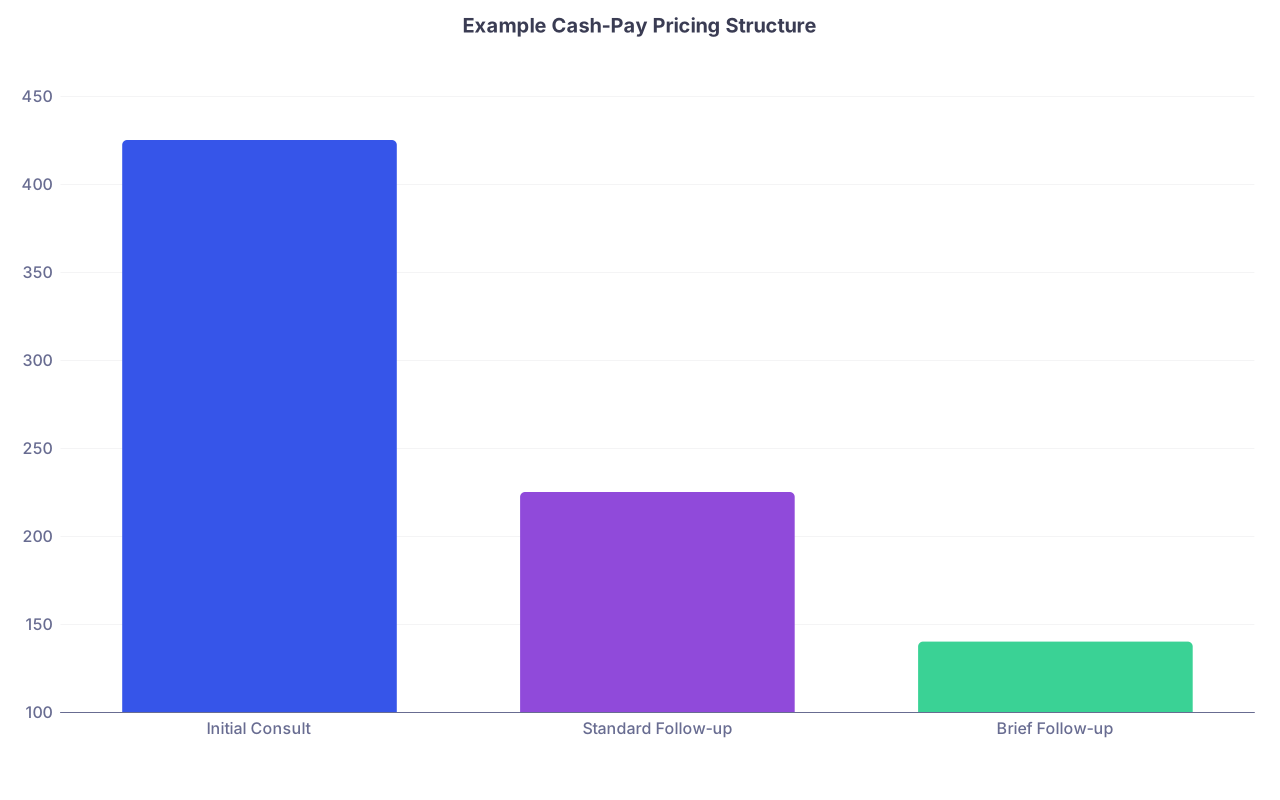
| Category | Value |
|---|---|
| Initial Consult | 425 |
| Standard Follow-up | 225 |
| Brief Follow-up | 140 |
This kind of visual clarity (even in‑office on a printed sheet) reduces awkward conversations.
7. Flow of Care: From Inquiry to Follow‑Up Without Chaos
You need a standard operating flow so you are not reinventing the wheel every time a patient emails or calls.
Here is a clean ADHD/mental health example:

| Step | Description |
|---|---|
| Step 1 | Patient finds website |
| Step 2 | Online intake form |
| Step 3 | Admin or you review fit |
| Step 4 | Schedule initial consult |
| Step 5 | Provide referral list |
| Step 6 | Collect deposit and forms |
| Step 7 | Initial visit |
| Step 8 | Send summary and plan |
| Step 9 | Schedule follow up |
| Step 10 | Ongoing care with clear messaging rules |
Key operational decisions:
Fit screening: Very brief questionnaire or email triage to avoid unsafe or inappropriate patients (e.g., active suicidality best referred to system‑based care).
Deposit: Collect a partial deposit at booking to reduce no‑shows, especially as your slots are limited.
Forms:
- Intake questionnaire (history, goals).
- Policies: no insurance billing, cancellation, communication expectations.
- Consent for treatment, telehealth if you use it.
Visit structure:
Start each new patient with a consistent script:- 5–10 minutes: patient story uninterrupted.
- 20–30 minutes: clarifying questions, history deep dive.
- 20–30 minutes: explanation, shared decision making.
- 10–15 minutes: tangible plan, next steps, follow‑up schedule.
Patients remember predictable structure more than they remember your medical school.
8. Coexisting With Your Insurance‑Based Job Without Getting Fired
This is where the “inside a predominantly insurance model” gets real.
You have obligations at your main job: panel management, call, metrics, RVUs. Your side practice cannot cannibalize your performance to the point you become a problem employee.
Concrete rules that keep you out of trouble:
No side practice during your employed hours.
Not even a “quick telehealth visit.” Hospital admin can and will check your EMR timestamps against your side practice times if there is a complaint.No poaching.
If a patient from your employed clinic “finds” your cash practice on Google and self‑schedules, that is one thing.
Inviting them in the exam room—“I also see patients in a separate practice if you want more time”—is a good way to trigger disciplinary action or worse.No confusion of roles.
You are not their hospital‑employed PCP and their cash‑only ADHD doctor under the same hat. If there is legitimate overlap, be crystal clear with the patient about:- Which practice is managing which problems.
- Where communication should go.
- How emergencies or off‑hours issues will be handled (likely through the main system, not your side line).
Documentation firewall.
Separate EMR. Separate records. If there is a true medical emergency or medico‑legal issue, you can share records appropriately, but day‑to‑day, keep systems distinct.
From a pragmatic standpoint: you want your employer to see your side practice as benign or even positive (you are engaged, entrepreneurial, not asking for endless raises), not as direct competition.
9. Patient Acquisition: How to Fill a Tiny Cash‑Pay Panel Without Sleaze
You do not need 500 patients. You probably need 40–120 semi‑regular patients to max out 1–2 half‑days per week if your follow‑up cadence is reasonable.
Where do they come from?
Audience: specific, not generic.
“High‑functioning professionals struggling with attention and burnout,”
“Women 40–60 with unmanaged perimenopausal symptoms,”
“Recreational athletes with persistent overuse injuries.”Website that does three things only:
- States who you help and how.
- Lists prices transparently.
- Lets people request / book an appointment.
No ten‑page essay about your medical school. One high‑quality headshot, one clear “Start here” button.
Basic SEO and local presence:
- Google Business Profile with:
- Name, address, phone.
- Hours (even if limited).
- Link to website.
- Have a few short, information‑dense pages on your niche topics. Not generic health fluff, but: “What to expect from a 90‑minute ADHD assessment,” “When perimenopause symptoms deserve medical attention.”
- Google Business Profile with:
Select, ethical referral sources:
- Therapists, coaches, PTs, dietitians who constantly see unmet medical needs in your niche.
- Nearby primary care docs who hate managing certain issues and are grateful to offload (e.g., ADHD, complex psych med management, refractory migraines).
You do not need a fancy lunch. You need a one‑page PDF or clean web page explaining:
- Who is a good fit.
- What you do and do not do.
- How quickly you can see their referrals.
- That you are cash‑pay and out‑of‑network.
Guardrails against burnout marketing:
- No overpromising “quick fixes.”
- No unlimited email access disguised as “premium care.”
- No trying to become a social media star when you barely have time to sleep.
A slow‑burn, word‑of‑mouth growth curve is fine. This is a side practice. Give it 12–24 months, not 12 weeks.
10. Time Management: Preventing the Two‑Job Death Spiral
You now have:
- A full‑time job.
- A micro‑business.
- A human life (allegedly).
You are one scheduling mistake away from hating both.
Practical constraints that actually work:
- Cap your side practice initially at one half‑day per week. That might mean:
- Wednesday 1–5 pm.
- Or Saturday morning 8–12.
- Hard‑block that time on:
- Your side EMR.
- Your personal calendar.
- Your mental list of “non‑negotiable commitments.”
Do not start at 3 half‑days, thinking “If I build it, they will come.” They will not, and you will resent the empty hours and sunk rent.
Track your actual hours:
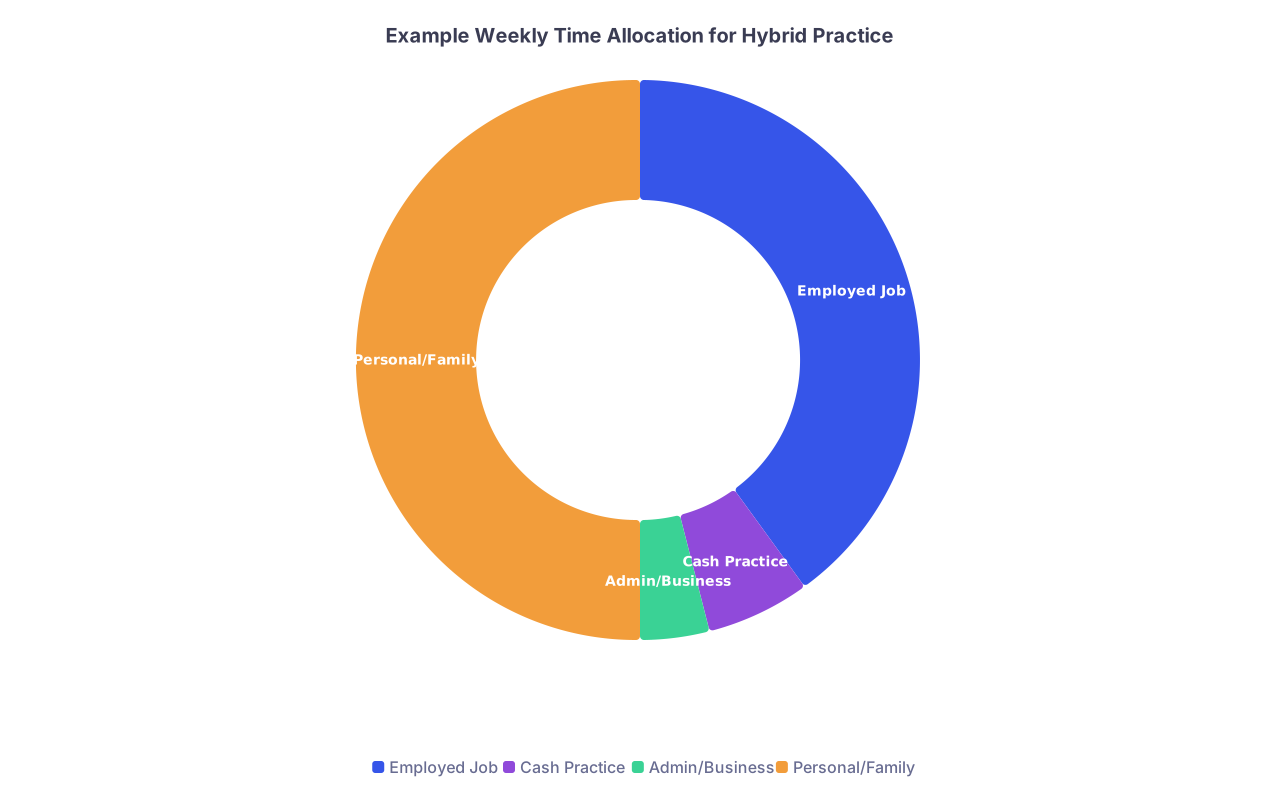
| Category | Value |
|---|---|
| Employed Job | 40 |
| Cash Practice | 6 |
| Admin/Business | 4 |
| Personal/Family | 50 |
That is a realistic early pattern: 40 clinical hours, ~6 hours of side practice (including charting), ~4 hours of admin/strategy, and whatever you can salvage for your life.
If your main job is already 55–60 hours/week with call, your move is not “add a side practice.” Your move is “fix or change the main job” first.
11. When and How to Scale This Beyond “Small”
The whole point of this model is optionality.
Three typical paths I see over 3–5 years:
Stable side practice, stable employed job.
You keep both, maybe increase your cash practice to 2 half‑days, enjoy diversification, and never go all‑in. Perfectly valid.Gradual shift of FTE.
You drop your employed role from 1.0 to 0.8 FTE, then to 0.6, and fill the gap with more cash‑pay sessions. This needs negotiation and planning but is realistic in many groups.Full pivot to independent practice.
Once your cash‑pay practice reliably covers your target income (or close), you let the employed job go. But by then, you have:- Systems.
- Patients.
- Proof of concept.
Scaling steps that actually move the needle:
- Add a second narrow niche that matches your current population.
- Extend hours slightly before hiring staff.
- When admin becomes painful, hire one part‑time admin/virtual assistant who understands healthcare, not five people at once.
- Consider adding telehealth across your state(s) for appropriate services.
Do not jump to:
- Hiring associates you cannot fill.
- Signing a big new office lease “because it looks more legit.”
- Accepting insurance “just for volume” and destroying the very margin that made the model viable.

12. Red Flags and Failure Patterns I See Repeatedly
Let me be blunt about what goes wrong:
- Vague offer: “I see adults for any primary care issues, but cash‑only.” That is code for empty schedule.
- Employer violation: side practice launched without contract review, discovered accidentally, leading to forced shutdown or worse.
- Underpricing: charging $125 for 60‑minute consults that require 30 minutes of unpaid paperwork after, then wondering why it feels like another RVU job.
- Emotional overextension: saying yes to every patient need because you are trying to “prove value,” ending up with boundaryless messaging, night calls, and burnout.
- Perfectionism delay: waiting to start until the website is flawless, the logo professionally designed, the EMR deeply customized. Meanwhile, months pass and you see zero patients.
The correct mindset:
Start small. Start imperfect. Start legally clean. Then iterate based on real patients, not on hypothetical projections.
FAQ (Exactly 4 Questions)
1. Can I start a cash‑pay practice while still in residency or fellowship?
Technically, in many states, yes—if you are fully licensed and your training program allows outside clinical work. Practically, I do not recommend launching a formal independent practice until you are at least PGY‑3 or later and your board eligibility is secure. Training demands, call schedules, and program restrictions make it hard to build anything consistent. Use residency to clarify your niche, observe what patients are not getting from the system, and maybe do some limited moonlighting to build comfort with independent decision‑making. The real build should start post‑residency when you have more control over your schedule and contracts.
2. How do I handle prescriptions and labs in a cash‑only, out‑of‑network setting?
Prescriptions are written exactly as in any other setting; the patient’s insurance (if they have it) still covers meds per their benefits. You do not bill insurance for your time, but the pharmacy and lab interface with payers as usual. For labs and imaging, you can either: send orders to in‑network facilities so patients use their insurance, or offer access to low‑cost cash arrangements (e.g., LabCorp/Quest cash panels, imaging centers with self‑pay rates). The key is transparency: tell patients whether you are optimizing for insurance use or lowest cash cost each time.
3. What malpractice coverage do I need for a small side practice?
You need a policy that explicitly covers your independent practice under its own entity and scope. Many carriers offer part‑time policies or riders for moonlighting and side work. Do not assume your employer’s policy covers your separate business; it almost never does. Be precise about your specialty, procedures, and expected volume when you apply. The premium for a small, low‑procedure cash practice is often surprisingly modest, especially if you are in lower‑risk fields (psych, primary care consultative work, non‑procedural subspecialties).
4. How long before a small cash‑pay practice becomes financially meaningful?
If you are disciplined and niche‑focused, you can see meaningful revenue (a few thousand dollars a month) within 6–12 months. To reach the point where it can replace a significant portion of a full‑time attending salary, you are typically looking at 18–36 months of consistent effort. This is not an overnight play. It is a slow, deliberate build—refining your niche, improving operations, building word‑of‑mouth, and gradually increasing your available hours as it proves itself.
Remember:
- The hybrid model works only if your cash‑pay offer is sharply defined and legally separate from your insurance‑based job.
- Start lean—sublease space, minimal fixed costs, one or two services—and price your expertise like it matters.
- Treat this as building an escape hatch, not a hobby; small, consistent steps over 1–3 years beat any grand “someday” plan you never actually start.