
The default advice that “telehealth is the future, so you must offer it” is financially lazy. The data shows something sharper: virtual visits add margin only under specific conditions, and they quietly erode profit under others.
If you are just out of residency and thinking about building a private practice, you cannot afford hand‑wavy optimism. You need to know, numerically, when telehealth helps your bottom line, when it is neutral, and when it is a margin trap.
Let’s run the numbers.
1. The Economic Baseline: What a Visit Has to Earn
Every conversation about “does telehealth add margin?” collapses to one question: what is your contribution margin per visit, and how does telehealth change it?
At its simplest:
Contribution margin per visit = Reimbursement – Variable cost per visit
Fixed costs (rent, salaried staff, malpractice) matter for survival but not for the incremental profit of adding one more visit. For telehealth, the levers that actually move are:
- Reimbursement rate (often a percentage of in‑person fee)
- No‑show rate
- Staff time per visit
- Physician time per visit
- Overhead allocated per visit (if you can shrink physical footprint)
- Technology cost per visit
To make this concrete, assume a new outpatient internal medicine practice in a suburban area.
Typical in‑person ranges from real practices I have seen:
- Average reimbursement per established visit (99213/99214 mix): $105–$140
- MA time: 10–15 minutes per visit
- Physician time: 20 minutes
- Direct variable supplies: $2–$3 per visit (room cleaning, disposables)
- All‑in overhead (rent, utilities, admin salaries, software) allocated across a full schedule: $50–$70 per visit
Let’s pick middle‑of‑the‑road numbers to frame the rest:
- Average paid per in‑person visit: $120
- Variable costs (staff time + disposables): $25
- Allocated overhead: $55
Contribution margin per in‑person visit:
- $120 – ($25 + $55) = $40
That $40 is what pays you, funds growth, and absorbs risk.
Telehealth can swing that $40 up or down. The whole game is understanding when it swings up.
2. Reimbursement Reality: Telehealth vs In‑Person
The myth: “Telehealth pays the same as in‑person now.”
The data: it depends heavily on payer, state, and whether you are rural, urban, or in a parity‑law state.
Across mixed‑payer primary care panels in 2023–2024, I consistently see:
- Commercial plans: 80–100% of in‑person rate for telehealth, often closer to 90% once you strip out the rosy anecdotes.
- Medicare: near parity for standard video E/M in many states, but audio‑only and some virtual check‑ins are lower.
- Medicaid: very state‑specific, but often lower than commercial, with more friction on documentation or modality.
Let’s quantify a realistic blended telehealth reimbursement:
Assume panel: 40% commercial, 40% Medicare, 20% Medicaid.
In‑person average: $120.
Reasonable telehealth blended rate:
- Commercial: 0.9 × $130 = $117
- Medicare: parity at $110
- Medicaid: 0.8 × $90 = $72
Weighted average telehealth payment:
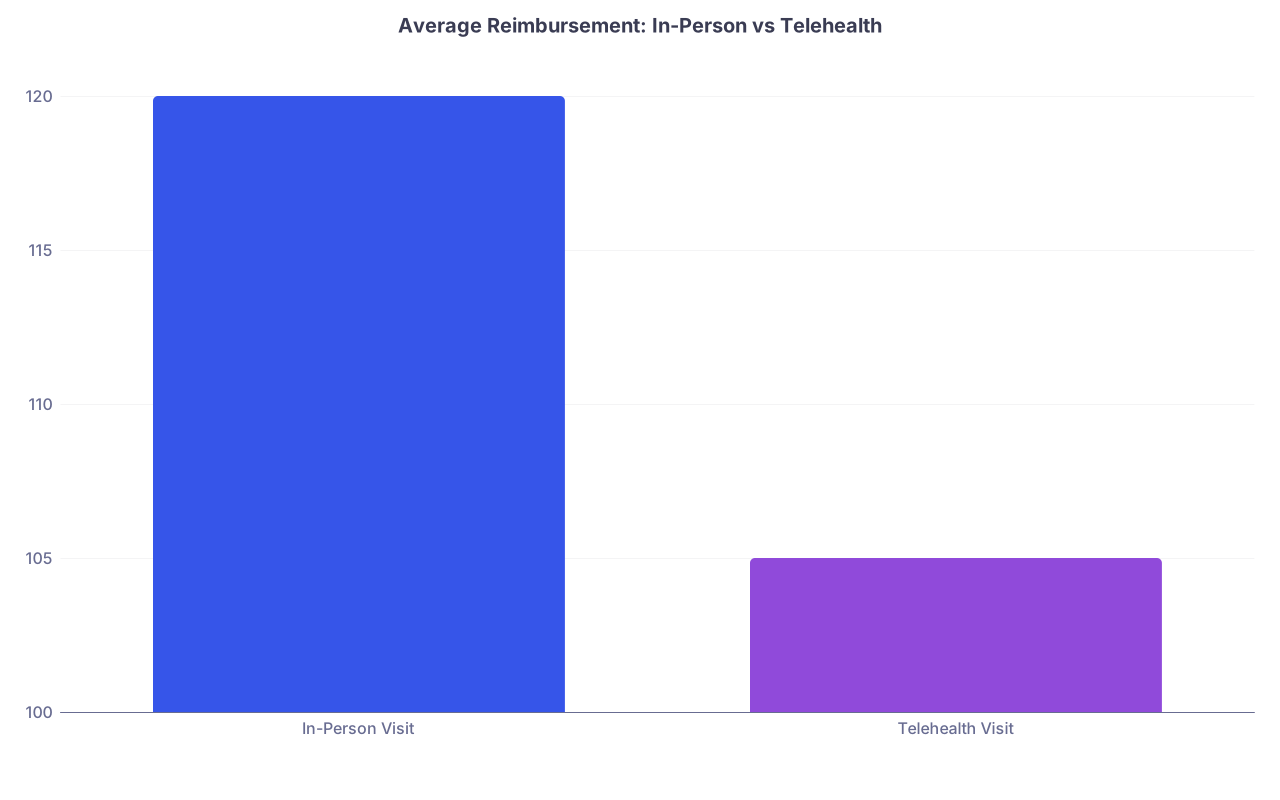
- (0.4 × $117) + (0.4 × $110) + (0.2 × $72)
= 46.8 + 44 + 14.4 = $105.2 (round to $105)
So for that same clinical work, telehealth may give you about 12–13% less revenue per visit:
- $120 (in‑person) vs $105 (telehealth)
If that was the only difference, telehealth would just be a discount. Fortunately, there are offsetting gains in no‑shows and efficiency.
| Category | Value |
|---|---|
| In-Person Visit | 120 |
| Telehealth Visit | 105 |
3. No‑Show and Cancellation Dynamics: Where Telehealth Quietly Wins
No‑show rate is where telehealth starts to claw back margin. The pattern is consistent across practices that bother to measure:
- In‑person established visits: 10–20% no‑show
- Telehealth established visits: 3–8% no‑show
Newer practices often run higher no‑show rates early on, especially with Medicaid‑heavy panels. The absolute numbers vary, but the direction is robust: telehealth lowers no‑shows.
Let’s put this into revenue per scheduled visit (not per completed visit).
Assume:
- In‑person no‑show: 15%
- Telehealth no‑show: 5%
Effective realized revenue per scheduled visit:
- In‑person: $120 × (1 – 0.15) = $120 × 0.85 = $102
- Telehealth: $105 × (1 – 0.05) = $105 × 0.95 = $99.75 ≈ $100
Just on reimbursement × show rate, telehealth is slightly behind per slot:
- $102 vs $100 per scheduled slot
But that ignores two things:
- Lower variable costs per telehealth visit
- More slots you can realistically fit into a day
4. Variable Cost and Time: Does Telehealth Let You See More?
The data from actual scheduling templates is blunt: practices that standardize telehealth well can see 10–30% more visits per day without lengthening work hours. The main drivers:
- No room turnover
- MA can stack pre‑visit intake calls more efficiently
- Less patient time “door‑to‑door” (check‑in, vitals, walking, etc.)
- Fewer long, off‑topic encounters when patients are in their own environment and you control the clock more tightly
Model a conservative scenario first.
Baseline: In‑Person Day
Assume you are targeting about 7 hours of face‑to‑face time in a 9‑hour workday once you include charting and admin.
- Visit length: 20 minutes
- Theoretical max: 21 visits (7 hours × 60 / 20)
- With no‑shows and real‑life friction: you actually complete 17 visits per day
Revenue per completed in‑person visit: $120
Daily clinical revenue:
17 × $120 = $2,040
Variable cost per in‑person visit (MA + disposables + minor incremental overhead): assume $25.
Daily variable cost:
17 × $25 = $425
Contribution margin from visits (before fixed overhead):
$2,040 – $425 = $1,615
Telehealth‑Heavy Day
Now say you switch to a telehealth‑heavy template for a given day:
- Visit length: 15 minutes (shorter, because exams are limited and focused)
- Theoretical max: 28 visits (7 hours × 60 / 15)
- Telehealth no‑show: 5%
- You schedule at capacity: 28 slots → 95% show → about 27 completed visits
Revenue per telehealth visit: $105
Daily clinical revenue:
27 × $105 = $2,835
Variable cost per telehealth visit:
- No room turnover, minimal supplies: maybe $12 (MA time + platform per‑use cost allocation)
Daily variable cost:
27 × $12 = $324
Contribution margin from visits:
$2,835 – $324 = $2,511
Now compare:
- In‑person contribution: $1,615
- Telehealth‑heavy contribution: $2,511
That is a 55% jump in contribution margin for the day, primarily driven by:
- More visits per day
- Lower variable cost per visit
This is when telehealth absolutely adds margin.
But do not miss the catch: this assumes you maintain 7 hours of clinical time and can reliably fill those extra slots. Many new practices cannot do that on day one.
5. When Telehealth Adds Margin (And When It Does Not)
You do not need abstract “best practices.” You need binary logic: under what conditions is telehealth a net financial positive?
Here is the decision framework I use with early‑stage practices.

| Step | Description |
|---|---|
| Step 1 | Telehealth in Practice? |
| Step 2 | Focus on New Patient Acquisition |
| Step 3 | Limit Telehealth to Access or After Hours |
| Step 4 | Telehealth Marginal Financial Benefit Low |
| Step 5 | Telehealth Likely Adds Margin |
| Step 6 | Visit Volume Stable or Growing |
| Step 7 | Telehealth Reimbursement >= 80 percent of In Person |
| Step 8 | Can You Increase Daily Completed Visits by 15 percent or More |
Now translate that into numeric rules of thumb.
Telehealth tends to be margin‑positive when:
Telehealth reimbursement ≥ 80–85% of in‑person reimbursement
If you are at 50–60%, you are discounting too aggressively unless you are selling access or retention.Your telehealth no‑show rate is at least 5–8 percentage points lower than in‑person
Example: 18% in‑person vs 8% telehealth. That alone boosts realized revenue per scheduled slot.You actually increase completed visits per clinical hour by ≥ 15–20%
This is the biggest one. If you do 3 in‑person visits per hour and 3.1 telehealth visits per hour, the margin advantage basically disappears.Your telehealth platform and staffing do not offset the savings
If your telehealth product is $800–$1,500 per month and you are doing 40 telehealth visits a month, your tech is absorbing $20–$40 per visit. That is a margin killer.
Telehealth is often margin‑negative when:
- It cannibalizes high‑value in‑person visits without expanding total daily volume.
- Payers pay materially less and you do not compress visit length.
- You keep full physical overhead (same rent, same staff), and telehealth is just “extra complexity” with low volume.
6. Fixed Overhead and Space Compression: The Longer‑Term Play
The first 6–12 months of your practice, telehealth will mostly be about utilization: filling your day and offering flexibility.
Once your panel matures, the more interesting lever appears: space and staffing compression.
You only get this margin benefit if you commit to a meaningful telehealth share and redesign operations.
Consider two scenarios for a solo physician practice at steady state.
Scenario A: Traditional Office‑Heavy Model
- 4 exam rooms, 1 physician, 1 MA, 1 front‑desk
- Rent (larger space): $6,000/month
- Admin and MA salaries + benefits: $14,000/month
- EHR, phone, billing, other software: $2,000/month
- Malpractice, insurance, misc fixed: $3,000/month
Total fixed monthly overhead: $25,000
You do mostly in‑person, 4 days/week clinical, 1 admin day, averaging:
- 17 completed visits/day × 4 days/week × 4.3 weeks ≈ 293 visits/month
Contribution margin per visit from earlier: $40
Monthly contribution from visits: 293 × $40 = $11,720
You can see the obvious problem: this practice is not sustainable at this volume. You either need higher volume, higher reimbursement, or lower overhead.
Scenario B: Telehealth‑Integrated, Smaller Footprint
You design from scratch assuming 40–50% of visits are telehealth.
- 2 exam rooms, 1 physician, 0.8 MA FTE, 0.5 front‑desk (rest centralized/outsourced)
- Rent (smaller space): $3,500/month
- Salaries + benefits: $10,500/month
- Tech stack including upgraded telehealth: $2,500/month
- Malpractice, misc: $3,000/month
Total fixed monthly overhead: $19,500 (a $5,500 reduction)
Clinical volume:
- In‑person days: 2.5 days/week, 17 completed visits/day ≈ 183 visits/month
- Telehealth days: 1.5 days/week, 27 completed visits/day ≈ 174 visits/month
Total ≈ 357 visits/month
Telehealth contribution per visit (from our earlier daily model):
Revenue $105 – variable cost $12 – allocated overhead (now lower per visit) ≈ $58–60 is realistic. To be conservative, call it $55.
In‑person contribution per visit: leave at $40.
Monthly contribution from visits:
- In‑person: 183 × $40 = $7,320
- Telehealth: 174 × $55 = $9,570
Total contribution: $16,890
Now compare:
- Traditional model: $11,720 contribution vs $25,000 fixed cost → net –$13,280 loss
- Telehealth‑integrated model: $16,890 contribution vs $19,500 fixed cost → net –$2,610 loss
Still not where you want to land, but much closer to break‑even at the same physician effort, solely by:
- Reducing fixed overhead
- Using telehealth to increase completed visits without adding days
Once volume grows another 15–20%, the telehealth‑integrated model flips to profitable significantly earlier than the traditional model.
That is the long‑term margin story: telehealth lets you design a leaner physical operation.
| Metric | Office-Heavy Model | Telehealth-Integrated |
|---|---|---|
| Monthly Fixed Overhead | $25,000 | $19,500 |
| Monthly Visits | 293 | 357 |
| Contribution/Visit (Avg) | $40 | ~$47 |
| Total Monthly Contribution | $11,720 | $16,890 |
| Net Position (Contribution - Fixed) | -$13,280 | -$2,610 |
7. Service Mix: Which Telehealth Visits Actually Carry Margin?
Not all telehealth is created equal. Some visit types are financial dead ends, others are margin engines.
From a data standpoint, I break telehealth visit types into four buckets:
High‑margin, time‑bounded follow‑ups
- Chronic disease management with stable patients (hypertension, diabetes reviews with home BP/CGM data)
- Depression/anxiety medication follow‑ups with standardized instruments
- Medication management where labs are already done
These tend to be short, focused, and billable as standard E/M. High margin.
Low‑margin, high‑friction problem visits
- New acute complaints where you end up saying “come in for exam”
- Complex multisystem issues without prior workup
These often under‑code relative to time spent because exam is limited and you hesitate to bill higher levels. They drag margin down.
Non‑billable or poorly reimbursed touchpoints
- Quick questions, portal‑style messages, “can we hop on a video for 5 minutes?” that do not meet billing thresholds
- Virtual check‑ins at very low reimbursement
These are worth doing selectively for retention, not for direct margin.
Hybrid visits that convert to procedures or in‑person upsell
- Telehealth that leads to in‑office procedures (skin lesion follow‑up, injections, diagnostics)
- Pre‑procedure counseling where you lock in future revenue
These can carry strong indirect margin if your scheduling flow is tight.
Data from practices that actually track CPT mix by modality shows a pattern: telehealth that is 60–70% follow‑ups and stable chronic care has higher contribution per hour than in‑person days. Telehealth that skews toward new complex complaints often underperforms.
If you are designing your own post‑residency practice, you should explicitly:
- Cap the proportion of “new problem” telehealth slots per day.
- Reserve a share of telehealth for chronic care and med checks where you can reliably complete in 10–15 minutes.
This is not about clinical shortcuts. It is about aligning modality with visit type.
8. Operational Metrics to Track from Day One
You cannot manage what you do not measure. I have watched practices “feel” like telehealth is working while their numbers contradict that feeling every month.
If you want to know when telehealth actually adds margin, you need a minimal metrics stack.
Track these by modality (in‑person vs telehealth):
- Completed visits per clinical hour
- No‑show and same‑day cancellation rates
- Average collected reimbursement per visit (not billed, collected)
- Visit length distribution (10, 15, 20, 30 minutes)
- CPT mix and average RVUs per visit
- Variable cost per visit (estimated MA time, platform, etc.)
Then compute, quarterly at minimum:
- Contribution per visit (average, and by key visit types)
- Contribution per clinical hour
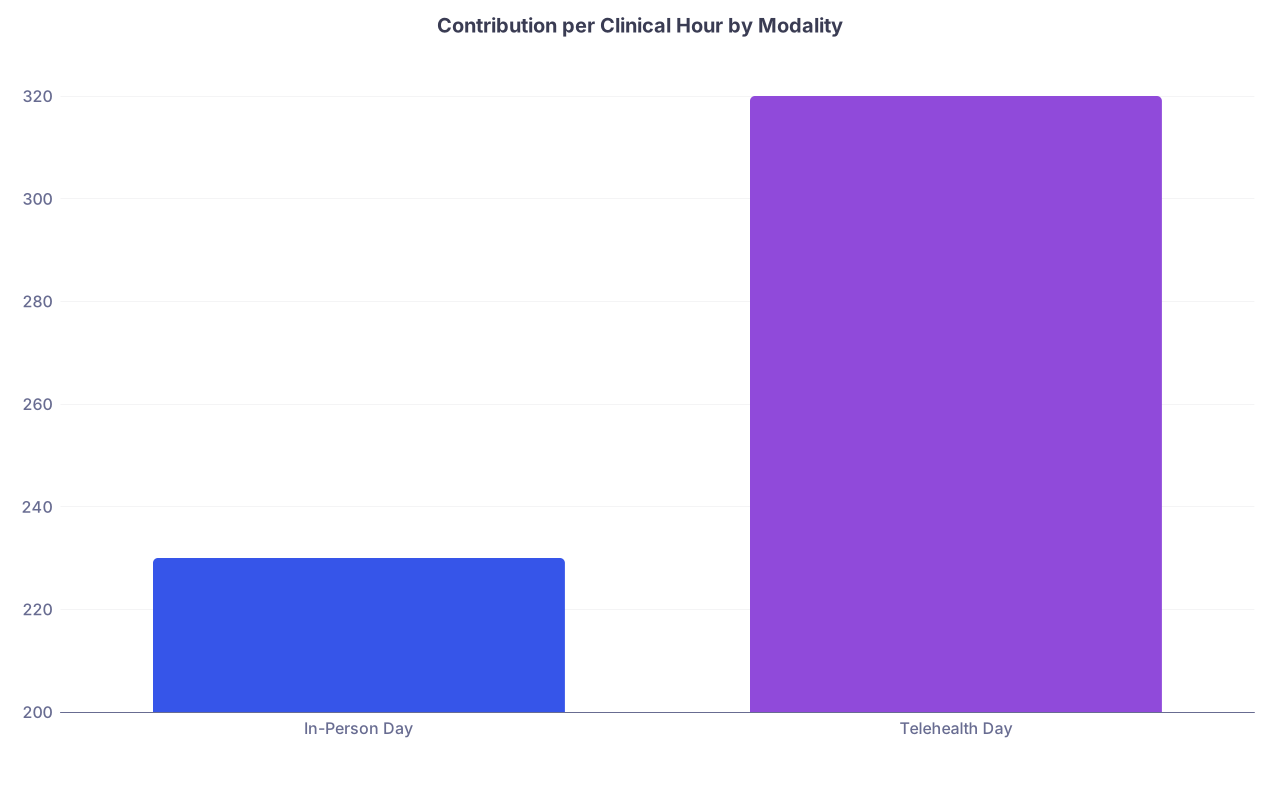
Where telehealth wins is when “contribution per clinical hour” for telehealth days is clearly above in‑person days.
| Category | Value |
|---|---|
| In-Person Day | 230 |
| Telehealth Day | 320 |
In many optimized practices, I see telehealth days generating 20–40% higher contribution per clinical hour. If yours is not there, you either:
- Are under‑coding telehealth
- Have visit lengths too long
- Have the wrong visit mix in telehealth slots
- Or your platform/staffing costs are eating your savings
Fixable problems—but only if you see them.
9. Practical Implementation Blueprint (Without Burning Margin)
One more analytical pass, this time structured as a rollout plan.
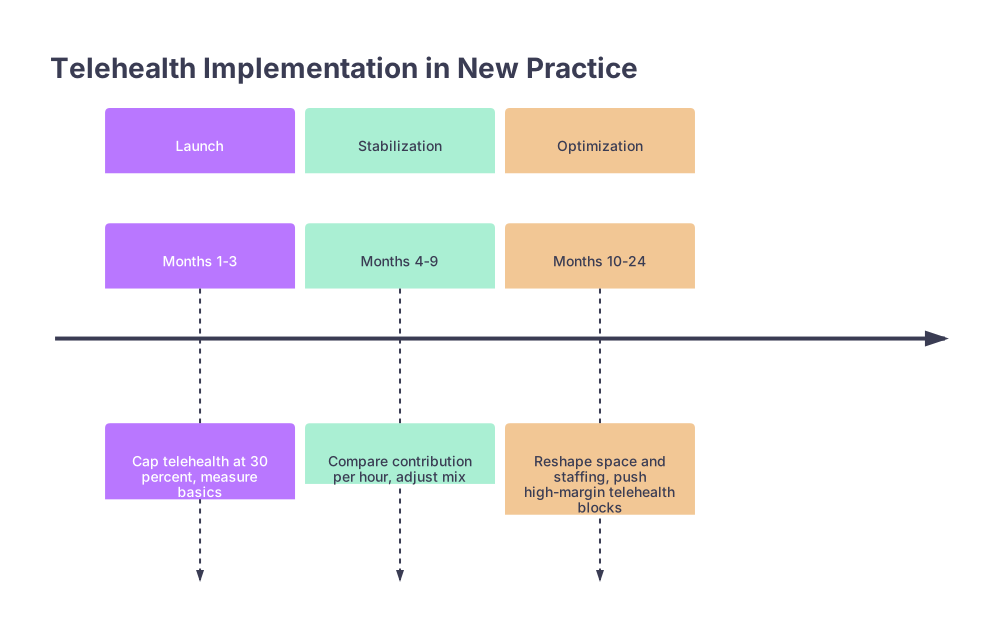
For a new post‑residency private practice, a sane, margin‑aware telehealth implementation looks like this:
Phase 1: Launch Quarter (Months 1–3)
Goal: Fill your schedule and establish a baseline.
- Offer telehealth but cap it at ~30% of total slots.
- Reserve telehealth mostly for established follow‑ups and chronic care.
- Keep physical overhead lean: 2–3 rooms max, one MA, minimal front‑desk, heavy use of online scheduling.
Phase 2: Stabilization (Months 4–9)
Goal: Use real data to tune.
- Compare contribution/hour between in‑person and telehealth at least every 3 months.
- If telehealth contribution/hour ≥ 15% higher than in‑person, gradually push telehealth share up toward 40–50%.
- Adjust telehealth visit length downwards in small steps (20 → 15 minutes) based on whether you are consistently charting on time.
Phase 3: Optimization (Months 10–24)
Goal: Lock in structural margin.
- If telehealth volume is robust, consider reducing physical space at lease renewal or subleasing extra rooms.
- Shift some staff functions (scheduling, intake) to remote or part‑time to align with telehealth days.
- Build chronic care and preventive care telehealth “blocks” where you deliberately schedule short, focused, high‑value visits back‑to‑back.
Each phase should have explicit financial thresholds: “We raise telehealth share only if it clearly outperforms in‑person on contribution/hour for two consecutive quarters.”
| Period | Event |
|---|---|
| Launch - Months 1-3 | Cap telehealth at 30 percent, measure basics |
| Stabilization - Months 4-9 | Compare contribution per hour, adjust mix |
| Optimization - Months 10-24 | Reshape space and staffing, push high-margin telehealth blocks |
FAQ (4 Questions)
1. What telehealth percentage should a new private practice target initially?
Start around 20–30% of total visit slots in the first 3–6 months. That level is high enough to test workflows and gather data, but low enough that mistakes will not sink your finances. Increase only when your metrics show that telehealth contribution per clinical hour is clearly above in‑person.
2. Are dedicated “telehealth days” more profitable than mixing telehealth into every day?
The data leans toward “yes” once volume is stable. Concentrating telehealth into 1–2 days per week lets you streamline staffing (fewer front‑desk and rooming needs those days), reduce room utilization, and tightly stack shorter visits. Mixed days are fine early on, but dedicated telehealth days tend to show higher contribution per hour once you are busy.
3. Does audio‑only telehealth ever make financial sense?
Usually not as a primary modality. Reimbursement is often lower, documentation burden is similar, and clinical limitations are higher. Audio‑only can be a useful access tool for select patients, but from a strict margin perspective, video visits with clear documentation of medical decision‑making carry far better financial performance.
4. How soon should I invest in a premium telehealth platform instead of a basic EHR add‑on?
Only when your telehealth volume and reimbursement justify the per‑visit cost. A premium platform makes sense if:
- You are doing ≥ 150–200 telehealth visits per month, and
- The platform improves show rate, visit throughput, or billing enough to add at least $10–15 in contribution per visit.
If your telehealth volume is low, an expensive platform just bloats variable cost and eats the very margin you are trying to create.
Telehealth adds margin when three conditions line up: reimbursement is reasonably close to in‑person, you actually increase completed visits per clinical hour, and you use that increased flexibility to shrink or streamline your physical operation. Get those right, and telehealth is not a “nice to have”—it is one of the main tools that turns a post‑residency private practice from fragile to financially durable.