
The biggest lie new private practice owners tell themselves is, “I just need more new patients.” The data almost always shows something different: you have a retention problem, not a new-patient problem.
If you do not understand patient retention metrics, you are flying blind. You will have no idea how many new patients you really need every month, whether your practice is growing or quietly bleeding out, or when you can safely hire staff.
Let’s walk through this like an analyst, not a motivational speaker.
1. The Core Equation: How Practices Actually Grow
Strip away the emotions and the “busy-ness.” A practice grows or shrinks based on one simple relationship:
Net patient change = New patients − Lost (inactive) patients
Everything else is noise.
To operationalize that, you need a few definitions. And you need to be consistent.
- New patient: First visit ever to your practice. (Do not count transfers within the group as new.)
- Active patient: Has been seen within a defined time frame.
- For primary care: typically “seen in last 18–24 months”
- For high-frequency specialties (psych, PT, pain): often 6–12 months
- Lost/inactive patient: Past that timeframe with no visit, OR explicitly transferred care.
Without these definitions locked, your metrics will be garbage.
Now the key formula that matters month to month:
Required new patients/month = Lost patients/month + Target growth/month
If you lose 30 patients a month to natural churn and you want to grow your active panel by 20 per month, you need 50 new patients per month. Not “as many as possible.” Fifty. That is a solvable problem.
2. What Retention Actually Is (And How To Measure It)
Stop thinking of retention as a vague “patients like me” feeling. Quantify it.
At minimum, track three related metrics:
- Visit retention rate (short-term)
- Panel retention / attrition rate (long-term)
- Average visits per patient per year
2.1 Visit Retention Rate
Basic version: Of all patients seen in a time window, what percentage come back within an expected interval?
Example for a primary care doc:
- Look at all patients seen in Q1 (Jan–Mar).
- Define “retained at 12 months” as “had at least one visit between day 91 and day 365 after that visit.”
- Visit retention rate = Retained patients ÷ Total Q1 patients.
If you saw 400 unique patients in Q1 and 300 of them had a visit again by the end of the year, then:
- Retention rate = 300 / 400 = 75%
- Annual visit loss on that cohort = 25%
Now repeat for every quarter and trend it.
2.2 Panel Retention / Attrition
This is the one that really tells you how many new patients you need.
Pick a simple active definition. For a new outpatient primary care practice I usually recommend:
- Active = seen in last 24 months
- Inactive/lost = not seen in 24+ months or transferred out
Now every month, calculate:
- Active panel size
- Number of patients that just transitioned from active → inactive
- New patients that month
Your monthly attrition rate:
Attrition rate = Lost patients this month ÷ Active patients at start of month
If your starting census is 800 active patients and 32 fall off this month:
- Attrition rate = 32 / 800 = 4% per month
That is too high for primary care; it suggests poor follow-up systems or a transient patient base. Annualized (not exactly but roughly) that is close to 1 − (0.96^12) ≈ 39% panel churn per year. Brutal.
2.3 Average Visits Per Patient Per Year
This matters because revenue is per visit, not per patient.
Visits per patient per year = Total visits in 12 months ÷ Number of unique patients seen in 12 months
Example:
- 3,600 visits in a year
- 1,000 unique patients seen
- Visits/patient/year = 3,600 / 1,000 = 3.6
This metric varies heavily by specialty:
| Specialty | Visits/Patient/Year | Comment |
|---|---|---|
| Primary Care | 2.5–4.0 | Age and complexity driven |
| Psychiatry | 6–12+ | High frequency follow-up |
| Dermatology | 1.5–3.0 | Mix of acute + annual |
| Pain Management | 6–12 | Interventions + follow-up |
| Physical Therapy | 8–20 | Finite treatment episodes |
Retention plus visit frequency tells you two things that actually matter:
- How many people you must keep to sustain/raise revenue.
- How many new people you must acquire to backfill losses.
3. How Many Active Patients You Actually Need
This is where most early attendings guess. And guess badly.
You do not start with “how many new patients per month.” You start with:
- Desired income
- Payer mix and average reimbursement per visit
- Work hours and visit slots
Then work backward.
3.1 Revenue Capacity Per Month
Example: solo primary care, post-residency, building from scratch.
Assume:
- 4 days/week of clinic
- 48 weeks/year → ~16 days/month
- 18 visit slots/day (mixed new and follow-up)
- Target utilization once mature: 90%
Total potential visits/month = 16 × 18 × 0.9 ≈ 259 visits
Average reimbursement per visit (after contractual adjustments) for a mixed payer panel:
- Say $120/visit (this will vary; use your numbers when you can).
Monthly revenue capacity at maturity:
- 259 × $120 ≈ $31,080
Annual: about $373,000 in gross collections before overhead. With 55–65% overhead, you net roughly $130k–$165k. That is the boring math very few advisors show you.
If you want to push income higher, you either:
- Increase visit slots/day
- Increase workdays/month
- Improve payer mix / add procedures / better coding
- Or some combination
3.2 Required Patient Panel for That Volume
You already calculated visits per patient per year. Let us assume 3.0 visits/patient/year in this example.
Annual visits at maturity (from above): 259 × 12 ≈ 3,108.
So required active panel:
Active panel = Annual visits ÷ Visits per patient per year
Active panel = 3,108 ÷ 3.0 ≈ 1,036 patients
That is your target active panel size to fill your schedule at those parameters.
3.3 How Many New Patients Until You Hit Steady State
New practices do not start at 90% utilization. The first 12–24 months are ramp-up.
Let’s assume:
- Target mature active panel: 1,000–1,100 patients
- You want to reach that in 24 months
- Expected annual attrition once stable: 15% of panel per year (common ballpark for primary care in urban/suburban areas)
For 1,000 patients:
- Annual loss = 0.15 × 1,000 = 150 patients
- Monthly loss ≈ 150 / 12 ≈ 12–13 patients
So at steady state, just to keep from shrinking, you need ≈ 13 new patients/month.
During growth phase:
- You need to reach 1,000 active patients in 24 months.
- Required net growth/month = 1,000 / 24 ≈ 42 patients/month.
- Net growth = New patients − Lost patients.
We assume attrition scales with your panel. During early months attrition is low because panel size is small. To simplify, let’s project average attrition over the ramp-up to be half the steady-state level. Call it ~6–7 lost patients/month on average over the first 2 years.
Then:
- Required new patients/month ≈ 42 (target net growth) + 7 (loss) ≈ 49 new patients/month on average for 24 months.
Let me repeat: to build to a 1,000-patient active primary care panel in 2 years, you are likely aiming for roughly 45–55 new patients/month. Not 10. Not “a couple a week.”
That is the job market reality if you are starting cold.
4. Converting Retention into New-Patient Targets
Now let’s look at how retention changes the new-patient requirement once you are “full.”
4.1 Example: Primary Care with Varying Attrition
Assume stable panel of 1,200 active patients, 3 visits per year. Compare three different annual attrition levels:
- Excellent retention: 10%/year
- Average retention: 15%/year
- Weak retention: 25%/year
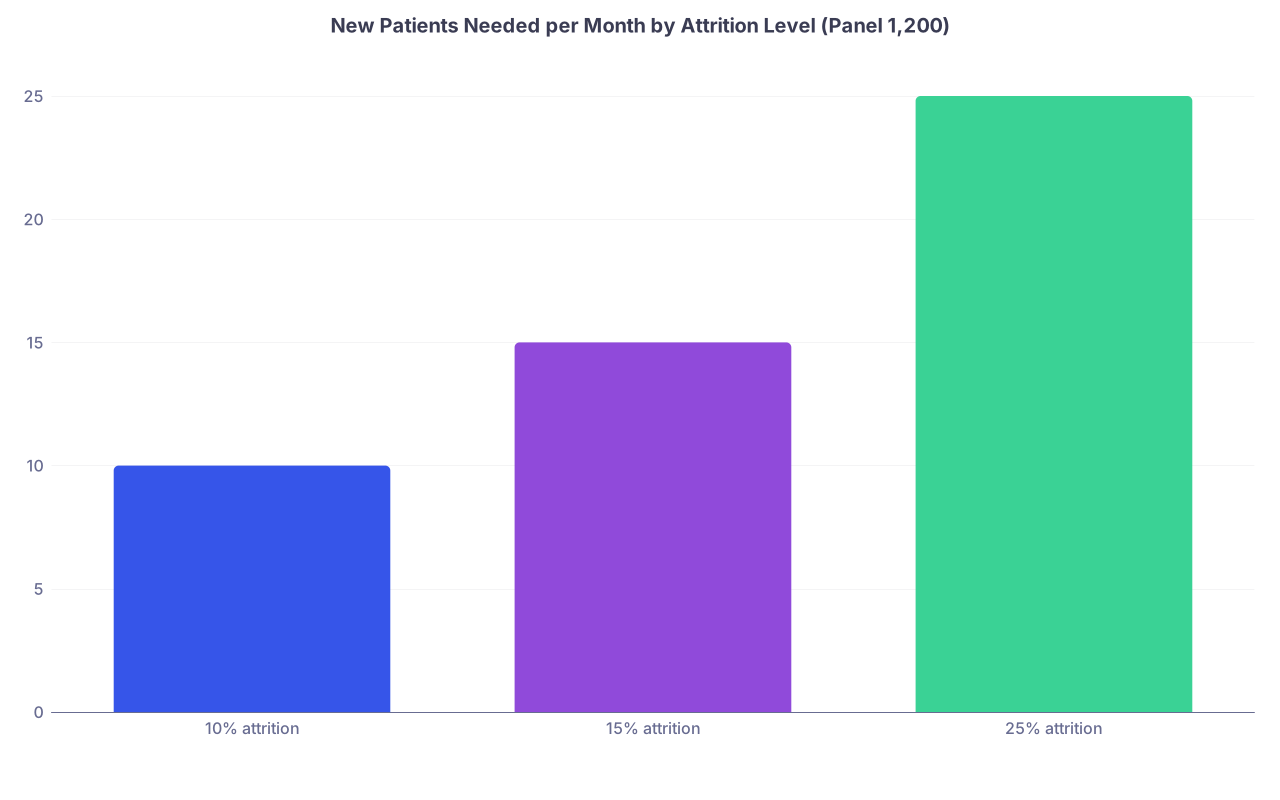
| Category | Value |
|---|---|
| 10% attrition | 10 |
| 15% attrition | 15 |
| 25% attrition | 25 |
Monthly new patients needed at each level:
- 10%: 0.10 × 1,200 ÷ 12 = 10 new patients/month
- 15%: 0.15 × 1,200 ÷ 12 = 15 new patients/month
- 25%: 0.25 × 1,200 ÷ 12 = 25 new patients/month
Same panel size, same visits per patient, same revenue target. A practice with 25% attrition needs 2.5× as many new patients per month just to avoid shrinking.
That is why social media marketing alone does not fix bad operations. If your follow-up processes leak, no amount of ads will save you.
4.2 Short-Interval Specialties Look Different
Take outpatient psychiatry:
- Typical panel: smaller, say 300 “core” patients
- Visit frequency: 8 visits/year average (mix of weekly, biweekly, monthly)
- Total visits/year: 300 × 8 = 2,400 visits → 200 visits/month target
If you lose 20% of your panel per year:
- Lost patients/year = 0.20 × 300 = 60
- Lost patients/month = 60 / 12 = 5
New patients required/month at steady state:
- That is it.
But if your retention drops to 35% attrition/year because patients disappear after 1–2 visits:
- Lost/year = 0.35 × 300 = 105
- Lost/month ≈ 9
- New patients required = 9/month to stay flat
Here is the punchline: those 4 extra lost patients per month (9 vs 5) represent 4 × 8 = 32 visits/year each in lost potential. That is 128 visits/year gone. At $160/visit, that is ~$20k/year. From a “small” change in retention.
Retention is leverage.
5. How To Actually Track Retention (Without a PhD in SQL)
Most EMRs are hostile to analysis. You will probably need exports and Excel/Sheets early on. Still, the workflow is straightforward.
5.1 Minimum Monthly Metrics
Every month, pull or calculate:
- Unique patients seen this month
- New patients seen this month
- Total visits this month
- Active panel size (based on your “seen in X months” rule)
- Number of patients that just turned inactive this month (no visit in last X months)
If your EMR will not show “just turned inactive,” approximate:
- Once a quarter, export all active patients.
- Next quarter, export again and compare lists.
- Patients missing from the new list = likely inactives.
Crude, but better than ignorance.
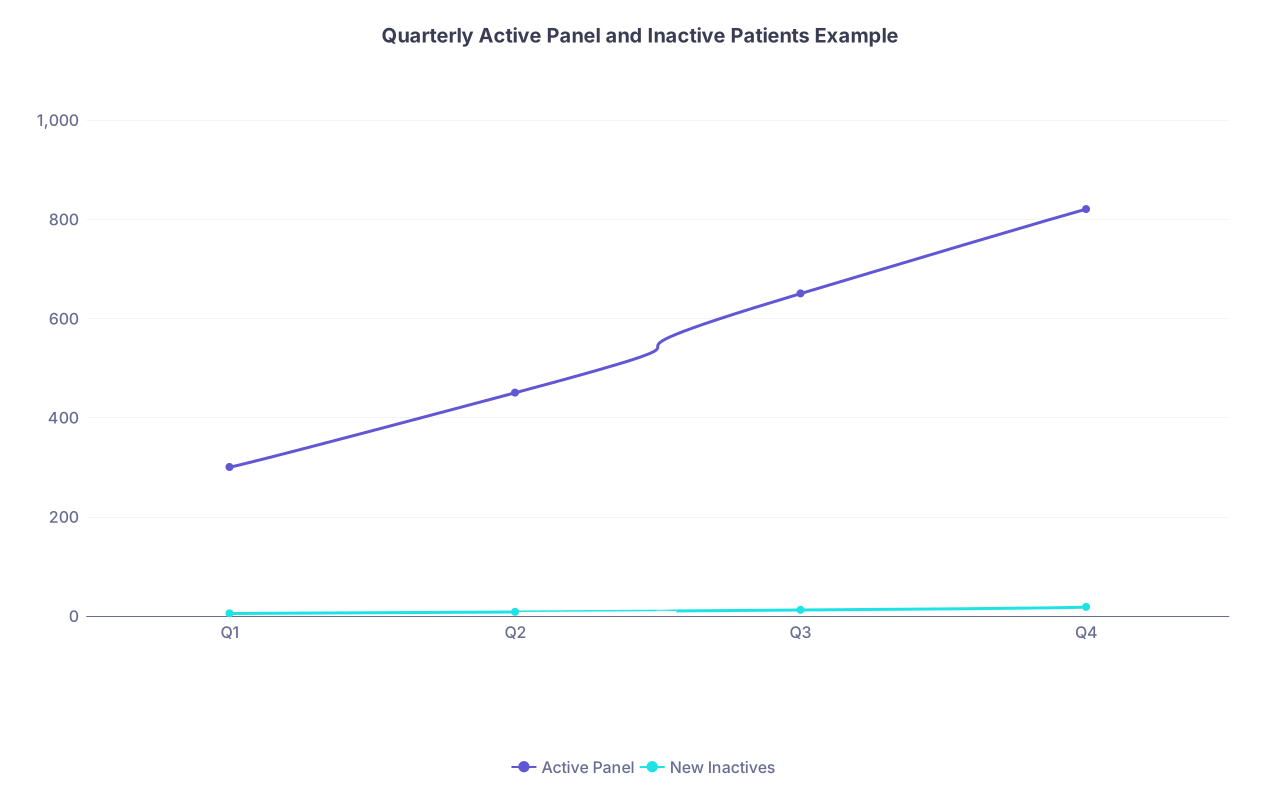
| Category | Active Panel | New Inactives |
|---|---|---|
| Q1 | 300 | 5 |
| Q2 | 450 | 8 |
| Q3 | 650 | 12 |
| Q4 | 820 | 18 |
Even a simple trend chart like this tells you if your leaky bucket is getting leakier as you grow.
5.2 Cohort Tracking (Optional but Powerful)
If you want to behave like a serious operator, track cohorts.
Example:
- Take all new patients who had their first visit in January.
- Measure what percent of them:
- Have a second visit within 3 months
- Have 3+ visits within 12 months
- Are still active after 12 months
This tells you if your onboarding process works.
If only 40% of new January patients have a second visit by April, you do not have a marketing problem. You have an operational one: scheduling, follow-up, communication, fit of services, something in the first visit that is turning people off.
Cohort retention curves will show you exactly where patients drop out. Then you fix that stage.
6. Common Patterns I See in New Private Practices
I have seen the same set of data problems play out in dozens of early practices. You will probably recognize yourself in at least one of these.
6.1 “I’m Busy, So I Must Be Growing”
You feel slammed. But the schedule is full of high-frequency follow-ups and not many new faces.
Symptoms in the numbers:
- High visits/patient/year (e.g., >5 in primary care without a super complex panel)
- Flat or shrinking active panel size
- Small number of new patients/month
What is happening: You have built a dense schedule around a small panel. It is fragile. One employer contract change or group of patients moving, and your volumes crash.
Correction:
- Explicit monthly goal for new patients (e.g., 25/month)
- Allocate protected “new patient” slots each week
- Monitor active panel trend line; if it is not climbing, you are not growing
6.2 “I Need More New Patients” (But The Panel Is Hemorrhaging)
Opposite problem. Constant marketing, but no growth in revenue after year 2.
Data pattern:
- New patients/month looks solid (e.g., 40–50)
- Active panel flat at 600–700 for months
- High proportion of “one-and-done” patients in the EMR
In one psych practice I reviewed, 52% of patients had only one visit ever. That is not a marketing problem. It is a retention disaster.
Fixes involve:
- Tightening follow-up scheduling before patients leave the visit
- Automated reminders and recall systems
- Clinical protocols that require follow-up, not PRN for everything
- Better patient education about expected treatment course
6.3 “We Don’t Even Know Our Active Panel Size”
This is extremely common. The doctor has a “feeling” of having 2,000–3,000 patients. The data usually says 800–1,200.
Get this number accurate. Even if it takes you a few hours running reports and cleaning an Excel sheet. Your panel size plus attrition is the backbone of every other decision.
7. Tying It Back to Post-Residency Reality
You are coming out of residency where volume was someone else’s problem. In private practice, the math is suddenly your problem.
Here is the practical, unvarnished version:
Year 1–2 are growth years.
You are building panel density. Expect (and plan for) a high new patient requirement per month. For many outpatient fields starting cold, 30–60 new patients/month is a realistic target.Retention starts small but matters early.
When you only have 100 patients, losing 10 in a month is a 10% hit. That feels bad but is fixable. Once you have 1,000 patients, that same 10 lost is 1%. The denominator changes. Track both the absolute count and the percentage.Your future overhead depends on these early metrics.
If you can show 15–20% annual growth in active panel with stable or improving retention, you can confidently:- Hire an MA or RN
- Add front desk staff
- Invest in better IT or a patient engagement platform
If your panel is flat and your attrition line is creeping up, you should delay those hires. You cannot afford them yet.
8. A Concrete Checklist: What You Should Know By Month 6
By 6 months into your private practice, you should be able to answer these questions with numbers, not vibes:
- How many new patients did I see in each of the past 3 months?
- What is my current active panel size? (Using a clear “seen in last X months” rule.)
- In the last quarter, how many patients turned inactive?
- What is my approximate visits per patient per year (or on a 6-month interim basis)?
- Given my target annual income and my current reimbursement, what active panel size am I aiming for in 2 years?
- Based on that, how many new patients/month do I need in the next 12 months?
If you cannot answer these yet, block a half-day, export data from your EMR, and build a simple spreadsheet. One tab for monthly summary metrics. One tab for quarterly panel snapshots.
It is not optional. It is the difference between building a stable practice and just surviving.
Key Takeaways
- Patient retention is not a feeling; it is measurable. Your active panel size, attrition rate, and visits per patient per year determine exactly how many new patients you need each month.
- In the growth phase after residency, most solo practices need 30–60 new patients per month to reach a sustainable panel in 1–2 years. Once mature, strong retention can drop that requirement to 10–25 per month.
- Without tracking these metrics, you will misdiagnose your problem. Most “I need more new patients” complaints are, in the data, actually retention and follow-up problems. Fix the leaks before turning up the faucet.