
47% of specialty practices are leaving at least 8–15% of collectible revenue on the table because their billing company’s “collections rate” is inflated or flat-out miscalculated.
If you are just out of residency and building a private practice, that missing 8–15% is the difference between hiring an MA versus doing your own vitals, between buying an ultrasound versus sending everything out. It is not abstract.
Let me walk through what the data actually show, where billing companies routinely game the numbers, and the benchmarks I use with clients to decide, bluntly, whether a revenue cycle partner is pulling its weight or coasting.
1. The first mistake: you are probably looking at the wrong “collections rate”
Most physicians start by asking: “What’s your collections rate?” Billing reps respond: “We collect 97–99% of what is owed.”
On paper, that sounds excellent. In reality, very often it means next to nothing.
There are at least three different “collection rates” floating around in sales decks:
Gross collection rate (GCR)
Collections ÷ Billed charges
Looks terrible because charges are inflated relative to payer contracts. Mostly useless except for trend monitoring.Net collection rate (NCR)
Collections ÷ (Billed charges − Contractual adjustments)
This is the real one. Measures how much of allowable money you actually collect. Properly calculated, this is the core benchmark.“Adjusted collection rate” with creative math
Collections ÷ (Billed charges − Contractuals − Small balances − Timely filing write-offs − “Uncollectible” buckets)
This is where the game starts. Subtract enough categories from the denominator and any billing company can claim a 99% rate.
If your billing company cannot show you their exact formula in writing, assume the number is massaged.
Here is the benchmark range I see across real practices (using true net collection rate, not marketing math), based on MGMA data, payer mix analyses, and internal client data.
| Practice Type | Solid Performance | Underperforming |
|---|---|---|
| Primary Care / IM | 96–99% | < 94% |
| Office-based Specialists | 95–98% | < 93% |
| Surgical Specialties | 94–97% | < 92% |
| Hospital-based (ED, Anes) | 93–96% | < 91% |
If your real NCR is 92% and should be 97%, that 5-point gap on $1,000,000 in annual allowed charges is $50,000 straight to your bottom line.
How to calculate a trustworthy net collection rate
You do not need a consultant for this. You do need clean data from your practice management or EHR system, not a spreadsheet from the billing company.
For a 6–12 month period:
- Pull total billed charges.
- Pull contractual adjustments (payer discounts) only.
- Pull total payments (not including patient pre-pay deposits that never turned into charges).
- Exclude true credit balances and obvious one-off anomalies.
Then:
Net Collection Rate = Total Payments ÷ (Total Charges − Contractual Adjustments)
No other adjustment types go into that denominator. Small balances, timely filing, non-covered services – leave them in for now. They indicate operational failure, not “fake” AR.
The billing company’s number should match yours within 0.5 percentage points. If it does not, you have a problem.
2. Denial rate: the canary in the coal mine
High net collection rates should not come with a double-digit denial rate and bloated days in A/R. When they do, something is being written off quietly.
National data for outpatient practices show:
- 5–10% of claims are denied on first pass.
- 60–70% of those denials are preventable.
- 50–65% of denied claims are never resubmitted successfully.
That last metric is where billing companies quietly tank your revenue. On paper, they “worked the denial.” In reality, the claim dies after one or two half-hearted attempts.
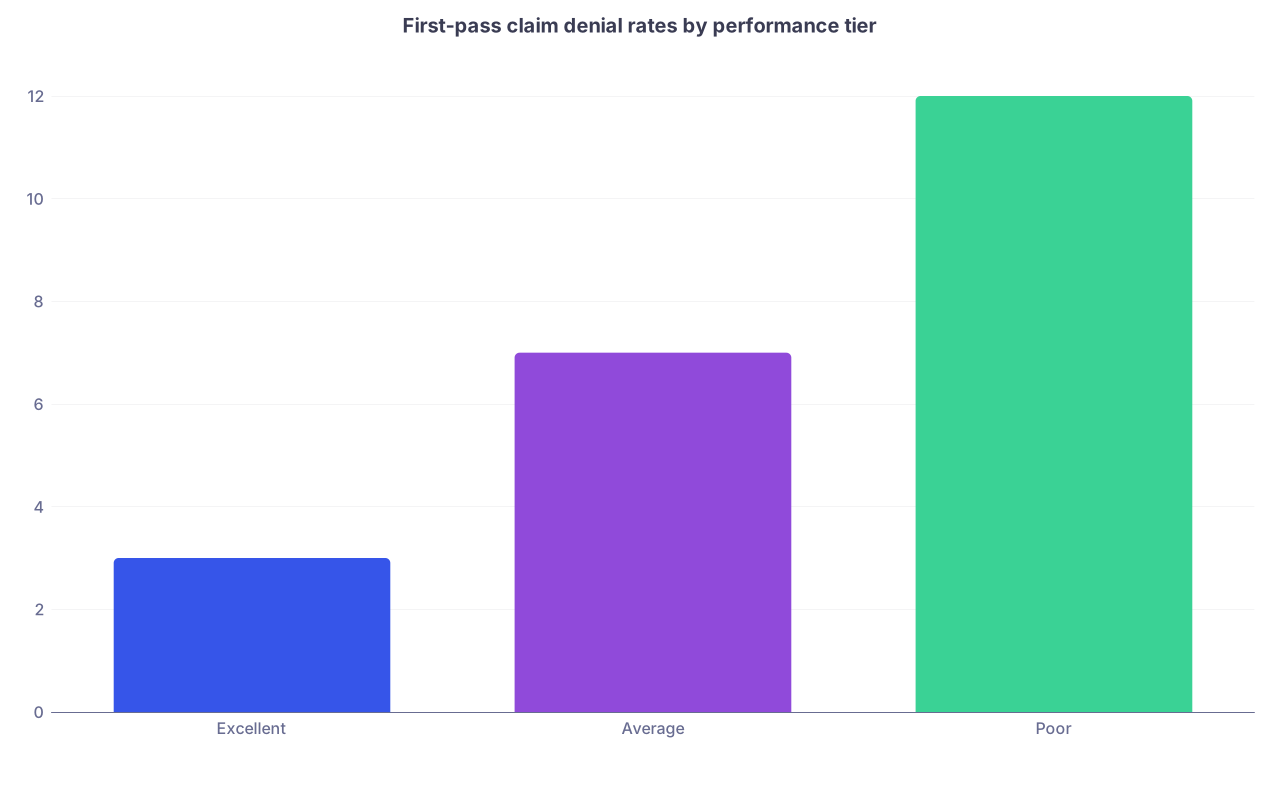
Here are realistic denial benchmarks based on payer analyses and claims audit work.
| Category | Value |
|---|---|
| Excellent | 3 |
| Average | 7 |
| Poor | 12 |
I classify clients like this:
Excellent: First-pass denial rate 2–4%.
Clean eligibility checks, accurate coding, and payer-specific rules baked into workflows.Average: 5–8%.
Some sloppiness on registration, prior auths, or documentation gaps, but recoverable.Poor: 9%+ first-pass denials.
You are donating time to payers.
With those bands, ask your billing company for:
- Denial rate by payer, by reason code, by month.
- Recovery rate of initially denied claims (of $100 denied, how much was eventually paid?).
If they cannot produce this broken down – or if all their denial reasons are lumped into “other” – they are not managing, they are reacting.
3. Days in A/R: speed is not everything, but it is close
Collections rate without a time dimension is misleading. Collecting 97% of your money is not impressive if it takes 200+ days and destroys your cash flow.
A/R benchmarks vary by specialty and payer mix, but there are consistent patterns.
| Metric | Excellent | Acceptable | Red Flag |
|---|---|---|---|
| Total Days in A/R | < 30 days | 30–45 days | > 45 days |
| % A/R > 90 days | < 10% | 10–20% | > 20% |
| % A/R > 120 days | < 5% | 5–10% | > 10% |
In a typical small specialty practice, if more than 20% of your A/R is older than 90 days, you are carrying dead weight. A lot of it will never convert to cash.
The more subtle issue: some billing companies boost their “days in A/R” performance by aggressively writing off old balances. They are not collecting faster. They are giving up faster.
You want to see two things together:
- Days in A/R trending down or stable, and
- Net collection rate stable or rising.
If days in A/R improve while NCR drops, someone is sweeping bad debt under the rug.
4. Payer mix, contract rates, and the dangerous “we collect 98%” line
A billing company bragging about a 98–99% net collection rate without referencing payer mix and contract terms is selling a fantasy.
Simple example:
Practice A: 80% Medicare, 20% commercial.
Clean claims, standardized rates, low patient responsibility. High NCR is achievable.Practice B: 40% Medicaid, 40% high-deductible commercial, 20% Medicare.
Higher patient responsibility, more eligibility and auth headaches. Hitting 99% NCR is unrealistic unless write-offs are excluded.
I evaluate billing performance against expected allowed amounts, not just charges.
Very rough heuristics I use in conversations:
- If >70% of your volume is traditional Medicare and large commercial payers, a sustained 96–99% NCR is realistic.
- If you have heavy Medicaid, narrow networks, or self-pay, 93–96% NCR may actually be solid – but patient collection processes become critical.
The billing company should be able to show you, per payer:
- Allowed amount / charge ratio.
- Collection performance by payer.
- Denial rates by payer and reason.
If all you ever see is one composite “collections rate,” they are hiding the story.
5. The 4 billing behaviors that quietly drain 5–10% of your revenue
Patterns repeat. Across dozens of reviews, the same operational failures show up in underperforming billing vendors.
1. Chronic eligibility and demographic errors
Front-desk sloppiness is not just an internal issue. If your billing partner is not pushing back hard on eligibility and demographic errors, you eat the cost.
Look at your denial codes. If a significant portion of denials are:
- “Patient not eligible on date of service”
- “Coverage terminated”
- “Subscriber/ID not valid”
then your billing vendor is tolerating bad front-end data.
A well-run billing operation has:
- Real-time eligibility checks for most payers.
- Daily feedback to your front desk about error patterns.
- Clear, written policies about holding claims for clean-up vs. submitting garbage and “seeing what happens.”
2. Weak follow-up on small-dollar claims
Underperforming billing companies love to say: “It is not worth chasing a $25 balance.” That logic might be fine for a massive health system. It is destructive in a 1–3 physician practice.
The data pattern I see:
- Large commercial claims are worked aggressively.
- Low-allowed Medicaid or small secondary claims get one or two touches, then abandoned.
- Patient balances under a certain threshold quietly written off.
If you see a lot of “small balance write-offs” or “administrative adjustments,” compute the annual amount. In several practices, this category alone was >$20,000 per year.
On $500,000–$1,000,000 in collections, that is 2–4% of revenue.
3. Timely filing failures
This one is straightforward and inexcusable.
Every payer has timely filing limits: 90 days, 180 days, 365 days. When a claim misses the window, that is pure operational failure.
You should track:
- Total dollars written off as “timely filing” per year.
- % of those dollars relative to allowed charges.
Benchmark: anything over 0.5% of allowed charges lost to timely filing is unacceptable. Crossing 1% is a bright red flag.
If your billing partner blames your staff or your EHR for timely filing issues, the bottom line does not change: money is permanently gone.
4. Poor patient collections strategy
High-deductible plans turned patient balances into a core revenue segment. A billing company that still thinks in 2005-era “send three statements and send to collections” terms will underperform by several percentage points.
I look at three metrics:
Point-of-service collection rate: payments collected at or before visit / total patient responsibility.
Strong practices push this above 40–50% for established patients with predictable copays.Patient bad debt write-offs: dollar amount and % of total allowed.
Many practices quietly lose 3–8% of revenue here.Self-pay discount and charity policies: whether there is rational structure versus ad hoc giveaways by frustrated staff.
Any billing company that has not updated its patient collection strategies (text-to-pay, payment plans, card-on-file, clear scripting) is handicapping you by 2–5% of revenue.
6. A simple diagnostic: is your billing company underperforming?
Let’s put numbers to this. Assume:
- You generate $1,200,000 in annual allowed charges (after contractuals).
- Your current billing company takes 6% of collections as their fee.
We will compare three scenarios using conservative, real-world numbers.
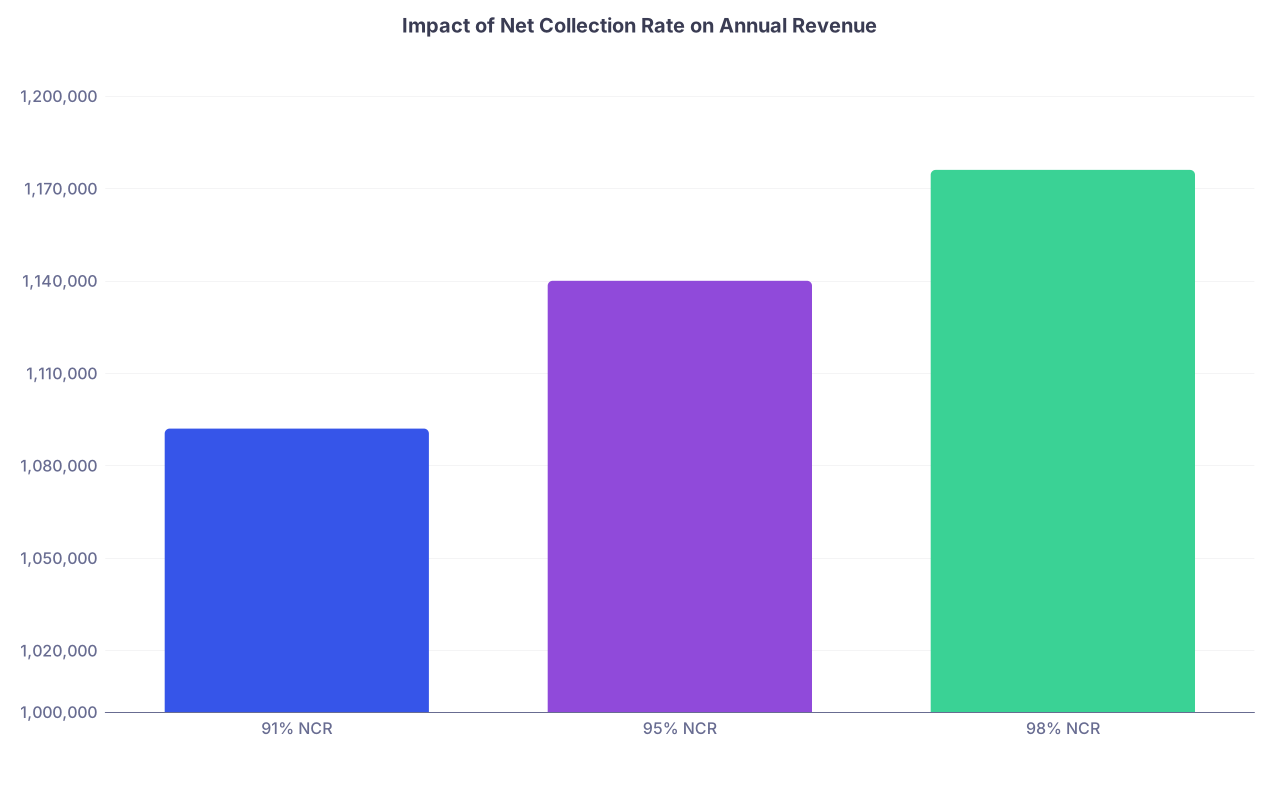
| Category | Value |
|---|---|
| 91% NCR | 1092000 |
| 95% NCR | 1140000 |
| 98% NCR | 1176000 |
Scenario 1 – Underperforming vendor:
- Net Collection Rate (NCR): 91%
- Collected: 1,200,000 × 0.91 = $1,092,000
- Billing fee (6%): $65,520
- Net to practice: $1,026,480
Scenario 2 – Solid vendor:
- NCR: 95%
- Collected: 1,200,000 × 0.95 = $1,140,000
- Billing fee (6%): $68,400
- Net to practice: $1,071,600
Scenario 3 – High-performance vendor or strong in-house team:
- NCR: 98%
- Collected: 1,200,000 × 0.98 = $1,176,000
- Billing fee (assume higher, 7%): $82,320
- Net to practice: $1,093,680
Compare scenario 1 vs scenario 3. Same work, same patients, same contracts. Just better revenue cycle execution:
- Additional net revenue: $1,093,680 − $1,026,480 = $67,200 per year.
That is a full MA salary. Or your malpractice premium plus rent. It is not trivial.
So yes, paying 1% more in billing fees for a truly better vendor can be rational. The math either pencils out or it does not.
7. What to demand in your reporting (and what silence tells you)
Underperforming billing firms have a common trait: opaque, high-level reports that never get into actionable detail. Think two-page PDFs with:
- Total charges
- Total payments
- A/R balance
- “Collection rate: 98%”
That type of reporting is almost useless.
At minimum, you should be seeing monthly:
- Net collection rate (your formula, not theirs) for the last 6–12 months.
- Gross charges, contractuals, payments, and adjustments with categories (bad debt, small balance, timely filing, non-covered).
- Days in A/R and A/R aging buckets (0–30, 31–60, 61–90, 91–120, 120+).
- Denial rate by payer and by top 10 reason codes.
- Patient balance metrics: statements sent, payment plans, bad debt sent to collections.
If they resist giving you this level of transparency, two interpretations:
- They do not have the data (their systems and processes are weak).
- They have the data and do not want you to see it (performance is poor).
Neither is compatible with a high-performing private practice.
8. When to cut your losses and switch
Physicians wait too long to fire underperforming billing partners because disruption feels expensive. The data usually say otherwise.
You should be actively considering a change if, over a 6–12 month span:
- True NCR (your calculation) is <93–94% for an outpatient specialty practice.
- Denial rate is >8–10% and not improving with clear corrective plans.
- Timely filing write-offs exceed 0.5–1.0% of allowed amounts.
- A/R > 90 days is consistently >20% of total A/R.
Those are not “work with them a little more” numbers. Those are “you are bleeding revenue” numbers.
A sensible timeline:
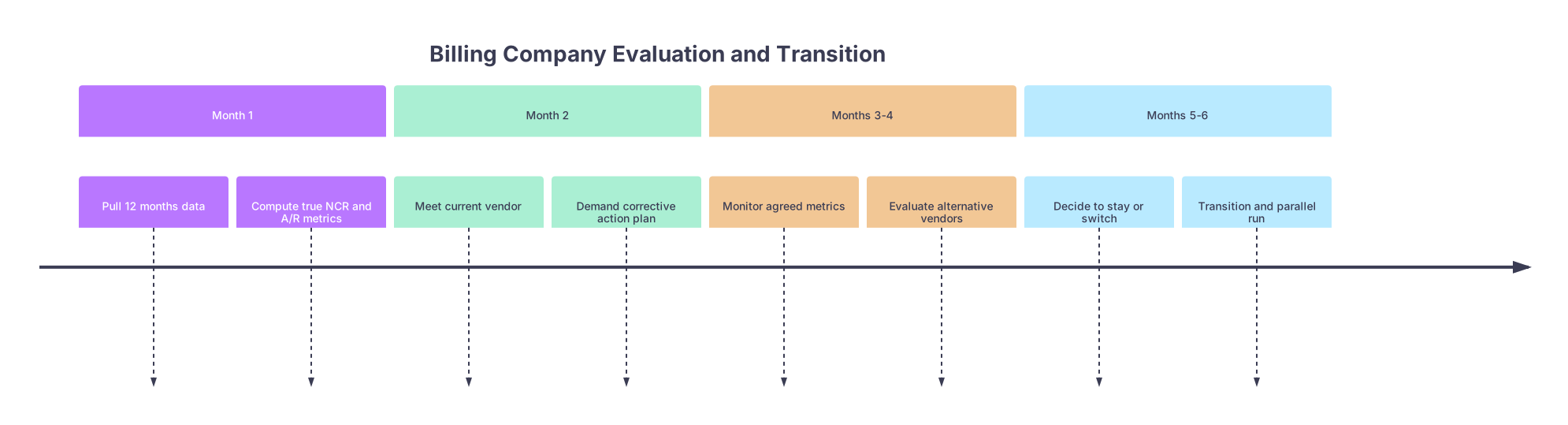
You do not have to switch tomorrow. You do need a structured, data-driven plan with deadlines. Otherwise, you drift, and the compounding revenue loss is brutal.
9. What “good” actually looks like in a small private practice
To ground this, let me give you a composite of what I consider healthy numbers in a 2-physician subspecialty clinic, 60–70% commercial, 20–30% Medicare, 0–10% Medicaid, using an external billing company:
- Net Collection Rate: 96–98% over a rolling 12 months.
- Days in A/R: 28–38 days.
- A/R > 90 days: 8–12% of total A/R.
- First-pass denial rate: 3–6%, mostly medical necessity and prior auths.
- Timely filing write-offs: <0.3% of allowed.
- Billing fee: 4–7% of collections, depending on scope (coding, credentialing, patient call center, etc).
When I see a practice with those ranges, I stop worrying about their billing. There are usually higher-ROI problems to solve (scheduling efficiency, case mix, pricing, etc.).
If you are not close to those bands, the next move is not guessing. It is measuring with your own numbers, confronting your vendor with specifics, and deciding if they are capable of closing the gap.
Key takeaways
The only “collections rate” that matters is a correctly calculated net collection rate based on your own data. If your NCR is below 93–95%, you are almost certainly leaving money on the table.
Look beyond one vanity metric. Denial rate, days in A/R, and write-off categories (especially timely filing and small-balance adjustments) expose whether your billing company is actually performing or just creative with math.