
The fastest way to burn cash in a new practice is to buy diagnostic toys before your patient base and payer mix justify them.
Let me break this down specifically: EKG, PFT, and point‑of‑care ultrasound (POCUS) can be fantastic revenue and clinical tools in a private practice. They can also sit in a corner, depreciating quietly while you fight denials and regret signing that equipment lease.
You are post‑residency, staring at the job market, and the math on employed positions versus going out on your own. If you commit to private practice, diagnostics become one of the first “big decision” line items. Do you bring them in‑house early, phase them in, or outsource everything and stay lean?
We will walk through this like I would with a colleague planning their first office: by specialty, by volume, by payer, with actual numbers and clinical realities— not vague “it depends” nonsense.
1. The Three Big Questions Before You Buy Anything
Every in‑office diagnostic decision should clear three hurdles:
- Does it materially improve care or access for your specific patient population?
- Will it be used enough—by your own hands or partners—to justify purchase, staff training, and maintenance?
- Will insurers actually pay you, at rates and frequencies that cover costs with a sane margin?
If you cannot answer yes to all three, it is not time yet.
The problem is that most new practice owners start with the wrong question: “Can I bill for this?” Reimbursement is useless if volume is sporadic or your front desk keeps forgetting pre‑auth requirements and you eat denials.
Before we dig into each modality (EKG, PFT, ultrasound), you need a basic framework.
| Factor | EKG | PFT/Spirometry | Ultrasound (POCUS) |
|---|---|---|---|
| Upfront cost | Low | Low–Moderate | Moderate–High |
| Training need | Low | Low–Moderate | High (skills + billing) |
| Space required | Minimal | Small dedicated area | Cart-based, flexible |
| Frequency needed | Moderate | Moderate–High | High for profitability |
If you remember nothing else: POCUS has the highest upside and the highest risk of underuse; EKG is low cost and low risk; PFT slots in the middle and is extremely context dependent.
2. EKG in the Office: The Lowest Hanging Fruit (But Not a Guaranteed Win)
12‑lead EKG is the gateway drug of in‑office diagnostics. The barriers are low. That is why almost every adult generalist practice either has it or wants it.
When EKG Makes Clear Sense
There are some scenarios where not having EKG is almost malpractice‑level silly.
- You are an internist, cardiologist, FM, or geriatrician with:
- A significant population over 50
- Chronic disease management (HTN, DM, CHF, CAD)
- Patients on QT‑prolonging meds, chemo, antiarrhythmics, psych meds
- You plan to accept same‑day visits for:
- Chest pain (low–moderate risk)
- Palpitations
- Pre‑operative clearance
- Syncope, near syncope
If you check those boxes, in‑office 12‑lead EKG:
- Speeds decision‑making: you are not sending stable chest pain to the ED just because you cannot obtain an EKG.
- Reduces leakage: you are not sending patients to urgent care or cardiology for straightforward rhythm issues.
- Generates predictable, small but real revenue.
Typical cost profile for EKG in a new office:
- Device: $2,000–$4,000 for a solid digital 12‑lead system (Midmark, Welch Allyn, etc.).
- EKG paper and electrodes: pennies per test.
- Staff training: minimal; MAs can be trained quickly.
- Space: almost none; fits in most exam rooms or a hallway alcove.
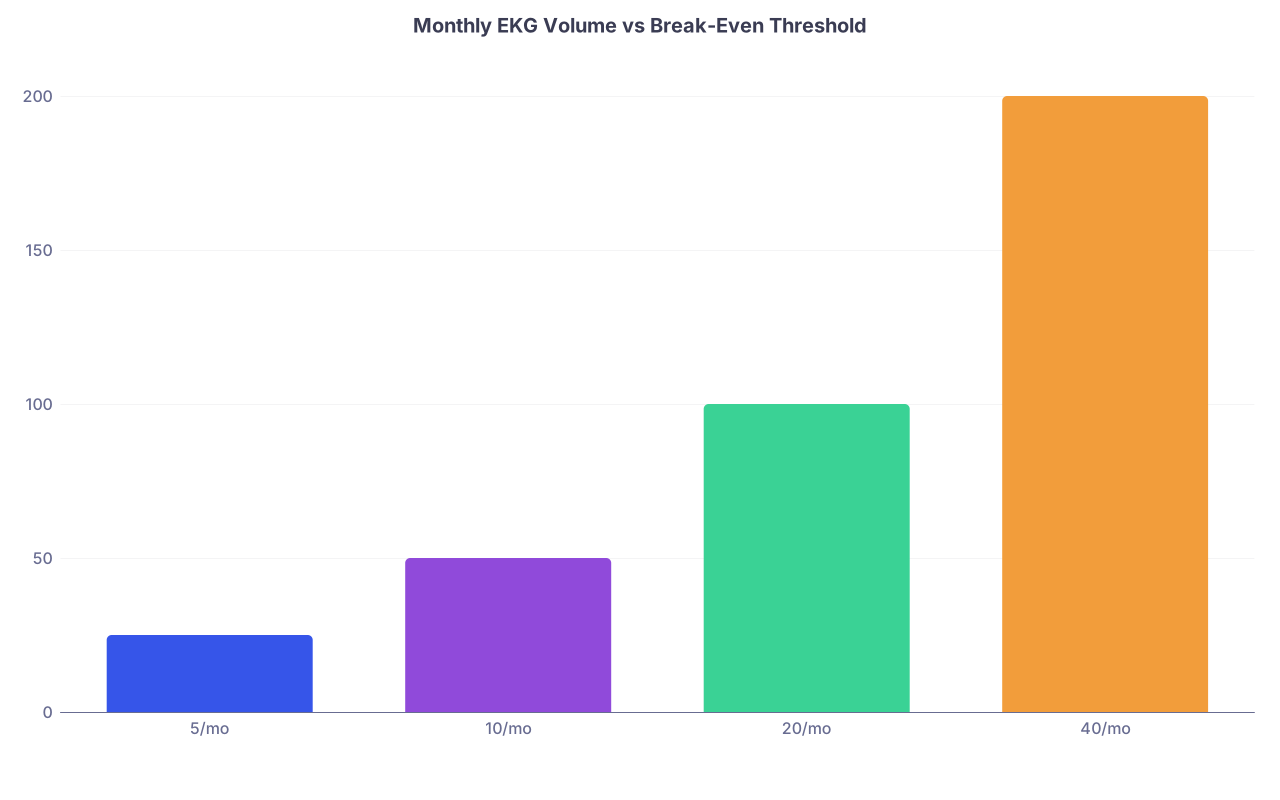
Now the numbers that matter: you want to see at least 15–20 EKGs per month per clinician consistently to justify the setup financially, assuming your payer mix is not 90% Medicaid with rock‑bottom rates.
| Category | Value |
|---|---|
| 5/mo | 25 |
| 10/mo | 50 |
| 20/mo | 100 |
| 40/mo | 200 |
Think of that chart as a quick reality check: under about 20/month, it is barely moving the needle; above 40/month, it starts to matter.
Billing Reality Check
Most new private docs underestimate how often EKGs are bundled or paid poorly.
- Common codes:
- 93000 – 12‑lead EKG with interpretation and report
- 93005 – tracing only
- 93010 – interpretation only
- Pitfalls:
- EKG done during preventive visit may be considered part of the global service by some payers.
- Overuse patterns trigger audits quickly (e.g., every hypertensive visit gets an EKG “just because”).
- Some payers severely discount 93000 when billed with higher‑level E/M and chronic care codes.
If your payer mix is commercial + Medicare with some Medicare Advantage, EKG is typically worth it. If you are heavy Medicaid with low volumes of acute cardiopulmonary complaints, it may be more “nice to have” than essential early on.
When to Delay EKG
Delay or outsource if:
- You are pediatrics without a heavy cardiology/ADHD drug load, and you are not frequently dealing with syncope or sports clearances needing in‑house EKG.
- You are a pure outpatient psych clinic (yes, some want EKG for antipsychotics, but volume is usually low).
- You are sub‑specialized with minimal cardiovascular risk assessment in your daily workflow.
In those cases, partnering with a nearby urgent care or cardiology office for same‑day EKGs is often smarter for year one.
3. PFT and Spirometry: High Clinical Value, Mixed Financial Reality
Pulmonary function testing is where many internists and pulmonologists overspend early.
There are tiers here:
- Simple office spirometry (pre/post bronchodilator, not full PFT lab)
- Advanced spirometry plus lung volumes and DLCO (true PFT lab level)
- Oscillometry, FeNO, etc. (niche, usually later additions)
For “starting practice” conversation, we are really talking about office spirometry and maybe “PFT‑lite” setups, not full hospital‑grade labs.
Who Should Seriously Consider In‑Office PFT Early?
A few practice profiles where it is almost a no‑brainer:
- Pulmonology private practice
- Asthma, COPD, ILD follow‑up constantly
- Need baseline plus interval assessments routinely
- Allergy/Immunology
- Asthma evaluation and monitoring are central to revenue stream
- Internal medicine / FM in high COPD/asthma population
- Rural or underserved areas where outside PFT access is poor
- You are already seeing frequent exacerbations and ED follow‑ups
One real‑world pattern I have seen: a solo pulm/allergy doc starting with a single spirometer, then scaling to full PFT lab after the patient base reached 800–1,000 active patients with asthma/COPD. That sequence works. Jumping straight to full PFT without patient volume rarely does.
Cost, Workflow, and Space
Office spirometry is cheap compared to its revenue potential, but still not “EKG cheap.”
Typical setup:
- Hardware: $2,000–$5,000 for a quality spirometer with software.
- Disposable mouthpieces and filters: low per‑test cost, but non‑trivial over hundreds of tests.
- Staff:
- Need at least one MA or nurse who does this well and consistently.
- Poor technique = useless data = wasted time and risk of misclassification.
You also need:
- A semi‑private area or small room where the patient can sit, blow hard, and not cough all over the front desk.
- A reliable calibration routine and infection control process.
Billing and Volume: Where People Get Burned
Coding is usually with:
- 94010 – Spirometry, including graphic record, total and timed vital capacity, with or without maximal voluntary ventilation
- 94060 – Bronchodilation responsiveness, spirometry as in 94010, pre‑ and post‑bronchodilator
- 94729/94726 – More advanced, for diffusion capacity and lung volumes, if you have that capability
Reality:
- Insurers are very alert to over‑utilization. If you bill spirometry at nearly every asthma or COPD visit, expect scrutiny.
- Many PCPs underutilize PFT, so when someone starts doing the right amount (guideline‑consistent), payers sometimes flag you simply because most others are under‑testing.
You want:
- A clear clinical indication documented each time (asthma dx/monitoring, dyspnea workup, COPD staging, pre‑op evaluation).
- Consistency with guideline‑based intervals (e.g., annual spirometry for stable asthma, more often if medication changes or unstable control).
Volume reality:
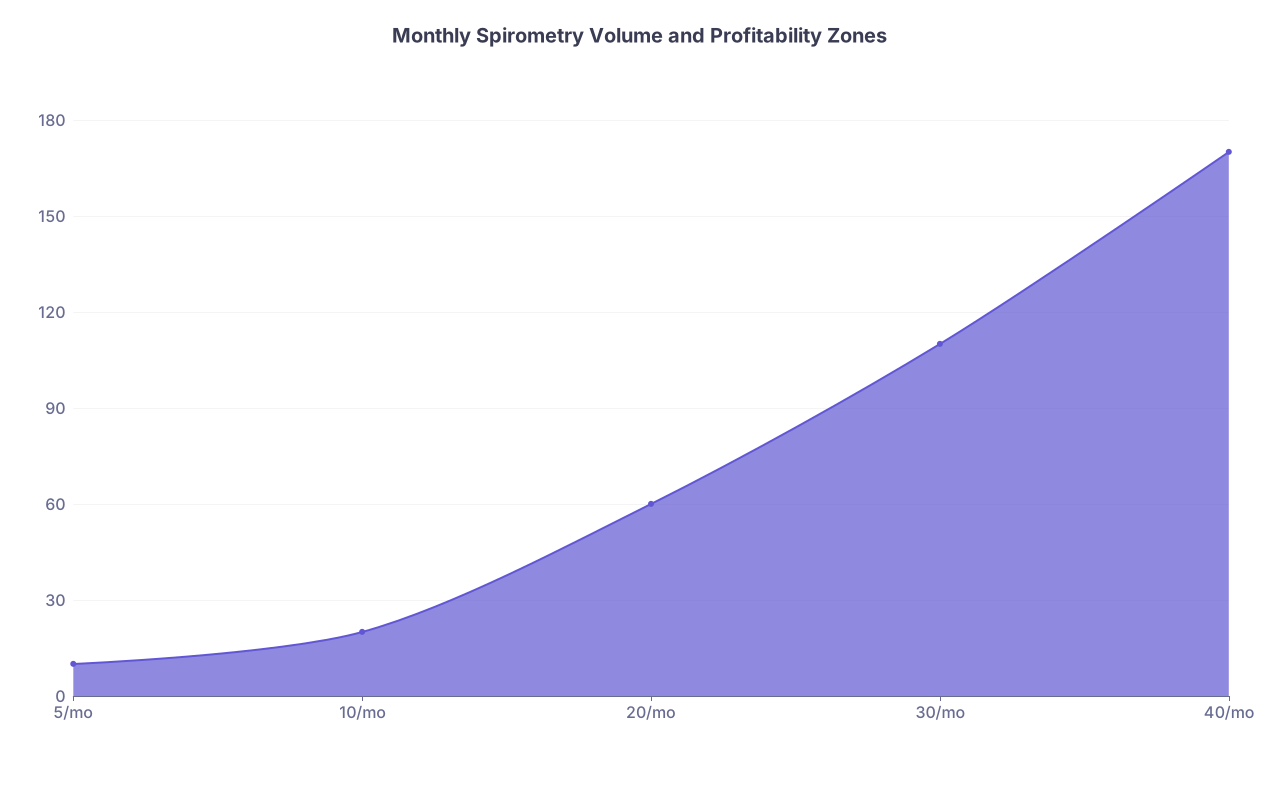
- Break‑even for basic spirometry: roughly 10–15 tests/month if reimbursement is fair.
- “Worth the headache” threshold: around 25–30+/month consistently.
| Category | Value |
|---|---|
| 5/mo | 10 |
| 10/mo | 20 |
| 20/mo | 60 |
| 30/mo | 110 |
| 40/mo | 170 |
Low volumes are not catastrophic, but they slow ROI. High volumes (20–40/month) actually make spirometry one of the best value diagnostics in an outpatient setting.
When PFT Does Not Make Early‑Stage Sense
I have seen this mistake repeatedly: new general internist in a suburban area with multiple hospital PFT labs nearby, moderate commercial payer mix, buys mid‑range PFT setup immediately.
Outcome: they use it 4–6 times a month, forget to bill or document correctly half the time, and spend more energy fighting claims than managing patients.
If any of these are true, consider delaying:
- There is excellent access to hospital or nearby pulm‑run PFT labs with fast turnaround.
- You are not niche‑focused on pulmonary disease.
- Your payer mix is heavy Medicaid or low‑pay commercial where the technical component gets gutted.
In that situation, it is smarter to:
- Start with good referral relationships for PFTs.
- Track how many times/month you are ordering PFT externally.
- Once you see stable demand (say 20+ per month) and consistent no‑show management, then bring it in‑house.
4. Ultrasound in the Office: High Reward, High Skill, High Risk if Done Poorly
POCUS is the shiny object in modern outpatient medicine.
It can be transformative:
- Rapid bedside answers.
- Fewer unnecessary referrals.
- Better patient engagement (“Let me show you what your gallbladder looks like.”).
- Strong revenue stream in the right hands.
But it is also the quickest way to overextend yourself, especially if your training and billing infrastructure are not strong.
Who Should Seriously Consider POCUS Early?
There are clear winners here:
- Rheumatology
- Joint injections with ultrasound guidance.
- Effusion assessment.
- Sports medicine and ortho
- Tendon, ligament, and joint imaging.
- Guided procedures.
- OB/Gyn
- Early pregnancy viability.
- Limited anatomy and growth scans (if trained and credentialed).
- Cardiology
- Echo and vascular studies, if you have the training and staffing.
- EM‑trained docs transitioning to outpatient urgent care or primary care
- Already competent in FAST, biliary, early pregnancy, soft tissue, basic cardiac.
For a general internist/family physician:
- Think focused use cases:
- DVT rule‑in/rule‑out in office.
- Limited cardiac function assessment.
- AAA screening.
- Lung ultrasound in dyspnea cases.
- Simple procedural guidance (central lines are rare outpatient, but joint aspirations or injections are not).
POCUS is not all‑or‑nothing. You do not need to be a mini‑radiologist. You need a clearly defined set of applications that:
- You are trained for.
- Fit your patient mix.
- Are billable and documented cleanly.
Cost, Training, and Credentialing
Hardware:
- Handheld devices (Butterfly iQ+, Philips Lumify, GE Vscan): ~$2,500–$5,000 plus subscription fees.
- Mid‑range cart systems: $15,000–$40,000 depending on probes and features.
Training:
- This is where most people cut corners and pay for it later.
- You need:
- Course‑based training (e.g., ACP POCUS courses, AIUM, specialty society offerings).
- Supervised scans, either from residency or CME environment, documented if you ever get credentialing questions.
- A comfort level with image acquisition, interpretation, and clinical correlation—not “I can make out something that looks like a kidney”.
Credentialing and liability:
- Some hospitals require proof of training and competency for ultrasound privileges. Outpatient, you have more freedom but the same liability.
- If you start billing limited echoes or OB ultrasounds, you are inherently claiming a certain standard of skill. Plaintiffs’ attorneys understand this.
Billing Reality for POCUS
This is where people either do very well or screw themselves.
Key points:
- There must be:
- A specific clinical indication.
- A formal interpretation documented in the note.
- Images saved (archived) to prove it actually happened.
- “For my own interest” or undocumented scanning is non‑billable and a medico‑legal risk.
Common code patterns:
- Limited ultrasound by body area:
- 76815 – Limited OB ultrasound
- 76536 – Ultrasound soft tissues of head and neck
- 76882 – Limited extremity ultrasound (nonvascular)
- 76942 – Ultrasound guidance for needle placement
- Echo, abdominal, pelvic, vascular: each with specific CPT codes, often higher paying but more scrutinized.
Pitfalls:
- Upcoding a limited POCUS as a full diagnostic study.
- Billing guidance codes (e.g., 76942) without meeting documentation requirements.
- Lack of image storage solution; auditors ask for images and you have nothing.
For early practice, I usually advise:
- Pick 3–5 focused, high‑yield POCUS applications that match your training.
- Make sure your EHR and IT setup can store images (local PACS, cloud, or vendor solution).
- Build templated documentation to match coding requirements.
Volume and margins:
- A well‑used handheld POCUS with 25–40 billable scans/month can easily justify itself.
- A $30k cart that sees 5 scans/month cannot.
5. How Your Specialty and Practice Model Change the Equation
Blanket advice is useless. Let us cut it by practice type.
| Practice Type | EKG Priority | PFT Priority | Ultrasound Priority |
|---|---|---|---|
| General IM/FM | High | Medium | Medium |
| Pulmonology | High | Very High | Medium |
| Cardiology | Essential | Low | Very High |
| Rheumatology | Low | Low | High |
| Sports Med/Ortho | Low | Low | Very High |
| OB/Gyn | Low–Medium | Low | Essential |
General Internal Medicine / Family Medicine
My usual phased approach for a new IM/FM outpatient practice:
Phase 1 (months 0–6):
- EKG: Yes, if adult population and chronic disease focus.
- PFT: Refer out; track external orders.
- POCUS: Only if you already have strong skills and a clear plan; otherwise wait.
Phase 2 (months 6–18):
- PFT: Bring in basic spirometry if:
- You are ordering >15–20/month externally.
- Access to external labs is poor or delayed.
- POCUS: Consider a handheld for limited use if:
- You have taken formal training.
- You commit to using it weekly, not “occasionally”.
Phase 3 (after 18 months, once panel size stabilizes):
- Expand POCUS applications or upgrade equipment if usage and reimbursement are strong.
- Consider more advanced PFT capabilities if you are edging toward a pulmonary niche.
Pulmonology
You know the answer already.
- Spirometry/PFT: Early and aggressive. That is your bread and butter.
- EKG: Yes, given cardiopulmonary overlap and older patients.
- Ultrasound: Helpful but not mandatory early, unless you are doing a lot of procedures (thoracentesis, etc.) and do not have easy access to hospital resources.
Cardiology
Here the bar is different:
- EKG: Absolutely essential, from day one. Multiple machines if multi‑room workflow.
- PFT: Usually outsourced; low priority unless you have a specific cardio‑pulm integrated model.
- Ultrasound:
- Echo: Core diagnostic service; you either build an in‑house lab or have a very tight hospital‑based setup.
- Vascular: Often bundled in the same lab.
- This is not an optional POCUS play; this is infrastructure.
For a small cardiology startup, you might:
- Start with a high‑quality portable echo machine and basic vascular capability.
- Scale to a full echo/vascular lab as patient volume and staffing allow.
Rheumatology / Sports Medicine / MSK‑Focused Practices
For these, ultrasound is not a toy. It is central.
- EKG: Generally low priority.
- PFT: Low, unless you are dealing with systemic autoimmune diseases with lung involvement and want basic screening (but still often outsourced).
- POCUS:
- Early investment is usually justified.
- Key is training: MSK ultrasound requires real pattern recognition, not “I see a blob.”
A well‑run rheum/sports practice can generate substantial procedure revenue from ultrasound‑guided injections alone, with better patient outcomes compared to blind techniques.
OB/Gyn
- EKG: Low priority except for specific high‑risk or co‑managed patients.
- PFT: Rarely in‑office; refer out if needed.
- Ultrasound:
- Early pregnancy, viability, follow‐up, biophysical profiles: you need ultrasound.
- Whether you do it yourself or bring in a sonographer depends on size and scope, but outsourcing all ultrasound is unusual once you are established.
6. Payer Mix, Local Market, and Practical Logistics
Equipment decisions live or die by three unsexy factors: payer mix, local competition, and your staff’s competence with workflows.
Payer Mix Reality
If your panel is:
- 70–80% Medicare + good commercial:
- EKG and spirometry generally pay decently.
- POCUS can be very profitable with correct coding and documentation.
- 60–80% Medicaid:
- Reimbursements for diagnostics may be extremely low or bundled.
- Capital outlays hurt more and payback takes longer.
- Heavily HMO / capitated:
- Diagnostics might not increase revenue directly but can reduce cost of care and improve quality metrics, helping with bonuses.
- You must think population health, not fee‑for‑service margin.
Local Market and Access
Ask yourself:
- How far do patients have to travel for:
- EKG (usually trivial).
- PFT (often hospital only or limited locations).
- Ultrasound (hospital radiology, imaging centers, other specialists)?
- How long is the wait?
- If external PFT or ultrasound wait times are 4–6 weeks, you gain real competitive differentiation by offering them in‑office.
- What are your competitors doing?
- If every nearby practice is bare‑bones and you can market “same‑day EKG, spirometry, and ultrasound,” you become the no‑brainer choice for complex patients.
Staff and Workflow
You can have the best equipment in town and still lose money if:
- No one remembers to schedule or perform tests.
- MAs rotate constantly and no one becomes proficient.
- Your biller does not understand the codes, modifiers, and documentation requirements.
I have seen practices where:
- Ultrasound machine: $25,000.
- Actual billable usage: 2 scans/month.
- Reason: the physician “does not have time” and staff “forget to flag indications.”
The boring fix:
- For each modality, assign:
- A clinical champion (you or a partner).
- A staff point person (MA or nurse) responsible for room setup, patient prep, and data capture.
- Create standing orders and protocols:
- e.g., “For all new asthma patients, spirometry before MD enters the room, unless contraindicated.”
- “Any pre‑op risk assessment in patient >50 with cardiac history: EKG performed if not done within the last 12 months.”

| Step | Description |
|---|---|
| Step 1 | Patient Check In |
| Step 2 | EKG before MD |
| Step 3 | Spirometry ordered |
| Step 4 | Ultrasound room reserved |
| Step 5 | MD interprets PFT |
| Step 6 | Ultrasound done and images saved |
| Step 7 | Document interpretation |
| Step 8 | Billing with correct CPT |
| Step 9 | Visit Type |
That flow diagram is what a mature practice actually looks like. Automatic triggers, not ad‑hoc decisions every time.
7. Practical Timelines: When to Add Each Modality in a New Private Practice
Let me give you a blunt roadmap. Assume you are a general IM or FM doc opening a new clinic, moderate payer mix, mostly adult patients.
Months 0–3:
- Focus on:
- Getting panels filled.
- Nailing scheduling, billing, and E/M documentation.
- Diagnostics:
- EKG: Reasonable to have from day one.
- PFT: Refer out.
- Ultrasound: Only if you already have strong POCUS training and a clear use case.
Months 4–12:
- You now see patterns:
- How many chest pain/palpitations per month?
- How many asthma/COPD patients?
- How many times you say, “I wish I could see this in real time with ultrasound.”
- Diagnostics evolution:
- Optimize EKG workflow and billing.
- Evaluate monthly external PFT and ultrasound orders.
- Start POCUS training if that is on your roadmap.
Months 12–24:
- Add basic spirometry if external PFT orders are frequent, or access is a bottleneck.
- Add handheld ultrasound if:
- You have finished course‑based training.
- You commit to using it weekly in defined scenarios.
- Start building templated notes and image storage workflows.
Beyond 24 months:
- Upgrade to more advanced PFT or higher‑end ultrasound system only if you are routinely using the basic versions and can justify the jump with volume and payer data.
This is the disciplined version. The opposite path—buy everything in month one and “figure it out as we go”—is how people lock themselves into costly leases and overextend on low‑margin services.
Key Takeaways
- EKG is low‑risk, low‑cost, and makes sense early for most adult‑focused practices; PFT and ultrasound should be phased in only when volume and skills justify them.
- PFT and POCUS can be powerful clinical and financial tools, but their success depends on training, workflow, and payer mix more than on the hardware itself.
- The smart move is staged adoption: track your external orders and clinical gaps for 6–12 months, then bring diagnostics in‑house when the numbers—and your competence—support the investment.