
It’s 8:30 p.m. The kids are finally in bed, there are cold leftovers on the counter, and you and your spouse are staring at a draft LLC operating agreement on your laptops. You both hate your employed jobs for different reasons. You both like the idea of autonomy. And now, somehow, you’re trying to figure out who owns what, who runs what, and how you don’t destroy your marriage in the process of building a practice together.
This is where you are: excited, a little scared, and one bad decision away from either a fantastic life or years of low-grade resentment.
Let me walk you through how to do this like adults: clearly, deliberately, and with your eyes open.
Step 1: Decide What You’re Actually Building Together
Before you touch ownership percentages or titles, you need to answer a more basic question: what is this practice supposed to be for each of you?
Not the fluffy mission statement. I mean in real life:
- Do you both want to see patients full-time?
- Is this mainly a platform for one spouse’s career that the other is “supporting”?
- Are you trying to build a scalable business (multi-location, associates, ancillaries), or a high-touch boutique shop?
- Who is more entrepreneurial vs. more risk-averse?
These answers dictate everything else: roles, equity, compensation, and even branding.
I’ve seen three common models for physician couples:
| Model Type | Primary Goal | Typical Ownership |
|---|---|---|
| Co-founders, equal | Shared clinical + biz | 50 / 50 |
| One lead, one support | One main career | 70 / 30 or 60 / 40 |
| Parallel but linked | Separate panels/brands | 50 / 50 or separate |
If you’re not sure which you are, ask each other this blunt question: “Five years from now, whose career is this practice primarily advancing?” If you don’t say “both of ours” with a straight face, you’re not “equal co-founders” in practice, even if you pretend on paper.
Do this before you meet with a lawyer. Lawyers draft what you tell them. They don’t fix your marital misalignment.
Step 2: Roles – Who Does What, And Why It Has To Be Explicit
“Let’s just both do everything and figure it out” is code for “we’re going to fight over whose turn it is to handle the staff crisis.”
You need written roles. Not because you don’t trust each other. Because your future selves will be tired, stressed, and forget what you agreed to.
Clinical roles
Decide:
- Who is responsible for clinical protocols, quality, and standards of care?
- Who handles complex patient escalations?
- Who oversees any APPs, residents, or fellows (if relevant)?
- Are you both doing the same type of work, or is one doing procedures, one doing consults, etc.?
If one of you is more senior/experienced in the specialty, it may make sense to designate that person as Medical Director, with a stipend and formal authority.
Business and operations roles
This is where most couples blow it. They both hate admin, so they unconsciously assume “we’ll hire people for that.”
That’s nice. But someone still has to:
- Choose and manage the office manager
- Approve major expenses
- Decide on EHR, billing, and vendors
- Handle contract negotiations (leases, payer contracts, service agreements)
- Oversee compliance and risk (HIPAA, OSHA, etc.)
You can split this, but don’t split it stupidly. It’s better to have:
- One “CEO” (even if you don’t use the title) who has final say on business decisions.
- One “COO/CMO” who runs day-to-day operations or clinical quality.
If you’re thinking, “But we’re equals, we both should be CEO,” that’s romantic and operationally dumb. The practice needs a tie-breaker. You can agree on spheres: one spouse has final say on clinical matters, the other on business / financial. But write it down.
Non-clinical but critical roles
You’ll underestimate these every single time:
- Marketing and referral relationships
- Staff culture and HR issues
- IT and workflows
- Financial tracking, dashboards, and metrics
This is where one spouse often “falls into” doing more invisible work (usually the more detail-oriented person), and then three years in they’re quietly furious because they’re doing a second full-time job for free.
Solve that at the beginning: identify these buckets, assign a primary owner for each, and attach either:
- Protected time in their schedule, or
- Actual pay (e.g., a “medical director / admin” stipend)
If you don’t attach time or money, you’re telling yourselves it’s not real work. It is.
Step 3: Equity – Ownership vs. Contribution vs. Reality
Now the part everyone obsesses over: equity.
Here’s the blunt truth: equity is not primarily a reward for how “busy” someone is. It’s a mix of:
- Risk taken
- Capital contributed
- Ongoing responsibility
- Long-term commitment
If you both are:
- Signing personal guarantees on loans
- Putting in similar cash
- Planning to be in the practice long-term
- Taking similar reputational and legal risk
Then 50/50 ownership is clean and defensible, even if your FTEs aren’t identical. You can always adjust compensation to reflect actual work.
Where equity should diverge:
- One spouse is going to stay 0.5 FTE indefinitely, the other 1.0 FTE and taking all leadership roles.
- One spouse is not clinically part of the practice at all (e.g., different specialty, full-time hospitalist, but “helping” with the business).
- One is putting in most of the startup capital from pre-marital savings or inherited money and is taking on bigger financial risk.
In those situations, pretending it’s 50/50 just kicks the resentment down the road.
A simple, grown-up way to think about it:
- Equal risk + equal commitment to the business = equal equity.
- Unequal risk or commitment = unequal equity, but protect the marriage with good docs and clear expectations.

| Category | Value |
|---|---|
| Equal Co-founders | 50 |
| Lead + Support | 70 |
| One Clinical Owner | 100 |
You can also do something like:
- 60/40 equity
- But pay both physicians based on production (wRVUs or collections)
- And add an admin/medical director stipend for whoever is doing the business heavy-lifting
That keeps day-to-day income fair while still acknowledging different risk/ownership.
One more thing: do not hide behind “but we’re married; it all goes to the same place.” That might be true philosophically, but if things go sideways (divorce, disability, death), the practice is an asset that will be sliced up by a judge or creditors if you don’t plan for it intelligently.
Step 4: Compensation – How You Pay Yourselves Without Killing Each Other
Equity is ownership of the cake. Compensation is who gets how big a slice of the current piece.
You have three main levers:
- Salary (base)
- Productivity-based pay
- Administrative/leadership stipends
- Profit distributions
A solid approach for married co-owners:
- Pay each of you a reasonable base for your clinical FTE (based on market rates).
- Add production bonuses if your work is materially different (e.g., one does high-RVU procedures, the other mostly follow-ups).
- Add a fixed stipend for the spouse doing operational leadership (e.g., $30–80k/year depending on size/complexity).
- Distribute remaining profit according to equity.
This does a few things:
- Makes invisible work visible and paid.
- Reduces the fight of “I’m seeing more patients but we’re taking home the same.”
- Keeps distributions clean and aligned with ownership.
If one of you is going to be 0.5 FTE for family reasons, reflect that in salary and production pay, not necessarily equity (unless that reduced commitment is long-term and baked into the model).
Step 5: Legal Structure, Documents, and “Getting It in Writing”
Yes, you need a lawyer. No, LegalZoom templates are not enough if you’re serious.
Core documents you need customized for “married co-owners”:
- Entity choice and formation (usually LLC or professional corporation, depends on state)
- Operating Agreement / Shareholder Agreement that:
- Lists ownership percentages clearly
- Defines roles and decision-making authority
- Sets rules for adding partners or associates
- Details what happens if one of you:
- Dies
- Becomes disabled
- Wants out
- Loses license
- Buy-sell provisions:
- How to value the practice
- Who can buy (does the other spouse have first right?)
- How buyout payments work (lump sum vs. over time)
Also, deal with this now: what if you divorce? You don’t need to script an ugly scenario, but you do need:
- A mechanism for one spouse to buy out the other.
- Or an agreed process to sell to a third party.
- Clarity on whether the practice can be co-owned post-divorce (usually a nightmare, don’t do it).
Yes, it feels awkward to talk about. Do it anyway. You’re not causing a divorce by planning for the worst-case; you’re protecting both of you and the staff depending on you.
Step 6: Boundaries – Work, Marriage, and Not Bringing EMR Fights to Bed
The business will eat your marriage if you let it. It doesn’t care that you love each other. It only cares that it’s hungry.
You need boundaries, and they need to be explicit.
Time boundaries
Decide now:
- One night a week that’s “business meeting night” where you can talk shop.
- One or two nights a week where practice talk is off-limits after, say, 7 p.m.
- Whether practice conflicts are allowed in the bedroom. (My vote: no. Your bed is not the boardroom.)
You will break these rules sometimes. That’s fine. The point is to have rules you can return to.
Decision boundaries
You cannot “consensus” every decision. It’s too slow and too emotional.
Set these categories:
- Decisions under $X (e.g., $1,000) – either spouse can make them.
- Decisions $X–$Y (e.g., up to $10,000) – whoever’s role it falls under decides, but informs the other.
- Decisions above $Y or with major impact (new location, major hire, new service line) – must be joint decisions; if deadlocked, follow the process you wrote in the operating agreement.
And then live with your own agreement. If you’ve agreed that your spouse is in charge of staff hiring/firing, you do not get to constantly second-guess them in front of staff.
Identity boundaries
This one’s subtle but dangerous: don’t let the practice become your only shared identity. You were people before you were co-owners.
That means:
- Have non-medical, non-business things you do together.
- Do not make every social interaction about the practice.
- Protect friendships that are yours individually, not just as “the doctor couple who started a clinic.”
If you notice that every conversation with your spouse eventually circles back to payroll, referrals, or the EHR, that’s a warning light.
Step 7: Day-to-Day Reality: How To Actually Run This As a Couple
Let’s get tactical. Here’s what a functional physician-couple practice does differently:
Weekly “partner meeting”
Yes, you need one. Not a chat over dishes. A real meeting.
Agenda (30–60 minutes max):
- Clinical: issues, escalations, any concerns about quality or risk
- Operations: staffing, process problems, vendor issues
- Money: quick look at dashboards – collections, AR, cash in bank
- Strategy: anything bigger on the horizon (e.g., adding a service, negotiating a new lease)
Rules:
- No personal attacks. “You always…” is banned.
- If it’s a hot topic, time-box it. If you can’t resolve in 15 minutes, park it, gather data, revisit.
- End with who is doing what by when.

| Step | Description |
|---|---|
| Step 1 | Start Meeting |
| Step 2 | Review Clinical Issues |
| Step 3 | Review Operations |
| Step 4 | Review Financials |
| Step 5 | Discuss Strategy Items |
| Step 6 | Assign Action Items |
| Step 7 | End Meeting |
Clear communication norms with staff
Your staff will test and watch your dynamic. Not maliciously. Just human nature.
You need to present as aligned even when you’re not fully aligned internally.
That means:
- No contradicting each other in front of staff about policy or decisions. If you disagree, hash it out later.
- No turning staff into messengers between you. (“Tell Dr. Smith that…” – absolutely not.)
- Clear org chart: staff know who their direct supervisor is and who to escalate to.
If staff can triangulate—ask Mom when Dad says no—you’re done.
Managing power dynamics
One of you is probably more extroverted, more dominant, or more business-savvy. Staff will naturally defer to that person. That can undercut the other spouse’s authority if you’re not careful.
Solve this by:
- Intentionally giving each spouse visible leadership in certain areas.
- Backing each other publicly, even if privately you would have done it differently.
- Rotating who leads staff meetings or 1:1s with key people.
Step 8: Career Trajectories – What If One of You Wants Out?
This is another thing couples avoid talking about: what happens if one spouse:
- Burns out
- Wants to reduce clinical time
- Wants to switch careers (academics, admin, industry, etc.)
- Has health or family constraints
You need a pre-agreed path.
For example:
- If either spouse wants to reduce to ≤0.5 FTE for more than 12 months, you both revisit:
- Compensation model
- Admin responsibilities
- Whether equity remains the same or adjusts (and how)
I’m not saying you need a complex formula. Just an understanding that changes in commitment trigger a structured conversation, not years of quiet frustration.
Also consider this honest truth: many practices started by couples eventually become primarily one spouse’s professional home. If that happens, you’ll be glad you built in a graceful way for the other to step back without blowing up the relationship.
Step 9: Money Outside the Practice – Protecting Your Household
There’s a dangerous pattern I’ve seen: every dollar is mentally “practice money,” and the family just gets whatever’s left.
Don’t do that. Your household is the client of the practice, not the charity.
Set:
- A target household “salary” you want to take home (combined), even if you can’t hit it year one.
- A minimum emergency fund at the personal level (not just business reserves).
- Rules for how much gets reinvested vs. distributed.

| Category | Value |
|---|---|
| Owner Compensation | 50 |
| Practice Reserves | 20 |
| Growth/Reinvestment | 15 |
| Taxes | 15 |
Use a real accountant who understands:
- Physician practices
- Pass-through entities
- Reasonable compensation rules
And separate your roles: at home, you’re spouses. At work, you’re co-owners. Don’t bring “you blew the marketing budget” into an argument about who forgot to buy milk.
Visual Snapshot: Phases of Building a Practice Together
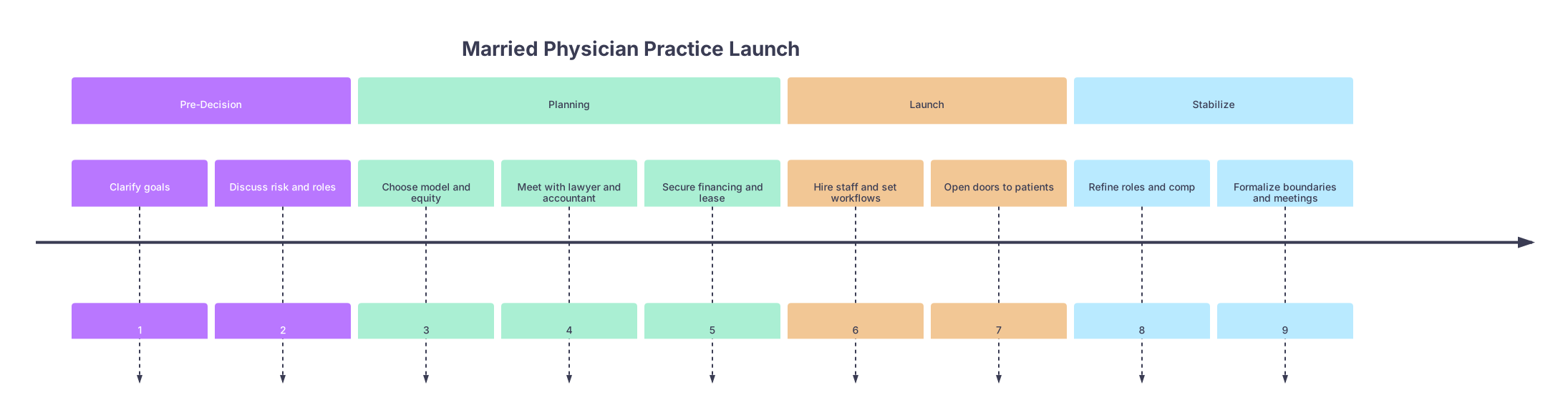
| Period | Event |
|---|---|
| Pre-Decision - Clarify goals | 1 |
| Pre-Decision - Discuss risk and roles | 2 |
| Planning - Choose model and equity | 3 |
| Planning - Meet with lawyer and accountant | 4 |
| Planning - Secure financing and lease | 5 |
| Launch - Hire staff and set workflows | 6 |
| Launch - Open doors to patients | 7 |
| Stabilize - Refine roles and comp | 8 |
| Stabilize - Formalize boundaries and meetings | 9 |
Quick Reality Check: Are You Two Good Candidates For This?
Some couples should not co-own a practice. I’ll say it.
Red flags:
- You cannot disagree without escalating to personal attacks.
- One of you chronically avoids conflict, the other steamrolls.
- There’s already resentment about career sacrifices, money, or workload.
- One partner wants this badly; the other is ambivalent but “going along.”
If those are present, fix the relationship dynamics first, then start a practice. Not the other way around. A business amplifies whatever is already there—good and bad.
On the other hand, if you:
- Communicate directly, even when it’s uncomfortable
- Respect each other’s judgment
- Can compartmentalize (work vs. home)
- Share values about money, risk, and how you treat staff/patients
Then a joint practice can be one of the most rewarding things you do together. It can give you control over your time, your income, and your professional integrity.
FAQs
1. Should we do 50/50 ownership even if one of us will be 0.5 FTE clinically?
If you’re both taking on equal business risk (signing the loan, on the hook for leases, reputational risk) and you both see this as a long-term joint venture, 50/50 can still make sense. Just don’t confuse equity with paycheck. Pay the full-time spouse more through salary/production and possibly an admin stipend. If the 0.5 FTE status is long-term and one spouse isn’t really invested in building the enterprise, consider something like 60/40 instead, with a clear plan and written expectations.
2. Do we need a prenuptial or postnuptial agreement if we’re starting a practice together?
If you’re already married, a postnup can be smart, especially in community property or equitable distribution states where a divorce court could do something messy with your ownership. At minimum, your operating agreement should spell out a buyout process and valuation method if the marriage ends. A postnup can align that with your broader financial life. It’s not “planning to divorce”; it’s planning to avoid a courtroom circus if the worst happens.
3. What if one of us hates business and just wants to see patients?
Then stop pretending you’re co-CEOs. Let the more business-minded spouse formally take that role, with explicit decision authority and compensation for it. The clinically focused spouse can be a co-owner but should be honest that they’re delegating business leadership. You can still be equal partners in spirit, but the practice needs one clear captain on operations and strategy, not two reluctant co-captains who both resent the helm.
Key points to walk away with:
- Get brutally clear on goals, roles, and equity before you sign anything.
- Separate compensation from ownership, and make invisible work visible and paid.
- Protect the marriage with boundaries, real documents, and a clear decision structure—your practice depends on that as much as your relationship does.