
The biggest mistake doctors make when starting a side practice is trying to “fit it in” around their hospital job. That is how you burn out and lose money at the same time.
You do not “fit in” a private practice. You engineer your week around it.
You’re post‑residency, you’ve got a hospital or employed job, and you’re itching to start your own thing: a small clinic, a niche consult service, maybe a cash‑pay practice. Good. But if you do this without a clear weekly structure, you’ll end up exhausted, double‑booked, and resented by both your employer and your family.
Let’s build a realistic, defensible schedule that keeps your W‑2 job safe, grows your practice, and does not wreck your life.
Step 1: Get Clear on Your Non‑Negotiables Before You Touch a Calendar
Your week is not a blank canvas. It’s already mostly sold.
Before you sketch a single clinic block, answer these, in writing:
- What exact hours does your hospital job own?
- What are your contractual obligations and restrictions?
- What family / sanity time is non‑negotiable?
- How many practice hours can you sustain weekly for 12 months?
If you skip this, you’ll build a fantasy schedule that collapses the first time you get stuck in sign‑out or your kid gets sick.
A. Map Your Hospital Job Precisely
Take your current job and break it down like you’re billing time:
- What days are you on service or in clinic?
- Start and end times, not “roughly 8–5”.
- How often do meetings land (M&M, department, admin)?
- Call schedule: in‑house vs home, post‑call rules.
Write it down like this, not in your head:
- Mon: Hospital clinic 8–4, usually out by 4:30
- Tue: OR 7–3, admin 3–5
- Wed: Service 8–6, team rounds late
- Thu: Admin 8–12, mostly Zoom meetings
- Fri: Service 8–5
- 1 in 4 weekends: Rounding Sat/Sun 7–11
Now you can see usable spaces instead of vibes.
B. Know Your Contractual Landmines
Do not start scheduling patients until you know what your contract actually says. I’ve watched people get disciplined or fired because they “didn’t think anyone would care.”
Common traps:
- Non‑compete radius (geographic and scope)
- Prohibition on outside clinical work without approval
- Restrictions on seeing the same patient population
- Ban on using hospital staff or systems (EMR, email) for side work
You need:
- Written approval for outside clinical work if required
- Clarity on where your new practice can be located
- Clarity on payor mix (some contracts restrict seeing existing hospital patients privately)
If anything is vague, you email HR/medical staff office and get a written answer. Not a hallway conversation.
Step 2: Choose Your Practice “Shape” First, Then the Days
Your schedule depends heavily on the type of practice you’re building. A cash‑pay ADHD clinic is not the same as a general IM office that bills insurance.
Three common shapes for part‑time practices while keeping a hospital job:
- Fixed half‑days (e.g., every Thursday afternoon and Saturday morning)
- Full “practice day” once or twice a week
- Telemedicine blocks in early morning/evening
You can mix these, but don’t get cute. Simple, repeatable blocks win.
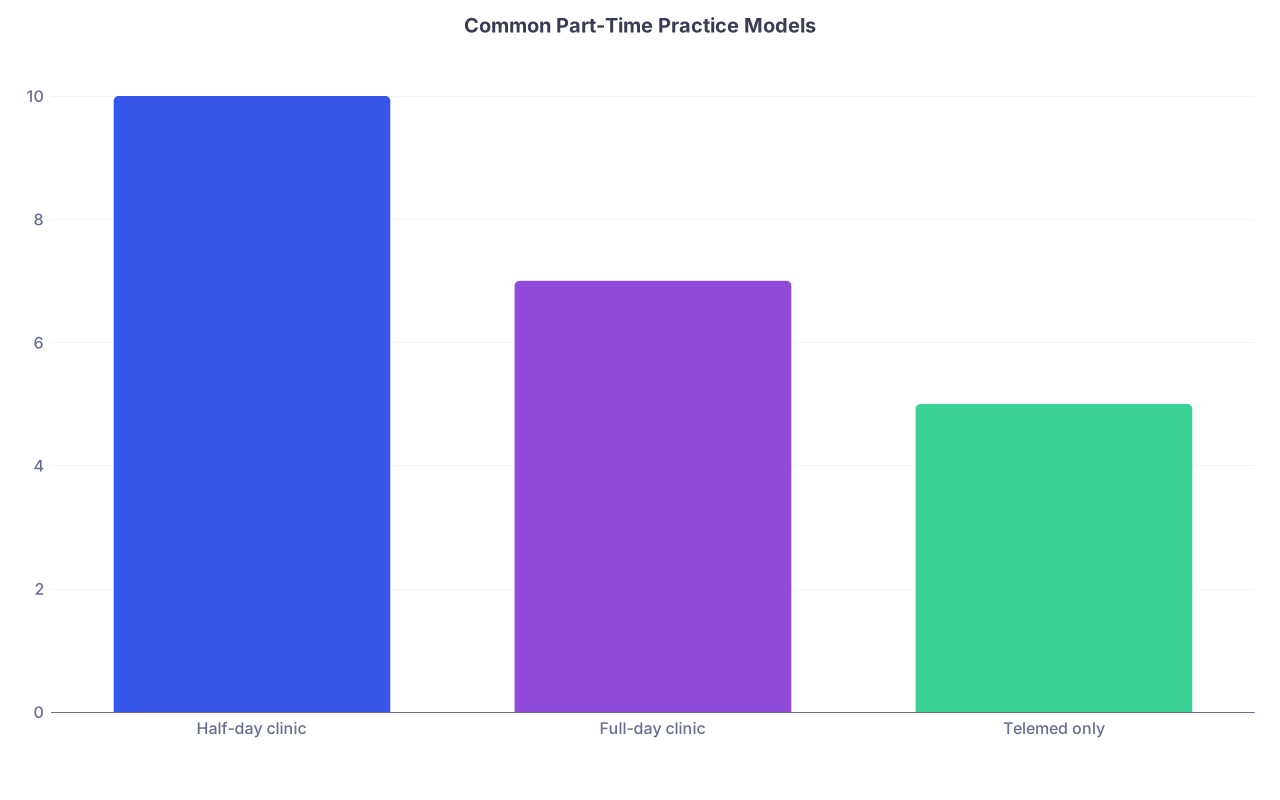
| Category | Value |
|---|---|
| Half-day clinic | 10 |
| Full-day clinic | 7 |
| Telemed only | 5 |
(Values here represent “difficulty level” out of 10—half‑day clinics while employed are usually the hardest to execute cleanly.)
Step 3: Sample Weekly Structures That Actually Work
Let’s get concrete. I’ll walk through realistic templates I’ve seen work for attendings in their first 1–2 years of part‑time practice.
Scenario 1: Full‑Time Hospitalist + Niche Cash Practice
You work 7‑on/7‑off, 7a–7p as a hospitalist. You want to run a small cash‑pay consult clinic (e.g., obesity medicine, sleep, ADHD, hormone clinic).
Bad move: trying to see patients on hospital days “after work.” Those days disappear into late admits, codes, and sign‑out.
Better structure:
- Practice runs only on your off‑week.
- Fixed clinic blocks: Mon/Wed/Fri 9–1, Telemed Tue/Thu 4–7.
- Zero clinic on hospital weeks. Maybe admin only.
Example week on your OFF block:
- Mon: Clinic 9–1, admin 2–3
- Tue: Deep work/admin 9–12, Telemed 4–7
- Wed: Clinic 9–1
- Thu: Marketing / referral outreach 9–11, Telemed 4–7
- Fri: Clinic 9–1, bookkeeping 2–3
You protect your on‑service sanity, and your practice grows with clear, reliable availability during the off week.
Scenario 2: 0.8 FTE Outpatient Employed + Insurance‑Based Practice
Say you’re an employed PCP at 0.8 FTE, M/T/W/F 8–4. You’re starting a small office across town focused on more extended visits or a different payor mix.
You think: “I’ll just run Thursday clinic 8–5 in my own office.” Sensible.
Your structured week:
- Mon: Employed clinic 8–4
- Tue: Employed clinic 8–4
- Wed: Employed clinic 8–4
- Thu: Private practice 8:30–4:30
- Fri: Employed clinic 8–4
You then layer in:
- 1–2 evenings per week of short telemed blocks (e.g., Tue/Thu 6–8) if you need more volume
- Protected admin block for the new practice (early mornings 6–7:30 on Mon/Wed, for example)
The hidden key here: you cap your new practice at something like 6–8 patients per day initially, so you’re not finishing charting at midnight.
Scenario 3: Full‑Time Specialist + Concierge / DPC‑Style Panel
Specialists (cards, GI, neuro, etc.) often want a tiny, highly curated panel of patients they see on the side for longer visits, second opinions, or specialty consults.
You probably have:
- OR days starting at 7 a.m.
- Long clinic days 8–5
- Sprinkle of call and late studies
Your best structure is usually:
- One recurring early morning clinic block (e.g., Wed 7–9 a.m. telemed)
- One recurring Saturday morning in‑person block (e.g., 9–12)
So your private practice hours might be:
- Wed: 7–9 a.m. Telemed consults
- Sat: 9–12 clinic, 12–1 admin
That’s 5 hours/week. Small but powerful if your per‑visit revenue is high.
Step 4: Build Your Week in Blocks, Not in Individual Appointments
If you build your schedule starting from “where can I squeeze this patient in,” you’re already lost. You’ll end up answering texts at 10 p.m. and doing notes on Sunday night.
You want fixed blocks.
Think in 3 kinds of blocks:
- Clinical blocks (face‑to‑face or telemed)
- Admin blocks (charting, billing, messages)
- Growth blocks (marketing, referrals, systems)
Your week should literally be chunked like this.

| Step | Description |
|---|---|
| Step 1 | Hospital Job Blocks |
| Step 2 | Identify Open Time |
| Step 3 | Reduce Practice Hours |
| Step 4 | Assign Clinical Blocks |
| Step 5 | Add Admin Blocks |
| Step 6 | Add Growth Blocks |
| Step 7 | Protect Family Time |
| Step 8 | Is it sustainable weekly |
How to Size the Blocks
Early stage practice (first 6–12 months):
- 2–3 clinical blocks per week, 3–4 hours each
- 2 admin blocks per week, 1–2 hours
- 1 growth block per week, 1–2 hours
So maybe:
- Tue: 6–8 a.m. admin/growth
- Thu: 1–5 p.m. clinic
- Sat: 9–12 clinic, 12–1 admin
Instead of seeing 3 patients every random evening.
Step 5: Guardrails So Your Hospital Job Doesn’t Blow Up Your Practice
Your employer will always try to expand into any usable open time you have. Not malicious. Just inertia.
You need structural protection, not “I’ll just say no.”
A few hard rules that work:
Fixed recurring unavailable times in your hospital calendar.
Block your practice clinic times as “Unavailable – external professional obligation” in Outlook/EMR scheduling so nobody drops a 3 p.m. admin meeting on your private clinic.Refuse same‑day meeting creep.
If your private practice clinic is Thu 1–5, you do not take a “quick noon Zoom.” That noon Zoom becomes 12:15–1:10 and your 1 p.m. patient walks into a locked door.Location and travel buffer.
If your hospital job ends at 4 and your clinic is 30 minutes away, your earliest patient is 5:15, not 4:30. You need buffers: hospital chaos + parking + traffic + bathroom + reset.Post‑call rules.
If you’re post‑call, your practice is admin only or off. Do not see clinic patients post‑call. Your judgment is off, and your patience is worse.
Step 6: Consider Call and Unpredictability Up Front
This is where most people underestimate the chaos.
If you have:
- Q4 or more frequent in‑house call
- ICU coverage
- ED backup where you’re often called in
You cannot pretend your life is a neat 8–5.
You need “flex” policies for your practice:
- Patients are told clearly on your website and intake: “Clinic days may occasionally be shifted or moved during call weeks; we guarantee reschedule within X days.”
- You prefer telemed on call‑adjacent days (so rescheduling is easier and no one’s driving across town).
- You do not anchor your practice’s survival to a single weekday evening that’s constantly at risk from overflow at the hospital.
One hack I’ve seen work:
- Make your primary practice time Saturday morning (in‑person or telemed).
- Use 1–2 weekday evenings as overflow/expansion only, not the core.
Weekend mornings are the least hijacked by hospital nonsense.
Step 7: Your Family Schedule is as Important as Your Clinic Schedule
If you ignore this, someone at home will eventually say, “So you work for the hospital, you work for your ‘business,’ when do you work for us?”
You need explicit agreements with your partner/family:
- Which evenings are off‑limits for work
- Which weekend mornings are sacred
- When you’re physically and mentally present, phone down
You literally plan:
- No clinic or admin: Wednesday evenings + Sunday all day
- Date night: Every other Friday after 6, no exceptions
- Kid activities: You commit to one recurring time (e.g., Saturday afternoon games)
Then build the practice schedule around those, not the other way.
Step 8: Start Smaller Than You Think, Then Expand Intentionally
New attendings especially like to overestimate their energy. You’re finally not a resident, you feel powerful, and you’re ready to “grind.” That enthusiasm dies fast once you’re doing two inboxes and two sets of quality metrics.
Initial target:
10–12 clinical hours per week maximum for the first 6 months. Often less.
Example ramp‑up:
Months 1–3:
- 1 half‑day clinic during the week (3–4 hours)
- 1 Saturday morning clinic (3 hours)
- 2 hours admin Total: 8–10 hours/week.
Months 4–6:
- Add 1 weekday evening telemed block (2 hours) Total: 10–12 hours/week.
Months 7+:
- Only after you know your stress points, consider:
- Adding another half‑day
- Increasing visit density
- Hiring help (MA, virtual assistant)
You want to be hungry for more time, not desperate for less.
Step 9: Concrete Weekly Templates You Can Steal
Here are a few templates you can basically copy‑paste and adapt.
| Scenario | Hospital Work | Private Practice Time |
|---|---|---|
| Hospitalist 7-on/7-off | 7a-7p on-service week | Off-week: M/W/F 9-1 clinic, Tu/Th 4-7 telemed |
| 0.8 FTE Outpatient | M/T/W/F 8-4 | Thu 8:30-4:30 clinic, Sat 9-12 telemed |
| Full-time Specialist | 4 days clinic/OR + call | Wed 7-9 telemed, Sat 9-12 clinic |
Use these as starting points, then adjust:
- Commute time
- Kid drop‑off / pick‑up
- Call weekends
Step 10: Admin, Billing, and the “Second Inbox Problem”
You are not just adding more patients. You’re adding:
- A second EMR or practice management system
- A second inbox (or several)
- Billing/reconciliation
- Credentialing and insurance headaches
If you don’t explicitly schedule admin time, it spills into your nights and you start thinking your practice was a bad idea. It wasn’t. Your calendar was.
Minimum admin structure:
- One 1–2 hour admin block mid‑week (for: billing, claims, messages)
- One 1‑hour admin block at week’s end (close charts, check denials, review finances)
Example:
- Tue 6–7 a.m.: Charting and messages
- Fri 2–3 p.m.: Billing and financial review
Do not try to “squeeze in” admin between patients. That just guarantees half‑finished notes and missed revenue.

| Category | Value |
|---|---|
| Clinical | 65 |
| Admin | 25 |
| Growth/Marketing | 10 |
Step 11: Telemedicine as Your Pressure Valve
Telemed is your friend if you’re balancing two jobs. But only if you treat it like real clinic, not casual “extra work.”
Best uses of telemed blocks:
- Early morning before hospital clinic (e.g., 6:30–8 a.m.)
- Evening after kids’ bedtime (e.g., 7–9 p.m.) no more than 1–2 nights/week
- Saturday mornings for follow‑ups and short visits
Rules that keep telemed sane:
- Strict start/end times. You do not add “just one more” at 9:15 p.m.
- Clear visit types (15‑ or 30‑minute blocks, no 60‑minute marathons after a full hospital day)
- No messaging free‑for‑all. Patients still book visits; you’re not running a text‑based anonymous hotline.
Step 12: Checkpoints: How to Know If Your Structure Is Working
Every 3 months, sit down with your calendar and ask:
- How often am I late to my own clinic because of the hospital?
- How often am I finishing notes after 10 p.m.?
- Have I missed or rescheduled more than 5–10% of private patients due to hospital obligations?
- Is my family pissed off? (You usually know.)
If:
- You’re constantly late or canceling → move your clinic blocks away from hospital volatility (e.g., to weekends or off‑weeks).
- Notes are piling up → decrease patient density or add admin time.
- You’re more exhausted than excited → scale back by 25–50% of clinical hours for 3 months, then reassess.
This is not quitting. It’s avoiding the trap where you start hating your own business.

| Step | Description |
|---|---|
| Step 1 | Current Schedule |
| Step 2 | 3 Month Review |
| Step 3 | Reduce Hours or Density |
| Step 4 | Maintain or Grow |
| Step 5 | Update Calendar |
| Step 6 | Overloaded |
Quick Reality Check: Money vs. Time
Everyone pretends this is all about autonomy. It is also about cash flow.
Part‑time practice will feel “slow” at first. Your instinct will be to cram more hours in. Resist.
Your job is to create option value:
- Build systems
- Learn your market
- Test your niche
- Grow a patient base
So if and when you want to cut back at the hospital, you can. That’s the long game.

FAQs
1. How many hours per week can I realistically add for a side practice without burning out?
For most attendings within the first 5 years out, 8–12 hours/week of total practice time (clinical + admin) is the upper safe limit if you’re full‑time employed. If you’re already at 0.8 FTE or less, you might stretch to 12–16, but only if you’re disciplined about admin blocks and not dragging charting into late nights regularly. If you’re consistently doing more than that and feeling fine, you’re either early in the ramp‑up (low volume) or underestimating the slow bleed on your energy; reassess every 3 months.
2. Should I reduce my hospital FTE before starting the practice, or start the practice first?
In most cases, start the practice first on a small scale while keeping your current FTE. Prove to yourself that patients will book, that your niche works, and that your systems are at least functional. Once you have stable demand (e.g., a few months of mostly full clinic blocks, minimal cancellations, positive cash flow), then negotiate dropping to 0.8 or 0.6 FTE at the hospital. Quitting or cutting back first and “hoping” the practice fills is how people end up financially stressed and desperate for any patient volume.
3. What’s the minimum viable weekly structure to make a part‑time practice worth it?
For most outpatient specialties, a minimum viable structure that can still grow looks like: one 3–4 hour in‑person or telemed clinic block on a weekday, one 3‑hour Saturday morning clinic block, and 2 hours of weekly admin. That’s roughly 8–9 hours/week. Anything less than 4–5 clinical hours/week and you’ll struggle to create momentum, remember workflows, and keep staff (if you have any) engaged. You can always start with fewer patients inside those blocks, but the recurring time itself needs to be there.
Key points to remember:
You don’t bolt a practice onto your life; you rebuild your weekly structure around it. Block your time ruthlessly, with protected clinic, admin, and family time. And start smaller than you think you “should,” then expand only when your actual calendar—not your optimism—says you can handle it.