
It’s July 1st. You finished residency, your first attending paycheck hasn’t even hit yet, and you’re staring at two things:
- Your student loan balance: $380,000 at blended 6.3%.
- A draft lease for 1,800 sq ft of clinic space that you really want.
Your co-residents think you’re insane for opening a clinic instead of taking the “safe” employed job with a big system. Your parents are asking why you’re not just doing PSLF. And meanwhile, you’re trying to figure out one thing:
Can I actually make this work without drowning in cash flow problems?
This is the exact situation this is for: you, an early-career physician with heavy student loans, who still wants to open a clinic—and needs concrete, cash-flow-focused strategies, not vague motivational fluff.
Let’s walk through how to set this up so the practice pays the bills, your loans don’t crush you, and you don’t run out of cash in month six.
Step 1: Set the Ground Rules — Your Practice Has to “Carry” Your Loans
I’m going to be blunt: if you open a clinic with significant debt, you can’t treat your loans as some separate background problem.
Your practice decisions must be built around this premise:
The practice has to generate enough reliable cash flow to cover:
- Operating costs
- Your minimum viable personal salary
- Your student loan strategy (even if that strategy is “pay the least legally allowed while I build the business”)
Not “someday.” From day one.
Know what “minimum viable life” actually costs
Before you look at a single office space, you need three numbers:
Your bare-minimum monthly personal budget (not fantasy, real):
- Modest housing
- Food, insurance, car, childcare if applicable
- Minimal discretionary (but not zero, that’s not sustainable)
Your minimum required student loan payment under the plan you’ll actually use:
- IDR (SAVE/IBR) vs standard vs refinancing
The smallest gross salary your practice has to pay you to cover #1 + #2 + taxes.
If you do not know these, you’re not planning. You’re guessing.
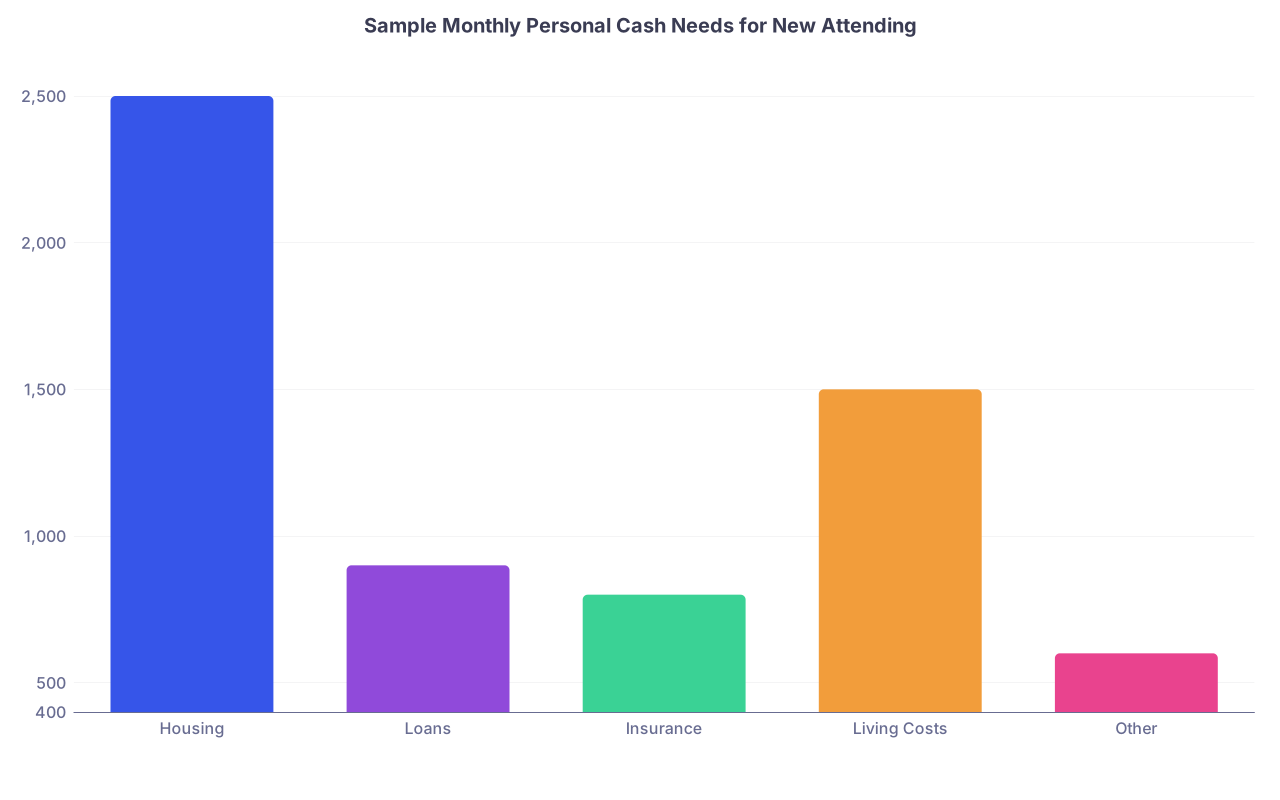
| Category | Value |
|---|---|
| Housing | 2500 |
| Loans | 900 |
| Insurance | 800 |
| Living Costs | 1500 |
| Other | 600 |
Suddenly that “I’ll just pay myself $10k a month” assumption gets tested. Good. It should.
Step 2: Use Your Student Loans Strategically, Not Emotionally
A lot of new attendings sabotage their practice cash flow by making emotionally satisfying but financially dumb loan decisions.
“I want these gone in 5 years” is noble. It can also bankrupt your clinic.
Pick a loan strategy that matches the business phase you’re in
Early practice years = fragile cash flow. That is not the time to force maximum debt paydown if it chokes the business.
Here’s the rough framework I’d use:
| Phase | Years In Practice | Loan Approach |
|---|---|---|
| Launch / Survival | 0–2 | Minimize payment |
| Stabilization | 2–5 | Moderate paydown |
| Growth / Maturity | 5+ | Aggressive payoff |
Launch / Survival:
You use IDR (like SAVE) or extended repayment to lower mandatory monthly payments, even if that means more interest over time. You’re buying runway for the clinic. If you later refinance and pay aggressively, fine. But you survive first.
Stabilization:
Once the clinic can reliably pay you a stable salary and keep reserves, you reassess: PSLF? IDR forgiveness long-term? Refinance and crush it? That decision is smarter when you’re not in survival mode.
Growth:
When monthly cash flow is comfortable and reserves are healthy, then you get aggressive on principal. Not before.
Common mistake I see all the time
New attending opens a clinic, refinances all loans to a 5-year term because “rates are higher but I want them gone fast.” Monthly payment jumps to like $7,000. Then month 4, patient volume is slower than expected, and suddenly you’re choosing between:
- Paying staff
- Paying rent
- Paying your refinance lender
Do not let your ego about “being debt free” kill your business in its infancy. Delay the aggressive payoff. That’s not weakness. That’s strategy.
Step 3: Design Your Practice Around Cash Flow, Not Prestige
Your first clinic is not your legacy building. It is a cash flow engine. Treat it like that.
This is where many physicians screw it up: beautiful space, top-tier equipment, full staff… and then they’re surprised that the money going out each month exceeds what’s coming in.
Keep fixed costs brutally low for the first 24 months
Your three killers:
- Rent
- Full-time staff before you have volume
- Locked-in overhead (equipment leases, long-term contracts, fancy EMRs)
You want variable costs (that move with volume) and optionality, not rigid fixed commitments.
A few concrete moves that actually work:
- Smaller space or shared suite for year 1–2. You’re not above subleasing from an established practice for two days a week.
- Use part-time / per-diem staff where possible (front desk, MA, biller) instead of full-time from day one.
- Basic but functional EMR first. You can upgrade later; right now you need reliable, cheap, and compliant.
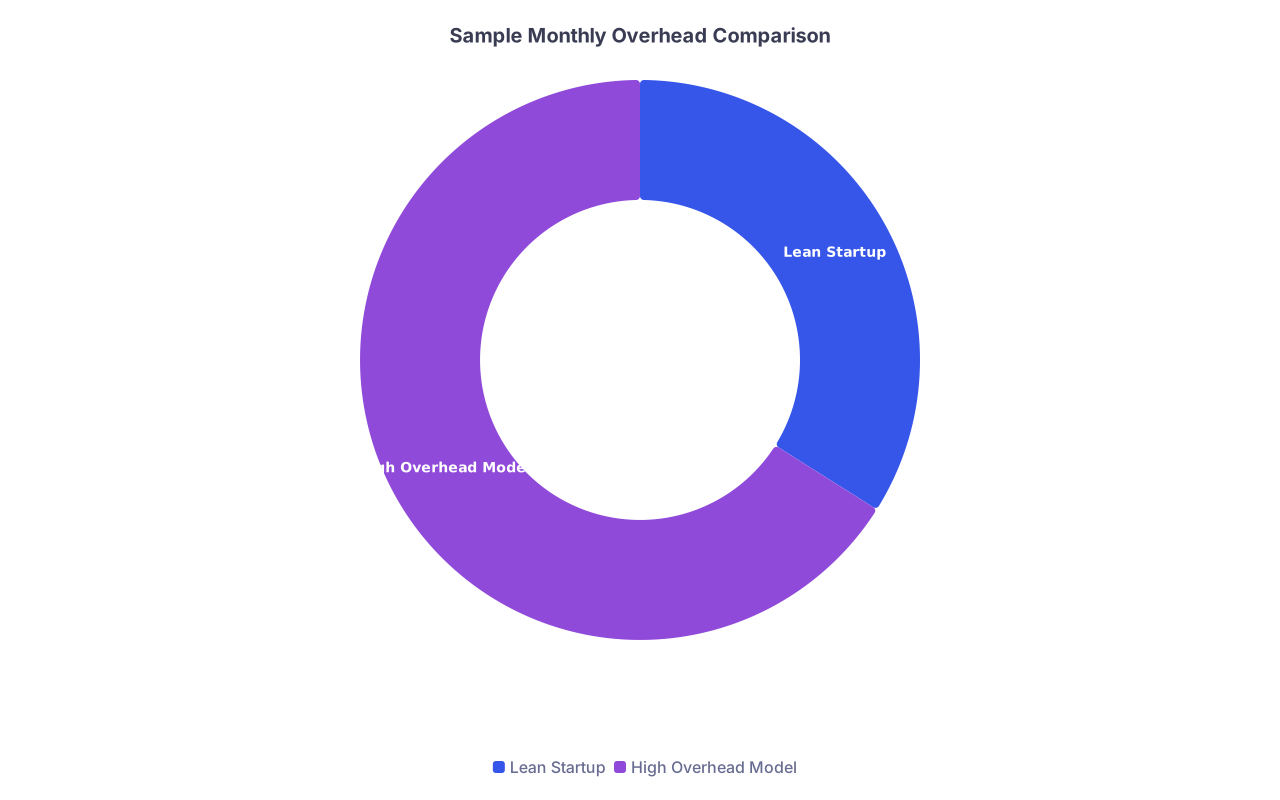
| Category | Value |
|---|---|
| Lean Startup | 18000 |
| High Overhead Model | 35000 |
The difference between $18k/month and $35k/month fixed overhead is the difference between sleeping and staring at the ceiling at 3 a.m.
Choose services and payer mix with eyes wide open
You do not have the luxury of pretending payer mix doesn’t matter. It does.
You want:
- Fast-paying payers (not ones that sit on claims for 90 days)
- Services with decent reimbursement vs time invested
- A mix that doesn’t leave you 80% dependent on the worst payer in town
Don’t just copy what your academic clinic did. They had system subsidies and a different mission. You need cash flow.
Step 4: Front-Load Revenue: Start Earning Before Your Doors “Officially” Open
The biggest trap: 6 months of build-out, credentialing delays, no revenue, just burn.
Here’s what you do instead.
Work a bridge job while you build
You don’t have to choose between “all-in clinic” and “fully employed forever.” Hybrid is often the smartest move.
Examples I’ve seen work:
0.5–0.7 FTE employed job (hospital, FQHC, urgent care) for 12–24 months while:
- You credential with payers for your practice
- You slowly build your own patient panel
- Your clinic overhead stays minimal at first
Locums 2–3 weeks/month and run your practice 1–2 weeks/month early on
Is it tiring? Yes. Does it massively de-risk your personal cash flow during those early months? Also yes.
Start seeing patients in some form before full launch
You can:
- Rent exam space by the half-day at an existing clinic
- Offer telehealth-only sessions under your future practice brand (if legal in your state)
- Start cash-pay consults for specific services (e.g., ADHD management, weight management, vasectomies, minor procedures)
You are not waiting for the grand opening ribbon-cutting. You’re trickling in revenue as soon as humanly possible.

| Step | Description |
|---|---|
| Step 1 | Finish Residency |
| Step 2 | Start 0.6 FTE Employed Job |
| Step 3 | Begin Credentialing for Own Clinic |
| Step 4 | Rent part-time exam space |
| Step 5 | See 1-2 clinic days per week |
| Step 6 | Build panel and reviews |
| Step 7 | Open full-time clinic and taper employed job |
If you treat “opening day” as the day revenue starts, you’re already behind. Revenue should start before the sign goes up.
Step 5: Build a First-Year Cash Flow Plan That’s Actually Honest
Your first-year “projections” should be less fantasy, more pessimistic spreadsheet.
Here’s what I push people to do:
- Build three models: best case, expected, conservative.
- Plan your spending based on the conservative one, not the best case.
- Have a specific trigger where you cut or expand costs depending on which model reality matches.
| Scenario | Month 3 Visits | Month 6 Visits | Month 12 Visits |
|---|---|---|---|
| Best Case | 180 | 350 | 650 |
| Expected | 120 | 250 | 450 |
| Conservative | 80 | 180 | 320 |
Now link that to revenue: visits x average collected per visit = gross revenue. Then subtract overhead. Then see what’s actually left for your take-home + loans.
If your conservative model barely covers your minimum salary + minimal loan payments, that’s acceptable if you’re using a bridge job or have savings. If it doesn’t, you need to adjust now: either cut overhead, increase outside income, or change your service mix.
Step 6: Use These Specific Cash Flow Levers Early On
Here’s where this gets practical. These are levers you can actually pull in real life, not theoretical “optimize revenue” nonsense.
1. Start with at least one high-ROI service line
Bread-and-butter clinic visits are fine, but some services give you better revenue per unit time.
Examples (depending on specialty and laws):
- In primary care:
- Annual wellness visits (if you understand coding)
- Chronic care management (CCM)
- Remote patient monitoring (RPM) if done properly, not through shady vendors
- In psych:
- Longer initial evals + meds management
- Group visits for specific conditions (ADHD, anxiety)
- In surgery/procedural:
- Office-based procedures with decent reimbursement and low supply cost
- Vasectomies, joint injections, skin procedures, etc.
You want at least one thing that isn’t just “15-minute low-paying follow-ups all day.”
2. Don’t delay billing and collections
Slow billing kills young practices. I’ve watched it firsthand.
From day one:
- Claims go out daily, not weekly “when we have time.”
- Someone (you or a biller) checks rejections and unpaid claims weekly.
- Co-pays are collected at the visit. Not “we’ll bill you later.” That’s charity, not business.
Slow revenue cycle + big loans = disaster. You don’t have the cushion to be sloppy here.
3. Build a small but real cash cushion
You’ll hear “have 6–12 months of expenses saved before starting.” Nice in theory, unrealistic for many with loans.
But you do want something. My realistic target for most new grads with high loans:
- 3 months of personal bare-bones expenses
- 2–3 months of clinic fixed overhead (once you know that number)
If you don’t have that, fine—but then you must have either:
- A bridge job with guaranteed minimum income, or
- A line of credit that you treat with extreme discipline.
Step 7: Decide When (and Whether) to Refinance Your Loans
Refinancing can be great. It can also lock you into high mandatory payments exactly when you need flexibility.
Here’s how I’d think about it in the context of opening a clinic.
Strong reasons to delay refinancing
- You’re not sure if you might end up back in a nonprofit setting and want PSLF as a potential future path.
- Your income will be unstable for 1–3 years and you need IDR flexibility.
- You’re about to take on practice debt (line of credit, business loan) and you don’t need another fixed large payment on your back.
When refinancing starts to make sense
- Your clinic income has stabilized for at least 12 months.
- You’re nowhere near PSLF eligibility and never plan to work for qualifying employers.
- You have at least modest reserves.
- The payment you’d owe under a 10–15 year refinance will not compromise practice stability.
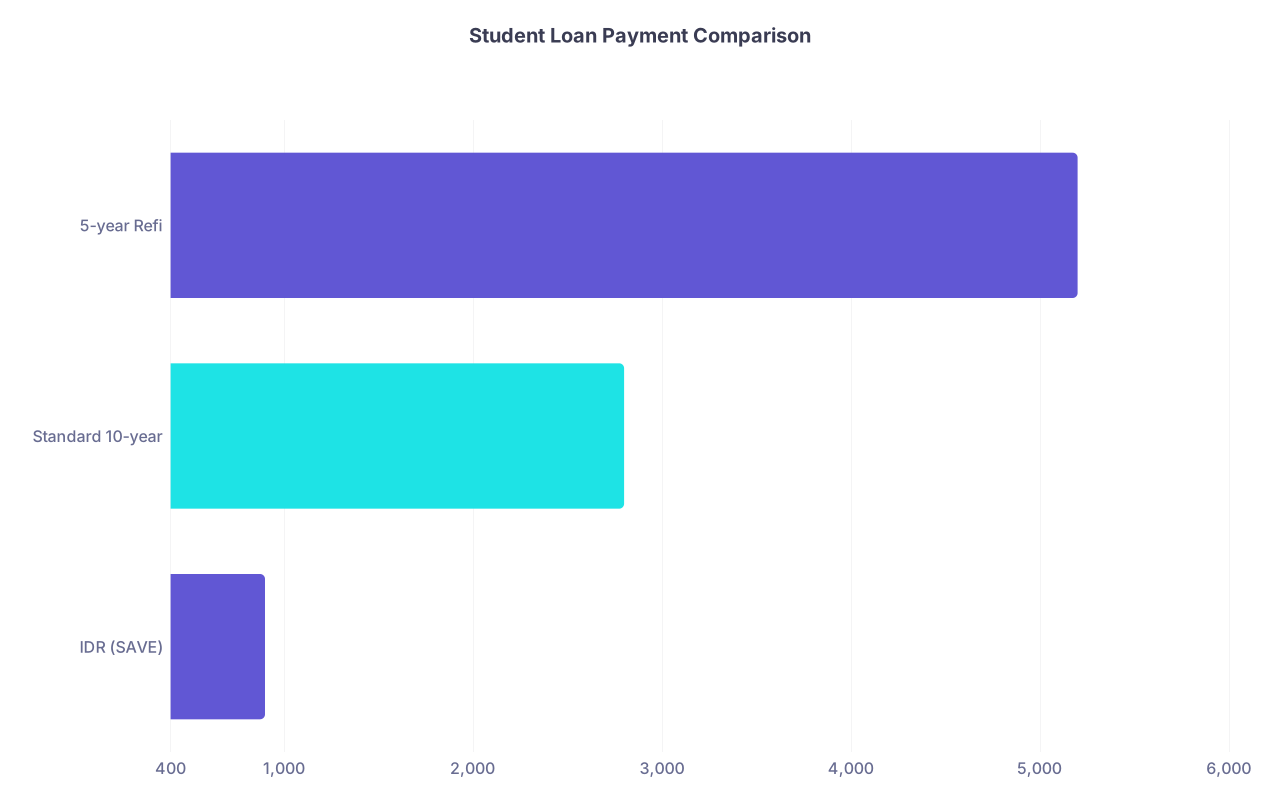
| Category | Value |
|---|---|
| IDR (SAVE) | 900 |
| Standard 10-year | 2800 |
| 5-year Refi | 5200 |
You might hate that $900 SAVE payment when the calculators show massive lifetime interest. Too bad. For now, that $900 is buying you the right to keep your clinic alive. Later, when the business is strong, you can refinance or throw huge extra payments at principal.
Step 8: Protect Your Personal Finances From Clinic Volatility
Your clinic is a startup. Treat it like a risky business venture, not a guaranteed salary machine.
That means:
Separate personal and business as much as possible
- Separate business bank accounts.
- Pay yourself a consistent, reasonable salary—don’t just drain the account when there’s extra.
- Avoid personally guaranteeing every possible thing if you can negotiate otherwise (you often can’t, but at least be conscious of what you’re signing).
Don’t “lifestyle-inflate” the moment revenue looks good
New attendings are notorious for this. First few good months, and suddenly:
- House upgrade
- New car
- Private school
- And “I’ll just start paying double on the loans”
Then volume dips for 2–3 months and you’re wondering why life feels tight again.
Your first few years out, with heavy loans and a new clinic, should look more like a resident who finally sleeps and eats decently. Not like a cardiologist with 20 years in.
Step 9: Example: How This Actually Plays Out With Numbers
Let’s walk a simplified example.
You:
- Owe: $400,000 in federal loans, weighted avg 6.2%
- Family: spouse + 1 toddler
- Minimum personal budget (realistic, not spartan): $6,000/month
- On SAVE: payment starts around $800–$1,200/month depending on income
- Goal: primary care clinic, insurance-based, moderate procedures
You decide:
- Year 1–2: Use SAVE to keep required payments low.
- You work 0.6 FTE at an urgent care making $160,000/year.
- You start the clinic 2 days/week, subleasing 2 rooms at an existing office.
Your early numbers:
- Personal income from urgent care after tax: about $8,000–$8,500/month
- Minimum personal + loan costs: about $7,000–$7,500
- Clinic:
- Overhead (sublease, part-time MA, EMR, malpractice share): $6,000/month
- Month 3 revenue: $5,000
- Month 6 revenue: $10,000
- Month 12 revenue: $18,000
Result:
- You’re not rich, but you’re not bleeding out either.
- Your urgent care job covers your life while the clinic ramps.
- By month 12, you can start tapering urgent care to 0.4 FTE if the growth continues.
In year 3–4, once the clinic can consistently pay you a stable $18k–20k/month, you revisit loans. Maybe you:
- Refinance to a 10-year at lower rate
- Increase monthly payment significantly
- Keep a strong practice reserve
That order matters a lot more than people think.
Step 10: Mental Framing So You Don’t Panic Every Time Cash Dips
You’re doing two hard things simultaneously:
- Being a brand-new attending
- Running a new business while heavily indebted
You will:
- Have months where cash is tight and you wonder if you made a mistake
- Compare yourself to co-residents who took stable jobs and are “crushing their loans”
- Be tempted to either overwork or shut it all down impulsively
Here’s the mindset that actually helps:
- The first 2–3 years are about survival and proof of concept, not maximizing income or loan payoff.
- Your practice is an asset that, if built right, will likely outstrip the financial benefit of quick loan payoff alone.
- You’re allowed to retreat strategically. If after 2–3 years the clinic is chronically anemic, you can:
- Sell the patient panel
- Shut down and take an employed job
- Reboot later with better knowledge
This is not a one-shot irreversible destiny decision. It just feels like it.

Quick Reality Check: When You Probably Shouldn’t Open Now
I’ll say what your mentors might be too polite to say.
You probably should not open a clinic right now if:
- You have zero emergency savings and no access to a bridge job or credit.
- Your spouse/partner is financially dependent on you and can’t handle income variability.
- You’re counting on “hitting the ground fully booked” with no clear plan for referrals or marketing.
- The only way the math works is if your volume hits your best case projections from day three.
That’s not grit. That’s gambling.
It’s better to take a stable job for 1–3 years, knock your loans down some, build savings, understand local referral patterns, then open with a stronger position.
Where to Focus First, Second, Third
If you’re serious about doing this with heavy student loans, your rough priority order:
- Get ruthless clarity on your personal minimum needs + loan strategy for the first 2–3 years.
- Design a lean, phased practice plan with a bridge income source and realistic revenue assumptions.
- Execute on boring, unsexy fundamentals: billing, collections, payer mix, controlled overhead.
You don’t need a perfect business plan. You need a cash flow plan that doesn’t lie to you.
Key Takeaways
- Early on, flexibility on student loans (IDR, delayed refinance) is often smarter than aggressive payoff if it keeps your clinic and household afloat.
- Treat your first clinic as a cash flow experiment, not a monument—keep overhead low, use a bridge job, and phase into full-time gradually.
- Conservative projections, fast billing, and at least one high-ROI service line will do more for your survival than any fancy branding or decor.
Build something that survives first. Then you can build something impressive.