
The idea that “more services automatically equal more profit” is one of the fastest ways a young physician can wreck a perfectly viable private practice.
The Core Myth: More Lines of Care = More Money
I hear some version of this every year from early attendings:
“If I add aesthetics / allergy testing / weight loss / cash labs / IV infusions / concierge-lite, I’ll diversify revenue and protect myself from insurance cuts.”
That sounds sophisticated. Feels like what “savvy entrepreneurs” are supposed to say.
Reality: in the first 3–5 years of private practice, most new lines of care destroy margin, time, and focus. They look good on a website and terrible on a P&L. The problem isn’t that these services can never be profitable. It’s that the timing, execution, and assumptions are usually wrong.
Let’s get specific.
What the Numbers Actually Show About “More Services”
There is data on this, though it’s usually buried in MGMA benchmarks, consulting reports, and bank underwriting models—not Instagram threads about “multiple revenue streams.”
The pattern is consistent:
- Practices that add new service lines before they’ve optimized the core visit-based engine often see lower net income per physician, not higher.
- Overhead creeps up and stays high.
- Collections per RVU stagnate or fall because the physician’s time shifts to low-yield work and the staff’s time shifts to complex workflows they barely understand.
Here’s a simplified comparison of what I’ve seen repeatedly in early private practices over the first few years.
| Metric (Year 3) | Focused Practice (1–2 core services) | Service Sprawl Practice (4–6 lines) |
|---|---|---|
| Overhead % Collections | 52–58% | 65–75% |
| Net per wRVU | Higher | Lower |
| Physician weekly admin hours | 5–8 | 10–15 |
| Days AR | 30–40 | 45–60 |
| Take-home vs employed peers | Clearly higher | Equal or worse |

| Category | Value |
|---|---|
| Focused | 55 |
| Service Sprawl | 70 |
This is not hypothetical. Lenders and practice consultants quietly build this reality into their risk models. They know that an internist running a lean clinic with a few ancillaries is a better bet than a new owner trying to stand up five new services on day one.
The Four Ways New Services Backfire
Let me walk through where this usually goes off the rails.
1. You Add Complexity Faster Than You Add Revenue
Every new line of care is not “just a service.” It’s a mini-business inside your practice, with its own:
- Workflow
- Scheduling logic
- Documentation requirements
- Billing rules and denial patterns
- Supply chain and inventory quirks
- Marketing needs
I sat in a small primary care office where the owner proudly told me, “We do everything now—chronic care management, allergy testing, aesthetics, IV therapy, obesity medicine, workers’ comp.” On paper, impressive. In reality?
- Front desk had 7 different visit types they didn’t understand.
- MAs were constantly asking, “Do I need a consent for this one?”
- Billing had 12 “special cases” they were supposed to remember for one doctor.
Result: patients waited longer, staff made more mistakes, denials spiked, and the physician spent evenings fixing charting and messaging vendors. Top-line revenue increased. Net margin did not.
The math is brutal: if you increase complexity by 50% and revenue by 15%, you are not “diversified.” You are tired.
2. You Underestimate the True Cost of Standing Up a Service Line
Physicians like to line-item the obvious: device lease, supplies, maybe a little marketing.
What usually gets ignored:
- Staff training time (and the productivity hit while they’re slow and confused)
- Policy and protocol development
- EMR template design and orderset building
- Billing setup, testing, and follow-up on denials
- Legal review of consents, cash pricing, Stark/AKS implications
- Your own time to manage all of the above
In one start-up dermatology practice, the owner added cosmetics aggressively in year 1. New lasers, injectables, branded skincare. The equipment itself looked like the big cost. It wasn’t.
The real bleed was the countless unpaid hours:
- Re-recording consent videos.
- Fixing flawed note templates.
- Dealing with a botched marketing campaign that attracted price shoppers from 2 hours away who never converted to medical dermatology.
By their own accounting, the cosmetic side broke even in year 1 (if you only count direct costs). When we added a conservative value for their time, it was clearly negative. They would have made more money doing a few extra biopsies and excisions.
3. You Chase Margins That Only Exist at Scale
Those beautiful PPT decks from vendors? The “average annual profit per patient” slides? They’re based on:
- High-volume centers
- Sophisticated marketing
- Tight operations
- Often a dedicated staff team focused only on that line of care
A solo or two-physician practice is not that. Not in year 1–3.
Telepsych plus TMS. Primary care plus full-blown weight loss program. Family med plus full-service aesthetics. All of those can be profitable. At scale. With dedicated effort.
But what most new owners do is add miniature versions of these service lines. Tiny volumes, inconsistent marketing, half-trained staff, minimal tracking. The economics at that size are completely different.
It’s like trying to copy Mayo Clinic’s service mix with the budget and staff of a corner urgent care. Wrong playbook.
4. You Dilute the One Asset You Actually Have Early On: Positioning
When you open a practice post-residency, no one in your community cares that you now offer “comprehensive integrated care with multiple service lines.”
They care about one thing:
“Who exactly is this doctor for, and are they good at that thing?”
Early on, you win by being sharply defined:
- A cardiologist known for quick access and rock-solid communication with PCPs.
- A psychiatrist known for stabilizing complex patients fast and coordinating with therapists.
- A primary care physician known for same-week access, rational prescribing, and brutal honesty.
When you plaster your website with menus of services—IV lounge, peptides, corporate wellness, medspa, DME, allergy, hormones—you blur your signal. Patients get confused. Referrers assume you’re unfocused or desperate.
I’ve seen excellent physicians lose referrers because their websites started to look like “a hybrid between a clinic and a Groupon page.” Their words, not mine.
Where More Services Actually Make Sense
So no, I am not saying “never add services.” That would be as dumb as “always add services.” The truth is narrower.
New lines of care tend to work when three things are true:
- Your core clinical engine is efficient and profitable already
- The new service aligns tightly with what your existing patients already want from you
- You can execute it with process discipline, not vibes and hope
Let’s break that down.
First: Fix the Core Engine
Your basic visit-based practice should not be on life support while you chase “higher margin” bolt-ons. You want:
- Reasonable schedule utilization (no gaping holes every day)
- Clean billing processes
- Overhead under control
- Staff workflows that mostly work without you constantly firefighting
If your days in AR are 60+, you’re behind on notes, and your MA turnover is high, the last thing you need is a new service line. You need operational stability.
I know a neurologist who spent six months obsessing over adding EMG and Botox for migraine before they had basic new patient pipelines figured out. By the time the services were live, they were still sitting at half a clinic. That’s upside down. They would have been better off spending that time shoring up referrer relationships and access times.
Second: Align With What Your Patients Already Expect From You
The easiest wins are services that:
- Fit your specialty identity
- Solve a painful, obvious problem your patients already complain about
- Leverage your existing visit structure and staff
Examples that usually work:
- Endocrinology practice adding structured diabetes education visits and CGM programs once the base is solid.
- Rheumatology practice adding in-office infusions when volume and payer mix justify it.
- Psych practice adding measurement-based care workflows, then a carefully designed SPRAVATO or TMS program.
Examples that usually blow up in early years:
- A fresh primary care clinic deciding to also become “the premier medspa in town.”
- A general psychiatry practice trying to be simultaneously the leading TMS center, PHP-lite, addiction clinic, and ADHD telehealth shop.
The distance between your core patient problem and the new service should be small. If you need a full rebrand and a different audience, it’s probably not for year 1–3.
Third: Treat Each Service Line Like a Real Business, Not a Side Hustle
If you are going to add something, you can’t half-build it. You should be able to answer, in writing:
- Who exactly is this for?
- How will they hear about it?
- Who on my team owns each part of the workflow?
- How will we measure success beyond “I feel like it’s busy”?
This is where most practices fail. They stand up a service because a rep convinced them, then never track:
- Visit volume
- Actual collections
- Staff time
- Complication/complaint rate
- Opportunity cost (what you’re not doing instead)
A simple rule I push on young owners: if you cannot see a clear path to at least 3x direct contribution margin on your time and overhead within 12–18 months, it probably does not belong in an early-stage practice.
A Simple Sequence That Actually Works
Here’s the boring, unsexy path that quietly makes physicians rich instead of burned out.

| Step | Description |
|---|---|
| Step 1 | Open Practice |
| Step 2 | Stabilize Core Visits |
| Step 3 | Optimize Operations |
| Step 4 | Deepen Existing Services |
| Step 5 | Add 1 High Fit Service |
| Step 6 | Systematize and Measure |
| Step 7 | Consider Next Service |
You stabilize core visits first. You fix scheduling rules, clinical workflows, documentation, and billing. You get staff trained to muscle memory on the basics. Only then do you add something—and you add one thing.
Do that well, and you’ll usually find much less “service sprawl” satisfies both your patients and your bank account.
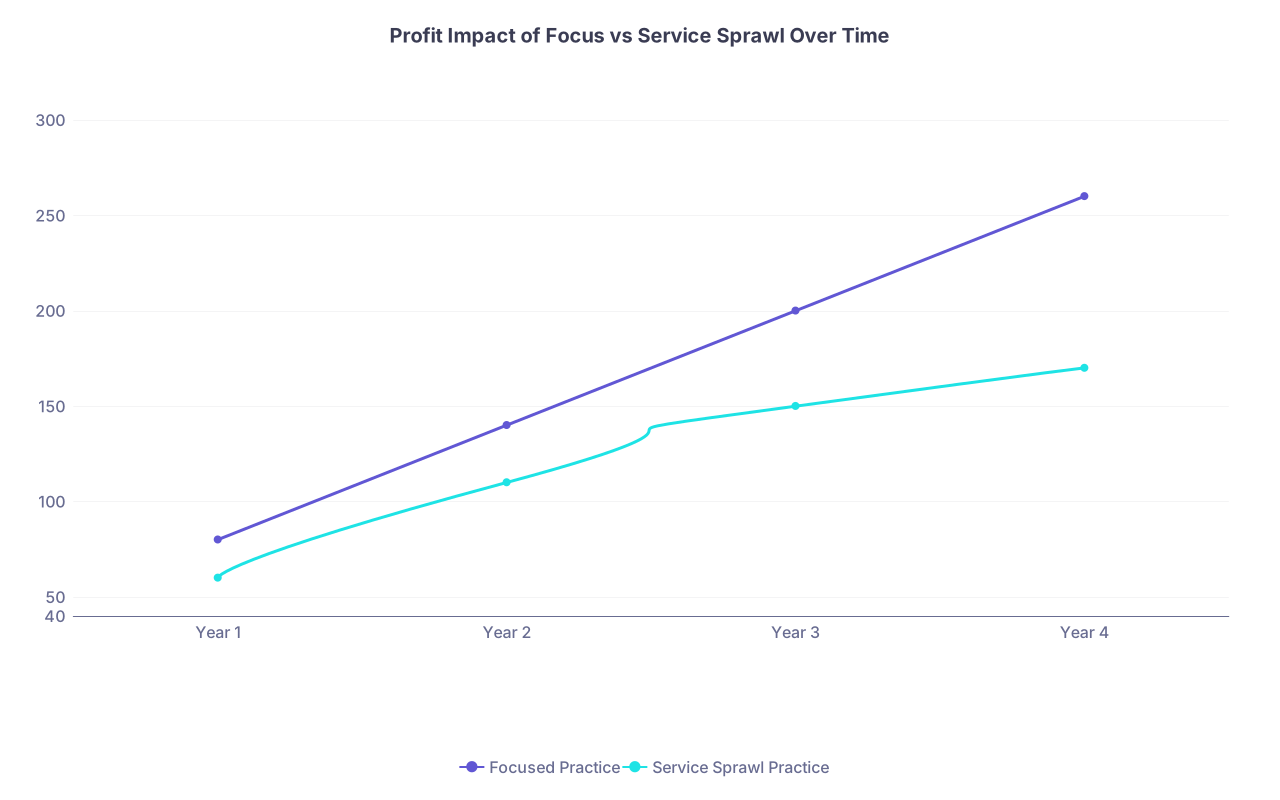
| Category | Focused Practice | Service Sprawl Practice |
|---|---|---|
| Year 1 | 80 | 60 |
| Year 2 | 140 | 110 |
| Year 3 | 200 | 150 |
| Year 4 | 260 | 170 |
The focused practice grows slower in surface-level “offerings,” but net income climbs steadily. The sprawl practice looks busy, but profit flattens or barely grows.
The Vendor and Consultant Problem
One last harsh truth: almost everyone selling you on “adding service lines” gets paid when you say yes, not when your practice actually earns more net income.
- Device companies make money if you lease their machine, not if your schedule is full.
- Certain “revenue enhancement” vendors get paid per patient enrolled, not per patient whose care is meaningfully improved and properly reimbursed.
- Consultants love a complex practice because complexity means more billable hours.
You’re the only one in the room whose personal income depends on net, not gross. Gross revenue is loud and impressive; net profit is quiet and boring. Pay attention to the quiet number.
I’ve watched practices brag about “hitting seven figures” while the owner’s take-home is barely more than their old hospital-employed salary. That’s the ultimate tell: they chased gross revenue via service expansion, and the net never came.
How to Pressure-Test Any New Service Line
Before you add anything, run it through a brutally honest filter:
- Does this strengthen or dilute my core identity to patients and referrers?
- Can my existing staff realistically run this with excellent quality within 3 months?
- Do I know, in real numbers, what success looks like in year 1 and year 2?
- What will I say no to in order to make room for this?
If you can’t answer clearly, you’re not “expanding your practice.” You’re buying yourself a new set of problems with a thin hope of profit.
The Bottom Line
More services do not automatically equal more profit. Often, they equal more overhead, more chaos, and less time for the clinical work that actually pays.
The three takeaways you should not forget:
- Get your core practice ruthlessly efficient and profitable before adding anything fancy.
- Only add services that tightly align with what your existing patients and referrers already see you as.
- Treat every new line of care like a real business: defined, measured, and accountable—otherwise, it’s just an expensive distraction with good marketing copy.