
The obituary for solo and small-practice medicine has been written so many times it should qualify for a CPT code. It is also wrong.
Solo practice is not dead. It is changing, consolidating, and getting squeezed. But dead? The numbers do not support that story.
Let me walk through what the data actually shows, because a lot of the “you have to join a big system or you’ll go bankrupt” advice is lazy, outdated, or conveniently aligned with the interests of hospitals, large groups, and private equity.
What’s Really Happening to Small Practices?
First, the macro trend: the percentage of physicians in small and solo practice has absolutely declined. That’s real.
AMA Physician Practice Benchmark data (2020–2024) shows roughly:
- Around 2012: just over 60% of physicians in practices of 10 or fewer
- By 2022: closer to mid-40% in practices of 10 or fewer
- In 2012, nearly half of physicians owned their practice; now it’s well under 50%, with hospital or corporate ownership rising hard.
So yes, consolidation is happening. Hospitals and corporate entities have been on a buying spree.
But here’s what everyone leaves out when they throw around “Solo is dead”:
- Small and solo practices are still a huge chunk of the market.
- In several key specialties, small practice remains the dominant model.
- Younger physicians are underrepresented in ownership mostly because of debt, risk aversion, and culture—not because the model is economically impossible.
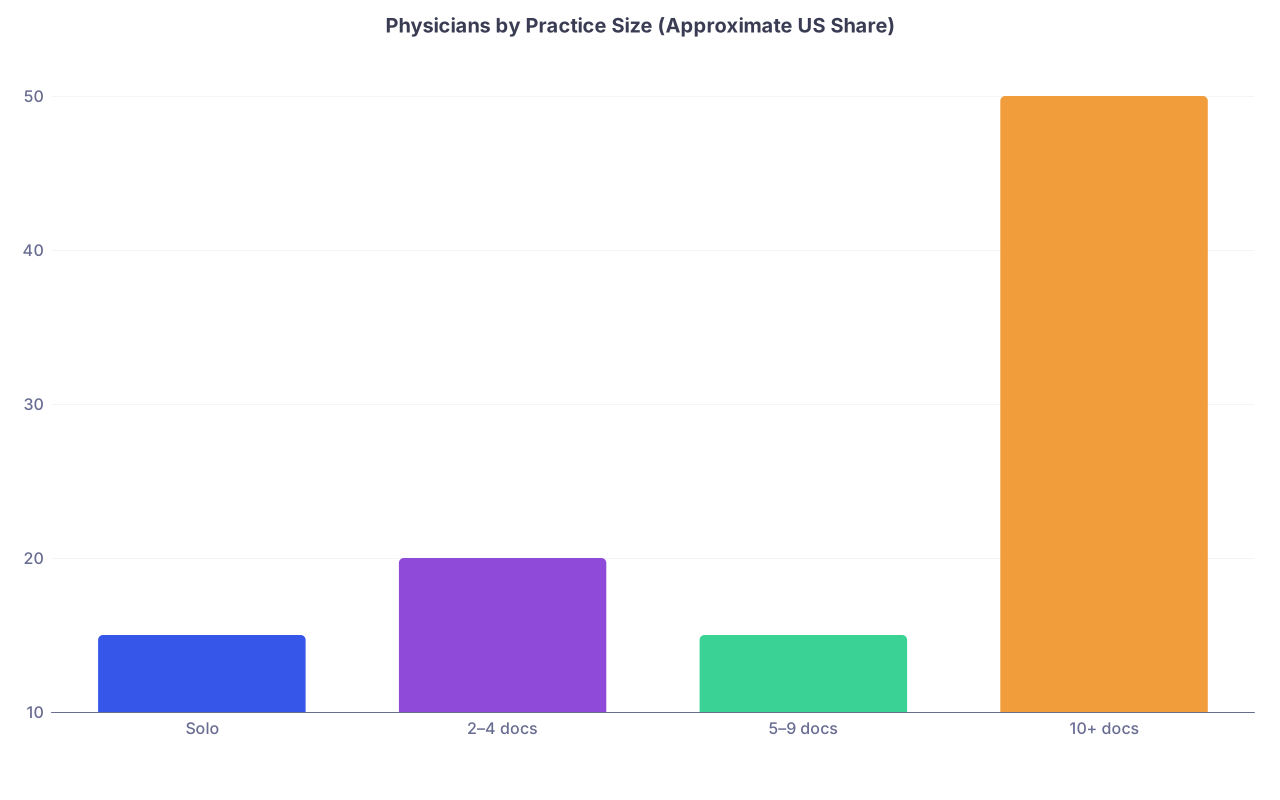
| Category | Value |
|---|---|
| Solo | 15 |
| 2–4 docs | 20 |
| 5–9 docs | 15 |
| 10+ docs | 50 |
Are the exact numbers a little squishy? Sure. Different surveys get slightly different splits. But the direction is consistent: big groups up, tiny practices down, yet still a solid minority share for small clinics.
If solo practice were truly “dead,” you’d see single-digit percentages, rapidly approaching zero. That’s not what’s happening.
The Myth: “You Can’t Compete With Hospitals”
I hear this one constantly: “You’ll never compete with big health systems; they have all the contracts, all the referrals, all the money.”
Half-true. Which is another way of saying half-false.
Hospitals and health systems absolutely use:
- Employer contracts
- Narrow-network insurance deals
- Employed PCPs as referral machines
to keep as much care in-house as possible. That creates headwinds for independent clinics.
But three things are underrated:
- Payer mix and flexibility
- Patient preference for access and service
- Lean cost structure and autonomy
Let’s be specific.
Reimbursement: Are Small Clinics Getting Crushed?
Commercial payers do, on average, pay large systems better negotiated rates than solo practices in many markets. That’s one reason hospitals want to own physicians—physician services themselves have thin margins, but they’re gateways to imaging, procedures, and admissions.
But the idea that solo practices “can’t make money” is nonsense. The practices that suffer tend to have:
- Poor billing and coding
- No-show problems with no enforcement
- Terrible payer contracting (or none at all)
- Bloated overhead (often due to legacy leases, staff, or tech)
Lean, well-run small practices often outperform employed positions on net income per hour worked—especially when you factor in call schedules, uncompensated admin, and RVU pressure.
There’s also a quiet rebellion happening: more small practices mix revenue streams:
- Traditional insurance plus membership/“direct primary care” tiers
- Cash-pay procedures (aesthetics, vasectomies, IUDs, vasectomy reversals, etc.)
- Occupational medicine, employer contracts, workers’ comp
- Imaging and ancillary services where legal and feasible
The idea that you submit a 1500 form to one big insurer and pray is outdated. The nimble small clinic that survives 2025+ almost never has just one revenue door.
Who Still Thrives in Small or Solo Practice?
Not all specialties have the same odds.
| Specialty | Small/Solo Still Strong? | Typical Model Trend |
|---|---|---|
| Family Medicine | Mixed | Large system + DPC growth |
| Psychiatry | Strong | Solo / small groups |
| Dermatology | Strong | Small groups, PE roll-ups |
| Pediatrics | Moderate | Legacy small, new system |
| ENT / Ophtho | Strong | Group practices |
| EM / Anesthesia | Weak | Large groups / contracts |
Psychiatry, dermatology, ophthalmology, ENT, many outpatient surgical subspecialties, and direct care primary care? Small practice is not an anomaly; it’s still a norm.
Contrast that with emergency medicine or anesthesia. Those worlds run on contracts with hospitals and groups. Starting an independent solo ED practice is like deciding you’re going to be an independent air-traffic controller. Wrong game.
So no, “solo is dead” is not the right statement. “Solo is highly specialty- and market-dependent” is more accurate.
The Obvious Problem: Student Debt and Risk Aversion
Here’s the part no health system exec wants to talk about because it exposes the game.
The biggest reason new grads say, “I can’t open a practice” is not that the business model is fundamentally broken. It is that:
- You’re coming out with $200k–$400k+ in student loans
- You’ve had zero training in operations, billing, HR, or contracting
- Every mentor you had works for a hospital or large group
- Banks treat “physician income” like a safe bet—if you take the W-2 job
So you take the path of least resistance: a job with a signing bonus, loan repayment, and a salary guarantee…tied to an RVU expectation that mysteriously jumps in year 3 when the guarantee expires. I’ve seen this movie many times.
You aren’t “proving” solo is dead by taking that route. You’re responding rationally to an educational and financing ecosystem that’s biased toward employment.
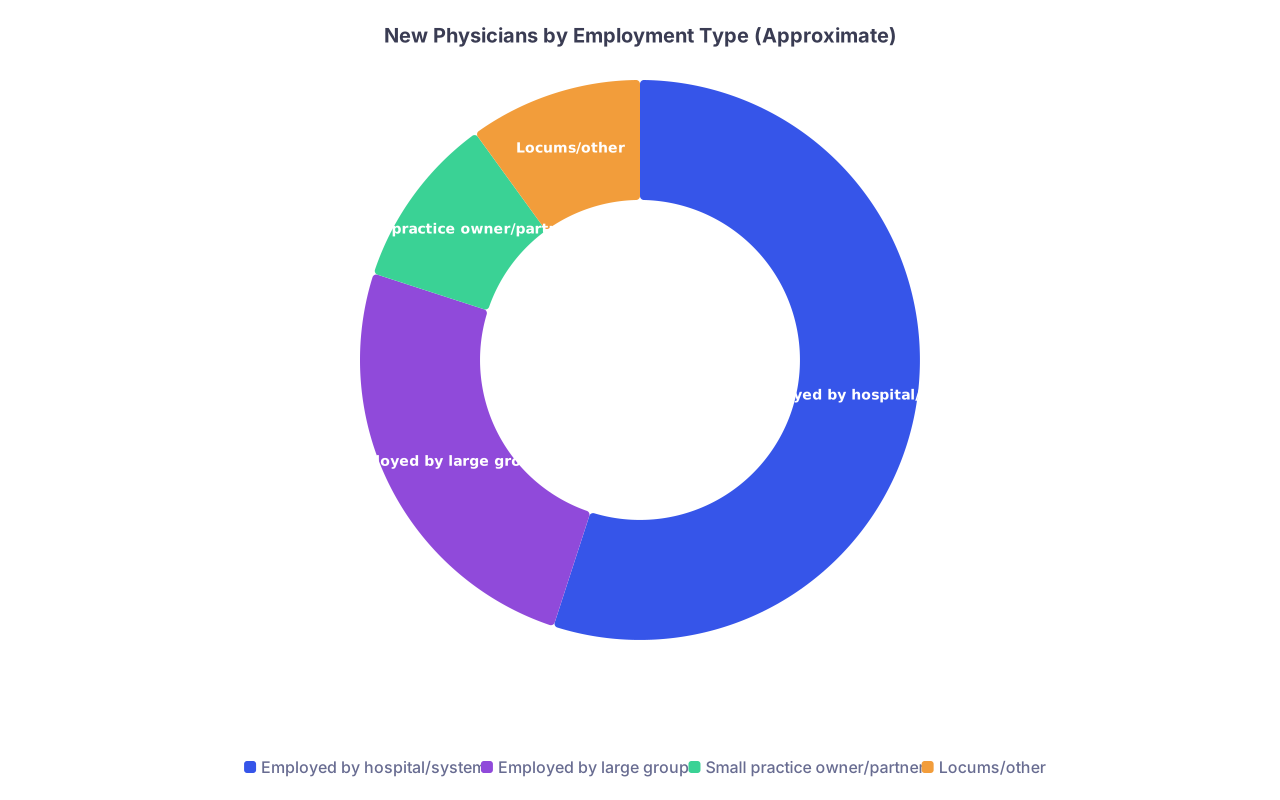
| Category | Value |
|---|---|
| Employed by hospital/system | 55 |
| Employed by large group | 25 |
| Small practice owner/partner | 10 |
| Locums/other | 10 |
Those numbers aren’t exact, but they rhyme with the trend: most new docs go employed. That’s a cultural and financial pipeline effect, not a proof that independent practice is impossible.
The Real Killers of Small Practices (They’re Not What You Think)
People love to blame “regulation” in the abstract. HIPAA. OSHA. Stark. MACRA. Buzzword salad. Reality is more specific.
The small clinics that collapse usually die from a combination of:
Terrible contracts
- Signing all-comer contracts with bottom-tier payers
- Failure to renegotiate annually
- Staying in networks that pay below cost “for volume”
Bad overhead decisions
- 10-year office leases signed at peak rents
- Buying every shiny EMR or device rep pushes
- Over-staffing because “that’s how my residency clinic did it”
Incompetent billing and RCM
- Denials ignored
- Under-coding to “avoid an audit” (aka voluntary pay cut)
- Not tracking days in A/R or collection rates
No basic business skills
- Not understanding cash flow vs profit
- No budget, no forecast, no metrics
- Blind to payer mix and referral sources
None of those are inevitable. They’re correctable. But because most physicians are never taught any of it, they walk right into the same traps.
What the Successful Small Clinics Are Doing Differently
I’ve watched small practices turn into machines while bigger competitors moan about “reimbursement cuts.” They share some patterns:
- They run lean on staff and automate low-value tasks.
- They negotiate hard with payers and drop bad contracts.
- They actively cultivate direct-to-patient marketing instead of waiting for hospital referrals.
- They simplify their service lines: do fewer things, but do them efficiently.
Here’s a rough, realistic picture of economics for a reasonably well-run small specialty clinic versus a typical employed job. The numbers are illustrative, not gospel.
| Scenario | Employed Doc | Small Clinic Owner |
|---|---|---|
| Collections / Salary | $350,000 | $900,000 |
| Practice Overhead (rent, staff) | N/A | -$450,000 |
| Owner Salary / Draw Before Tax | $350,000 | $450,000 |
| Autonomy / Equity Value | None | Grows over time |
Again, these are broad strokes. But I’ve seen versions of this in real P&Ls. Hospital systems typically keep a large chunk of the revenue you generate. As an owner, you’re taking risk—but also claiming that spread.
You Don’t Need to Go “Full Solo” Day One
Here’s another myth: starting a practice means you must walk out of residency and sign a lease on a 3,000-square-foot office, buy an EMR, and hire three staff.
That’s 1998 thinking.
Modern small-practice launches often look like this:
- Start part-time in a shared space or sublease (half day a week)
- Use a cloud EMR and a virtual front desk / billing service
- Do minimal equipment purchases
- Grow via word of mouth, online reviews, and targeted marketing
- Ramp volume before committing to full-time bricks-and-mortar
You don’t have to choose: either fully employed OR fully independent on day one. You can transition.

| Step | Description |
|---|---|
| Step 1 | Residency Graduation |
| Step 2 | Take Employed Job |
| Step 3 | Pick Niche and Market |
| Step 4 | Start 0.5 day Clinic Sublease |
| Step 5 | Build Patient Panel and Reviews |
| Step 6 | Increase Clinic Days |
| Step 7 | Negotiate Payer Contracts |
| Step 8 | Full Time Independent or Hybrid |
I’ve seen hospital-employed docs build part-time DPC or niche cash clinics until the math made sense to flip full-time. Not allowed everywhere, yes—employment contracts can have non-competes and side-work restrictions. But where possible, this “gradual escape velocity” model works.
Geographic Reality: Your ZIP Code Matters More Than Your Dreams
Some markets are structurally hostile to small practice. Others are fertile.
Red flags for starting a small clinic:
- Single dominant health system with aggressive acquisition of PCPs and specialists
- Narrow-network plans where the big system essentially is the network
- State laws or local politics tilted heavily toward hospital monopolies
- High commercial rent, saturated physician supply in your specialty
Green lights:
- Multiple competing systems and payers
- Growing population and shortage of your specialty
- Reasonable office rents in high-traffic areas
- Employers hungry for access and frustrated with system bottlenecks
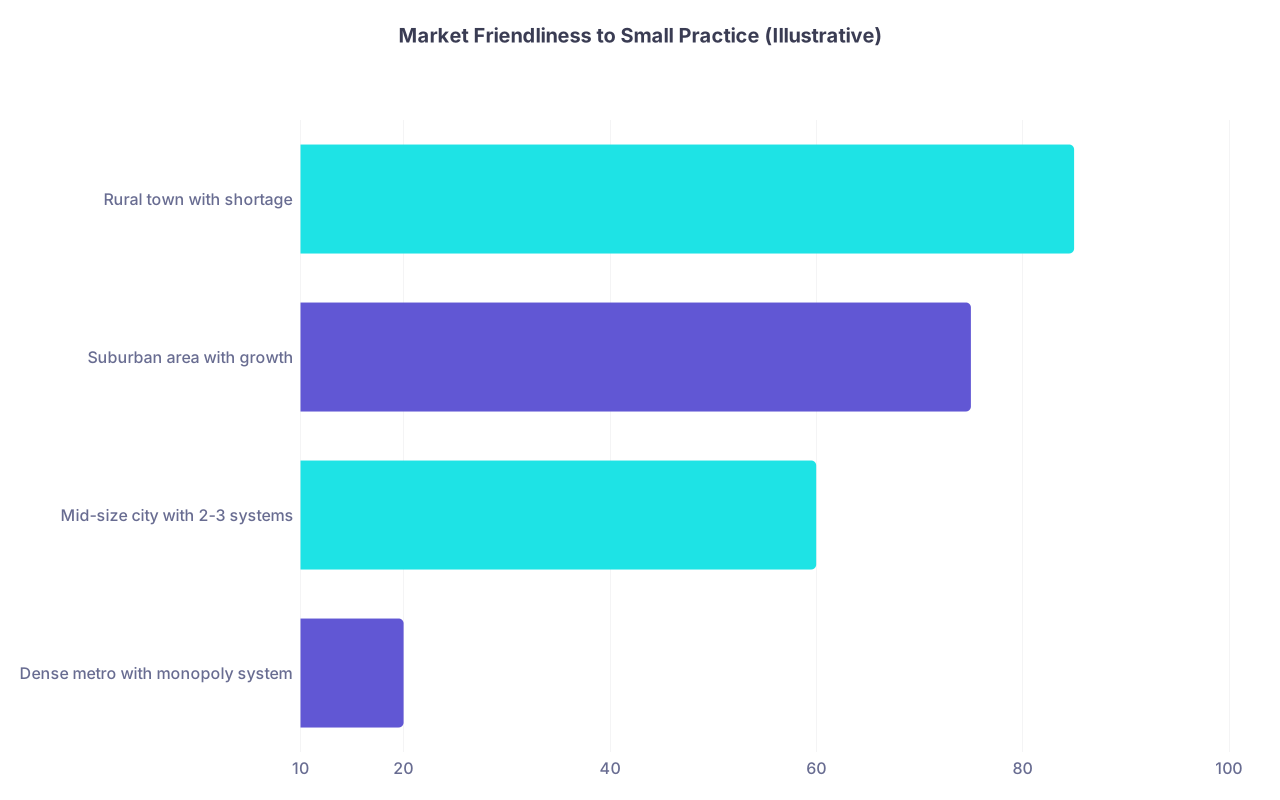
| Category | Value |
|---|---|
| Dense metro with monopoly system | 20 |
| Mid-size city with 2-3 systems | 60 |
| Suburban area with growth | 75 |
| Rural town with shortage | 85 |
The point: “solo is dead” is often just code for “solo is very hard in the particular coastal metro where I live.” That’s not universal reality.
The Regulatory Boogeyman: Real Headache, Not Death Sentence
Let’s talk about the usual villains: prior auths, MACRA/MIPS, quality metrics, HIPAA, OSHA, etc.
Yes, they add friction and cost. But the idea that small practices are uniquely doomed by them is exaggerated.
Here’s what actually happens:
- Big systems hire entire departments to manage metrics and reporting
- Small practices outsource a lot of this or use software vendors that bundle compliance
- Direct care / cash-heavy practices sidestep large chunks of the insanity altogether
If you design your practice model around efficiency and simplicity instead of trying to replicate a mini-hospital clinic, you can drastically reduce the administrative burden.
The practices that get crushed are the ones trying to play the exact same high-volume, insurer-heavy game as the hospital, but with fewer resources and worse contracts. That’s just bad strategy.
Hard Truth: Some Physicians Should Not Own a Practice
Now the part you probably expect me to soft-pedal. I won’t.
Not everyone should start a clinic. Some of you absolutely should not:
- If you hate making decisions and want everything “handled”
- If the idea of firing an underperforming MA makes you queasy
- If you refuse to look at numbers, budgets, or P&L statements
- If you want 100% predictability and zero financial volatility
Then yes: take the job. Enjoy your W-2. There is nothing morally superior about owning a practice.
But if you’re reading this because you feel trapped by RVU quotas, productivity demands, inflexible schedules, and bureaucratic nonsense—you’re exactly the person the “solo is dead” narrative is designed to scare into staying put.
So, Is Solo Practice Dead?
No. What’s dying is:
- Inefficient, overstaffed, paper-heavy, poorly run small practices
- The fantasy of “I’ll just hang a shingle and patients will show up”
- Ignorance of business realities
What’s very much alive:
- Lean, tech-enabled, niche-focused small clinics
- Direct primary care and hybrid membership models
- Specialty practices that own their niche and run like real businesses, not charity projects
If you want to start a private practice post-residency, you are not crazy. You are not “fighting the inevitable.” You are swimming against a strong cultural current, but the water is not poisoned.
The data shows decline in ownership and small-practice share, yes. It does not show impossibility. It shows a system nudging you toward employment. Not forcing you.
The Bottom Line
Three takeaways you should remember:
- Solo and small practices are shrinking as a share, but they’re far from dead—and still dominant in several specialties and markets.
- The practices that survive and thrive are lean, strategic, and diversified, not copy-paste versions of hospital clinics.
- The main barriers for new grads are debt, culture, and lack of business training, not the fundamental impossibility of making a small clinic work.
If you want independence after residency, ignore the funeral hymns for solo practice. The model isn’t dead. But the lazy version of it should be.