
“Build it and they will come” is fantasy-land thinking. In healthcare, that belief does not just strain a new private practice—it quietly kills it.
Most new owners do not fail because they are bad clinicians. They fail because they assumed patients would magically appear once the lease was signed, the EHR was installed, and the website went live. That’s myth-level thinking. And the data, the payer mix, and the actual behavior of patients after residency say something very different.
Let me walk through what actually sinks new practices—and what practices that survive do differently.
The Myth: Good Doctor + Nice Office = Automatic Demand
Here’s the story I hear over and over from brand‑new attendings:
“I joined a hospital‑employed job, got burned out in 18 months, so I opened my own place. We have a beautiful office, up-to-date equipment, a clean website, and five-star customer service. Six months in… our schedule is half empty.”
That gap between expectation and reality isn’t random. It comes from two flawed assumptions:
- That demand for care is equal to demand for you specifically
- That once you open your doors, payers, referrers, and patients will naturally channel toward you
Healthcare isn’t a coffee shop where foot traffic will bail you out if you guess wrong. It’s a controlled, constrained funnel: insurance panels, referral patterns, employer networks, and search visibility dictate who you see.
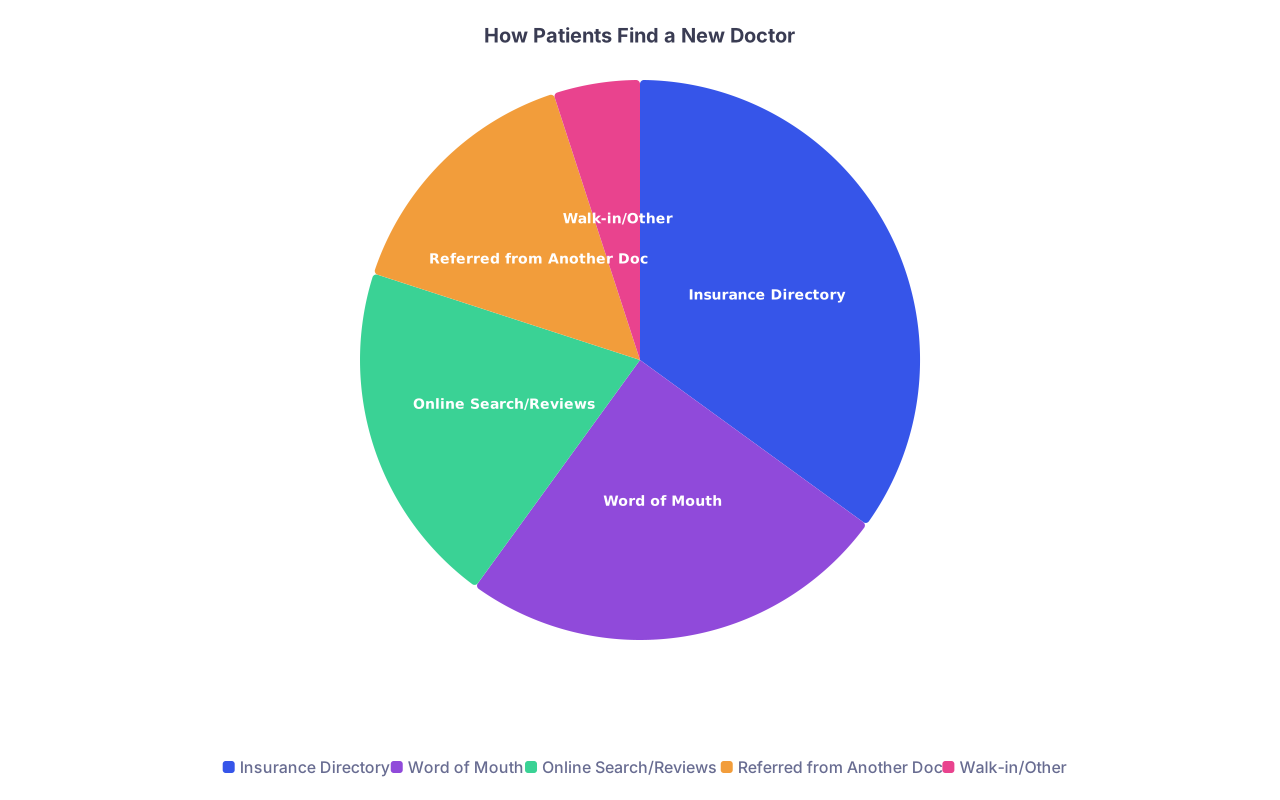
Look at how most patients actually find a new doctor:
| Category | Value |
|---|---|
| Insurance Directory | 35 |
| Word of Mouth | 25 |
| Online Search/Reviews | 20 |
| Referred from Another Doc | 15 |
| Walk-in/Other | 5 |
If you open your doors and assume “word will spread,” you’re ignoring the fact that 70–80% of patients are steered by insurance lists and referrers, not vibes.
Your clinical skill matters. Your compassion matters. But in the first 12–24 months, what matters more is: are you even on their radar and allowed by their insurance?
What the Data Actually Shows About New Practice Failure
Most physicians never see the numbers behind private practice failures because there is no single national registry of “closed within two years.” But you can triangulate.
Medical societies, lenders, and EHR vendors quietly share similar patterns: for new, independent practices, the risk window is real. Here’s a simplified composite of what I’ve seen across specialties.
| Year in Operation | Approx. Survival Rate* |
|---|---|
| End of Year 1 | 80–85% |
| End of Year 3 | 60–70% |
| End of Year 5 | 50–60% |
*Varies by specialty, geography, and ownership structure, but the pattern is consistent: first 3 years are brutal.
Ask practice brokers what they see. You will hear the same phrase: “Underperforming collections and no referral base.”
Not “bad doctor.”
Not “poor outcomes.”
Revenue. Volume. Payer mix.
The root cause almost always traces back to an early belief that demand would take care of itself. It rarely does.
Why “If You Build It” Fails in Healthcare Specifically
This belief might work if you opened a trendy restaurant in a dense urban area with heavy walk‑by traffic. Healthcare does not work that way for several reasons.
1. Insurance Networks Dictate Who Can Come
Patients do not choose freely. Their employer or their exchange plan has already narrowed the menu. If you are not in‑network—or not shown properly in-network—you are functionally invisible.
I’ve watched this wreck practices.
Doc signs a lease, does the build‑out, buys a shiny ultrasound machine. Then finds out panel enrollment for a major commercial payer in that city is “closed,” or credentialing will take nine months, or the practice’s address is wrong in the insurer directory so patients cannot even find them.
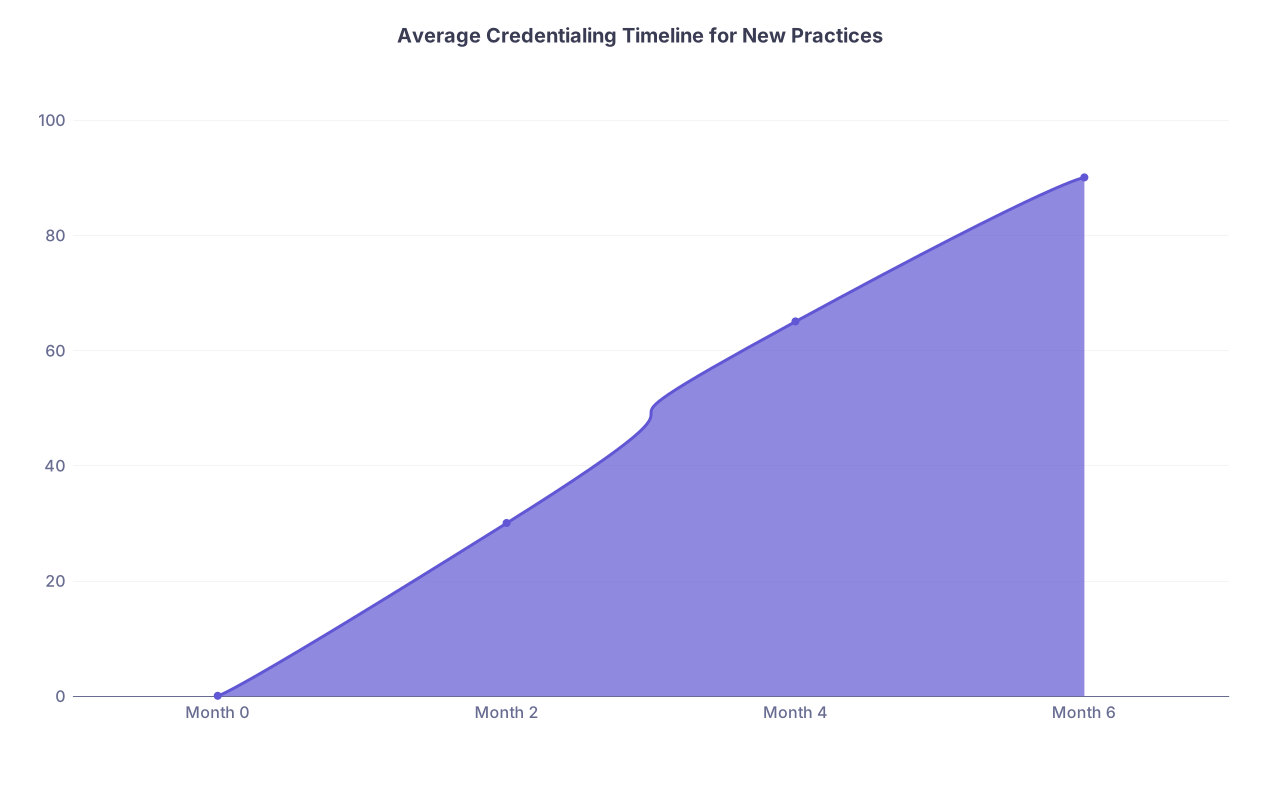
Here’s how the delay actually plays out:
| Category | Value |
|---|---|
| Month 0 | 0 |
| Month 2 | 30 |
| Month 4 | 65 |
| Month 6 | 90 |
That “90 days to enroll” the rep promised? Often becomes 4–6 months in real life with missing forms, re-submissions, and payers moving at glacial speed.
If you open your doors before payer contracts are fully executed and tested with live claims, don’t be surprised when “if you build it” becomes “if you wait long enough, you go broke.”
2. Referral Patterns Are Inertial, Not Rational
Patients ask their PCP or specialist: “Who should I see?” And those PCPs do not update their mental list every time a new attending opens shop.
They refer where they’ve referred for years.
Referrals are social habits. Built from residency buddies, hospital committees, shared call, the older doc they trained under. New, independent practices—especially if you just left the big hospital system—are usually not on that list at all.
So if your “strategy” for getting patients is “PCPs will send them,” I want to know:
- Which specific PCPs?
- Have you met them, in person, more than once?
- Are they under pressure from their own system to keep referrals in-house?
Healthcare systems now spend huge money to keep referrals internal. Many PCPs literally get dashboards showing “leakage.” You’re competing with that. Simply existing isn’t a strategy.
3. Patients Search Online Long Before They Walk In
Patients google you before they call you. Often before they even accept a referral.
When I look at analytics from new practices, the pattern is monotonous. The practices screaming “we’re not growing” often look like this:

| Category | Value |
|---|---|
| Month 1 | 20 |
| Month 3 | 60 |
| Month 6 | 100 |
| Month 9 | 130 |
| Month 12 | 150 |
Twenty visitors a month is not a demand problem. It is an invisibility problem.
These same practices usually have:
- An unclaimed or poorly completed Google Business Profile
- No patient reviews
- A generic website that doesn’t answer what they actually do or for whom
- Inconsistent NPI / address info across insurance directories and locator tools
Patients cannot “come” if they can’t find you, cannot tell if you’re in‑network, or do not trust you yet.
The Real Reasons New Practices Sink
Strip away the excuses and it usually boils down to four things.
1. Underestimating the Ramp‑Up Curve
New owners constantly misjudge how long it takes to reach a clinically and financially sustainable volume.
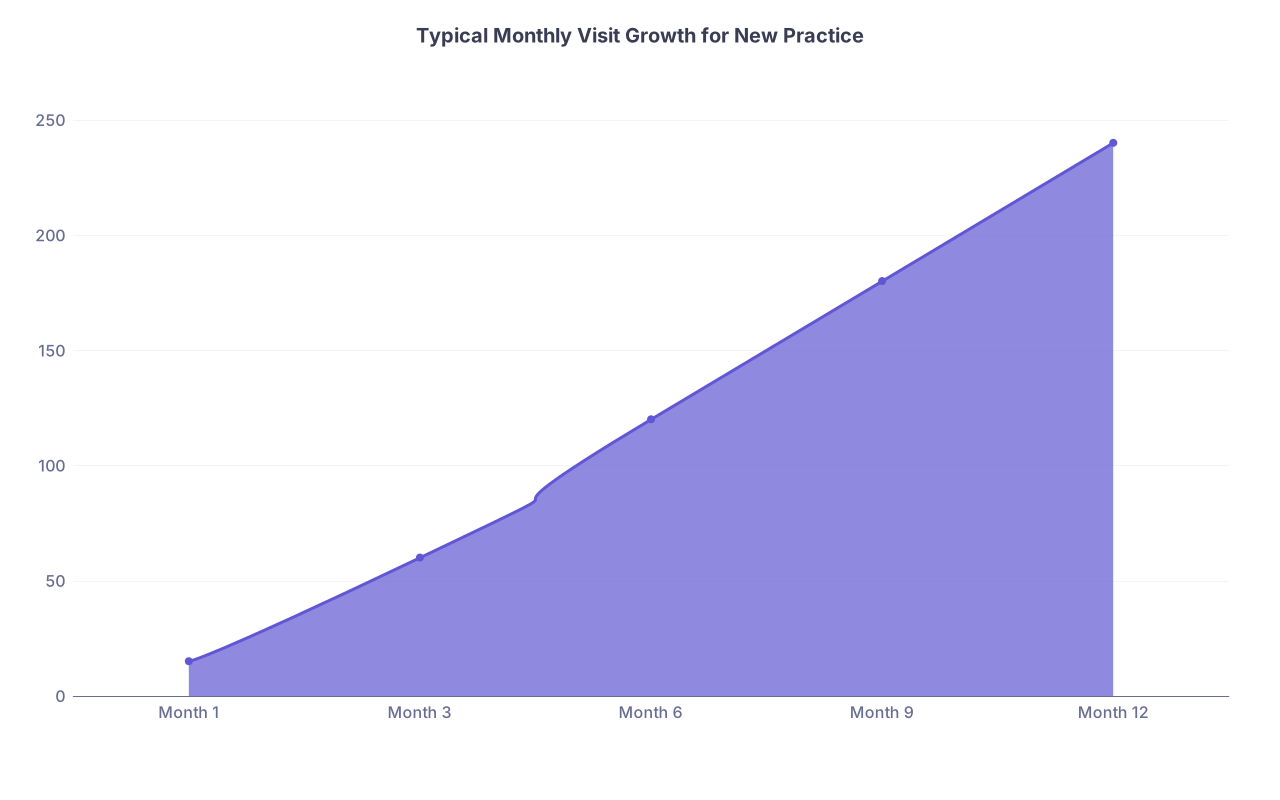
They imagine a straight line: a few patients week one, then steady growth.
Reality looks more like a lethargic curve that finally bends—if you force it to bend.
| Category | Value |
|---|---|
| Month 1 | 15 |
| Month 3 | 60 |
| Month 6 | 120 |
| Month 9 | 180 |
| Month 12 | 240 |
If you built your overhead and debt structure assuming you’d be at Month‑9 volume by Month‑3, you’re in trouble.
I have seen physicians lock in 3,000+ sq ft, high-end furniture, and full‑time staffing because “we’re planning for growth.” Then revenue lags reality and they start borrowing to make payroll. Not because they’re bad, but because they believed demand would be immediate.
Reality: for most outpatient specialties, it’s 12–24 months before you feel stable. Sometimes 36.
2. No Defined Patient Niche
“If you build it” thinking treats patients like a generic blob called “people who need care.” That’s lazy.
High‑performing practices are very precise. Think: “young families in X suburb needing same‑day pediatrics,” “busy professionals needing after‑hours primary care,” “perimenopausal women wanting hormone management,” “diabetics within 10 miles of this zip code for ulcer prevention.”
When you are specific, you can target: employer groups, Facebook audiences, referral sources, website copy, community talks.
When you are vague, you get ignored.
Hospitals are already generic. You cannot out‑“we do everything for everyone” a full‑service health system with 10x your budget. You won’t win that game.
3. Zero Real Marketing Plan (because “that feels slimy”)
This is the most physician thing I see: “We don’t do marketing; we rely on quality.”
That’s not noble, it’s naive.
Marketing isn’t billboards and bad radio ads. At its core, it’s just making it easy for the right patients to discover you, trust you, and access you.
The numbers are not complicated. A bare‑bones, survivable plan for a new practice usually includes:
- Clean online presence (website + Google profile + consistent directory listings)
- Review generation system (front desk actually asks satisfied patients, every day)
- A repeatable introduction strategy to local PCPs / relevant specialists
- Some low‑cost targeted outreach—employer HR, community organizations, or focused digital ads
Practices that treat marketing as optional are stuck at the “friends and family” stage forever.

4. Weak Operations and Access
A quiet schedule is often self‑inflicted.
I’ve called practices “secret shopped” for owners who swear there’s no demand. What I find:
- Phones go to voicemail at lunch and near closing
- No online booking or it’s hidden
- New patient appointments booked six weeks out because the owner blocks huge chunks for admin “just in case”
- Front desk scripts that repel patients: “We don’t take that plan,” click, instead of “We’re out of network but here’s what that means…”
“If you build it” owners tend to obsess over decor and gadgets, not over the friction of actually getting in.
Patients are not going to fight their way through your clunky systems out of loyalty that does not exist yet. They will go wherever answers the phone and can see them soon.
What Practices That Actually Grow Do Instead
Let’s flip this around. Because there are new practices that thrive. They are not relying on the universe. They’re doing some very specific, very un‑mystical things.
They Start With the Math, Not the Dream
Before signing anything, they know:
- Their minimum monthly visit volume to cover overhead
- Their expected average reimbursement per visit by payer
- How many new patients per week they must add for the first 12–18 months
They run scenarios: “What if I only get 50% of my optimistic volume by Month 6?” Then they cut fixed costs or build a cash buffer to match.
They do not confuse “my ideal schedule” with “the minimum I need to avoid insolvency.”
They Treat Visibility as Clinical Infrastructure
Website, online search presence, and reviews are not vanity projects. They are as essential as your EMR. Because if patients cannot find you, it doesn’t matter how excellent your charting is.
The practices I see win:
- Claim and fully populate their Google Business Profile with photos, hours, and accurate services
- Build a simple, fast website that clearly states who they serve and how to book
- Make reputation building part of the workflow, not an afterthought

They Attack Referral Inertia Directly
Instead of complaining “PCPs keep everything in system,” they:
- Identify 10–20 realistic referrers (PCPs, urgent cares, PTs, midwives, dentists—depends on specialty)
- Schedule short, focused visits to introduce themselves and explain exactly how they help
- Make referrals absurdly easy: direct cell for urgent cases, same-week new patient slots, clean notes back to the PCP
They understand the PCP’s problem: patients waiting months, systems that treat community docs like a nuisance, poor communication. Then they become the antidote.
They Design for Patient Convenience, Not Doctor Convenience
At least at first.
Earlier hours twice a week. One evening. Tight telehealth windows. Same-week access for new patients. Clear parking and directions on the website. Online forms that do not require a PhD.
They know they’re not the default option yet. So they remove every bit of friction they can.

Post‑Residency Reality: You’re Not in the Ivory Tower Anymore
Post‑residency, the job market pushes a seductive story: hospital employment is “safe,” private practice is “risky.” That binary is lazy too.
Here’s the real breakdown I’ve seen:
| Model | Main Advantage | Main Hidden Risk |
|---|---|---|
| Hospital-employed | Stable paycheck early | Loss of control, RVU pressure |
| Big corporate group | Admin handles business | Easy to replace, little equity |
| Independent practice | Autonomy and long-term value | Volume and business risk upfront |
Private practice isn’t inherently riskier. It’s just more obviously tied to reality. If you cling to the same magical thinking that’s baked into a lot of large systems—“volume will come because we exist”—you don’t have their capital reserves to survive the fantasy.
You escaped residency where your schedule was full by design. Clinics fed you patients. Now you’re on your own, and you have to build the pipeline yourself.
That’s the adult version of medicine. Not just diagnosing disease, but diagnosing demand.

| Step | Description |
|---|---|
| Step 1 | Clear Patient Niche |
| Step 2 | Targeted Visibility |
| Step 3 | Initial Patients |
| Step 4 | Great Access and Experience |
| Step 5 | Reviews and Referrals |
| Step 6 | Growing Volume |
| Step 7 | Improved Cash Flow |
| Step 8 | Reinvest in Capacity and Marketing |
That loop is intentional. Not magical.
The Bottom Line: Stop Waiting for “Them” to Come
Let’s strip this down to the studs.
First: Patients do not materialize just because you opened a door. Insurance networks, referral habits, and online visibility shape who walks in. Ignore that, and you are rolling loaded dice.
Second: Most new practices that fail don’t die from bad medicine. They die from slow volume growth, weak visibility, and unrealistic financial assumptions in the first 24 months.
Third: Practices that survive and thrive treat patient flow as something to be engineered—through networks, systems, and clear positioning—not as some cosmic reward for being a good doctor.
You can absolutely build a thriving private practice post‑residency. Just don’t build it and wait.
Build it, then go get the patients.