It’s July 1st, your first real attending contract is sitting in your inbox, and someone on your last rotation told you, “You should just open your own practice, you’d crush it.”
Except the thought of “business stuff” makes you want to dry heave.
You like patients. You’re okay with notes. You can tolerate call. But payroll? P&L statements? Negotiating leases? You’d honestly rather do 3 am pages for chest pain forever.
And now your brain is spiraling:
What if I open a practice and accidentally commit tax fraud because I don’t know what I’m doing?
What if I miss some compliance rule and lose my license?
What if I can’t make payroll one month and everyone hates me?
What if I just… shouldn’t be in charge of anything?
Let’s walk through this like two residents hiding in the call room at 2 am, spiraling together but trying to be at least a little rational.
First: You Can Hate Business And Still Own A Practice (But Not The Way You’re Imagining)
Let me be blunt:
If by “run my own medical practice” you mean “personally handle every business task, from QuickBooks to credentialing to marketing,” and you truly hate business… that’s a terrible plan. You’ll be miserable and you’ll probably screw something up.
But that’s not how functional private practices actually work.
Every successful physician-owner I’ve seen who openly admits, “I hate business,” has done one of three things:
| Path | Who Handles The Business Stuff |
|---|---|
| Join small group as partner | Other partners/administrator |
| Hire strong office manager/administrator | Manager + external accountant |
| Use management company / concierge group | Outside company handles most ops |
The fantasy that you’ll be both the brilliant clinician and the scrappy solo entrepreneur? For most people, that’s just residency brain talking. In real life, the “safe” version of owning a practice is: you control clinical decisions and major high-level choices, and you pay other people to handle the detailed business junk.
So the real question isn’t:
“Can I run my own practice if I hate business?”
It’s:
“Can I own a practice while minimizing how much business stuff I personally touch, without being reckless or blind?”
That, honestly, is doable.
What Actually Needs Doing (And What You Can Safely Offload)
Here’s the fear: there’s some secret list of 400 business tasks that if you miss one, the DEA appears, the IRS freezes your bank account, and the board revokes your license.
Reality is uglier… and less dramatic.
There are basically a few big buckets:
- Legal/structural (entity, contracts, compliance)
- Money (billing, payroll, taxes, basic financial sanity)
- Operations (scheduling, HR, vendors, IT/EHR)
- Strategy (what services, what payors, how you grow or don’t)
You do not have to love—or personally manage—every bucket. But you do have to:
- Understand the basics well enough to spot something obviously wrong
- Hire people who are not clowns
- Look at a handful of key numbers regularly
- Ask “explain this to me like I’m a med student” without shame
If you try to opt out of even understanding the basics? That’s where “unsafe” starts.
The Worst-Case Scenarios You’re Secretly Obsessed With
Let’s drag the boogeymen into the light, because pretending they’re not there doesn’t help.
1. “What if I get in legal trouble because I didn’t know some rule?”
Which flavors of trouble are you probably imagining?
- Billing fraud / upcoding / Stark / Anti-kickback
- HIPAA violations
- DEA issues (if you prescribe controlleds)
- Labor law stuff (overtime, misclassifying employees)
- Licensing/board issues
Here’s the hard truth: yes, people get nailed for this. I’ve seen it.
But it almost never comes from “well-meaning clinician trying to do the right thing and asking questions regularly.”
It comes from either:
- Straight-up fraud / greed
- Or “I let my biller do whatever, never asked questions, never looked at anything, never hired a healthcare attorney, and signed whatever was in front of me”
In other words: blind trust + complete disengagement is more dangerous than “I hate business but I’m going to force myself to understand the basics and hire help.”
If you do three things, your risk plummets:
- Have a healthcare attorney set up your structure, review your contracts, and be your “stupid questions” person.
- Hire a reputable billing company or in-house biller with references and do periodic audits.
- Set a recurring time—monthly or quarterly—where you review a simple dashboard: charges, collections, adjustments, days in A/R, and look for patterns that don’t make sense.
None of that requires you to become a business nerd. It requires you to swallow your discomfort just enough to ask, “Walk me through this like I’m PGY-1.”
2. “What if I go bankrupt?”
This is the loud one for most people.
You picture a fancy buildout, no patients, six-figure loans, you burning through savings while staff watch you panic.
Bankruptcy doesn’t usually come from one bad month. It comes from fixed costs that are too high + no willingness to cut losses.
Things that actually protect you:
- Starting lean: small space, used equipment, basic furniture, not the Pinterest-perfect office
- Not overhiring staff on day one “just in case”
- Having at least 6 months of personal expenses saved before you start reducing your W2 income
- Running projections before you sign anything, even a rough spreadsheet
If those words made your stomach flip because you hate Excel: fine. Sit with a financially literate friend, your accountant, or a consultant for two hours. Build a simple model:
- Best case: If I see X patients/day at Y reimbursement, here’s what I bring in.
- Middle case: Lower volume.
- Worst case: Depressingly low volume.
If even the middle case can’t pay rent and staff and you… that’s a red flag. You walk away or redesign the plan. That’s how you avoid “oh no I didn’t see this coming.”
Is it fun? No. Is it safer? Absolutely.
Ways To Own Without Drowning In Business
You don’t have to choose between “employee forever” and “solo practice where I’m CFO, CEO, and janitor.”
There are hybrid routes that work well for people who hate business.
1. Join a small private group with a path to partnership
You’re not reinventing the wheel. The structure already exists. The billing system exists. The staff exist.
You come in as an employee, learn how the machine runs, then—if you like it—buy in later. Your business job becomes: understand the numbers your group shows you, vote on major decisions, and maybe lead one small project (like improving scheduling or whatever you tolerate least painfully).
This is the least terrifying version of ownership for business-averse people.
2. Open a practice but outsource heavily
You’re technically solo, but:
- Bookkeeping + payroll → accountant / payroll service
- Billing + coding → reputable billing company
- HR policies → payroll service templates + employment attorney check
- IT + EHR setup → IT contractor and vendor support
- Compliance policies → consultant to help set up, then you follow them
Your “business tasks” are more like:
- Approve invoices
- Review monthly financials with your accountant
- Decide which contracts to sign or drop
- Set basic policies with staff
Is it still business? Yes. But it’s more “decision-maker in short meetings” than “in the weeds with spreadsheets.”
3. Use a management / concierge company
Some groups essentially “wrap” your practice: they deal with front desk, billing, scheduling, sometimes even space, and take a cut.
You trade income potential for less headache.
This can be fine if your priority is: “I want clinical control and reasonable income, and I don’t want to live in QuickBooks.”
The real risk here is getting into a lopsided or predatory contract. So again: healthcare lawyer, not your cousin who does divorces.
How Much Business Knowledge Do You Actually Need To Be “Safe”?
You don’t need an MBA. You do need to understand a few things to “attending-level” competency.
Think of it like this:
You don’t need to be an interventional cardiologist to manage basic CHF. But you shouldn’t be totally clueless and just page cards for everything.
Same with practice ownership.
Bare minimum to aim for:
- You know your overhead percentage. Roughly what percent of what you bring in goes to rent, staff, supplies, etc.
- You can read a basic profit & loss statement without wanting to cry.
- You know how your billing works: what codes you commonly use, what your top payors are, what “denials” are and what your denial rate is.
- You understand your personal risk: what you’ve personally guaranteed (lease, equipment loans, etc.)
- You know the big compliance landmines in your specialty (e.g., supervision rules, controlled substance rules, referrals and ownership).
This is like a few evenings of learning. Unpleasant, yes. Impossible, no.
Okay But Emotionally: What If I Just Don’t Want To Think About This Stuff?
Then own that, instead of pretending.
If your honest truth is: “I want to show up, see patients, get paid, go home, and have someone else worry about all of it,” then solo private practice is probably a bad fit.
Not because you’re dumb. Because your tolerance for this kind of stress is low. And that matters more than any Instagram fantasy of being the independent doctor-entrepreneur.
There is nothing wrong with:
- Being a long-term employee in a group you like
- Negotiating for autonomy and protected time instead of ownership
- Joining a practice as a partner later once you’ve seen how it runs
- Deciding, “I’d rather earn a bit less and never think about payroll”
What is wrong is gaslighting yourself into: “Real doctors run practices” or “If I don’t do this, I’m somehow weaker or less ambitious.”
No. You’re just being honest about your wiring.
Simple Risk-Check: Are You Someone Who Should Not Start A Practice Right Now?
Let’s be harsh for a second. If all of these are true, I’d seriously wait:
- You’re finishing residency with basically zero savings
- You have intense avoidance around money (never check your bank account, hate looking at numbers)
- You catastrophize to the point that any unexpected bill makes you feel paralyzed
- You don’t have at least one trusted person (mentor, financially literate friend, spouse, advisor) who will sit with you and go through stuff
That combination is gasoline + match.
You can fix most of this. Get a therapist, a financial planner, a mentor. Get some distance from the residency trauma before you sign on to something huge.
But if you’re checking those boxes and thinking, “Eh, I’ll wing it, it’ll be fine”? That’s how you end up as a cautionary story.
A More Realistic Picture Of “Safe Enough” Ownership
Let me paint you something less dramatic than your nightmares.
You:
- Start as an employee somewhere for 1–3 years, stack some cash, observe how a practice runs
- Take one basic “business for physicians” course or read one solid book
- Build a tiny, boring practice plan with an accountant or consultant
- Rent a reasonable space, hire minimal staff, buy used equipment
- Outsource billing, bookkeeping, payroll, IT
- Have a standing monthly call with your accountant and quarterly check-in with a healthcare lawyer
- Keep a simple one-page dashboard with: monthly revenue, expenses, net, AR, and new patient count
You still won’t love “business.” But it will feel like a chore you do once in a while, not a 24/7 existential threat.
And you’ll have the thing you actually want: a clinic where you can decide how long you spend with patients, what services you offer, what your culture feels like.
Not risk-free. But safe enough for a sane, reasonably cautious human.
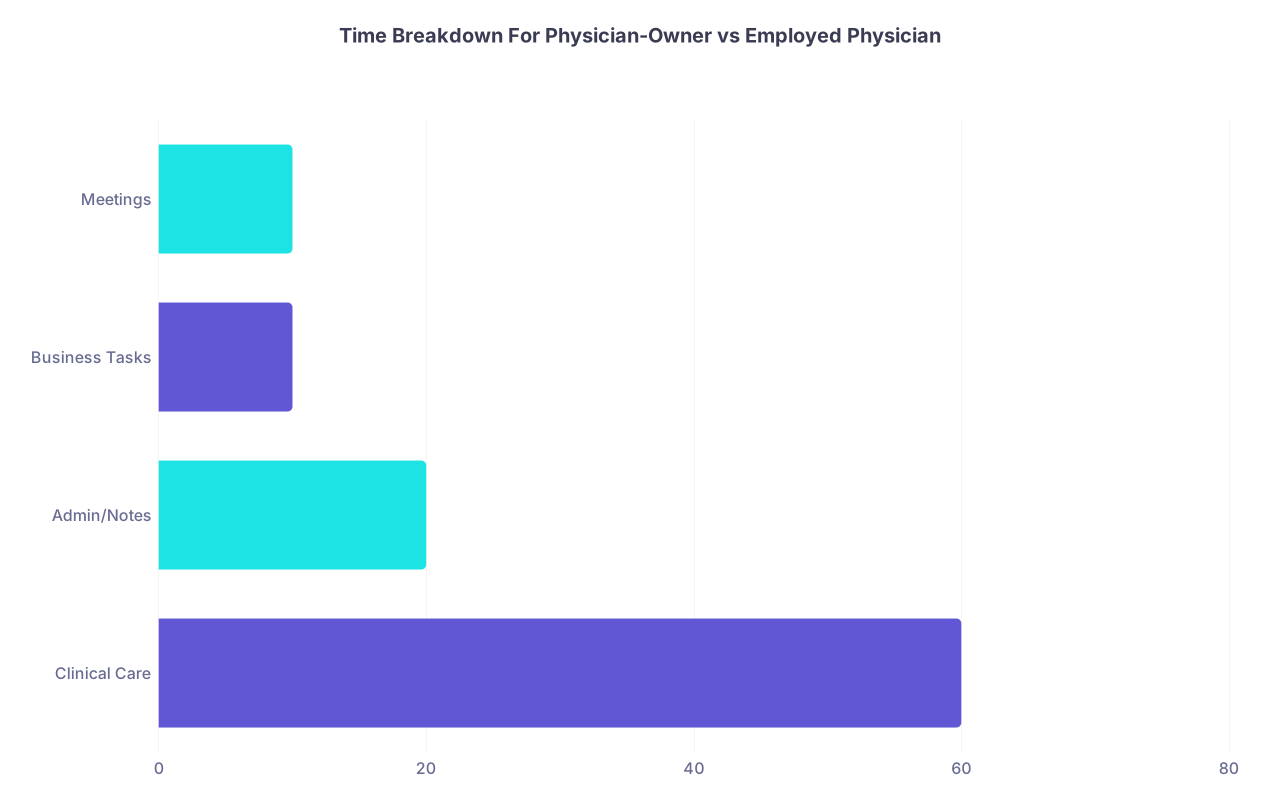
| Category | Value |
|---|---|
| Clinical Care | 60 |
| Admin/Notes | 20 |
| Business Tasks | 10 |
| Meetings | 10 |

| Step | Description |
|---|---|
| Step 1 | Finish Residency |
| Step 2 | Work as employee in private group |
| Step 3 | Hospital employed job |
| Step 4 | Learn practice ops |
| Step 5 | Buy in as partner |
| Step 6 | Hire strong admin and outsource |
| Step 7 | Stay employed long term |
| Step 8 | Hate business but want autonomy |
| Step 9 | Trust partners and structure |
| Step 10 | Still want own practice |
FAQ (Exactly 5 Questions)
1. If I hate business, should I just forget about owning a practice entirely?
Not automatically. Hating business doesn’t disqualify you. The key question is: are you willing to tolerate some discomfort to understand the basics, hire good help, and review key numbers regularly? If your answer is yes (even a reluctant yes), you can own safely with the right support. If your answer is “absolutely not, I refuse to ever think about this,” then full ownership is probably the wrong choice right now.
2. What’s the single most dangerous business mistake new physicians make?
Signing stuff they don’t actually understand. Leases with brutal terms. Billing contracts with terrible percentages and long lock-ins. Loan agreements where they personally guarantee way too much. If you do nothing else, promise yourself you’ll have a healthcare-savvy attorney and a financially literate person review every major contract with you before you sign.
3. How much money should I have saved before even thinking about opening a practice?
There’s no magic number, but I start to feel less queasy when I see: 6 months of personal expenses in cash, plus a realistic startup budget for the practice (buildout, equipment, initial payroll, insurance, etc.) that doesn’t rely on fantasy-level patient volume from day one. If you’re at $0 savings and high anxiety, focus first on a stable W2 job, pay down some debt, and build a cushion.
4. Can I start a practice and then decide it’s too stressful and go back to being employed?
Yes. People do this. It’s not a moral failure; it’s data. The main thing is not to lock yourself into huge, long-term obligations that make it hard to exit—like a seven-year lease on way-too-big space. If you start small, keep initial commitments modest, and don’t over-hire, you have far more flexibility to pivot without disaster.
5. How do I know if a billing company or office manager is actually good?
You don’t rely on vibes. You ask other physicians you trust who they use. You demand references. You ask them to explain their reports in simple terms and see if they’re transparent or evasive. Then you verify by looking at your own numbers over time: clean claim rate, denial rate, days in A/R, collection percentage. A good biller or manager welcomes questions and can show clear metrics; a bad one gets defensive and hides behind jargon.
Key points:
You can hate business and still own a practice, but you can’t be completely disengaged from it.
Your safety comes from understanding the basics, hiring competent help, and not signing things blindly.
If the idea of any of that feels impossible right now, it’s okay to wait, be employed, and come back to this later with more stability and less panic.