
The people approving your new clinic are not impressed by your dream. They are trying to protect themselves from risk.
Let me tell you what credentialing committees are actually doing when your file hits the table—and why perfectly good doctors get quietly blocked, delayed, or half-approved while no one gives you a straight answer.
You think it’s about your training. They think it’s about liability, politics, and “how badly could this blow up in our face?” Once you understand that, you stop being surprised by the stupid hoops. And you start winning.
The Real Power Players: Who Actually Approves Your Clinic
You are not dealing with a single person. You are walking into a machine.
In most hospitals and health systems, three groups matter:
- Medical Staff Office (MSO) staff
- Department chair / service line leadership
- Credentials / Medical Executive Committee (MEC)
Here’s the dirty secret: the MSO staff can make or break you long before any physician ever votes. I have watched more than one new doc get “lost in process” simply because they annoyed the one coordinator who tracks missing documents.
What each group really cares about:
MSO staff care about: complete paperwork, clean timeline, no surprises, “does this look like work for me later?” If your file is messy, piecemeal, or full of gaps, they flag you mentally as future trouble.
Department chair cares about: your reputation, whether you’re going to poach their referrals, dump on-call work, or embarrass them. They will not say that to you. They call it “fit with service” and “resource alignment.”
Credentials/MEC care about: patterns of risk, prior discipline, malpractice signals, and whether you’re trying to stretch your scope beyond what your training obviously supports.
When you apply for privileges for your new clinic (whether independent or “aligned” with a health system), your name gets run through this entire pipeline. They are not just deciding if you can see patients. They are deciding if they’re comfortable being tied to you when something goes very wrong.
The Quiet Checklist: What They Actually Scan First
No one tells you this, but credentialing committees rarely start by reading your CV line by line. They look for red flags and anchors.
Red flags are things that make them slow down. Anchors are things that make them relax and sail you through.
Here’s how it usually goes behind closed doors:
Board certification and training pedigree
The question is not “are you competent?” It’s “can I defend this if we get sued or audited?”A clean story:
- ACGME residency/fellowship in the exact specialty you’re requesting
- ABMS or AOA board certified (or eligible with a realistic timeline)
- No strange gaps or unaccredited training jumps
When you open a clinic and ask for procedure-heavy or high-risk privileges, the committee wants the paper trail to match: “Why is a general internist asking for advanced endoscopy?” If the narrative is not obvious, you’re in trouble.
If you’re non–board certified, they’re asking:
“If this goes to court or payer review, will we look stupid for approving this?”Malpractice history that tells a story
This part is underrated by young docs. It’s not just “how many cases.” It’s pattern recognition.Three things they zoom in on:
- Multiple similar cases (e.g., repeated failure-to-diagnose)
- Recent large payout or judgment
- Omissions or contradictions with NPDB or insurer verification
I’ve seen applications torpedoed not because of an ugly case, but because the narrative the physician gave did not match what the committee saw in the NPDB report. Once they sense you’re hiding something, trust is gone.
Employment and training gaps
Any unaccounted-for span longer than about 30 days raises eyebrows. They look for:- “Sabbatical” with no clear purpose
- “Locums work” with no details
- Periods where your license was inactive
In a normal job, gaps are fine. In credentialing, gaps feel like smoke. Smoke implies fire.
License and DEA status
They want to see:- No probation, consent orders, or weird restrictions
- No sudden license changes between states without a clean explanation
- DEA active and clean, or at least a logical reason if it’s limited
If you’ve ever had a board investigation, even if “resolved,” assume they will see it and discuss it.
Why Your New Clinic Makes Them Nervous
When you’re seeking privileges tied to a new private practice, the committee isn’t just approving you. They’re implicitly blessing the environment you’re working in.
That’s the part most physicians completely miss.
They consider:
Are you practicing solo or in a small group with no back-up?
For higher-risk procedures, solo practice feels dangerous. Who covers your complications? Who is your backup plan on weekends?Does your clinic have the infrastructure to support what you’re requesting?
Sedation, post-procedure monitoring, crash cart, transfer agreements. They will not phrase it as “your office looks rinky-dink,” but that’s what they’re thinking.Are you trying to do hospital-level care in an outpatient storefront?
Chronic transfusions, complex infusions, heavy sedation, outpatient surgery in an office that looks like a dental suite. Massive red flag.
When they see a brand-new independent clinic, the default mental picture is: under-resourced, over-optimistic, and invisible until something catastrophic happens.
Your job is to flip that perception.
The Documents That Make or Break You (That No One Prepares You For)
Most physicians focus on the CV, licenses, and CME. That’s the bare minimum. What quietly sways committees is how well your paperwork pre-answers their risk questions.
These are the pieces that actually matter when you’re opening a clinic and applying for privileges:
- Your requested privileges list – and how realistic it is
For a new clinic, you need to be ruthlessly honest: “What do I actually need to do out of my office?” and “What’s better left to the hospital or ASC?”
If you submit an aggressive privilege list, the internal conversation sounds like:
- “Why is a fresh grad wanting this entire menu?”
- “Do they know our usual practice?”
- “Who is going to bail them out when something goes wrong?”
What works better: tailoring your privilege request to:
- Your actual training and documented experience (case logs help)
- What your clinic is genuinely equipped to support
- Local norms (ask a friendly senior doc what’s considered standard)
- Your clinic’s policies and procedures
This is where almost everyone is underprepared. You’re thinking like a clinician. They’re thinking like a regulator and a plaintiff attorney.
For a new clinic, you should be ready (if asked) with:
- Written emergency protocols
- Transfer agreements or at least a written process with the nearest ED/hospital
- Sedation policies (if applicable)
- Infection control policy, instrument reprocessing plan (if you do procedures)
- Documentation templates, including informed consent language
No, not every hospital will ask to see all of that. But the ones who care about risk will. When you can email them a clean package within 24 hours, their confidence in you skyrockets.
If you’re requesting procedures beyond the most basic, you need proof. This is where lots of young subspecialists get burned.
Behind the scenes, someone is asking:
- “How do we know they actually did enough of these to be safe?”
- “Was this part of an accredited training program or ‘informal’?”
If you come out of fellowship with decent logs, keep them. Back them up. They are golden when you start a private practice and need to convince a skeptical committee you’re not overreaching.
Politics and Turf: The Stuff No One Admits Out Loud
Here’s the ugly part. Sometimes the barrier is not your competence. It’s the local fiefdom.
If you’re opening a new clinic, you are by definition entering someone else’s established referral ecosystem. That senior doc who has been there 20 years? He’s probably sending a steady stream of cases and revenue to that hospital. You? You are unknown and potentially disruptive.
Common unspoken motives that influence credentialing decisions:
Protecting existing referral patterns
A cardiology group with a longstanding cardiac cath lab arrangement is not thrilled about a new interventionalist asking for full cath lab privileges while building an outside clinic. Does the credentials committee say that? No. But inertia and “concerns” suddenly appear.Gatekeeping call coverage
Some groups use credentialing to force you into their call schedule or to punish you if they think you’re not “carrying your weight.” Your privileges may quietly hinge on agreeing to an “equitable call arrangement.”Fear of you siphoning procedures to your own space
If you’re opening a procedure-heavy practice (GI, pain, ortho, ENT), hospitals worry you’ll build your own ASC or use competitors’ facilities later. That fear colors how generous they are with granting high-margin privileges.
You need to understand: not all pushback is about your file being weak. Sometimes it’s about you being too strong a competitor.
This is why having at least one person on the inside—department chair, service chief, or well-respected colleague—who will say, “We want this person here,” is invaluable. That support can override quieter political friction.
What Committees Love to See (And Almost Never Tell You)
If you want your new clinic to breeze through approval instead of dying by a thousand “we still need…” emails, you build your application like a malpractice defense.
There are several things that make a room full of jaded committee members relax:
- A clean, coherent story
If your CV, application, and explanations line up with a simple narrative:
- Trained in X
- Practicing X within reasonable scope
- Opening a clinic focused on X with clear infrastructure
- No weird detours, hidden gaps, or mismatched requests
They’re comfortable. If your story is messy but you explain it clearly and early, they’re still comfortable. What they hate is feeling like they’re discovering surprises.
- Preemptive explanations of anything unusual
Out-of-sequence training, non-ACGME fellowship, career gap, malpractice case, board action. If you pretend they won’t notice, they assume you’re either naïve or evasive.
The docs who sail through write a short, factual, non-defensive explanation before being asked. The tone matters. You’re not apologizing for existing. You’re giving them ammunition to defend approving you.
- Evidence that you know your own limits
This is subtle but powerful. When you:
- Don’t request every possible privilege
- Are explicit about what you won’t do outpatient
- Have a clear plan for escalation, referral, and transfer
The committee sees you as safer. Mature. Less likely to get in over your head and drag them into the mess.
- Demonstrated connection to the community
They love seeing:
- Established local references (from training or previous jobs)
- Collaborative letters from existing groups – even if you’ll technically compete
- Indications you’ll participate in QI, morbidity/mortality, committees
You’re not just dropping a for-profit box on their doorstep. You’re joining their professional ecosystem.
The Timeline Games: Why Everything Takes Forever
You’re going to be furious about how slow this feels. Expect that.
Here’s what you’re really up against:

| Step | Description |
|---|---|
| Step 1 | Submit Application |
| Step 2 | MSO Completeness Check |
| Step 3 | Request More Info |
| Step 4 | Primary Source Verification |
| Step 5 | Department Chair Review |
| Step 6 | Credentials Committee |
| Step 7 | MEC or Board Approval |
| Step 8 | Privileges Granted |
Every “step” is tied to fixed meeting dates. Credentials committees and MECs often meet monthly, sometimes less. Miss one cutoff and you slip a full cycle.
Common slowdowns that are absolutely predictable, but no one warns you:
- References not responding quickly
- Verifications from older training sites or defunct institutions
- Foreign training or previous state licensure verification
- Incomplete malpractice history or mismatched dates
If you’re opening a new clinic, your burn rate is real: rent, equipment, staff. The best move is to start credentialing with your major hospitals and payers months before you sign your lease or announce your opening.
Hospitals vs Payers: Two Different Credentialing Universes
Another thing that trips people up: hospital credentialing and insurance panel credentialing are cousins, not twins.
Hospitals care about clinical privileges, safety, liability, and peer review mechanisms.
Payers care about:
- Network adequacy (do they need another doc like you?)
- Sanctions, exclusions, OIG list
- Cost/utilization patterns if you’re coming from another network
Opening a clinic means you’re doing both. Often simultaneously. Get used to repeating the same information in slightly different formats.
To keep your sanity, build a master credentialing file:
- Digital folder with every license, DEA, board cert, CME, malpractice declarations page
- Chronological CV updated monthly
- Standardized narrative for any “issues” in your history
You then feed this to everyone: hospitals, commercial payers, Medicare, Medicaid. The docs who treat each application as a fresh creative writing exercise end up contradicting themselves and raising flags.
Common Ways New Clinic Docs Shoot Themselves in the Foot
I’ve sat in those rooms and watched applications go sideways for reasons that had nothing to do with raw competence. The pattern repeats.
The most avoidable self-inflicted wounds:
Asking for every imaginable privilege “just in case I might want it later.” Committees interpret that as bad judgment.
Being defensive or evasive about past malpractice or board actions. They’re not outraged by the event. They’re outraged by the half-truth.
Ignoring emails from the MSO or responding weeks later. They flag you as disorganized and high-maintenance.
Letting a staffer “handle everything” while you never personally review the final application. I’ve seen staff list wrong dates, omit jobs, mis-state board status. Guess who owns the consequences? You.
Failing to cultivate one internal champion who will speak positively about you in the room. You want at least one person to say, “I’ve worked with her; she’s solid.”
A Simple Mental Model: What They’re Really Asking Themselves
Behind every line item they review, the committee is applying a few basic questions:
- If this physician hurts someone badly, can we defend having approved them?
- Does their training, behavior, and requested scope look like the other safe docs we already have?
- Are they likely to create more work for us—complaints, investigations, peer reviews, legal headaches?
- Do they seem like the type who will cover their own patients appropriately and collaborate when needed?
If your application, your clinic setup, and your communications give them confident “yes/no” answers to those questions in the right direction, you get approved. Often quickly.
If you leave blanks, inconsistencies, or drama, they slow-walk you, carve out your privileges, or quietly suggest “resubmit in six months” while you bleed money in your new space.
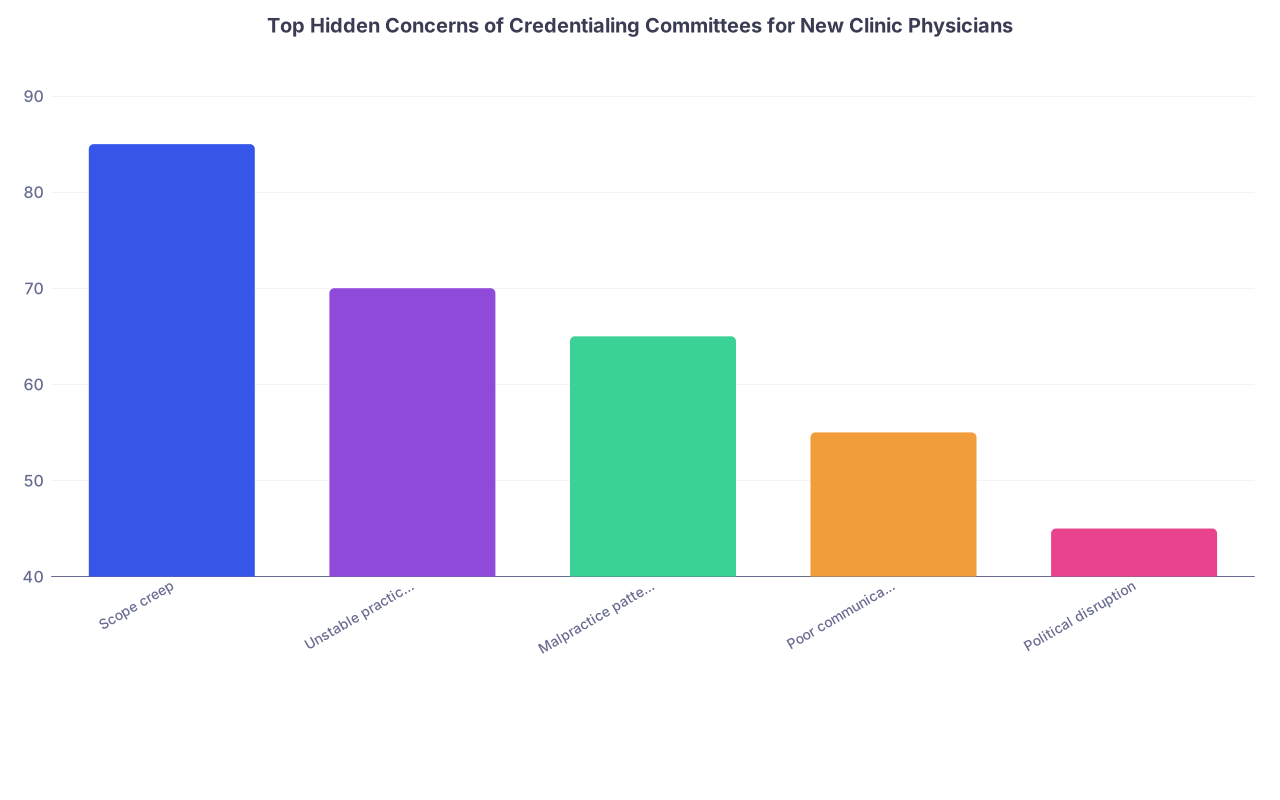
| Category | Value |
|---|---|
| Scope creep | 85 |
| Unstable practice setup | 70 |
| Malpractice pattern | 65 |
| Poor communication | 55 |
| Political disruption | 45 |

Quick Comparison: What Strong vs Weak Files Look Like
| Aspect | Strong Profile | Weak Profile |
|---|---|---|
| Board status | Certified or clearly eligible with timeline | Lapsed, unclear, or alternative only |
| Training narrative | Linear, documented, no major gaps | Multiple gaps, unverified positions |
| Privilege request | Focused, matches training and clinic setup | Overreaching, broad, poorly justified |
| Malpractice history | Few cases, clear consistent explanations | Pattern of similar claims, vague narratives |
| Clinic infrastructure | Defined policies, transfer plan, equipment | Vague plans, no documented protocols |
FAQs
1. Do I really need hospital privileges if my clinic is 100% outpatient?
In many markets, yes, especially if you’re doing anything beyond low-acuity primary care. Hospitals and some payers view hospital privileges as a proxy for peer approval and emergency backup. Even if you never admit, being on staff somewhere reassures everyone that you can escalate care appropriately.
2. How bad is it to have a malpractice case on my record when starting a clinic?
One case, even a big one, is usually survivable if the story makes sense and your explanation matches the NPDB report. Multiple similar cases, recent events, or any sign that you’re minimizing your role are what scare committees. Own the facts, show what changed in your practice afterward, and do not lie by omission.
3. I’m not board certified. Am I dead in the water for opening a private practice?
Not automatically. It depends heavily on your specialty, region, and hospital bylaws. Some community hospitals still accept “board eligible” with time limits, or alternative boards, especially in less saturated areas. But you will have a harder time with both hospitals and payers, and your requested scope will be scrutinized much more closely.
4. How early should I start the credentialing process before opening my clinic?
Six months is a realistic minimum if you want a smooth launch. Nine to twelve months is safer, especially if you’ve worked in multiple states, have older training institutions, or any prior board or malpractice issues. Hospital credentialing, payer enrollment, Medicare/Medicaid—all of it stacks. Starting late is the easiest way to burn cash.
5. Is it worth hiring a credentialing service, or should I do it myself?
You can outsource the grunt work, but you cannot outsource the responsibility. A good credentialing service can streamline forms and follow-ups, but you still need to personally review every application for accuracy and consistency, craft your own explanations for any red flags, and maintain your master file. Lean on them for process, not judgment.
Key takeaways: Credentialing committees are not evaluating your dream; they’re evaluating their risk. Your new clinic gets approved faster when your story is clean, your scope is realistic, and your paperwork anticipates their worst-case thinking. And if you remember that politics and perception matter just as much as raw competence, you stop being the confused outsider and start playing the insider’s game.