
The way practice owners really evaluate new physicians has almost nothing to do with what you were praised for in residency.
They are not primarily impressed by your fellowship pedigree, your wRVU numbers on a hospital service, or how many lines you can place in 10 minutes. They are quietly asking one thing: “If I attach this person to my business, will they make me money…or cost me money and headaches?”
Let me walk you through how that actually plays out behind closed doors, because I’ve sat in those meetings. I’ve watched owners flip through CVs and say one sentence that seals someone’s fate. You need to know what they’re really looking at—especially if you think you might eventually become a partner.
The Two Tracks: Associate vs Future Partner
Private practice owners mentally put you into one of two boxes the moment they see your CV and your first email:
- Pure associate (worker bee)
- Potential future partner (someone they might eventually share equity with)
They won’t tell you this out loud. But it colors everything—your offer, your schedule, how they treat you, and how closely they watch certain behaviors.
Here’s the brutal distinction:
- Associates are evaluated on “production, compliance, low drama.”
- Potential partners are evaluated on “ownership mindset, business sense, and long-term trust.”
Same clinic. Same exam rooms. Totally different lens.
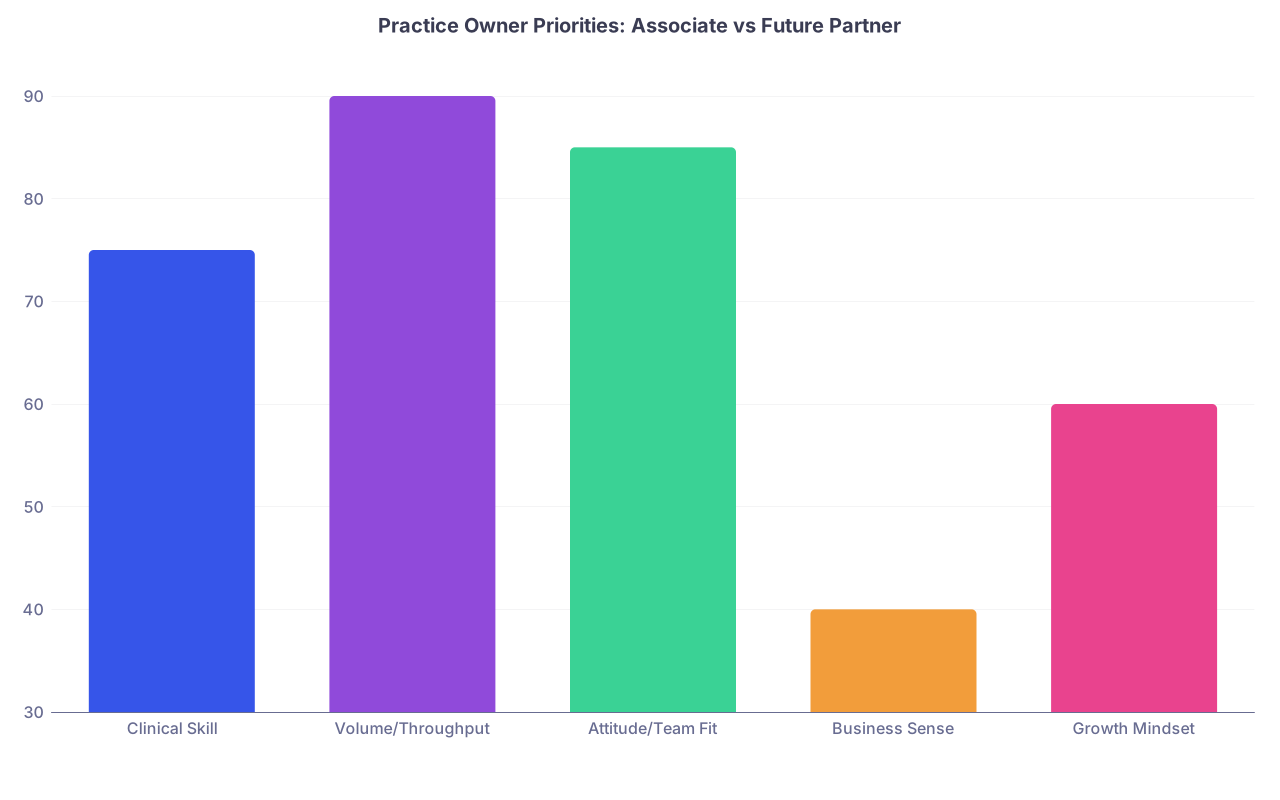
| Category | Value |
|---|---|
| Clinical Skill | 75 |
| Volume/Throughput | 90 |
| Attitude/Team Fit | 85 |
| Business Sense | 40 |
| Growth Mindset | 60 |
That chart? That’s roughly how owners weight things for a typical associate. For a future partner, the “business sense” and “growth” bars shoot way up, even if they never say it in the interview.
If you want a real shot at partnership, you need to start signaling you belong in the second bucket from day one, not year five when you suddenly “ask about partnership.”
What Owners Really Check Before They Even Meet You
When a CV hits the practice owner’s inbox, here’s the unfiltered thought process you’ll never see.
1. “Can this person fill the holes in my schedule and make more money than they cost me?”
They immediately do mental math.
- Your base salary + benefits
- Expected collections if you work like a median doc in their specialty
- Existing patient demand and referral flow
- How quickly they think you can build a panel without handholding
If they’re smart, they’ve already run rough pro formas:
“Okay, if I give this new family med doc 3 exam rooms, 2 MAs, and start them at 14–16 patients a day ramping to 22+, can they cover 2.5x their total comp within 12–18 months?”
That “2–3x comp in collections” rule of thumb drives more hiring decisions than anyone will admit publicly.
| Factor | Rough Owner Threshold |
|---|---|
| Total comp (salary + benefits) | $275–$350K for primary care |
| Target collections by year 2 | 2.5–3x total comp |
| Ramp-up time tolerated | 12–18 months |
| Minimum patient volume goal | 18–25/day depending on specialty |
You? You’re thinking, “Is the salary competitive vs MGMA?”
Them? “Will this doc be cash-flow positive fast enough to justify the risk and the overhead?”
2. “Are they going to quit in two years?”
Owners hate churn. Hate it.
They’ve been burned by the pattern: new doc shows up, uses the practice as a landing pad for 1–3 years, then jumps to a hospital or competitor for a slightly better deal.
So they scan you for flight risk:
- Multiple short stints in training (switching specialties, extra years for “fit issues”)
- Geography: zero ties to the area, spouse with portable job, no kids, no house
- Vibe: Are you asking lots of questions about “work–life balance” and “exact hours” before asking a single question about how the practice is doing?
You can practically watch the owner’s guard go up when they smell “temporary.” They’ll still hire you sometimes. But as an associate. Not as someone they’ll ever seriously mentor into ownership.
3. “Will patients like this person?”
They know you can practice medicine. You graduated. You passed boards. That’s the baseline.
The real question is:
“If I put them in front of my existing patients and referral sources, will those people ask for them again, or ask not to see them again?”
This is brand risk. Patient experience risk. Online review risk.
They look for soft tells:
- How you greet the receptionist when you walk in (yes, they ask afterward)
- Whether you can talk to non-physicians without sounding condescending
- If you can explain your own CV without rambling or jargon
More than once I’ve seen an owner say afterward:
“Technically very sharp. But something about the way they talked to the MA—hard pass.”
That never shows up in your rejection email.
How Your Behavior Gets Scored Once You Start
Once you’re hired, your “evaluation” is not a formal yearly review. It’s a running ledger in the owner’s head, updated weekly by what they see, what their staff tell them, and what the numbers say.
Let’s break down what really moves that needle.

1. Throughput without chaos
They are watching how many patients you can see while keeping the wheels on.
Not just volume. Volume + stability.
- Are your rooms turning over, or are you chronically 30–60 minutes behind?
- Do staff dread working with you because “your days are always a mess”?
- Are you reasonable about add-ons, urgent visits, and same-day cases?
A very common private conversation among owners:
“Dr. X is clinically great, but she runs 45 minutes behind every day. Staff hate working her rooms. Patients are starting to complain. I can’t scale that.”
You don’t need to see insane volume. You do need to show you can hit a sustainable, efficient stride without generating drama.
2. How you handle staff
This one is huge and under-discussed. Owners hear everything from their long-term staff. And they believe their staff more than you.
If your MA says, “Dr. Y is always nice to patients but snaps at me when we’re behind,” that sticks.
If the front desk says, “We can never find Dr. Z when a patient calls back,” that sticks.
Owners are listening for three kinds of red flags:
- Disrespect: talking down, blaming staff in front of patients, ignoring workflow norms
- Volatility: big mood swings, unpredictable anger, constant complaints
- Entitlement: refusing to help with small things (“that’s not my job”), treating everyone like they exist solely to make you comfortable
Healthy practices protect their good staff because replacing them is painful and expensive. You go after the staff, you go after the owner’s foundation. That’s how you get labeled “not partner material” even if your numbers are stellar.
3. Your documentation and coding
Here’s a dirty little secret: many owners gauge your maturity by your notes and coding more than by your board scores.
Why? Because your documentation is where your clinical brain, your risk tolerance, and your business sense collide.
Things they notice:
- Are you chronically under-coding out of fear? (Great for insurer, bad for business.)
- Are you up-coding without clear support? (Liability risk. Audit risk. Owner nightmare.)
- Do you respond like an adult when coding feedback comes, or do you get defensive?
I’ve literally heard an owner say:
“He took my feedback on E/M levels gracefully and fixed his patterns within a month. He’s teachable. That’s a partner trait.”
This is the stuff no one tells you.
How They Decide Who Gets a Real Shot at Partnership
Let’s talk about the “future partner” track. Because this is where the game completely changes, and most young physicians are blind to it.
Partner evaluation isn’t formal. It’s a long, quiet audition.

| Stage | Activity | Score |
|---|---|---|
| Year 0-1 | Prove clinical competence | 4 |
| Year 0-1 | Show up, be low drama | 5 |
| Year 1-3 | Build panel and referrals | 4 |
| Year 1-3 | Show business curiosity | 3 |
| Year 3-5 | Demonstrate loyalty | 5 |
| Year 3-5 | Ask smart questions about equity | 4 |
Here’s what owners are actually looking for before they ever float a number.
1. You think beyond your own exam room
Owners watch whether you demonstrate an ownership mindset without the title.
Red flags you’re not there yet:
- You never ask how the practice is doing financially—only about your own comp
- You complain about schedule gaps but never suggest solutions or outreach ideas
- You see every policy through: “How does this inconvenience me?”
On the flip side, what makes them take notice:
- You ask, “What percent of visits are no-shows and what’s working to reduce them?”
- You’re curious about payor mix, major referral sources, and which services are actually profitable
- You show you understand that expenses exist beyond “the owner’s pocket”
I’ve watched owners pull a partner aside and say:
“She gets it. She asks about the bottom line and doesn’t act like the lights turn on by magic.”
2. You protect the brand
When a practice attaches your name to the door, they’re tying their reputation and legal exposure to your decisions.
So they watch for:
- Do you escalate early when something feels off legally or ethically?
- Do you practice within reason, or are you a cowboy with ordering, opioids, procedures?
- Are you pragmatic but clean with documentation, referrals, and conflict of interest?
Owners fear two types as partners more than anything:
- The revenue-obsessed borderline fraudster
- The careless liability magnet
You want to be the third type: the revenue-conscious, brand-protective grown-up.
3. You show loyalty and realistic expectations
Yes, this will sound old-school. But it’s real.
Owners ask themselves:
“If I sell this person equity, will they stick around long enough for it to be worth the hassle?”
They look at:
- Whether you’ve chased every slightly better offer in town
- Whether you survived a conflict at the practice and stayed to resolve it
- Whether you badmouth the practice or leadership to staff
They’re also listening very closely the first time you bring up “partnership.” If you lead with, “So what’s the buy-in and my take-home as partner?” before ever asking, “What does ownership actually entail here?”—you’ve just told them you want the upside, not the responsibility.
Owners respect the person who says:
“I’m interested in ownership, but I know that means more than just a title. Can you walk me through what your day-to-day looks like as owner and what risks you carry?”
That signals maturity. And that you’ve thought past the paycheck.
Numbers: How They Quietly Benchmark You
Owners love to pretend evaluations are “holistic.” Ignore that. They’re absolutely tracking key numbers on every doc.
, Staff Turnover Around You](https://cdn.residencyadvisor.com/images/articles_svg/chart-key-metrics-owners-informally-track-on-new-physici-2306.svg "Key Metrics Owners Informally Track on New Physicians")
| Category | Value |
|---|---|
| Collections/Comp Ratio | 85 |
| New Patients per Month | 70 |
| No-show and Cancel Rates | 60 |
| [Online Review Trends](https://residencyadvisor.com/resources/starting-private-practice/website-and-online-listing-errors-that-drive-patients-to-other-clinics) | 50 |
| Staff Turnover Around You | 40 |
Rough translation of those bars:
- Collections/Comp Ratio – Are you bringing in at least 2–3x your total comp by year 2–3?
- New Patients per Month – Are you still slowly building, or have you hit a “people ask for you by name” threshold?
- No-show/Cancel Rates – Is your panel engaged, or are patients disappearing?
- Online Review Trends – Have complaints started using your name specifically?
- Staff Turnover Around You – Do MAs rotate off your team at a higher rate than others?
Most of this is never in your formal “evaluation.” But it’s in every partner meeting where your future is discussed.
How to Present Yourself So Owners See “Partner Material”
Now the useful part. How do you align yourself with how owners actually think?
1. Speak “owner language” early—but not obnoxiously
You don’t walk into your first month asking for balance sheets. That’s weird.
You do start with small questions that show you’re thinking beyond yourself:
- “What’s the biggest bottleneck for the practice right now?”
- “Are there services we’re turning away that you wish we could offer?”
- “What’s the payer mix like, and are there contracts that are particularly painful?”
When you ask these questions as a learner instead of a critic, owners clock that. They remember who asked.
2. Be ruthlessly easy to work with
You want the staff, billers, and front desk talking about you this way:
“They’re busy, but they’re fair. They listen. They don’t blow up our day.”
Concrete behaviors that get you there:
- Return messages and results promptly so staff aren’t always chasing you
- Pitch in during crunch times without acting martyred
- Apologize when you screw up the schedule or documentation and fix it
Owners listen more to their 20-year office manager than to another physician when it comes to who they trust.
3. Build predictable habits around volume and quality
You don’t have to be the top producer. Owners value predictable producers more than sporadic rock stars.
Aim for:
- A steadily growing panel and referral base
- Reasonably consistent daily volumes (aside from natural swings)
- Low-complaint patterns from patients and ancillary staff
If every quarter looks a bit better than the last, and there’s no catastrophic drama, you are quietly becoming indispensable. That’s when owners start thinking, “Maybe we should talk to her about a more permanent role.”
The Unspoken Deal: What Owners Expect vs What You Should Demand
There’s a psychological contract here that both sides rarely articulate.
What owners expect if they’re going to seriously consider you for partnership:
- That you will be loyal for a substantial period (think 5–10 years)
- That you’ll share risk—financial, reputational, legal—when things get tough
- That you’ll accept some unpleasant tasks: meetings, admin, negotiations, hiring/firing
What you should expect from them if they dangle partnership:
- Transparent financials, not just “trust me, the numbers work”
- A clear buy-in structure that isn’t just a random big number
- Real authority commensurate with your equity, not “junior partner in name only”
If they want the upside of your commitment without showing you the books or involving you in decisions, that’s not partnership. That’s upgraded employment with a shinier title.

Quick Reality Check: Traits Owners Quietly Rank Highest
Let me condense the whole game into something blunt.
Owners will forgive:
- You being slower for a few months while you ramp
- You asking “dumb” business questions out of genuine curiosity
- You needing feedback on documentation and coding
They will not forgive, long-term:
- Chronic drama with staff
- Entitlement without production
- Gossip, toxicity, or undermining the practice’s reputation
- Ignoring financial reality while demanding more
If you want them to see “future partner” when they look at you, your job is straightforward:
Make their lives easier. Make their business stronger. Protect their brand. And show them you actually understand that all three matter.
Do that consistently for a few years, and you’ll be shocked how often the same cynical practice owner who “never takes on partners anymore” suddenly says:
“Maybe it’s time we talk about you buying in.”
With that mindset in place, you’re not just another associate passing through. You’re on the track to real ownership. How you approach the conversations about actual buy-in, governance, and exit terms—that’s the next level of the game. And that’s a story for another day.