
The way partners divide money in small practices is almost never what’s written in the contract.
There’s the formula on paper. And then there’s the real formula: power, leverage, who brings in what, who’s willing to walk, and who owns the relationships that actually matter. If you mix those up, you’ll spend a decade making less than you should and wondering why the “fair” partnership never feels fair.
Let me walk you through how this really works—what attendings say behind closed doors, what’s actually discussed at partner meetings once the junior people leave the room, and the unspoken rules that drive who gets paid what.
The Myth of “Equal Partners”
Most young docs think the endpoint is simple: become a partner, split everything equally, live happily ever after.
That’s fantasy.
In small practices (I’m talking 2–10 docs), “partner” is a status label. It does not automatically equal “equal owner,” and it definitely does not guarantee equal income. What really exists are layers:
- Founding partners
- Senior equity partners
- Junior equity partners
- “Partners” in title only
I’ve seen a group advertise “partnership in 2 years” and when you look under the hood, partnership meant 5% ownership, zero governance rights, and the right to buy in more… someday… maybe. The two founders still controlled 70% of the equity and 100% of all big decisions.
Here’s what’s actually going on in most practices:
- The people who took the early risk and borrowed against their houses keep structural advantages baked into the compensation model for years, sometimes permanently.
- Collections or RVUs are used as the polite, quantitative face of pay distribution. But adjustments get quietly made for call, goodwill, referrers, and “overhead allocations.”
- Anyone who doesn’t understand the math behind collections and overhead is subsidizing someone else.
You’re post-residency, looking at “partnership track.” What you’re really looking at is a ladder. And every rung has its own pay rules that nobody fully explains at the start.
The Real Levers: What Actually Drives Take-Home
You’ll hear a lot of words: productivity, overhead, ancillaries, buy-in, distributions, retained earnings.
Behind that jargon are a few concrete levers program directors and senior attendings talk about over drinks but never put in emails.
1. Collections vs. Production vs. Salary
On paper, most small practices use one of three base models:
- Straight salary
- Salary + productivity bonus
- Pure productivity (usually % of collections or RVUs)
In reality, even “salary” models have informal productivity expectations. If one partner consistently out-produces the others, pressure builds. That’s when the redefining starts: “We should really move to a more production-based model…”
Here’s the core unspoken rule:
The higher earner will always push the group toward a more production-based system. The lower earner will always push for “shared” models and equal splits.
At a certain size, the high producers usually win. Or they leave and start their own shop.
2. Overhead: Where the Games Are Played
You think the fight is about the top line. It’s not. The real money war is fought in overhead.
Overhead is not just rent and staff. In small practices it can quietly include:
- The founding partner’s spouse “practice manager” salary
- That extra administrator who “handles business development” but mostly works for one doc’s side projects
- The EMR that one partner insisted on because their cousin sells it
- The satellite office that loses money but preserves someone’s referral base
Most groups “allocate” overhead as a flat percentage. I’ve literally seen this conversation in a 4-partner meeting:
Partner A (high producer): “Why am I subsidizing the downtown office I never use?”
Partner B (founder): “It’s part of the practice brand. Without that presence, your referrals dry up too.”
Translation: we’re not changing the formula, we’re keeping the cross-subsidy.
Here’s the quiet reality:
If you’re not at the table when overhead categories are defined and allocated, you are the one paying for someone else’s preferences.
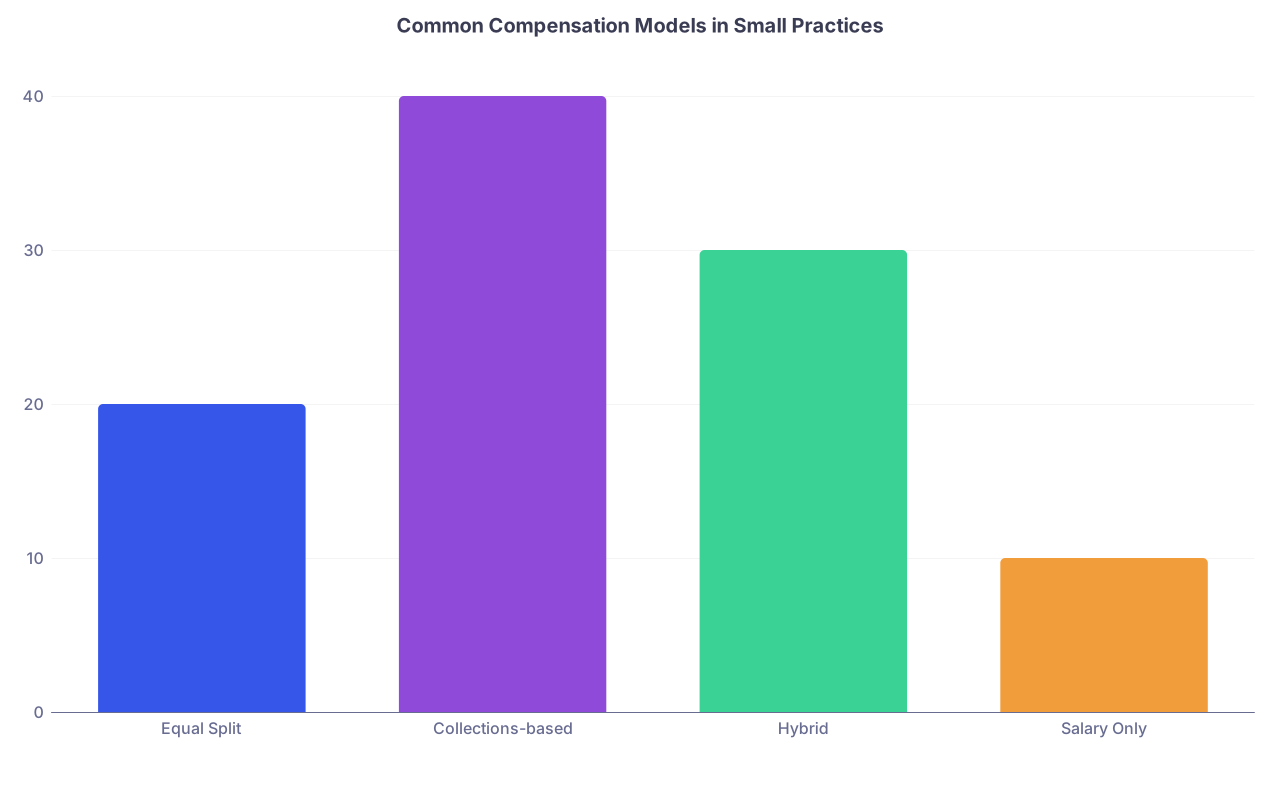
| Category | Value |
|---|---|
| Equal Split | 20 |
| Collections-based | 40 |
| Hybrid | 30 |
| Salary Only | 10 |
The Four Common Money Models (And What They Hide)
Every practice claims to have some unique, sophisticated structure. They don’t. Almost everyone is a variant of four basic models.
Model 1: Equal Split After Overhead
Everyone’s revenue goes into one big pot. Overhead comes out. What’s left is divided equally among partners.
Sounds fair. Feels collegial. Very “we’re all in this together.”
Here’s what really happens:
- The hardest worker eventually notices they’re funding the lifestyle of the slowest.
- Partners start subtly avoiding unprofitable work, “squeaky wheel” patients, or time-consuming Medicaid follow-ups.
- Senior partners drift into admin-heavy or low-volume “niche” work but keep full partner income because the pot masks individual performance.
This model survives when:
Everyone is roughly similar in productivity, or the culture is so strong that the high performers accept the implicit subsidy.
Whenever I see a young hotshot hospitalist or proceduralist join a pure equal-split group, I start a mental countdown clock. Three to five years before the blowup.
Model 2: Collections-Based Split
Each partner gets a fixed percentage of their own collections after overhead. For example:
- You keep 45–60% of your personal collections
- Practice takes the rest to cover overhead and group expenses
- Shared ancillaries or facility fees may be split differently
This is the default for small high-volume specialties: GI, ortho, ENT, anesthesia, some EM groups.
Sounds meritocratic. Produce more, earn more. But the trick is how overhead is defined.
Two quiet manipulations I see all the time:
Overhead rate is inflated.
A “50% overhead” practice where the real, verifiable expenses are only 35–40%. The difference becomes disguised profit to the founding partners, often via rent, management fees, or side LLCs.Overhead is misallocated.
You, the younger doc, get more MA and nursing support “because you’re building volume,” and then those costs are used to justify a higher overhead slice on your own collections.
So yes, collections-based is “eat what you kill.” But the founding partners are usually billing your meat through their grinder.
Model 3: Hybrid Model
This is what many serious groups end up with after a decade of internal fighting.
Typical hybrid:
- Base salary (low to medium, e.g., 150–300k depending on specialty and market)
- Bonus based on collections or RVUs above a certain threshold
- Some profit-sharing for ancillaries (labs, imaging, ASC), often tied to ownership rather than personal production
The unspoken logic:
- Salary keeps lower producers and lifestyle docs from getting crushed
- Productivity bonus keeps higher producers from walking
- Ownership of ancillaries quietly rewards the founders and early partners
If you’re joining a hybrid model, assume this:
Your path to 90th percentile income isn’t just seeing more patients. It’s getting a real slice of the ancillaries and real say in how overhead is structured.
Model 4: “You’re a Partner… in Name”
This is more common than people admit.
You’re told: “After 2 years, you’ll be partner.” And sure enough, at year 2 or 3, there’s a celebratory lunch, maybe even a new business card.
But your compensation model:
- Still has a base salary below the true market rate
- Offers a “bonus” that’s discretionary or capped
- Includes “profit sharing” that mysteriously doesn’t change your take-home by much
On paper, you’re partner. In reality, you’re quasi-employed in a privately-owned machine you don’t control.
The unspoken rule here:
Founders want succession without surrendering economic control. They want continuity of the practice but not true sharing of wealth.

The Power Dynamics No One Warns You About
Money in small practices is not divided by formulas. Formulas are the excuse. Money is divided by leverage.
Here are the real leverage points.
Who Owns the Patients and Referrers
In primary care, GI, ortho, cards, ENT, you’ll hear versions of this at partner meetings:
“Those referrals from Dr. X are because of my relationship.”
“The hospital gives us this block time because I negotiated it.”
Translation: “I control the spigot.”
Partners who own the referrer relationships or key institutional relationships get more say in compensation, even if RVUs or collections don’t fully reflect their value. Sometimes that shows up in explicit “relationship maintenance” stipends. More often it shows up as resistance whenever someone suggests changing the pay formula.
You can be the highest producer and still have less leverage than the quiet partner who golfs with the hospital CEO and chairs three committees.
Who Can Actually Walk
A non-compete is not just a contract clause. It’s a bargaining chip.
If you’re:
- Visa-dependent
- Tied down by spouse/kids/schools
- In a small town with one major system
Your threat to leave is weak. Everyone around that table knows it.
The partner with the most portable skill set, least geographic attachment, and best book of business has the most leverage. I’ve seen entire compensation structures get re-written because a single high-earning cardiologist credibly threatened to leave.
Nobody says this in the recruitment dinner. But they talk about it after you sign.
Who Understands the Books
Here’s the harsh truth: most physicians never really learn to read financials beyond glancing at a monthly collections sheet.
The partner who actually digs into:
- P&L statements
- AR aging
- Expense line items
- Rent and related-party transactions
…suddenly becomes “the finance person.” And that role can be weaponized.
Sometimes for good—cleaning up bloated overhead, renegotiating toxic contracts. Sometimes for self-interest—structuring comp and ancillaries in ways that quietly favor their lane of practice.
If you’re the only one at the table who can’t follow the discussion when they start tossing around “EBITDA,” “capex,” and “distributions vs. salary,” congrats: you’re the one being controlled.
| Lever | How It Affects Your Pay |
|---|---|
| Overhead allocation | Changes your effective % take |
| Ancillary ownership | Extra profit to select docs |
| Call compensation | Quiet subsidies or penalties |
| Management fees | Stealth income to founders |
Ancillaries: Where the Quiet Riches Hide
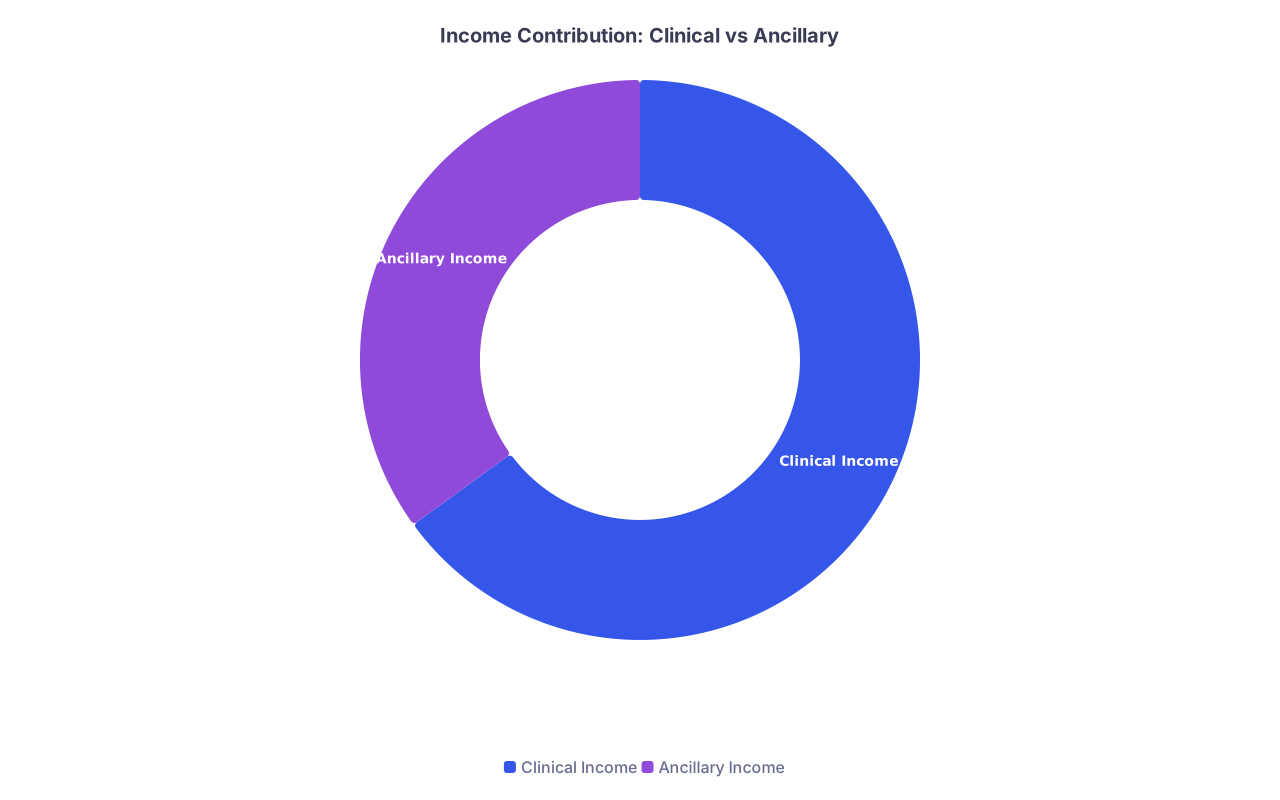
The real money in many small practices isn’t in office visits. It’s in everything bolted onto the core clinic.
Think:
- Imaging (MRI, CT, ultrasound)
- Lab
- Ambulatory surgery centers (ASC)
- Physical therapy
- Infusion suites
Publicly, ancillaries are “group revenue.” Privately, here’s what I’ve seen a hundred times:
- Founders form separate LLCs to own the ASC, lab, or building.
- The practice pays rent or fees to those entities.
- Income from those entities is divided by ownership percentage—often heavily skewed toward the founders—regardless of who generated the cases.
So a junior partner might be doing 70% of the scopes while only owning 5% of the ASC entity. That’s not an accident. That’s design.
Watch for phrases like:
- “Legacy ownership structure”
- “We’re not changing existing equity”
- “You can buy in more later once you’re more established”
Sometimes that’s reasonable—the founders did take real risk. But make no mistake: ancillaries are the hidden second paycheck you’re probably not getting… yet.
| Category | Value |
|---|---|
| Clinical Income | 65 |
| Ancillary Income | 35 |
The Buy-In: What You’re Really Paying For
Everyone gets fixated on the number.
“Buy-in is 150k.”
“Buy-in is one year’s salary.”
“Buy-in is 500k over 5 years.”
They throw that number at you like it’s a take-it-or-leave-it law of nature.
Behind closed doors, what that buy-in actually represents is a mashup of:
- Hard assets (equipment, accounts receivable, sometimes building)
- Intangibles (goodwill, referral base, brand, contracts)
- Exit packages for older partners who want money out without losing current income
In too many practices, buy-in isn’t about fair valuation. It’s a wealth transfer from the new partners to the old ones. A quiet retirement plan.
The sharp groups do this better. They’ll:
- Separate real estate from practice equity
- Have periodic third-party valuations
- Tie buy-in to a clear formula (e.g., X times EBITDA, updated annually)
The rest just say, “This is what we’ve always done.”
Ask to see:
- How the buy-in was calculated
- Whether previous partners paid the same multiple
- What partners get when they leave or retire (the “buy-out”)
Because here’s the dark joke:
If the buy-out is very generous and the buy-in is high, congratulations, you just bought yourself the privilege of funding the guy 20 years ahead of you.

| Step | Description |
|---|---|
| Step 1 | Associate Hire |
| Step 2 | Year 1-2 Salary Plus Small Bonus |
| Step 3 | Offer of Partnership Track |
| Step 4 | Partial Equity or Profit Sharing |
| Step 5 | Formal Buy In Proposal |
| Step 6 | Full Equity and Ancillary Access |
How Partners Actually Decide on Changes
On paper, major compensation changes require a vote. Often supermajority, like two-thirds.
In practice, changes follow a much messier script:
- A few partners start grumbling that the current formula is “unsustainable.”
- The highest earner or the one doing the least desirable work (heavy call, procedures, nights) threatens to scale back or leave.
- A “compensation committee” is formed. Usually consisting of the same 2–3 loudest or most senior voices.
- An outside consultant is sometimes brought in to “benchmark” compensation.
Translation: to justify whatever the strong personalities already want. - Everyone gets a model with spreadsheets showing a dozen scenarios. Most partners only half-understand it.
- People vote not based on fairness, but on which model gives them personally the best number without obvious outrage from others.
You don’t win these fights by moral argument. You win them by:
- Knowing your market value and being willing to walk
- Understanding the math well enough to propose an alternative
- Building alliances with at least one or two senior voices who’ll back you
Inside tip I’ve heard from more than one managing partner:
“The doc who quietly understands the numbers and calmly says, ‘Here’s another model that’s better for everyone and keeps us competitive’ almost always gets most of what they want.”
How You Protect Yourself As a New Grad
You’re not going to walk into a 4-physician group as a fresh graduate and rewrite their entire comp plan. That’s delusional.
But you can avoid getting trapped in the worst situations and set yourself up to benefit as your leverage grows.
Here’s the practical internal checklist physicians who’ve been burned wish they’d used.
Ask for actual numbers, not adjectives.
- “What’s the average partner compensation for the last 3 years?”
- “Range of lowest to highest partner take-home each of the last 3 years?”
- “What was the buy-in amount for the last person who became partner?”
Demand clarity on overhead.
- “What’s your overhead percentage right now?”
- “What’s included in overhead vs. partner distributions?”
- “Are there any related-party transactions—rent to an entity you own, management fees, equipment leases?”
Get the real definition of “partner.”
- “When you say partner, do you mean equity owner? What percentage?”
- “Does every partner have equal voting rights on comp changes?”
- “Do all partners participate in ancillary profits at the same rate?”
Understand the non-compete in context.
- If it’s aggressive and geographically huge, your leverage later is low. That directly affects how much real say you’ll ever have in compensation decisions.
Talk to the last person who left.
This is the most underused move. Find them. Call them. Ask, “How did the money actually work once you were here?”
If the group resists giving you transparency on these points, they’re not just disorganized. They’re hiding a hierarchy they don’t want to explain.
FAQs
1. Is any group truly “equal” in how partners divide money?
A few are. Usually older, stable, culturally tight-knit practices where everybody genuinely works at similar intensity and volume. Rural multi-specialty clinics, some long-standing primary care groups. But they’re rare. Most “equal split” groups are semi-equal, with golden handcuffs and quiet exceptions for founding partners or “special roles.” If a group claims perfect equality, verify it with actual partner-level financials and a candid talk with at least two non-founding partners.
2. How long should I accept being underpaid as an associate before pushing for a better deal?
Three years is a common breaking point. By year 2, you know your numbers and your value. If by the end of year 3 the path to real partnership and a fair split still feels vague, moving often makes more sense than endlessly negotiating from a weak position. The people who stay past 5 years in a bad structure almost never suddenly get treated fairly—at that point, you’re part of the business model.
3. Are high buy-ins ever actually fair, or are they always a rip-off?
High buy-ins can be fair if they’re tied to: verifiable valuation, strong ancillary income, and a transparent, reasonable buy-out when you eventually leave. I’ve seen 400–500k buy-ins that were absolutely worth it because they bought real equity in a profitable ASC and building. I’ve also seen 150k buy-ins that were pure smoke—no hard assets, no ancillaries, just overdressed goodwill. The difference is in documentation and whether non-founding partners actually end up with the same deal going forward.
4. What if I’m not a “numbers person”? Can I still protect myself?
Yes, but you can’t stay ignorant. You don’t need to be a CPA, but you do need to understand basic concepts: collections, overhead, distributions, equity, and ancillaries. Get help—hire a healthcare-savvy accountant or consultant to walk you through the financials before you sign anything. The worst position is “I trust them, they seem nice.” People change when hundreds of thousands of dollars are at stake. Numbers are how you protect yourself from that shift.
Key things to walk away with:
Money in small practices follows leverage, not slogans.
Overhead and ancillaries are where the quiet redistribution happens.
Your long-term income depends less on how hard you work and more on whether you get real equity, real transparency, and a real say in how the formula is written.