
The most expensive mistake new practice owners make is assuming “my CPA and lawyer will handle it.”
They will not. Not all of it. And the gaps between tax advice, legal advice, and reality? That’s where you lose tens of thousands of dollars and expose yourself to risk you do not see coming.
You’re a clinician. Not a tax attorney. Not a corporate lawyer. But if you abdicate these decisions instead of understanding them, you’ll regret it. Often for years.
Let’s go through the tax and entity-formation mistakes that quietly wreck new practices — and how to avoid stepping on the same landmines.
1. Picking the Wrong Entity Because “My Friend Did It”
The most common origin story of a bad structure: “My buddy from residency said he’s an S-corp, so I told my lawyer to do the same.”
That’s lazy, and it’s expensive.
Different entity choices exist for a reason. They affect:
- How you’re taxed
- What you can deduct
- How you pay yourself
- Your exposure to payroll tax
- Your flexibility if you grow, add partners, or sell
Here’s the mistake pattern I see constantly:
- Someone forms an LLC “taxed as a disregarded entity” and never revisits it once revenue grows
- Or they rush into an S-corp because “it saves self-employment tax,” but set salary and distributions wrong
- Or they create a C-corp without understanding double taxation and the pain of getting money out
| Entity Type | Typical Owner Count | Tax Default | Common Issue |
|---|---|---|---|
| Sole Prop | 1 | Schedule C | Zero liability shield |
| Single LLC | 1 | Disregarded | Missed S-corp election timing |
| Multi LLC | 2+ | Partnership | Messy partner exits |
| S-Corp | 1–100 | Pass-through | Unreasonable compensation problems |
| C-Corp | Any | Corporate | Double taxation on profits |
The costly part isn’t just taxes in year one. It’s how hard it becomes to fix the structure after you’ve:
- Signed a lease
- Credentialed with payors
- Bought equipment
- Taken out loans
- Put staff on payroll
Changing later can trigger taxes, legal fees, new contracts, and a ton of administrative pain.
How to avoid this mistake
- Don’t copy your friend’s entity. Their specialty, payor mix, growth plans, and state rules are not yours.
- Decide what you actually want over the next 5–7 years: solo lifestyle practice? Group? Possible sale to PE or a hospital system?
- Have a three‑way conversation (you, tax pro, attorney) before you file a single formation document. Not separate calls. Together.
If any professional tells you “it doesn’t really matter, we can always change later,” that’s your cue to find someone else.
2. Ignoring Professional Corporation Rules and Getting Cute With Ownership
This one bites physicians, dentists, psychologists, and other licensed professionals all the time.
In many states, you are not allowed to simply operate as “John Smith, LLC” and call it a medical practice. You may be required to be a:
- Professional Corporation (PC)
- Professional Limited Liability Company (PLLC)
- Professional Association (PA)
And often these entities have rules like:
- Only licensed professionals in the same field can own shares/membership interests
- Spouses or non-physician investors can’t own any piece of the professional entity
- Specific naming rules that require “Professional Corporation” or similar language
The mistake: people want to get clever.
“I’ll put my spouse as 50% owner so we can income split.”
“I’ll give 10% to my non-clinical partner who does the business side.”
“I’ll have my holding company own the practice directly.”
In some states, that’s simply not legal for a clinical entity. You can lose your license, get in trouble with your board, and have contracts voided.
The sophisticated version of this error: setting up a management company structure without understanding Stark, fee-splitting rules, or corporate practice of medicine (CPOM) laws. I’ve seen attendings borrow a PE-style model for a tiny 1–2 doc practice and accidentally create something that looks like illegal fee-splitting.
How to avoid this mistake
- Ask your attorney specifically: “What entity types are allowed for my profession in this state?”
- Confirm: “Who can legally own this entity, and in what proportions?”
- If using a management company, get advice from someone who understands CPOM and Stark, not a generic business lawyer.
Do not hand your entity structure to a random online formation service and assume it’s compliant for healthcare.
3. Blowing the S-Corp Election (Timing and Salary)
S-corp status can save real money. It’s also one of the most abused tools in small medical practices.
Two recurring disasters:
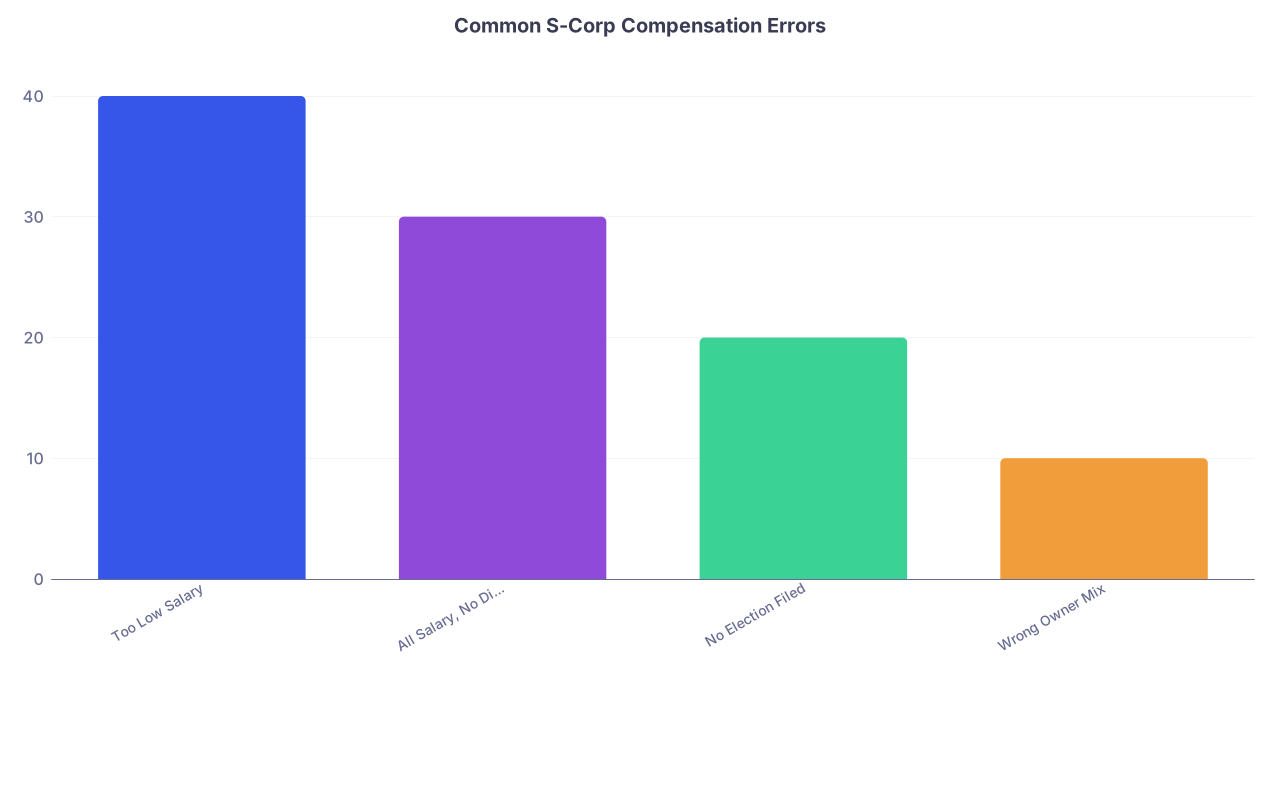
- You intended to be an S-corp, but no one actually filed Form 2553 on time. So you spend the whole first year as a default LLC/sole prop and overpay self-employment taxes.
- You elect S-corp, then pay yourself either:
- Almost nothing in W‑2 wages, or
- Nearly everything as W‑2 wages with no distributions
Both are wrong.
The IRS expects “reasonable compensation” for your role. If you’re taking home $350k and paying yourself a $60k salary with $290k in distributions, you’re waving a red flag. On the flip side, if you’re at $200k and you’re paying all of it as W‑2, you’re not using the structure effectively.
| Category | Value |
|---|---|
| Too Low Salary | 40 |
| All Salary, No Distributions | 30 |
| No Election Filed | 20 |
| Wrong Owner Mix | 10 |
Rough percentages here are directionally right: most S-corp problems are compensation related.
How to avoid this mistake
- Confirm in writing that your CPA has filed the S-corp election and received acknowledgment. Don’t assume.
- Revisit salary annually. Market, collections, and your role change. Your payroll should reflect that.
- Work with a CPA who actually advises on reasonable comp in your specialty, not one who just runs payroll.
If your “S-corp strategy” is based entirely on something you saw in a Facebook group, you’re playing with fire.
4. Mixing Personal and Business Money (Piercing Your Own Veil)
This is how you destroy the liability protection of whatever entity you just paid to set up.
Typical pattern:
- You open the practice, but you’re still using your personal credit card “just for the first few months.”
- You transfer money randomly between personal and business accounts without documentation.
- You pay personal bills directly out of the practice checking account.
Then someday, something goes wrong — malpractice, slip and fall, hostile former employee — and a good attorney has a field day with your records. “This is not a real separate entity. This is just Dr. X’s alter ego. Let’s pierce the veil.”
Even if they don’t win that argument, the legal costs to litigate it are ugly.
How to avoid this mistake
- Open dedicated business checking and savings accounts before you deposit a single patient payment.
- Use a business credit card. If you must use a personal card early, document owner contributions properly.
- Pay yourself in clear, recorded owner draws or payroll. Do not pay your home mortgage directly from the practice account. Ever.
This isn’t about being neat. It’s about protecting the only real shield you have between your practice’s problems and your personal assets.
5. Treating Contractors Like Employees (and Losing the Audits)
“I’ll just 1099 my MA and my front desk. Saves on payroll taxes.”
I’ve heard that sentence more times than I can count. It’s also one of the fastest ways to trigger:
- IRS payroll audits
- State unemployment tax assessments
- Wage and hour claims
If you control when they show up, what they do, how they do it, and they work only (or mostly) for you? They’re very likely employees in the eyes of the law.
The tax hit when you lose that battle includes:
- Back payroll taxes
- Penalties and interest
- Possible benefits liability
Plus, once your practice is on the radar for misclassification, you will not enjoy the increased scrutiny.
How to avoid this mistake
- Assume staff like MAs, reception, billers (working on site) are employees unless an employment attorney or tax pro gives you a very specific reason otherwise.
- If you truly use contractors (e.g., independent specialists, locums-tenens-style coverage), have tight contracts, multiple clients, and clear independence.
- Don’t let a payroll company “decide” classification. They’ll run whatever you tell them.
The false economy of “saving a few FICA dollars” can cost you 10x later.
6. Failing to Set Up Retirement and Benefits Through the Right Entity
Here’s a quieter but nasty one: you delay setting up retirement plans or benefits, then duct-tape them in later through the wrong entity.
Two common flavors:
- You operate as a sole prop or disregarded LLC, contribute to a SEP IRA, then later convert to an S-corp — and don’t adjust your plan or comp thinking.
- You start employees first, then later try to “bolt on” a 401(k) or cash balance plan without reviewing eligibility, testing, and funding capacity.
The mistake is not just tax inefficiency. It’s painting yourself into a corner where:
- You can’t contribute as much as you’d like
- You accidentally disqualify or underfund employees
- You create admin nightmares for your TPA and CPA
For a high-earning practice owner, under-using pre-tax retirement space is often a six-figure cumulative tax mistake over a decade.
How to avoid this mistake
- Before hiring your first employee, talk to a retirement-focused advisor about the likely end game: SEP, Solo 401(k), group 401(k), or cash balance.
- Make sure your entity type supports the structure you want (S-corp wages matter here).
- Build a 3–5 year view of hiring so plan design doesn’t surprise you with mandatory expensive contributions.
If your only “plan” is “I’ll set something up once the practice is profitable,” you’re already behind.
7. Ignoring State and Local Taxes, Licenses, and “Small” Filings
Physicians are used to dealing with boards. They aren’t used to dealing with city tax departments and obscure state agencies.
So they ignore them.
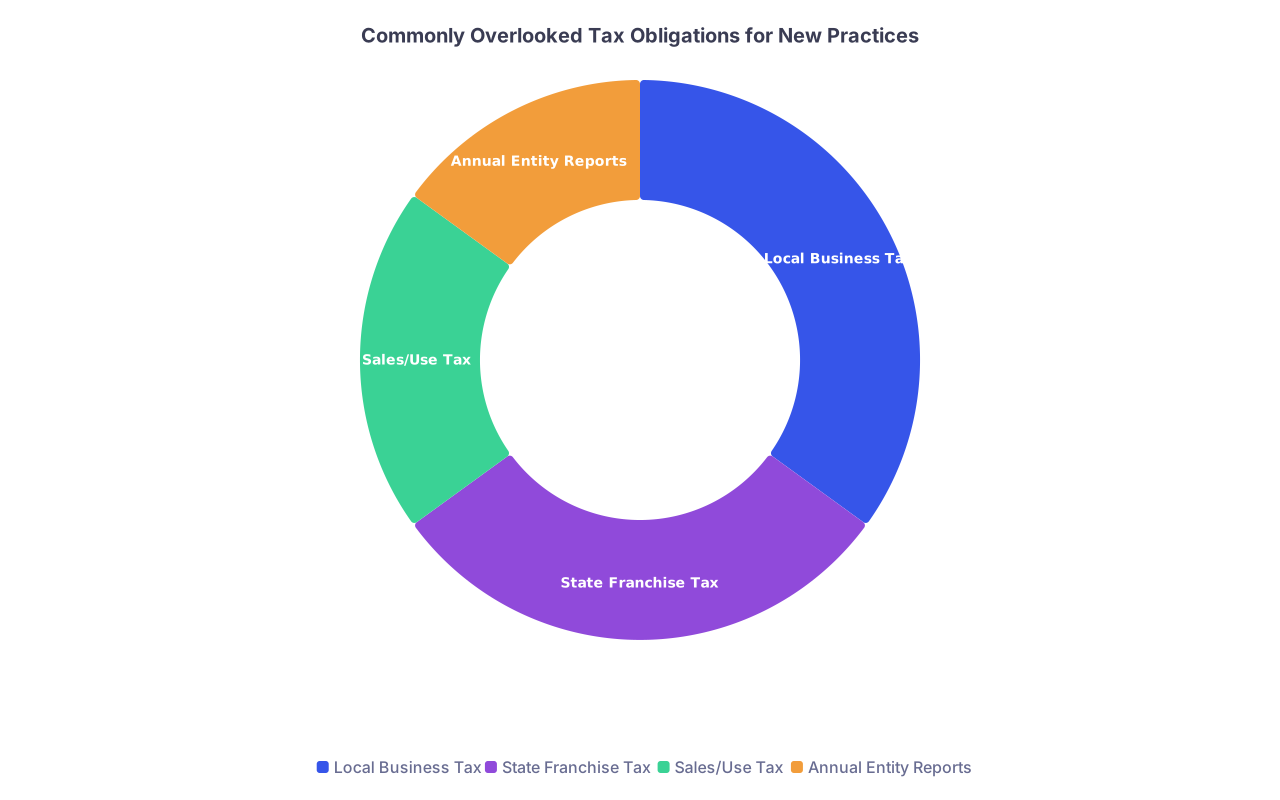
I’ve watched more than one practice get garnished by a city or county for business license taxes they didn’t even know existed. That letter that looked like junk mail from the “Office of Revenue Collections”? That was the warning.
You can run into trouble with:
- State franchise or gross receipts taxes
- Local business privilege / license taxes
- Sales tax on certain non-clinical services or products
- Annual report filings for your entity with the Secretary of State
| Category | Value |
|---|---|
| Local Business Tax | 35 |
| State Franchise Tax | 30 |
| Sales/Use Tax | 20 |
| Annual Entity Reports | 15 |
The late fees and penalties are annoying. The real problem is getting put on a list as a non-compliant business. That tends to snowball.
How to avoid this mistake
- Ask your CPA for a written list: all state and local filings and licenses your entity must maintain, with due dates.
- Put deadlines into an actual calendar. Treat annual reports and license renewals like expiring board certification.
- If you sell products (orthotics, skincare, supplements, etc.), explicitly ask about sales and use tax rules.
Do not assume “medical = exempt from everything.” That’s not how it works.
8. Signing Leases and Contracts in Your Personal Name
This one is almost unforgivable, but it happens constantly.
You go to sign:
- The office lease
- The EHR contract
- Your merchant services agreement
- Equipment leases
And because “the practice isn’t set up yet” or the vendor is lazy, they put your personal name on everything.
You’ve just personally guaranteed obligations that should sit with your entity. And in some cases, you’ve signed multi-year deals that outlive your current business plans.
This also gets weird later when you try to sell the practice or move locations. You end up with contracts that aren’t cleanly assignable or detachable from you as an individual.
How to avoid this mistake
- Do not sign major contracts until your entity is formed and has an EIN. Full stop.
- Sign as: “Your Name, in capacity as Managing Member / President of [Entity Name].”
- If a landlord insists on a personal guarantee, at least limit duration and scope — and have an attorney negotiate that, not you.
If you’ve already signed personally, don’t just shrug. Ask your attorney if any can be assigned or novated to the entity.
9. Not Building an Ownership and Exit Plan From Day One
You think you’re just starting a solo practice. Then:
- A colleague joins you
- A mid-level wants buy-in
- A hospital makes an offer
- You burn out and want out
And that’s when you realize: nothing in your entity or tax structure was set up with any of this in mind.
I’ve seen practices that can’t bring on a partner without massive legal restructuring, unexpected tax bills, and renegotiation of every contract. All because “I thought I’d just stay solo forever.”
Then they didn’t.
How to avoid this mistake
Early on, answer some uncomfortable questions:
- Could I ever want a partner?
- Do I want the option to sell? To who — hospital, PE, another doc?
- Do I want employees ever owning a piece of this?
With those answers, your attorney can:
- Draft an operating agreement or bylaws that anticipate new owners
- Build buy-sell provisions that don’t require World War III to implement
- Structure entities in a way that makes future sale or reorganization cleaner
You do not need a perfect 20-year plan. You do need something better than “I’ll figure it out later.”
10. DIYing Complex Stuff and Overtrusting “Template” Documents
Last one, and it underlies most of the others.
You’re smart. You made it through residency. You think, “How hard can an LLC be? I’ll just use LegalZoom or some template I found online.”
Or you assume your accountant’s generic new-business checklist covers medical-specific issues. It doesn’t.
Typical template misses:
- Nothing about professional corporation restrictions
- No thought to CPOM or Stark/AKS sensitivities
- No tailored owner comp approach for RVU-based or hybrid reimbursements
- Zero coordination between the legal form and your actual billing structure, payer contracts, or group NPI strategy
You end up with a pile of documents that look official but don’t fit your actual practice.
How to avoid this mistake
- Hire specialists: a healthcare attorney and a CPA with actual small-practice owner clients in your specialty. Ask for examples (no names) of similar clients they serve.
- Pay for a proper entity/tax “design” call before anyone files anything. If they don’t offer that, they aren’t thinking big enough.
- Revisit your structure at 6–12 months once you have real revenue and staff. Adjust early, not five years in.
You don’t have to become a tax lawyer. But you do need to stop pretending this is all “just paperwork.”
Quick Visual: Clean Setup vs. Messy Setup

| Step | Description |
|---|---|
| Step 1 | New Attending |
| Step 2 | Design Entity and Tax Plan |
| Step 3 | Form Proper Entity |
| Step 4 | Open Business Accounts |
| Step 5 | Sign Contracts as Entity |
| Step 6 | Set Compensation and Retirement |
| Step 7 | Copy Friend Structure |
| Step 8 | Random Online Formation |
| Step 9 | Mix Personal and Business Funds |
| Step 10 | Misclassify Staff and Ignore Local Taxes |
| Step 11 | Expensive Fixes and Audits |
| Step 12 | Talk to CPA and Attorney Together |
The path you’re on is not random. It’s determined by your choices in the first 90 days.
FAQs
1. I already started my practice as a sole proprietor. Is it too late to fix?
No, but don’t drag your feet. You can usually form an LLC/PLLC or corporation and roll your existing operations into it. The longer you wait, the more contracts, payor enrollments, and payroll you’ll have to unwind or amend. Get a CPA and attorney to coordinate the transition, especially around tax year timing and how assets, accounts receivable, and liabilities move over.
2. How much should I expect to spend on proper entity and tax setup?
If you’re balking at a few thousand dollars to set this up correctly, you’re focusing on the wrong number. A realistic ballpark for a medical practice in the US:
- $1,500–$4,000 for a healthcare attorney to handle entity formation, operating agreement/bylaws, and basic contract review
- $1,000–$3,000 for a CPA to advise on structure, elections, and initial planning
Yes, you can do it cheaper with templates and generic services. You’ll pay it back later — with interest — in taxes, penalties, or restructuring costs.
3. Do I really need an S-corp, or is an LLC enough?
“LLC” describes legal form. “S-corp” describes tax status. You can have an LLC taxed as an S-corp. Whether you should depends on your expected net income and payroll. If you’re going to net less than, say, $120k from the practice in the near term, the S-corp benefits may be marginal after admin costs. Once you’re consistently above that, it usually makes sense to look hard at it. But you decide this with your CPA, not Instagram.
4. How soon before opening should I form my entity?
Aim to have your entity formed and EIN obtained at least 2–3 months before:
- Signing a lease
- Signing major equipment or EHR contracts
- Submitting credentialing or enrollment paperwork
That gives you time to open bank accounts, set up payroll infrastructure, and ensure contracts are in the right name. Hanging your shingle first and fixing structure later is the reversed, expensive way to do it.
5. What’s the single most protective move I can make early?
Force a coordinated planning session. You, your CPA, and your healthcare attorney on the same call for 60–90 minutes, walking through:
- Your specialty, revenue expectations, and payor mix
- Your hiring and growth plans
- Your risk tolerance and exit possibilities
From that, they design your entity type, tax elections, ownership structure, and compensation framework together. That one meeting can prevent 80% of the mistakes we just went through.
Remember three things:
- Entity and tax choices are not “paperwork.” They’re infrastructure.
- Copying colleagues and trusting templates is how smart physicians end up overtaxed and underprotected.
- A few deliberate decisions in your first year can save you six figures and endless headaches later.
Do not outsource your brain on this. Get help, yes. But understand enough to see the red flags before they cost you.