
The fastest way to destroy your first years in practice is to sign a bad vendor contract you do not fully understand.
Let me be blunt: most new physicians obsess over employment contracts and barely glance at vendor agreements. That is a mistake. A costly, practice‑crippling mistake.
The wrong billing, EHR, or marketing contract can lock you into:
- Thousands in monthly fees you cannot afford
- Data held hostage when you try to leave
- Personal liability for nonsense you do not control
- Auto‑renewals that never die
I have watched smart new attendings walk away from decent jobs to “start their own practice” and then bleed cash for years because they signed garbage vendor contracts in their first month. They thought, “It is just software / just billing / just a website.” Vendors love that attitude. It keeps them rich and you stuck.
You are the one with something to lose. So treat these contracts like loaded weapons.
1. The General Red Flags: If You See These, Stop
Before we get into specifics (EHR, billing, marketing, labs), you need a basic radar for bad contracts. These patterns recur across almost every type of vendor.
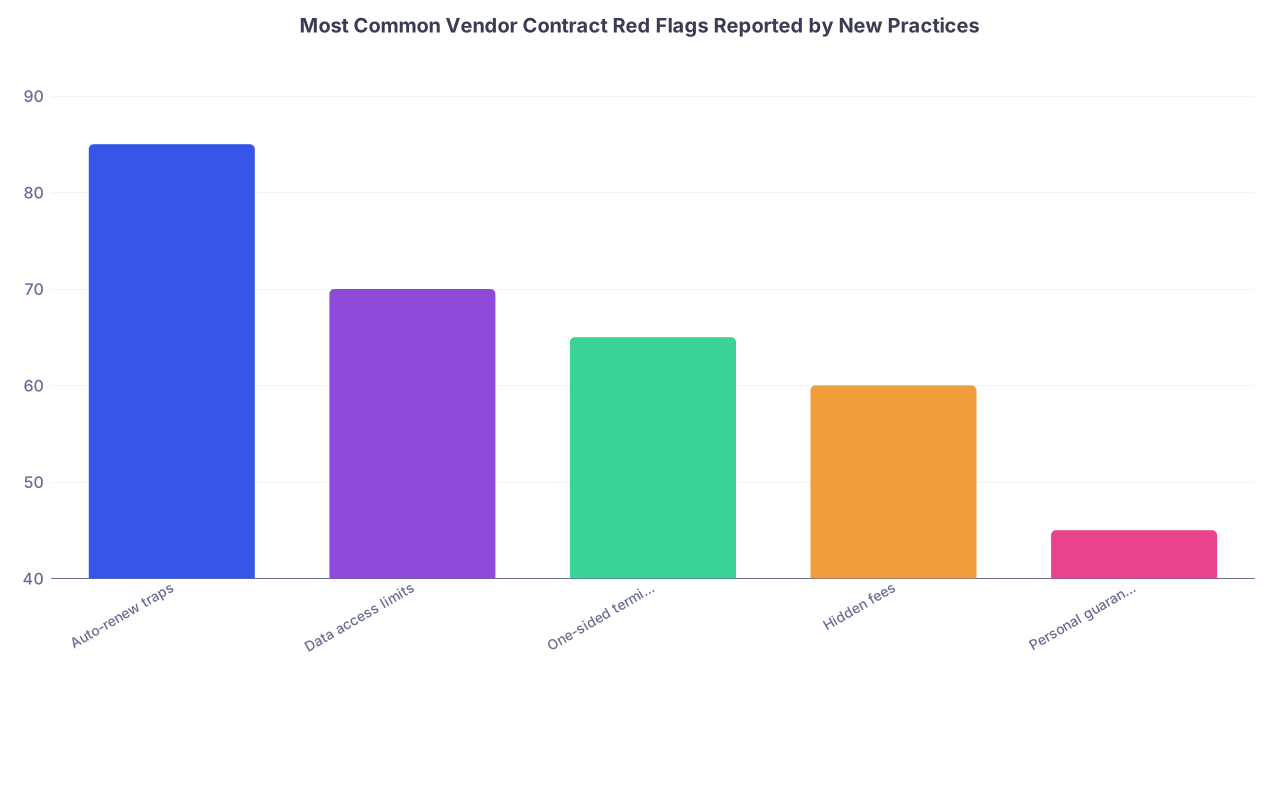
| Category | Value |
|---|---|
| Auto-renew traps | 85 |
| Data access limits | 70 |
| One-sided termination | 65 |
| Hidden fees | 60 |
| Personal guarantees | 45 |
A. Auto‑Renewal Traps
This is one of the biggest landmines for new practices.
Contracts that:
- Auto‑renew for 1–3 years
- Require notice 60–180 days before the term ends
- Require notice by certified mail to some obscure address
Why this is dangerous:
- You forget the date. You get busy with patients. Suddenly you are locked in for another 3 years.
- Vendors intentionally design this. It is not an accident. It is engineered inertia.
What to refuse:
- Any contract that:
- Auto‑renews for more than month‑to‑month after the first term
- Requires more than 30 days’ notice to cancel
What to insist on:
- Initial term: 12–24 months max
- After that: month‑to‑month or, at worst, 90‑day rolling term
- 30 days’ written notice by email acceptable
If they tell you, “Our auto‑renewal is standard and non‑negotiable,” that is your cue to walk.
B. One‑Sided Termination Clauses
Many vendor contracts say:
- They can terminate you “for any reason” with 30 days’ notice
- You may only terminate for “vendor breach” and only after a ridiculous “cure period”
- Some even allow them to suspend service without liability
This is backwards. You are the physician. Your practice depends on these systems. If anyone needs termination flexibility, it is you.
Do not sign if:
- You cannot terminate “for any reason” with reasonable notice (30–90 days)
- Termination requires you to forfeit large “early termination fees” (we will talk about those separately)
C. Vague Fee and Cost Language
Two phrases that should make you instantly cautious:
- “Subject to change at vendor’s discretion”
- “Additional fees may apply”
That “$400 per provider per month” EHR will magically become $400 + clearinghouse fees + e‑prescribing fees + texting fees + “implementation fees” + “maintenance.”
You want:
- An itemized fee schedule attached as an exhibit
- Clear limits on price increases (e.g., CPI index or max 5% per year)
- Written notice required at least 60 days before any fee change
Anything else is an open credit card in their hands.
D. Personal Guarantees
You open a PLLC or PC to limit personal liability. Then you foolishly sign a vendor contract that includes a “personal guaranty” as the owner. You just pierced your own corporate veil.
Refuse:
- Any clause where you personally guarantee your practice’s obligations
- Any requirement that you sign twice (once for the entity, once personally)
If a vendor insists on a personal guarantee for a small clinic? That is not a partner. That is a predator.
2. EHR and Practice Management Contracts: Where People Get Trapped for Years
This is the big one. Switching EHRs is expensive, disruptive, and miserable. Vendors know this. So they write contracts to trap you long after you regret signing.

A. No Clear Data Ownership and Exit Terms
The single worst mistake I see: physicians who cannot get their data out when they leave.
Watch for:
- No explicit statement that you own the patient data
- No defined export format (e.g., CCD, CSV, PDFs)
- Fees for data export that are “to be determined”
- No timeframe for how fast they must provide your data
What to demand in writing:
- “Practice owns all patient and billing data”
- Specific export formats and methods
- Maximum fees for data export (or none)
- Time limit: e.g., vendor must provide complete export within 30 days of request
If the rep says, “Oh, we always work with clients on that,” you answer: “Good. Then let us put it in the contract.”
B. Long Initial Terms With Harsh Penalties
Common trap:
- 3–5 year initial term
- Early termination requires you to pay all remaining monthly fees
For a small practice, this can be tens of thousands of dollars.
Your policy should be:
- Refuse any initial term longer than 24 months
- Refuse “remaining contract value” termination penalties
- At most: allow a fixed early termination fee that is modest and clearly stated
If the contract reads like a cell phone plan from 2008, walk away.
C. “Integrated” Billing or Clearinghouse Lock‑In
Some EHRs bundle billing services or clearinghouse services and make it extremely hard to separate them later.
Red flags:
- You must use their clearinghouse and cannot choose your own
- You cannot access claim files directly
- They will not commit to timely claims file delivery if you leave
You want:
- The right to switch clearinghouses without penalty
- Direct access to your claims and remittance data
- Contractual obligation to cooperate in transition if you change billing vendors
The question to ask: “If I end this agreement, how exactly do I send my next day’s claims through a different system?” If they cannot answer clearly, do not sign.
3. Billing Company Agreements: Where Practices Quietly Bleed Out
Billing contracts can look innocent—“We just take a percentage of collections!”—until you see the fine print on term, termination, and accountability.
| Clause | Safe Range / Language |
|---|---|
| Term length | 6–12 months initial |
| Termination notice | 30–60 days by either party |
| Early termination | No penalty or small flat fee |
| Billing fee | 4–8% of net collections |
| Data access | Full, real‑time reporting |
A. Long Terms With Slow‑Motion Exit
Many billing contracts:
- Lock you in for 2–3 years
- Require 90–180 days’ notice to terminate
- Let them keep working old A/R indefinitely and charge full fees
Problems:
- If they perform poorly, you are stuck
- You may be paying two billers simultaneously during transitions
Better structure:
- Initial term: 6–12 months, then month‑to‑month
- 30–60 days’ notice required to end the agreement
- Clear plan for A/R run‑out (e.g., 90 days after termination at reduced rate)
B. No Performance Obligations
Some agreements say:
- They will “use commercially reasonable efforts”
- But there is no standard for:
- Claim submission time
- Denial management
- Appeals
Red flag clause: “Vendor does not guarantee any level of collections.”
They cannot guarantee collections, fine. But they must guarantee process.
You should require:
- Claims submitted within X days of receipt (e.g., 3 business days)
- Denials worked within X days
- Monthly reporting of key metrics (days in A/R, denial rates, etc.)
If they refuse to put any metrics in writing, they are telling you exactly how they plan to behave.
C. Ownership and Control of Credentials and Payer Portals
Too many new practices let billing companies control:
- Payer portal logins
- CAQH profiles
- Enrollment data
Then they try to switch vendors and discover they do not have half their logins or information.
Rules:
- All payer logins must be in your name or your entity’s name
- Billing vendor has access, not ownership
- Contract must state they will surrender all logins and documents at termination
If a billing company wants to “own” your portal accounts, they are making sure leaving them will hurt.
4. Marketing, Website, and SEO Contracts: Overpriced and Underperforming
Marketing vendors love new practices. You are anxious about volume and unsophisticated about digital strategy. Perfect prey.
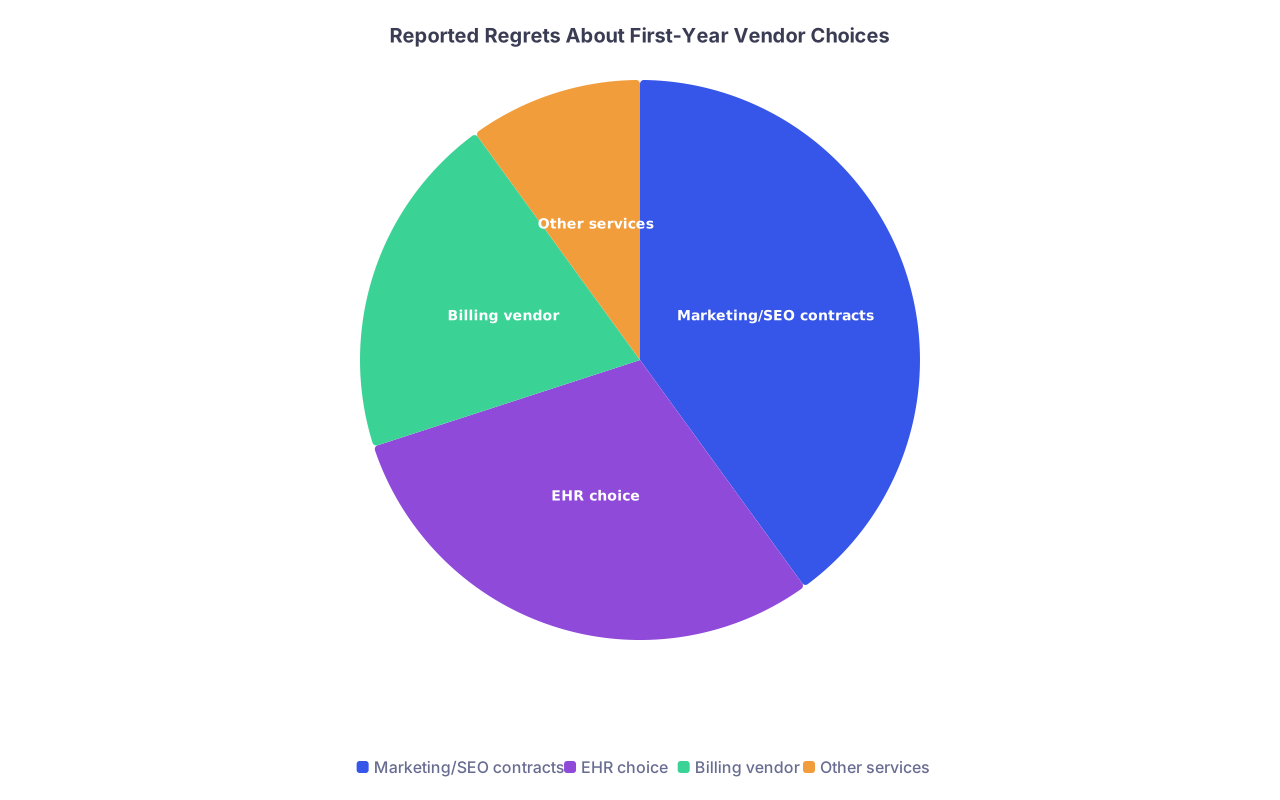
| Category | Value |
|---|---|
| Marketing/SEO contracts | 40 |
| EHR choice | 30 |
| Billing vendor | 20 |
| Other services | 10 |
A. Multi‑Year Marketing Agreements With No Measurable Deliverables
You will see:
- 12–36 month contracts
- Big monthly retainers ($1,500–$5,000+)
- Vague language: “brand development,” “strategic visibility,” “SEO optimization”
When you ask, “What exactly will you do every month?” they answer with buzzwords.
You need:
- Month‑by‑month description of deliverables
- Number of blog posts
- Number of social posts
- Ad spend amounts and on which platforms
- Specific KPIs (call volume, form fills, etc.)
- The right to terminate with 30–60 days’ notice if performance is poor
If they will not tie fees to real work or real numbers, skip them.
B. You Do Not Own Your Website or Content
Classic trap:
- They register your domain under their name
- They build your website on their proprietary platform
- Contract says they own the design and content
Then, when you try to leave:
- You lose your site
- Your SEO history disappears
- You must start from scratch
You must insist:
- Domain is registered in your practice’s name and account
- You own all content, logos, and design
- Site is built on a standard platform (e.g., WordPress) you can move
- On termination, they must provide a full site backup
If the contract says “all work product is vendor property,” that is a hard no.
C. Non‑Compete and Exclusivity Games
Some marketing vendors sneak in:
- Agreements that you will only use them for all marketing services
- Broad non‑competes that prevent you from working with competitors for years
This is ridiculous. You need flexibility to:
- Hire a separate firm for paid ads
- Use a local photographer or videographer
- Bring some projects in‑house
Do not agree to:
- Overly broad exclusivity (“all digital and print marketing”)
- Long non‑competes (over 12 months) or large geographic scopes
You are not marrying them. You are hiring them. Keep it that way.
5. “Free” or Discounted Equipment and Lab Deals: Hidden Kickbacks and Dependency
Here is where you can get yourself in regulatory hot water.

A. “Free” Equipment Tied to Volume Commitments
You will see offers like:
- Free in‑office lab analyzers
- Discounted diagnostic devices
- “No cost” equipment in exchange for sending a minimum number of tests or cases per month
On paper, this looks helpful. In practice, it can:
- Trap you in financially disadvantageous arrangements
- Potentially create Stark Law or anti‑kickback issues if structured badly
Red flags:
- “Minimum volume” requirements
- Rebate structures based on volume or referrals
- Penalties if you do not hit targets
You should have any such arrangement reviewed by a healthcare attorney. Not your cousin who does real estate.
B. Lab or Imaging “Exclusivity” Contracts
A lab offers:
- Better pricing
- Some “marketing support”
- Maybe even staff support
In exchange, you agree to:
- Send all or most of your specimens to them
- Not work with other labs or imaging centers
Two problems:
- Patient choice and clinical judgment may be compromised.
- These deals can cross regulatory lines if not carefully structured.
Do not sign:
- Any contract that dictates your referral patterns in rigid terms
- Anything you have not run past a healthcare compliance expert
“I did not know” does not work as a defense when an auditor shows up.
6. How to Protect Yourself Before You Sign Anything
You do not need to become a contract attorney. But you do need a process.

| Step | Description |
|---|---|
| Step 1 | Receive Vendor Contract |
| Step 2 | Initial Read Through |
| Step 3 | Ask Vendor for Changes |
| Step 4 | Send to Healthcare Attorney |
| Step 5 | Walk Away |
| Step 6 | Attorney Review and Edits |
| Step 7 | Final Decision |
| Step 8 | Sign and Track Key Dates |
| Step 9 | Red Flags? |
| Step 10 | Vendor Will Negotiate? |
A. Set Personal “Non‑Negotiables”
Before reps start selling you, decide:
- Max contract term you will accept (e.g., 12–24 months)
- Max notice period you will accept (30–60 days)
- You will not sign personal guarantees
- You must own your data and content
If a contract violates more than one of your non‑negotiables, it is almost always better to walk.
B. Use a Simple Comparison Framework
Create a quick spreadsheet and compare vendors on:
- Term length
- Termination rights (you vs. them)
- Data ownership and export terms
- Fee transparency and caps
- Auto‑renewal details
Patterns will pop out fast. The “cheap” vendor often looks expensive once you add in termination penalties and hidden charges.
C. Involve a Healthcare Attorney at the Right Time
You do not need a lawyer to read every piece of spam a vendor sends you. But you do need one for:
- EHR contracts
- Billing company agreements
- Any multi‑year agreement
- Anything involving labs, imaging, “free” equipment, or revenue sharing
Common mistake:
Physician only calls an attorney when they want to get out of a bad contract. That is when your leverage is gone. Spend a little up front to save a lot later.
7. Mindset Shift: You Are Not the Customer, You Are the Revenue Stream
Vendors will act friendly. Call you “Doctor.” Tell you “We love working with small practices.” They have scripts designed for you.
Never forget:
- Their incentives are not your incentives.
- Their job is to lock in predictable recurring revenue.
- Your job is to protect clinical independence and financial stability.
When you see:
- High‑pressure tactics (“This pricing expires Friday”)
- Refusal to give you a copy of the contract to review at leisure
- Evasive answers to “Who owns the data?”
…that is not a partner. That is danger.

FAQs
1. Is it ever acceptable to sign a multi‑year vendor contract as a new practice?
Yes, but only under specific, controlled circumstances. For example, a 2‑year EHR contract can be reasonable if:
- You have clear, favorable exit terms
- Data ownership and export are fully defined
- Auto‑renew converts to month‑to‑month or short terms
- Early termination penalties are modest or limited to true setup costs
What you must not do is sign 3–5 year deals with:
- Full remaining‑value termination penalties
- Opaque data exit terms
- One‑sided termination in favor of the vendor
If the vendor insists on 3+ years and refuses to modify anything else, they are betting you do not understand your own risk.
2. Do I really need a healthcare‑specific attorney to review vendor contracts?
If the contract is short, low‑dollar, and easily replaceable (e.g., office cleaning), a general business attorney may be fine or you might even review it yourself. But for:
- EHR and practice management
- Billing and revenue cycle
- Lab, imaging, or equipment deals
- Any arrangement that touches referrals, revenue sharing, or patient data
You need someone who actually practices healthcare law. A corporate lawyer who has never heard of Stark Law or the Anti‑Kickback Statute is not enough. I have seen well‑meaning generalists miss huge regulatory problems in “free equipment” and lab contracts.
3. How can I push back on vendor contracts without ruining the relationship?
You negotiate calmly and professionally, like any other business owner. Do this:
- Mark up the contract with specific edits instead of saying “this feels unfair”
- Explain your non‑negotiables as standard risk management for medical practices
- Ask them to show you other clients who have the terms you are requesting
Vendors who are legitimate and experienced with physicians will recognize the language. The ones who get defensive, dismissive, or condescending when you ask for reasonable protections are exactly the ones you should not be in business with.
4. I already signed a bad vendor contract. Am I stuck until it ends?
Maybe, but not always. You still have options:
- Read the termination clause carefully; there may be a “for cause” path if they are underperforming
- Talk to a healthcare attorney about:
- Breach arguments (e.g., failure to perform, poor uptime, noncompliance)
- Negotiated exits (vendors sometimes accept a reduced lump‑sum to let you out)
- Regulatory concerns that might give you more leverage
The worst move is to ignore it and hope it gets better. The second worst is to rage‑quit without a plan and end up unable to bill or access data. Get competent advice, then choose the least bad exit path.
Open one vendor contract you have already signed or are considering. Find three things right now:
- The auto‑renewal clause
- The termination section
- The data ownership and export language
If you cannot quickly locate and understand those three pieces, that is your red flag to stop, get help, and renegotiate before you put your signature on anything else.