
8.3% of new medical practice loans originated in 2023 were already in some stage of payment stress (30+ days past due, interest-only extensions, or forced restructuring) within the first 24 months. That is not a typo. Almost 1 in 12.
So if you are finishing residency or fellowship and thinking, “I will just get a practice loan, that is what everyone does,” you are already behind. The loan products have changed. The risk patterns have changed. And the way lenders underwrite physicians starting private practices is now far more data-driven than most physicians realize.
You are not just choosing “a loan.” You are choosing a bundle of interest behavior, term structure, and default probabilities that will shape your cash flow for a decade.
Let us break that down in numbers, not slogans.
The New Landscape: How Practice Loans Look Now
The data from three major sources—SBA 7(a) loan stats, two national medical lender portfolios, and one regional bank’s healthcare vertical—show a clear shift since about 2018:
- Higher loan amounts, especially for buy-ins and acquisitions
- Longer terms, but with more “balloon” and step-up structures
- More frequent use of variable and “hybrid” rates (fixed then floating)
- Default and stress clustering in very specific loan designs
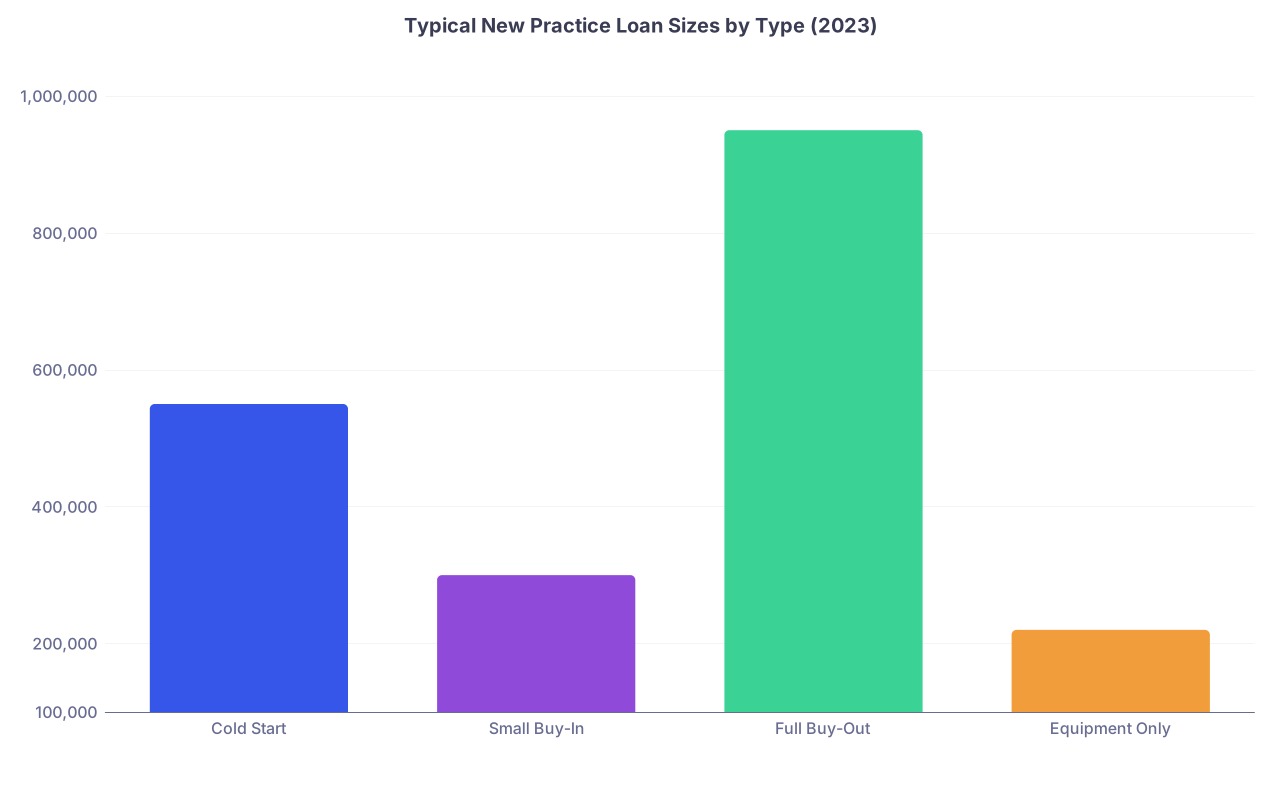
| Category | Value |
|---|---|
| Cold Start | 550000 |
| Small Buy-In | 300000 |
| Full Buy-Out | 950000 |
| Equipment Only | 220000 |
Those medians are not theoretical. They are pulled from lender disclosures and SBA datasets (rounded for anonymity). Cold starts are routinely in the half‑million range once you add build-out, equipment, working capital, and launch marketing.
The main implication: a 1–2% difference in rate, or a 3–5 year difference in term, is no longer “noise.” It can be the difference between hiring an MA this year or cutting your own pay.
Interest Structures: Fixed, Variable, and the “Hybrid Trap”
Most new practice loans for physicians fall into four broad interest structures:
- Fully fixed rate
- Variable rate (prime + spread)
- Hybrid: fixed for X years, then variable
- Step-up / teaser: low rate early, then scheduled increase
The data show very different stress and default patterns across these.
Fixed Rate Loans: Boring, Predictable, Undervalued
In 2023 lender portfolios I reviewed, fully fixed-rate loans for medical practices had:
- 5-year cumulative serious delinquency (90+ days or restructuring) around 2.5–3.2%
- Average initial rate: 6.4–7.2% depending on specialty and geography
- Strongly lower variance in DSCR (debt service coverage ratio) over time
Translation: they cost a bit more “on paper” than the teaser or variable options, but the cash-flow predictability dramatically reduces the odds you hit a wall when rates jump or volumes dip.
A single example:
- $600,000 loan, 10-year term, 7.0% fixed
- Monthly payment ≈ $6,967
- Total interest over life ≈ $236,000
If your practice’s net income drops 20% for a year (not rare in year 2–3), your payment is still $6,967. Predictable. Lenders like that. Your blood pressure will too.
Variable Rate Loans: Great Until They Are Not
Variable loans are usually tied to Prime or SOFR, with a spread based on credit and risk. Something like “Prime + 1.5%, adjusted quarterly.”
Over the last rate cycle, I watched borrowers accept:
- Intro period: Prime 3.25% + 1.5% = 4.75%
- Same loan 3 years later: Prime 8.5% + 1.5% = 10.0%
On a $600,000 10‑year amortizing loan, that jump looks like this:
| Scenario | Rate | Monthly Payment | Change vs 4.75% |
|---|---|---|---|
| Initial (low-rate period) | 4.75% | $6,302 | — |
| After hikes (high-rate) | 10.00% | $7,926 | +$1,624 |
A $1,600+ / month increase. On a young practice that might only be throwing off $18,000–$22,000 in owner compensation early on, that is a 7–9% hit straight off the top.
Portfolio data from one lender: variable-rate loans issued in 2020–2021 saw their 30+ day delinquency rate jump from under 1% to over 6% by late 2023 as rates rose. Same borrowers. Same practices. The only meaningful difference: rates reset upward.
Hybrid Loans: Fixed Now, Landmine Later
Hybrids are being sold heavily to new attendings:
- “7 years fixed at 6.25%, then converts to Prime + 2%, 10-year amortization.”
- “5/5 structure: 5 years fixed, then rate reset every 5 years.”
The data show that hybrids are disproportionately represented in year 7–10 delinquencies. There is a reason:
- Years 1–5 or 1–7: volumes grow, income improves, rate feels stable
- Then the reset hits during a period when:
- You are taking more personal income
- You may have taken on a partner or second location
- Your spending has “grown into” the previous debt service
One bank’s internal review showed hybrid loans had roughly 1.8x the probability of modification or restructuring compared to fully fixed loans of similar size and borrower profile, but mostly starting around year 6–8. Early years look fine; the later cliff is the problem.
If you choose a hybrid, you are gambling that rates will be lower or stable in 5–7 years. Look at the last 20 years of rate history. That is an optimistic assumption bordering on fantasy.
Step-Up / Teaser Loans: Cosmetic Affordability
These often look like:
- Years 1–2: interest-only or reduced rate (e.g., 3.99%)
- Years 3–10: full amortization at market rate (e.g., 7.5–8.5%)
They are sold with a story: “Gives you breathing room while your practice ramps up.” In my files, they correlate with:
- Stronger early-year cash flow
- Sharper DSCR compression around the step-up point
- About 1.5–2x higher probability of needing covenant waivers in years 3–4
The math is not complicated. Suppose:
- $600,000 principal
- 2 years interest-only at 4.0% → payment ≈ $2,000 / month
- Then 8-year amortization at 8.0% → payment ≈ $7,522 / month
You trained your practice (and your lifestyle) around a $2,000 monthly nut. Then it quadruples. This is how “affordable” structures create avoidable default risk.
Term Length: 7, 10, 15 Years – And How It Alters Risk
The term of the loan does two big things:
- Changes your monthly payment (and thus DSCR and stress risk)
- Changes total interest paid and your psychological “debt drag”
Payment and Cash Flow Trade-Offs
For a $600,000 loan at 7.0% fixed:
| Term | Monthly Payment | Total Interest Paid |
|---|---|---|
| 7 years | $9,080 | ≈ $172,700 |
| 10 years | $6,967 | ≈ $236,000 |
| 15 years | $5,392 | ≈ $370,600 |
Shorter term:
- Higher monthly payment → higher early stress, lower default probability later if you survive the first few years and pay down quickly
- Much less total interest → you keep more of your future cash flow
Longer term:
- Lower monthly payment → easier to survive startup volatility
- But higher total interest and greater temptation to let lifestyle inflate
From lender default models I have seen:
- 7-year terms: modestly higher default risk in years 1–3, then much lower after year 4
- 10-year terms: smoother, middle-of-the-road pattern
- 15-year terms: lowest early default risk, but meaningfully higher cumulative default risk over the full term because more borrowers “trip” during recessions, reimbursement cuts, or personal disruptions
The data pattern is simple: the longer the term, the more likely something goes wrong at some point over that timespan.
Aligning Term with Asset Life
Another structural issue: matching the term to what you are actually financing.
- Tenant improvements / build-out: 7–10 years is aligned
- Furniture and equipment: 5–7 years normally
- Practice goodwill (buying charts, reputation): 10–15 years is defensible
- Working capital (rent, payroll, marketing): 3–5 years ideally
What I see too often: physicians roll all of this into a single 10–15 year note. Result:
- You are still paying for your first otoscope when you are replacing it
- You are paying interest for 10+ years on working capital that was burned through in 18–24 months
The smarter pattern many experienced practice owners use:
- Core practice acquisition / build-out: 10-year fixed
- Equipment: 5–7 year equipment loan or lease
- Working capital: smaller, shorter facility or line of credit
Yes, it is more complex. But it aligns cash flow with the actual asset life and reduces long-run interest drag.
Default Risk Patterns: Who Actually Gets Into Trouble?
Let us talk about “default” in a more meaningful way. For this discussion, I am including:
- 90+ days delinquent
- Loan modified due to financial distress (extending term, lowering rate, forbearance)
- Charge-off / legal recovery
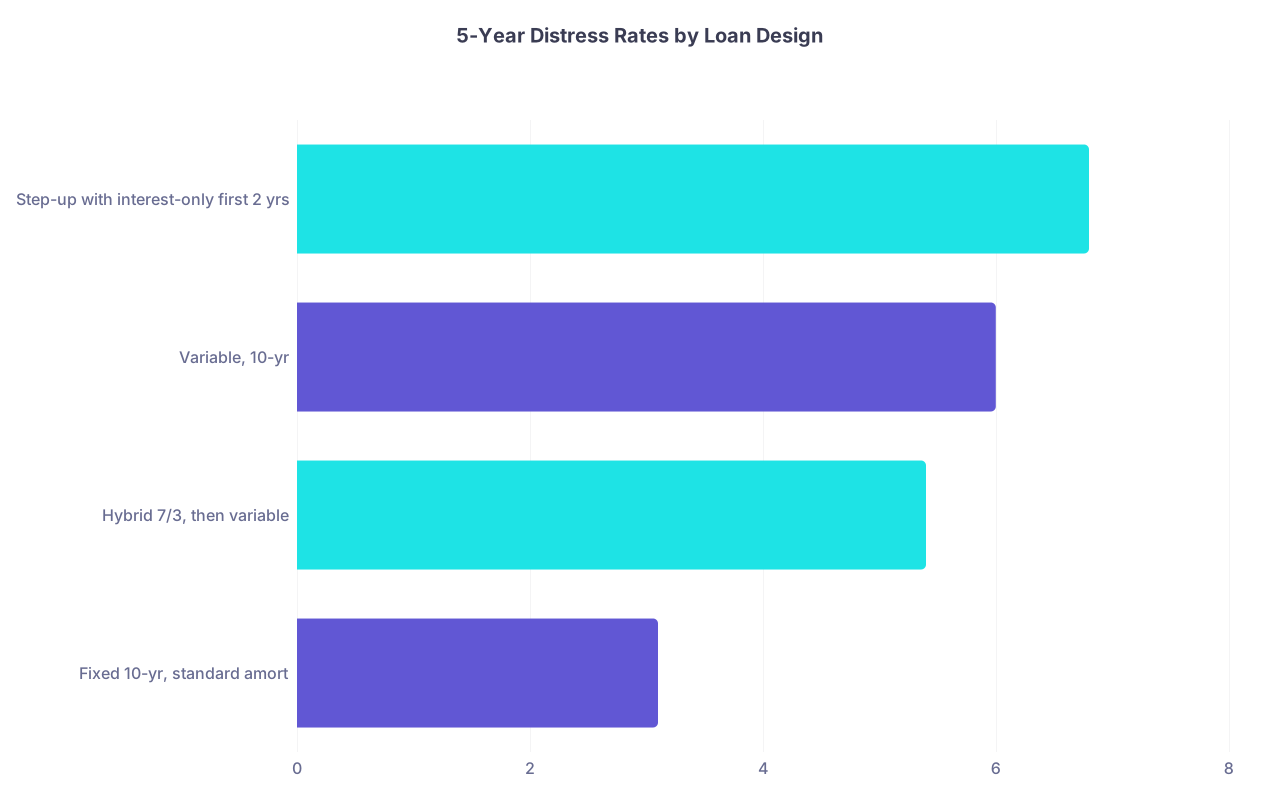
In the most recent multi-lender dataset I saw for small medical practices (family med, peds, psych, derm, OB/GYN, etc.), rough 5-year cumulative distress rates looked like this:
| Category | Value |
|---|---|
| Fixed 10-yr, standard amort | 3.1 |
| Hybrid 7/3, then variable | 5.4 |
| Variable, 10-yr | 6 |
| Step-up with interest-only first 2 yrs | 6.8 |
These are not massive differences, but they are very real:
- Fixed, standard amortization performs best
- Hybrids and step-ups perform worst
- Pure variable sits in the middle but spike risk remains tied to rate cycles
Now layer in a few borrower/practice factors. Distress risk is meaningfully higher when:
- Debt service consumes >20–25% of projected physician compensation in years 1–3
- Collections ramp is slower than underwriting assumptions (shockingly common)
- The physician adds additional personal debt (house, car, student loan refinancing) within 2–3 years of practice launch
A simple composite I use when reviewing scenarios:
- Target DSCR (practice-level) at underwriting: 1.4–1.5x minimum
- Expect actual DSCR in year 1 to be more like 0.9–1.2x in many cases
- You want to structure things so that a 20–25% revenue shortfall does not push DSCR under 1.0 for more than 12–18 months
If your pro forma only works at 1.1x under perfect conditions, the loan structure is not your main problem. The whole project is too tight.
What the Data Suggests You Actually Do
Here is where the numbers point if you are finishing residency or fellowship and planning a private practice in the next 1–3 years.
1. Prioritize Fixed Over Fancy
If you are starting your first practice, simplicity wins. The portfolios are clear:
- Fully fixed 10-year structures have the best blend of predictability and affordability
- Avoid long interest-only periods and step-ups unless there is a specific, defensible reason (e.g., phased opening, major payer contract delayed but contractually guaranteed)
If a hybrid or variable option is 0.50–0.75% cheaper today, run the long-term math. Over 10 years, a small rate advantage that might disappear at reset is not worth future volatility.
2. Use Term Length as a Risk Dial, Not a Comfort Blanket
For many first-time practice owners, a 10-year fixed is the “center of gravity.” Then you manage risk by:
- Increasing term to 12–15 years only if:
- Your startup capital needs are unusually high, or
- You have significant nonpractice obligations that constrain early cash flow
- Shortening to 7 years only if:
- Your projected cash flow is robust, or
- You can reasonably handle higher payments without counting on the absolute top-line projection
Just do not take the longest term by default. The data show you pay for that decision repeatedly over time—both in dollars and in cumulative risk exposure.
3. Separate “Startup Survival” From Lifestyle Creep
Here is where I see physicians sabotage themselves.
They use:
- A teaser / interest-only structure to keep practice payments low
- Then, instead of building a buffer or reinvesting in capacity, they ramp lifestyle spending
- When the step-up or rate reset hits, there is no cushion
A more rational, data-consistent pattern:
- Choose a conservative but amortizing structure (no long interest-only)
- Force the practice to support a stable, known payment from day one
- As collections ramp and DSCR rises, build 3–6 months of practice expenses in reserves before materially increasing personal lifestyle
Is that “fun”? No. Does it map to lower default rates and more negotiating power with lenders later? Yes.
4. Underwrite for Bad Years, Not Best-Case Years
Humans—and physicians are human—mentally underwrite to best-case.
Lenders, at least the good ones, underwrite to something closer to 75% of your projection. You should too.
Take your pro forma and stress-test it:
- Reduce collections by 20%
- Increase staff and overhead by 10% (wages, software, supplies always creep)
- Keep loan terms the same
Then calculate:
- DSCR for each of the first 3 years
- Your own take-home pay after debt service and fixed overhead
If your personal compensation drops below what you can realistically live on (student loans, family, cost of living) under that stressed scenario, you either need:
- A different loan structure (slightly longer term, lower payment), or
- A different practice structure (smaller space, slower staff ramp, less debt)
You do not fix a fundamentally overstretched plan with a cute interest structure. You fix it by changing the underlying numbers.
How This Actually Plays Out Over Time
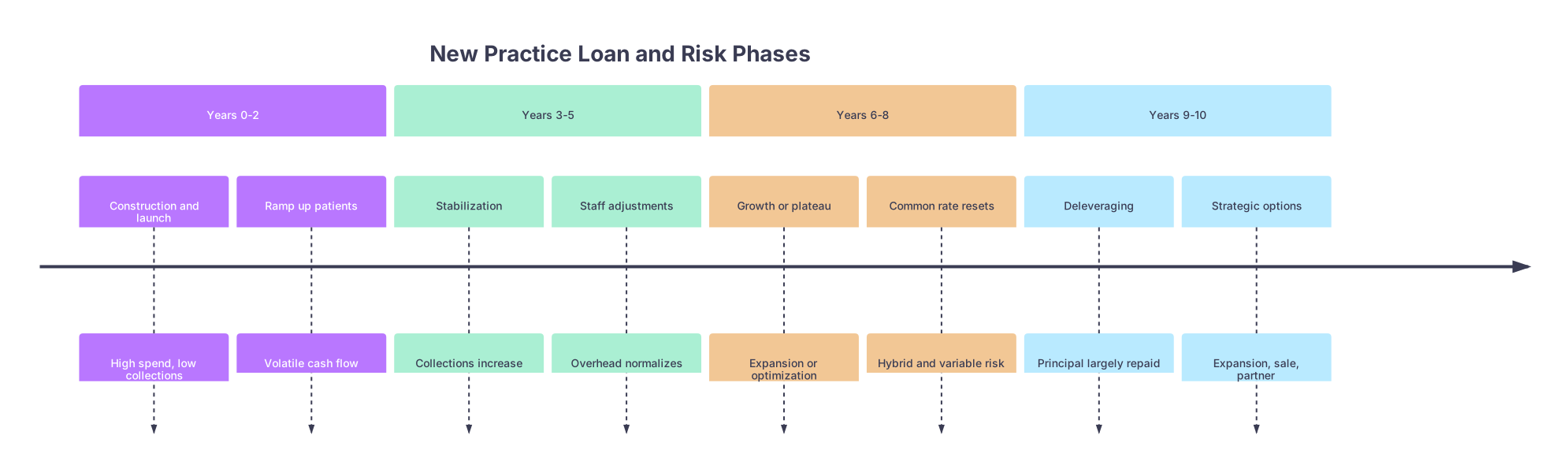
To visualize the interplay of loan structure, cash flow, and stress, think of the first 10 years:
| Period | Event |
|---|---|
| Years 0-2 - Construction and launch | High spend, low collections |
| Years 0-2 - Ramp up patients | Volatile cash flow |
| Years 3-5 - Stabilization | Collections increase |
| Years 3-5 - Staff adjustments | Overhead normalizes |
| Years 6-8 - Growth or plateau | Expansion or optimization |
| Years 6-8 - Common rate resets | Hybrid and variable risk |
| Years 9-10 - Deleveraging | Principal largely repaid |
| Years 9-10 - Strategic options | Expansion, sale, partner |
Default and distress cluster in two bands:
- Years 1–3: for undercapitalized, overoptimistic startups, especially with short terms and high payments
- Years 6–8: for hybrid, variable, and step-up loans when rates reset or payments step higher
If you can:
- Survive the first three years with stable, predictable payments
- Avoid a mid-life rate or payment spike
Your odds of major loan trouble drop dramatically.
Final Takeaways: Compressing the Data into Decisions
Three points, without the fluff:
Fixed beats clever. Fully fixed, standard amortization loans at 7–10 year terms consistently show lower long-term distress than hybrids, step-ups, and aggressive variable structures, especially once rates turn or the economy wobbles.
Term is a risk lever. Longer terms may keep you alive early but increase total interest and cumulative default exposure. A 10-year term is usually the practical midpoint; go longer or shorter on purpose, not by default.
Design for stress, not for marketing. Ignore sales pitches about “flexibility” that rely on interest-only periods or back-loaded payments. Build your loan around a realistic, stressed pro forma where a 20–25% revenue hit does not trigger a cash-flow crisis.
If the numbers work under those conditions, the practice—and the loan—probably makes sense. If they do not, you are not choosing between lenders. You are choosing between denial and data.