The most lucrative private clinics are not in “good neighborhoods.” They are in mathematically advantaged zip codes. If you are choosing a clinic location by vibes, realtor anecdotes, or where your friends live, you are leaving six to seven figures on the table over a decade.
The data is blunt: zip code selection is one of the top two financial levers you control when starting a private practice (the other is your payer mix strategy). Everything else—decor, logo, even your website—is secondary.
Let us walk through this the way a quant would: define the variables, build a rough model of clinic demand and revenue by zip code, then show how to rank locations using public data before you sign a lease.
1. The Core Question: What Makes a “High‑Yield” Zip Code?
Strip away marketing fluff. A high‑yield zip code for a fast‑growing clinic has three defining statistical properties:
- Enough people
- Enough “right” people (for your specialty and payer mix)
- Not enough competition
Everything else—traffic patterns, visibility, retail neighbors—is marginal compared with those three.
From a data perspective, you are really estimating three functions at the zip-code level:
- Potential patient demand per year
- Realistically capturable share of that demand
- Expected revenue per encounter
You do not need perfect precision. You need to be “directionally correct” and avoid obvious losers. Here is the mental model I use when I help physicians pick sites:
Estimated annual revenue potential for a new clinic in ZIP Z ≈
Population(Z) × Visit rate(Z, specialty) × Capture rate(Z) × Revenue per visit(Z)
You will never plug exact numbers into that formula. But you can approximate each term well enough to compare zips against each other.
2. The Data Stack: What You Actually Need (and Where to Get It)
You can build a surprisingly strong location model using six data categories, almost all from free or low‑cost sources:
- Population and age structure
- Income and insurance coverage
- Competing providers per capita
- Growth trends (population and housing)
- Commuting and daytime population
- Health risk / utilization proxies
Let us be specific.
| Data Type | Primary Source |
|---|---|
| Population, age, income | U.S. Census / ACS |
| Insurance coverage | ACS / state health data |
| Payer mix proxies | Medicaid, Medicare stats |
| Provider counts | NPI registry, Google Maps |
| Utilization proxies | CDC, state health reports |
| Housing & growth | Zillow, Redfin, local gov |
If you are serious, you pull this into a spreadsheet or small database and score each candidate zip from 0–100.
Let me translate that into what actually matters for different specialties.
3. Demand Side: Who Lives There and How Often They See You
3.1 Population and Age: Basic Volume Screen
The data shows a very simple truth: small zip codes with beautiful demographics still often underperform because there just are not enough bodies.
Two baseline filters I use:
- Floor: 20,000 residents per ZIP (preferably 30,000+) for primary care, pediatrics, OB/GYN, urgent care
- Floor: 10,000–15,000 residents may be reasonable for high-intensity specialties (GI, ortho, pain) if neighboring zips feed in
Age structure by specialty:
- Pediatrics: % under 18 is your primary driver. You want zips in the top quartile regionally for child density.
- OB/GYN: Women 18–44 and 45–64 as separate cohorts. Fertility, pregnancy, and GYN follow‑up are different revenue streams.
- Primary care / IM / FM: Heavy weight on 45+ population. Chronic disease management = repeat visits and higher revenue per year.
- Ortho / pain / spine: Aging populations plus higher‑income working‑age adults (sports, overuse, degenerative disease).
- Psych: Broad, but higher density of working‑age adults with employer insurance is a strong plus.
You can pull this directly from the American Community Survey (ACS) by zip. The mistake I see often: a physician loves a zip because “there are so many young families,” but the data shows 16% under 18 whereas a neighboring zip quietly sits at 27%. That is the difference between needing aggressive marketing versus filling your panels from word of mouth.
3.2 Income and Insurance: Revenue Density, Not Just Volume
Raw population tells you how many potential visits exist. Insurance and income tell you what those visits will pay.
At zip‑code level, you want to know:
- Median household income
- Percent below 200% of federal poverty level
- Percent with private insurance
- Percent with Medicaid
- Percent 65+ with Medicare (which you already approximated from age structure)
For many outpatient specialties, ideal zips are not the absolute richest. They are upper‑middle: solid employer‑based insurance, not ultra‑wealthy who flee to concierge or tertiary centers for everything.
For example, if you compare three hypothetical zips:
| Metric | ZIP A | ZIP B | ZIP C |
|---|---|---|---|
| Population | 25k | 40k | 32k |
| Median Income | $55k | $130k | $85k |
| Private Insurance | 45% | 88% | 72% |
| Medicaid | 35% | 5% | 18% |
| Medicare (65+) | 14% | 9% | 16% |
| Competing PCPs | 6 | 18 | 8 |
ZIP B looks rich, but also saturated. ZIP A looks underserved but heavily Medicaid. ZIP C is often the sweet spot: adequate population, strong private mix, moderate Medicare, and tolerable competition.
Payer strategy matters:
If you want high growth plus reasonable reimbursement, prioritize zips with:
- Private + Medicare combined ≥ 65–70%
- Medicaid in the 10–30% range (manageable, good for volume, especially for peds/OB)
If you are deliberately building a high-access, high-volume Medicaid or FQHC‑adjacent model, your filters will differ, but you still need scale and low competition.
Here is the pattern I see in fast‑growing clinics within 3–5 years of launch:
- Median income roughly 1.1–1.8× metro median
- Private insurance share ≥ metro median by at least 5–10 percentage points
- Medicaid not more than ~2× metro average unless you have a deliberate safety-net model
- At least moderate density of 45+ population (for medicine) or under‑18 (for pediatrics)
4. Supply Side: Competition and Capacity Gaps
You can have perfect demand and still fail if you plant your flag in a zip code that already has enough doctors for the next decade.
4.1 Provider Density: Per 10,000 Residents, Not Just Headcounts
Crude but effective: count competing providers by specialty in the zip and surrounding 2–3 mile radius, then standardize per 10,000 residents.
For primary care, a rough benchmark:
- Underserved: < 4–5 PCPs per 10,000 residents
- Adequate: 5–8 PCPs per 10,000
- Saturated: > 8–10 PCPs per 10,000
You can adapt that logic for other specialties, but do not obsess over exact thresholds. The pattern matters more than the absolute number.
Use:
- NPI registry (download and filter by specialty and zip)
- Google Maps / Healthgrades / Zocdoc queries (“primary care near 12345”)
- State licensing board directories
Then classify each competitor by:
- Solo / small group versus multi‑specialty system
- Open to new patients or “not accepting new patients” (yes, you can often tell from their sites or phone trees)
- Presence of extended hours / urgent slots
The data pattern that correlates with explosive growth for new clinics:
Moderate absolute competition count, but most incumbents are either system‑owned with long wait times or “not accepting new patients,” and there is no modern, access‑focused independent clinic.
I have seen zips with 10+ “primary care” listings where 60–70% are actually concierge practices or subspecialized IM not taking general patients. To the raw data, that is saturated. To you, it is open territory.
4.2 Waiting Time as a Proxy for Latent Demand
If you want one killer metric that most physicians never quantify, it is this: average “soonest new-patient appointment” wait across your top five competitors in a zip.
Call as a mystery patient and log:
- Next available new‑patient slot (days out)
- Whether telehealth is offered for new patients
- Office hours (evening/weekend coverage)
Then treat that as quantitative data:
- <7 days: market is likely well‑served
- 7–21 days: moderate tension, you can win with access and marketing
- 21+ days: strong latent demand; this is where fast‑growing clinics often live
Make a simple scatter in your spreadsheet:
X‑axis = providers per 10k; Y‑axis = average wait days.
You are looking for zips in the top‑right quadrant of wait days but only mid‑range on provider density. That is unsatisfied demand, not just “no one wants care here.”
5. Growth Signals: Where Demand Will Be in 5–10 Years
Too many physicians choose clinic locations for today’s demographics instead of the 10‑year arc. That is a mistake, especially if you are early in your career.
Three quantitative growth markers I track:
- Population growth rate over last 5–10 years by zip
- Housing permits / new construction concentration
- Commercial development: retail centers, employers, medical complexes
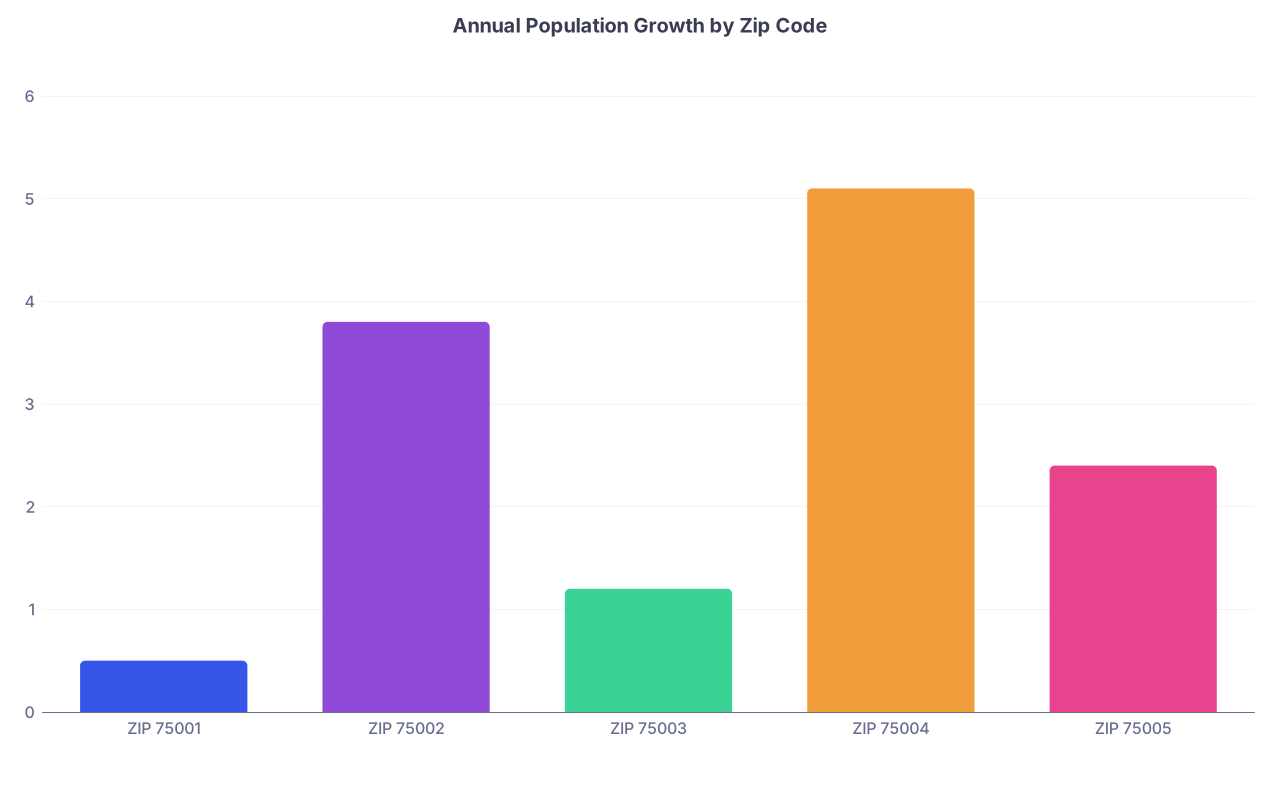
| Category | Value |
|---|---|
| ZIP 75001 | 0.5 |
| ZIP 75002 | 3.8 |
| ZIP 75003 | 1.2 |
| ZIP 75004 | 5.1 |
| ZIP 75005 | 2.4 |
If you are comparing five candidate zips and one is growing at 4–5% per year while others sit around 0–1%, the answer is obvious. Compounding works in real estate, not just finance.
From a business perspective, high‑growth zips give you three advantages:
- New residents are not yet locked into existing physicians
- Employer growth brings better-paying commercial plans
- Early entry establishes your clinic as “the default” before others notice
The ideal pattern:
- Above‑average population growth, but not yet swarmed by corporate urgent care chains
- Rapid housing growth within 10–15 minutes’ drive, even if the zip itself is partially undeveloped
- Evidence of growing daytime population (office parks, schools, logistics hubs, etc.)
Look at school enrollment trends. Businesses opening. New freeway exits. These are all crude but useful demand multipliers.
6. Specialty‑Specific Zip Code Profiles
Now let us get more concrete. “Good zip code” means different things for different practice types. Here is what the data tends to favor.
6.1 Primary Care / Internal Medicine / Family Medicine
High‑growth primary care clinics tend to share:
- Population ≥ 25–30k in primary zip, with 75–100k in 10–15 minute drive time
- 45+ population at or above regional average, 65+ not negligible (≥ 12–15%)
- Private insurance share ≥ 60–65%, Medicare 15–25%, Medicaid 10–25%
- PCP density in the 4–7 per 10k range, but average new‑patient wait ≥ 14 days
- Population growth ≥ 2% annually over last 5 years
You want zips where older adults are piling in (55+ master‑planned communities, for example) and hospital‑owned groups are booked out.
6.2 Pediatrics
For pediatrics, the data profile shifts:
- Under‑18 percentage clearly above regional average (say 25–30%+ in many suburbs)
- High household formation: lots of new single‑family homes, not just apartments
- Strong employer‑based insurance or CHIP/Medicaid coverage, depending on your model
- Pediatrician density low relative to child population (e.g., < 3–4 peds per 10k children)
- High birth volume in nearby hospitals, but limited outpatient pediatric presence locally
I have seen pediatric practices explode in master‑planned communities where young families are moving in faster than pediatric capacity can be built. Zip analysis plus simple counts of daycare centers, elementary schools, and OB practices is extremely predictive.
6.3 Urgent Care / Walk‑In
Urgent care is extremely sensitive to:
- Total population within 10–15 minutes, not just within the zip
- Traffic patterns and visibility—your location must intersect commuter flows
- Retail co‑location (grocery, big box, pharmacy)
Statistically, winning urgent care zips tend to show:
- Population of 50k+ within a short driving radius
- Strong share of commercially insured working‑age adults (employer plans)
- ER usage volumes that suggest people are going to the hospital for non‑emergent issues
- Either: relatively few urgent care centers per 25–50k residents, or clear service gaps (no evening/weekend hours nearby)
Do not just count urgent care logos on a map. Look at reviews, hours, wait times, and whether large systems dominate. System‑dominated markets with mediocre patient experience are ripe for modern, access‑centric entrants.
6.4 High‑Intensity Specialties (GI, Ortho, Cardiology, Pain)
For procedure‑heavy specialties, the zip code calculus centers on:
- High density of 50+ population, particularly with chronic disease risk factors
- Above‑average income (ability to handle deductibles and cost‑sharing)
- Employer clusters that drive commercial volume
- Hospitals and ASCs within a reasonable radius for procedural work
Data pattern to look for:
- Plenty of generalists (PCP, IM) with high panel loads
- Long wait times for subspecialty referrals
- Fewer independent subspecialists than you would expect for the population size
- High incidence proxies: obesity, diabetes, smoking (from county or tract‑level data)
You might site the clinic in a high‑income zip that pulls referrals from a wider, more mixed socioeconomic catchment.
7. Turning Data into a Zip Code Scoring Model
If you do not trust gut feeling, build a simple composite score per candidate zip. It does not have to be perfect. It just needs to be transparent and consistent.
Example framework (weights are illustrative):
Demand (40%)
- Population size (10%)
- Age match for specialty (15%)
- Population growth trend (15%)
Revenue potential (30%)
- Private insurance share (15%)
- Medicare share (5–10% depending on specialty)
- Median income (5–10%)
Competition / access (30%)
- Providers per 10k (10%)
- Average new‑patient wait (15%)
- Presence of corporate/system competitors (5%)
Standardize each metric 0–10 (for example, based on percentile ranks among candidate zips), multiply by weights, sum to a 0–100 score.
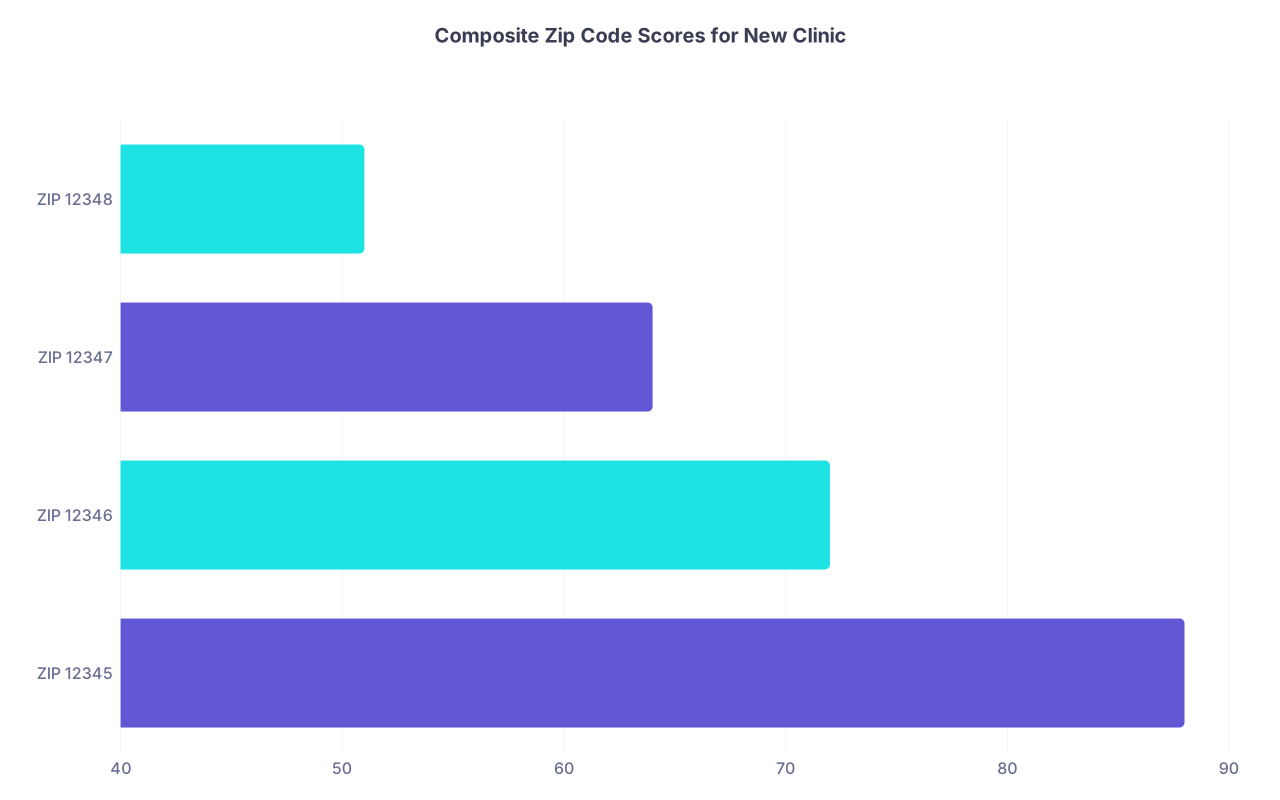
| Category | Value |
|---|---|
| ZIP 12345 | 88 |
| ZIP 12346 | 72 |
| ZIP 12347 | 64 |
| ZIP 12348 | 51 |
You do not blindly follow the highest score. You use it to:
- Kill obvious bad ideas your gut is weirdly attached to
- Concentrate site visits, broker negotiations, and deeper research on the top 2–3 zips
- Have a rational discussion with partners, banks, or investors
And yes, you should actually visit these zips. Data tells you if the market is there. Walking the area tells you if it feels aligned with your brand, safety expectations, and personal life.
8. Common Mistakes Physicians Make with Zip Codes
I have watched this play out too many times:
- Choosing a location near the physician’s own home rather than where the patient data points
- Equating “rich zip code” with “ideal clinic zip code” and finding out all the high‑value patients already go to a flagship academic center 25 minutes away
- Ignoring payer mix and being shocked by how many Medicaid / uninsured patients show up
- Overestimating how far patients will drive for routine care (hint: 10–15 minutes is the comfort zone for most primary and peds)
- Underestimating latent demand in “average” looking areas with high wait times and poor system performance
The data consistently punishes these errors. Slow growth, burnt‑out founders, and eventually, relocation or sale.
9. How to Operationalize This in 4–6 Weeks
You are post‑residency, maybe holding a hospital job offer, and considering going solo. Time is not unlimited. Here is a lean but effective process:

| Step | Description |
|---|---|
| Step 1 | Define Specialty and Payer Strategy |
| Step 2 | Pull Census and ACS Data |
| Step 3 | Filter to Candidate Zips by Demand |
| Step 4 | Add Insurance and Income Metrics |
| Step 5 | Map Competitors and Provider Density |
| Step 6 | Call for Wait Times and Access |
| Step 7 | Score and Rank Zips |
| Step 8 | Visit Top 2 to 3 Areas |
| Step 9 | Choose Zip and Start Site Search |
Week 1–2: Data pull and initial filtering.
Week 3: Competition mapping and phone calls.
Week 4: Composite scoring, site visits, and decision.
This is not theoretical. I have seen clinics go from “no idea where to put this” to “we are signing a LOI in a clearly advantaged zip” in a month using precisely this workflow.
10. The Bottom Line: What the Data Really Says
If you strip away anecdotes and glossy brochures, the numbers argue for three blunt conclusions:
The best zip codes for fast‑growing private clinics combine solid population scale, favorable age structure, and a payer mix skewed toward private insurance and Medicare, with clearly measurable access gaps like long wait times and moderate (not zero, not overwhelming) competition.
Growth beats glamour. Zip codes with 2–5% annual population growth, active housing development, and rising daytime populations will typically outperform static but “prestigious” neighborhoods over a 10‑year horizon, both in patient volume and eventual practice valuation.
A simple, transparent scoring model built from public data—population, insurance, income, provider density, and wait times—beats gut decisions every time. If your chosen zip does not look good on paper, you are not “seeing something others do not”; you are gambling your career on anecdote.
Choose your zip code like an investor, not a tenant. The clinic you build will reflect that decision, in your schedule, your bank account, and your stress level for years.