
Most new private practices are flying blind on productivity – and it shows in their numbers.
The data is brutal. In first year solo and small-group practices, I routinely see RVU output at 40–60% of established peers, visit volumes stuck at 8–12 visits per day, and cash flow models that assumed 18–22 visits by month 3. That gap between fantasy and math is where practices fail.
If you want a durable practice, you need to treat RVUs and visit volumes like vital signs. Measurable, trendable, and non-negotiable.
This is the quantitative blueprint.
1. The Core Metrics: RVUs, Visits, and Capacity
Strip away the fluff. A year‑one practice lives or dies on three linked numbers:
- Work RVUs (wRVUs) produced
- Visits per day / per week
- Capacity utilization (how full your schedule actually is)
If you do not track these from week one, you are guessing. And guessing is how you end up overstaffed, underpaid, and shocked at your accountant’s face in month six.
What counts as “normal” productivity?
Let’s anchor this with realistic year‑one targets for a full‑time physician (4–4.5 clinical days per week).
For primary care and common specialties, the data from MGMA, AMGA, and a mix of payer EOBs tells roughly this story:
- Established full‑time outpatient primary care tends to average:
- 4,500–6,000 wRVUs per year
- 18–24 visits per day
- Year‑one private practice primary care usually hits:
- 2,500–4,000 wRVUs (55–70% of mature level)
- 10–16 visits per day by end of year
For procedural/surgical specialties, the spread is larger, but the pattern is the same: year‑one is usually 50–70% of mature volume.
| Specialty | Mature Full-Time (wRVUs/yr) | Year-One Reasonable Target (wRVUs/yr) |
|---|---|---|
| Family Med / IM (OP) | 4,500–6,000 | 2,800–4,000 |
| Pediatrics (OP) | 4,000–5,500 | 2,500–3,800 |
| Endocrinology | 4,000–5,000 | 2,200–3,500 |
| General Neurology (OP) | 3,800–4,800 | 2,000–3,200 |
| Orthopedic Surgery | 9,000–12,000 | 5,000–8,000 |
These are not ceilings. They are survival targets. Below these numbers, your margin for error shrinks fast unless you have very high reimbursement or low overhead.
2. Translating RVUs to Daily Visit Targets
You do not produce RVUs in theory. You produce them via CPT codes linked to actual visits and procedures. Year‑one planning has to start with: “How many patients do I need to see per day, at what complexity, to hit a viable RVU total?”
The math is straightforward.
Step 1: Estimate your average RVUs per visit
For a typical outpatient setting, using E/M codes:
- Level 3 new: ~1.4 wRVUs
- Level 4 new: ~2.4 wRVUs
- Level 3 established: ~1.3 wRVUs
- Level 4 established: ~1.9 wRVUs
New practices skew heavily toward new visits (which carry higher RVUs), especially in the first 6–12 months. Reasonable averages:
- Primary care year‑one: 1.6–1.9 wRVUs/visit
- Non‑procedural specialty: 1.8–2.2 wRVUs/visit
- High‑procedural (ortho, GI): 2.5–4.0+ wRVUs/visit depending on procedure mix
Let’s be conservative and use 1.8 wRVUs/visit for a new outpatient IM/FM practice.
Step 2: Decide your annual wRVU target
Year‑one realistic target for outpatient primary care that wants financial viability by end of year:
≈ 3,200–3,600 wRVUs.
Let’s pick 3,400 wRVUs as a working target.
Step 3: Convert to visit counts
Annual visits needed = Target wRVUs / wRVUs per visit
3,400 ÷ 1.8 ≈ 1,889 visits/year.
Now translate to per day:
Assume 46 working weeks (4 weeks off total), 4 clinic days/week → 184 clinic days.
Visits per day = 1,889 ÷ 184 ≈ 10.3 visits/day.
So here is the uncomfortable truth: mathematically, 10–11 visits/day could technically get you to 3,400 wRVUs.
In practice, you will not hit perfect coding distribution, you will have no‑shows, admin time will leak into clinic, and some days will be light. You need buffer. Think in ranges:
- Survival baseline: 10–12 visits/day by month 6
- Healthy growth: 14–18 visits/day by months 9–12
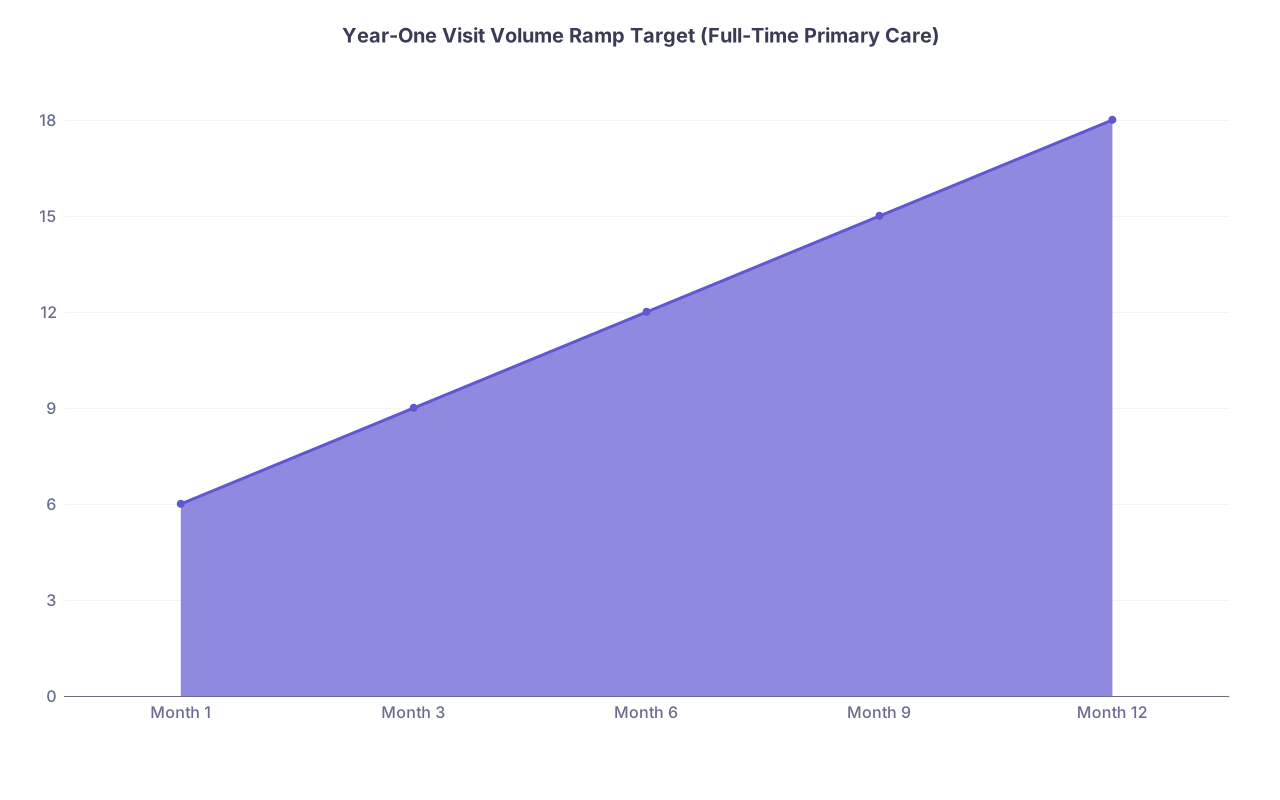
| Category | Value |
|---|---|
| Month 1 | 6 |
| Month 3 | 9 |
| Month 6 | 12 |
| Month 9 | 15 |
| Month 12 | 18 |
I have seen too many pro formas built assuming 18–20 visits/day by month 3. The data does not support that for most cold-start practices without aggressive referral strategies or immediate system affiliation.
3. Month-by-Month Benchmarks: Ramp, Not Leap
Productivity in year‑one is a ramp curve, not a step function. You are building panels, referral streams, and operational routines simultaneously. The schedule does not fill evenly.
A more realistic outpatient year‑one trajectory for a cold-start (no existing panel):
- Months 1–2: 4–8 visits/day
- Months 3–4: 8–10 visits/day
- Months 5–6: 10–12 visits/day
- Months 7–9: 12–15 visits/day
- Months 10–12: 15–18 visits/day (if your marketing/referrals are actually working)
Translate that into approximate wRVUs, using 1.8 wRVUs/visit and 4 clinic days/week:
| Month Range | Avg Visits/Day | wRVUs/Day (approx) | wRVUs/Month (4 days/wk) |
|---|---|---|---|
| 1–2 | 6 | ~10.8 | ~173 |
| 3–4 | 9 | ~16.2 | ~259 |
| 5–6 | 11 | ~19.8 | ~317 |
| 7–9 | 14 | ~25.2 | ~403 |
| 10–12 | 17 | ~30.6 | ~490 |
Sum those ranges and you land in the 3,000–3,800 wRVU ballpark by the end of year one. Which aligns with the earlier benchmark table.
This is why the plan matters more than the daily number. If you are still averaging 8–9 visits/day at month 9, you have a structural problem, not a “new practice” problem.
4. Specialty-Specific Year-One Benchmarks
“Average” is a dangerous word. The RVU and visit volume expectations in dermatology vs general surgery vs psychiatry are wildly different.
Let’s break a few out with reasonable, data‑anchored year‑one targets for a full‑time physician in private practice.
Primary care (FM/IM outpatient only)
- Target wRVUs year‑one: 3,000–4,000
- End-of-year daily volume: 16–20 visits/day
- Average RVUs/visit: ~1.6–1.9
Practical markers:
- By month 3: ≥8 visits/day
- By month 6: ≥12 visits/day
- By month 12: ≥16 visits/day, with a clear trajectory toward 18–22 within year 2
Outpatient psychiatry
Very different pattern: longer visits, fewer per day, higher no‑show risk.
- Typical visit mix:
- New eval: 60 min (2.0–3.0 wRVUs)
- Follow‑up: 20–30 min (1.0–1.5 wRVUs)
- Reasonable year‑one target:
- 1,800–2,400 wRVUs
- 8–12 visits/day at maturity; 5–8 in early months
Psych practices can still be very profitable because reimbursement per hour is often higher and overhead lower. But if you are below 5 visits/day at month 6 with mostly 60‑minute slots, something is off in marketing, access, or scheduling rules.
Orthopedic surgery
Surgical practices are heavily skewed by OR days and procedural RVUs.
- Office visits: 2.0–3.0 wRVUs for more complex/new visits
- Common procedures: 10–40+ wRVUs per surgery
- Year‑one target:
- 5,000–8,000 wRVUs depending on case mix
- Clinic days might sit at 12–18 patients, but OR days can add huge spikes in RVUs
The key non-obvious point for new surgeons: you can have “low” clinic visit volumes but still hit strong RVU numbers if your OR utilization is decent. So benchmarking purely on visits/day is misleading; you must track RVUs per OR day and per clinic day separately.
Non-procedural cognitive specialties (endocrinology, rheumatology, neurology)
- Higher complexity visits, more level 4s
- Average RVUs/visit: ~2.0–2.4
- Year‑one RVU target: 2,800–3,800
- End-of-year daily volume: 10–14 visits/day
These specialties often grow more slowly due to referral dependence, but once panels build, they can be RVU-dense without requiring the 20–24 visit/day grind of primary care.
5. Capacity, Scheduling Templates, and Fill Rates
RVU and visit targets are meaningless unless tied to scheduling capacity. You need to quantify three things:
- Slots available per day
- Slots filled (completed visits)
- Fill rate = completed visits / available slots
If you want 14 visits/day and you only create 14 slots/day, you are assuming 100% fill with zero no‑shows or cancellations. Not happening.
Year‑one, I recommend planning capacity like this:
- Expected no‑show/cancel rate in a brand new practice: 10–20% easily
- Desired completed visits/day at month 6: 10–12
- Required slots/day at month 6: 12–15
By month 12:
- Desired completed visits/day: 15–18
- Plan for 18–22 slots/day depending on your no‑show rate and tolerance for overbooking
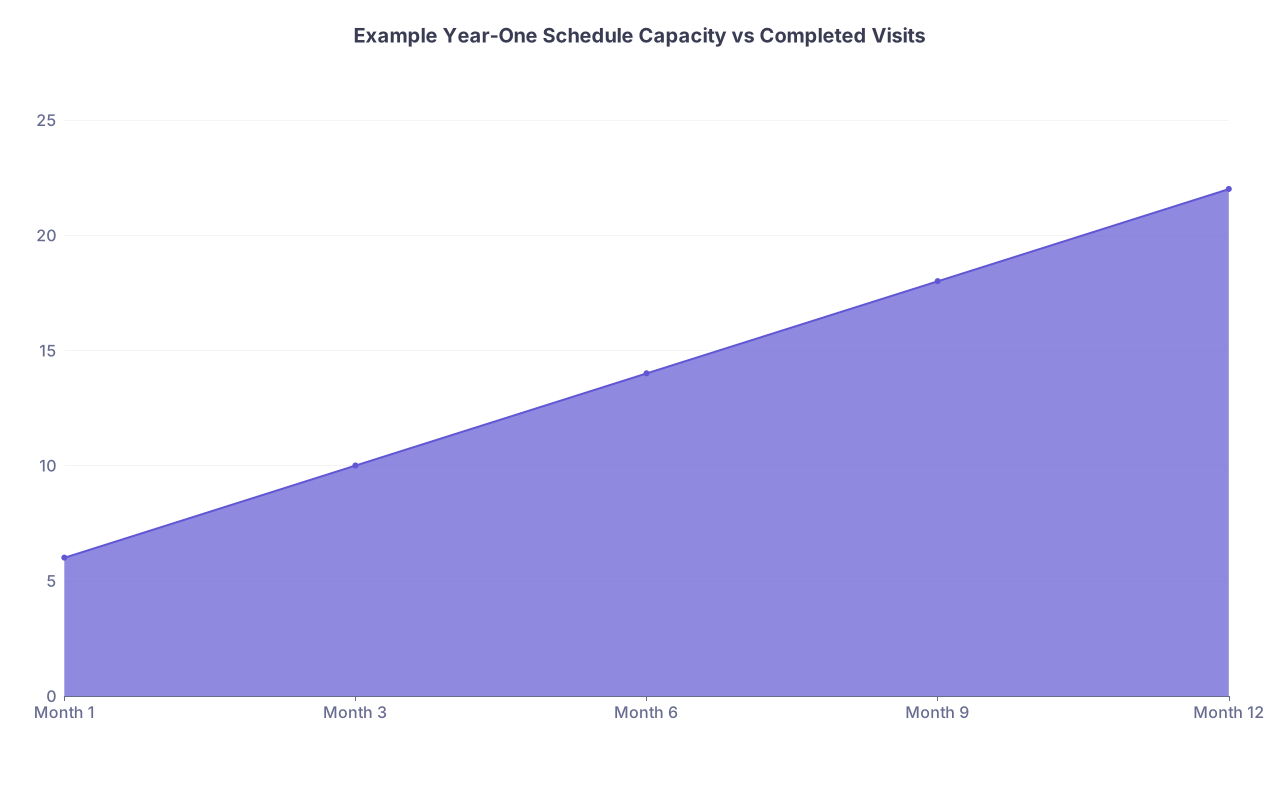
| Category | Value |
|---|---|
| Month 1 | 6 |
| Month 3 | 10 |
| Month 6 | 14 |
| Month 9 | 18 |
| Month 12 | 22 |
Think of slots as inventory. Underproduce inventory and you cap your revenue. Overproduce and you sit with empty shelves and idle staff. The target in year‑one: 70–85% fill rate by month 9–12.
If you are at 50–60% fill with stagnant referrals, you have a demand problem. If you are at 95–100% fill with long waits, you have a capacity/conversion problem.
6. Payer Mix and RVUs: High Volume Is Not Always High Revenue
RVUs are not dollars. They are a weighting system. Two physicians can produce the same wRVUs and end up with very different cash results based on payer mix and contract rates.
Basic pattern I see in new practices:
- Commercial: pays 100–150% of Medicare for many E/M codes
- Medicare: baseline
- Medicaid: often 50–80% of Medicare, sometimes lower
- Narrow network / low‑pay commercial plans: may be worse than Medicaid on some services
Let’s quantify for a simple 99214‑heavy practice (established level 4, ~1.9 wRVUs):
- Medicare allowables (national average ballpark): ~$130–$140
- Medicaid: maybe $70–$100
- Commercial: $140–$220 depending on contract
So if you are targeting 3,400 wRVUs year‑one at 1.8 wRVUs/visit → ~1,889 visits.
Scenario A – 50% commercial, 30% Medicare, 20% Medicaid
Scenario B – 15% commercial, 35% Medicare, 50% Medicaid
You can easily see a 20–30% swing in revenue for the same RVU output. The point: hit RVU benchmarks, yes. But be very deliberate about payer mix and which contracts you accept, especially in year‑one when your slot inventory is precious.
7. Use Benchmarks Aggressively: Red-Flag Thresholds
Benchmarks are not for vanity. They are early warning systems.
Here are hard thresholds where I start to worry in a year‑one private practice (assuming full‑time commitment, 4 days/week clinic, no major external disruptions):
By Month 3:
- Average <6 completed visits/day → weak demand or serious access issues
- Less than 100 total new patients added → marketing/referral network is not functional
By Month 6:
- Average <9 completed visits/day
- Cumulative wRVUs < 1,000 for most cognitive specialties
- Schedule regularly has >30% open slots within 48 hours
By Month 9:
- Average <12 completed visits/day
- Cumulative wRVUs < 2,000 (primary care) or <1,600 (most other outpatient specialties)
- Payer mix skewed to >60% Medicaid/lowest payers without concurrent volume growth
By Month 12:
- Average <14–15 completed visits/day in primary care
- Total annual wRVUs < 2,500 outpatient in most settings (outside psychiatry and very niche models)
- You are still heavily reliant on one or two referral sources (concentration risk)
You do not need perfect alignment with MGMA percentiles in year‑one. You do need to avoid the bottom quartile trap where survival gets mathematically difficult.
8. Year-One Tactics to Move the Numbers
Data without levers is pointless. Once you know your RVUs and visit volumes are lagging, you need specific, measurable interventions.
A few that consistently move the needle:
Increase new patient capacity.
New patients drive higher wRVUs/visit and build long‑term panels. If your schedule is clogged with overly frequent returns, you are trading growth for false busyness. Simple metric: percentage of slots reserved for new vs established. Early months: new visits should be ≥40–50% of your schedule.Extend or shift clinic hours strategically.
Not “work more” for its own sake. Target evening or early morning blocks once or twice a week where demand is highest. If you add 4 extra high‑demand hours per week at 3–4 visits/hour, that is 12–16 additional visits/week → 600–800+ visits/year → easily 1,000–1,500 extra wRVUs depending on complexity.Tighten no‑show management.
Automated reminders, same‑day waitlist, confirmation requirements for chronic no‑show patients. If your no‑show rate drops from 18% to 10%, your effective capacity jumps without adding hours.Fix coding leakage.
I constantly see new practices undercoding from residency habits. If 30–40% of your charted “level 3” visits are actually level 4 under 2021+ E/M rules, you are walking away from 0.4–0.6 wRVUs per visit. At 2,000 visits/year, that is 800–1,200 wRVUs lost. Which is insane.Track weekly, not yearly.
Annual numbers are lagging indicators. You need a weekly dashboard:- Visits completed
- New vs established ratio
- wRVUs generated
- Fill rate
- Top 3 referral sources
I do not care how “small” you are. This is how you run a real business.
9. What Success Looks Like by the End of Year One
Let’s be concrete. What do the numbers look like for a year‑one practice that is actually on track for a sustainable future?
For a full‑time, outpatient primary care or cognitive specialty practice:
- Annual visits: 1,800–2,500
- Annual wRVUs:
- Primary care: 3,000–4,000+
- Cognitive specialty: 2,800–3,800+
- Procedural specialty: ranges widely, but usually ≥5,000 if the OR is reasonably utilized
- End-of-year daily visit volume:
- Primary care: 16–20/day
- Cognitive specialty: 10–14/day
- Psychiatry: 8–12/day
- Schedule fill rate: 75–90% on most clinic days
- Payer mix: not dominated by the lowest-paying segment, with at least a solid minority of well-paying commercial or Medicare Advantage plans
- Referral diversity: no single referral source >25–30% of total new patients
If your data line up reasonably close to that picture, you are not behind. You are ahead of the majority of cold-start practices I have seen.
Key Takeaways
- Year‑one productivity is a ramp, not an instant jump. For most outpatient practices, 3,000–4,000 wRVUs and 1,800–2,500 visits are realistic success benchmarks.
- Visits per day, RVUs per visit, and schedule fill rate must be tracked weekly from day one. Under 9 visits/day at month 6, or under 12 at month 9, is a red flag for a full‑time clinician.
- Payer mix, coding accuracy, and new‑patient access determine whether your RVUs translate into viable revenue. Volume alone does not save a poorly structured year‑one practice.