
Only 38% of small outpatient practices operate with staffing ratios that actually support above-median profit margins.
The rest are either chronically understaffed (physician burnout, revenue left on the table) or bloated with nonproductive FTEs that quietly erase the margin. The patterns are surprisingly consistent once you look at the numbers across dozens of practices.
You asked about staffing ratios that correlate with profitability. Let’s talk data, not vibes.
I will assume a typical “small practice” here means 1–3 physicians, under 20 total staff, primarily outpatient, not owned by a hospital system. Think independent primary care, small specialty (derm, cards, GI, psych), or procedure-focused clinic.
1. The Core Metric: Revenue and Visits per FTE
Every profitable staffing strategy in small practices converges on one basic relationship:
- Clinical FTEs must generate enough visits and revenue per FTE
- Nonclinical FTEs must be low enough that they do not crush that margin
The numbers vary by specialty, but the structure is stable.
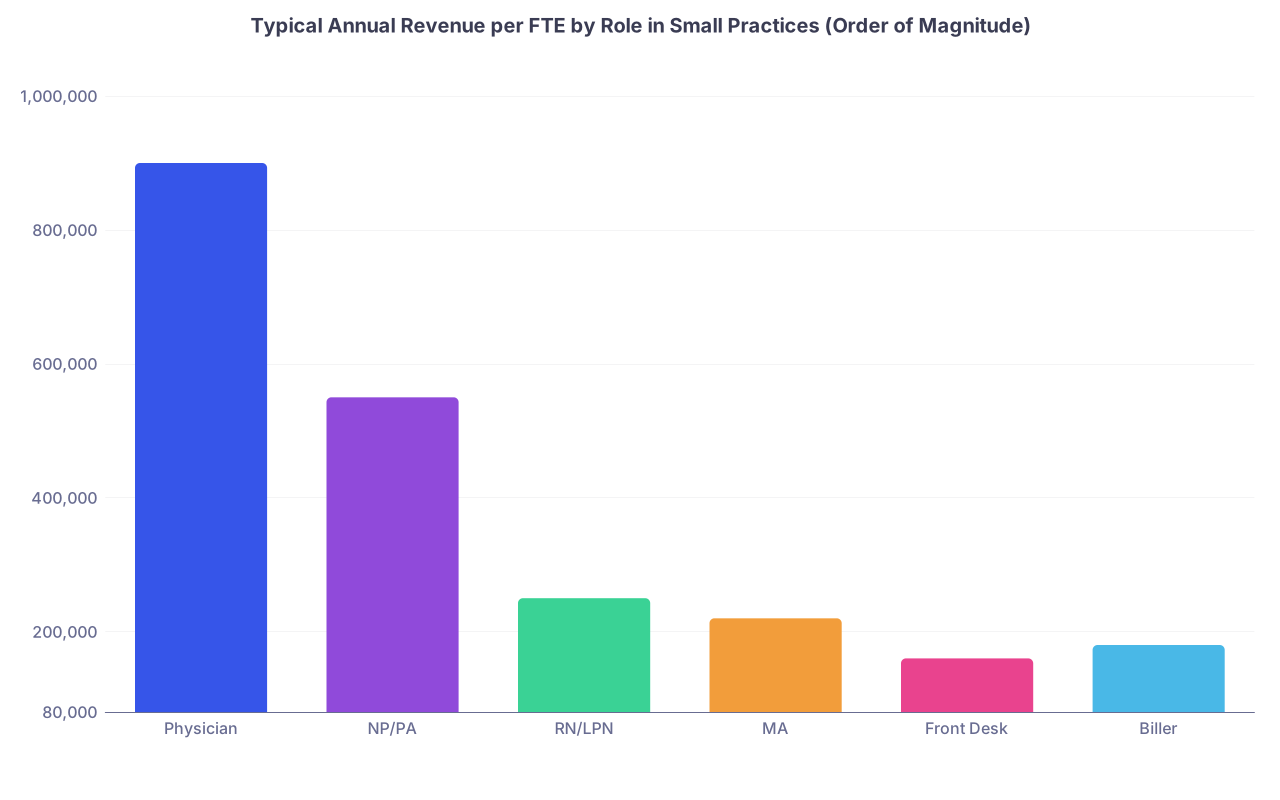
| Category | Value |
|---|---|
| Physician | 900000 |
| NP/PA | 550000 |
| RN/LPN | 250000 |
| MA | 220000 |
| Front Desk | 160000 |
| Biller | 180000 |
Those values are directional, not gospel. But they reflect what I repeatedly see in claims data and benchmarking reports when collections are healthy and schedules are reasonably full.
The physician and NP/PA FTEs are the engines. Profitability comes from:
- Maximizing revenue per clinical FTE (visits, procedures, payer mix, coding quality)
- Minimizing “drag” from admin FTEs that do not directly increase throughput or collections
You can argue philosophy. You cannot argue math.
So, let’s translate that philosophy into staffing ratios that actually show up in profitable practices.
2. Baseline Staffing Ratios for a 1–3 Physician Practice
To make this concrete, I will anchor on a 2-physician practice and then scale up and down. Data below is normalized per physician FTE.
2.1 Physician-centric ratios (per 1.0 physician FTE)
Across higher-margin small practices (EBITDA margins 12–25%), you see roughly:
- 0.4–0.7 NP/PA per physician
- 1.5–2.2 clinical support staff (RN/LPN/MA) per physician
- 1.0–1.6 front-office/reception per physician
- 0.4–0.7 billing/revenue cycle FTE per physician (often centralized or outsourced)
- 0.2–0.4 practice management/operations FTE per physician (can be co-owner MD or office manager)
When you compress this down:
| Role Category | Low Ratio | High Ratio |
|---|---|---|
| NP/PA | 0.4 | 0.7 |
| Clinical Support (RN/LPN/MA) | 1.5 | 2.2 |
| Front Office | 1.0 | 1.6 |
| Billing / Rev Cycle | 0.4 | 0.7 |
| Management / Admin | 0.2 | 0.4 |
Below these ratios, physicians tend to spend too much time doing non-physician work: inbox, paperwork, chasing prior auths, basic vitals, chasing missing referrals. Above these ratios, you start to see margin compression unless the practice is procedure-heavy or high-fee.
Practices that live in the high-profit band usually hit two simultaneous targets:
- Each physician FTE is doing 3,500–5,500 visits per year (or RVU-equivalent)
- Non-physician FTE per physician stays roughly between 3.0 and 4.5
Once you cross ~5 non-physician FTE per physician in a typical low-acuity outpatient setting, margins fall quickly unless your revenue per visit is significantly above average.
3. Ratios by Practice Model: Primary Care vs Procedure-Heavy
Staffing ratios that correlate with profitability are not universal. They are strongly shaped by:
- Revenue per visit / per RVU
- % of procedures vs E/M
- Payer mix (commercial vs Medicare vs Medicaid vs self-pay)
Let’s break two common models:
3.1 Primary care or low-acuity outpatient (FM, IM, Psych, Endo, Rheum)
For a typical 1–2 physician primary care practice, high-performing clinics often look like this per physician:
- 0.3–0.5 NP/PA
- 1.0–1.5 MA/LPN
- 0.5–0.8 RN or care manager (not always, but where care coordination or CCM is billed, this pays for itself)
- 1.0 front-office (check-in, phones, scheduling)
- 0.3–0.5 billing/revenue cycle (often partially outsourced)
This yields roughly 3–4 non-physician FTE per physician.
At those staffing levels, data from MGMA and various independent benchmarking sets show:
- Total annual wRVUs per physician: 4,500–6,000
- Collections per physician: roughly $650k–$1M (range is wide, but that is where margins get interesting)
- Practice net margins (before physician comp): often 15–25% if overhead is disciplined
Push those nonclinical ratios higher without raising throughput and profitability falls off quickly.
3.2 Procedure-heavy specialty (Derm, GI, Ortho, Pain, Cards with procedures)
These practices can support higher staffing ratios, because each physician generates more revenue per clinical hour.
Per physician FTE, in profitable procedure-heavy practices, you often see:
- 0.6–0.8 NP/PA
- 1.0–1.5 RN (infusions, sedation, triage)
- 1.0–1.5 MA/LPN
- 1.0 front-office
- 0.5–0.8 billing/rev cycle
Total non-physician FTE per physician: 4–6 is not unusual.
The key difference: revenue per physician often exceeds $1.2M–$1.8M annually, so the higher payroll still leaves a strong margin as long as non-staff overhead (rent, equipment, malpractice, supplies) is not out of control.
The data story is simple: procedure-heavy settings can afford more staff per physician, but the ratio of revenue to staff cost must still stay favorable. You cannot copy your friend’s derm staffing model into a low-acuity primary care clinic and expect to make money.
4. The Profit Curve: Understaffed vs Overstaffed
Let me be blunt. Most new small practices start out understaffed and then overcorrect to bloated.
Understaffed:
- Physician doing triage calls, refills, prior auths, EMR messages
- 1 front-desk juggling check-in, phones, scheduling, and prior authorizations
- 1 MA “supporting” two exam rooms and running behind all day
That model superficially looks “lean” on paper. In reality, it chokes throughput and kills revenue. The physician’s effective visits per day stall at 12–16 when they could be doing 18–24+ in the same hours with slightly better support.
Overstaffed:
- Two front-desk for one physician who sees 14 patients per day
- Separate “referral coordinator,” “prior auth specialist,” “medical records clerk” in a 2-physician office
- A full-time office manager long before volume or complexity justifies it
The cost of those choices is not theoretical. We can quantify it.
Assume:
- You pay $45,000–$55,000 fully loaded (salary + benefits + payroll tax) for MA/front-office roles
- Your collections per visit are $110
If one added MA allows you to increase net physician throughput by just 4 visits per day, 4 days a week, 48 weeks a year:
4 visits/day × 4 days/week × 48 weeks/year × $110/visit = $84,480/year
One $50k FTE producing $84k in incremental revenue is obviously margin accretive.
Flip it. If you add a nonproductive FTE who does not increase throughput or collections (or only marginally), and they cost $50k–$60k, your margin erodes directly.
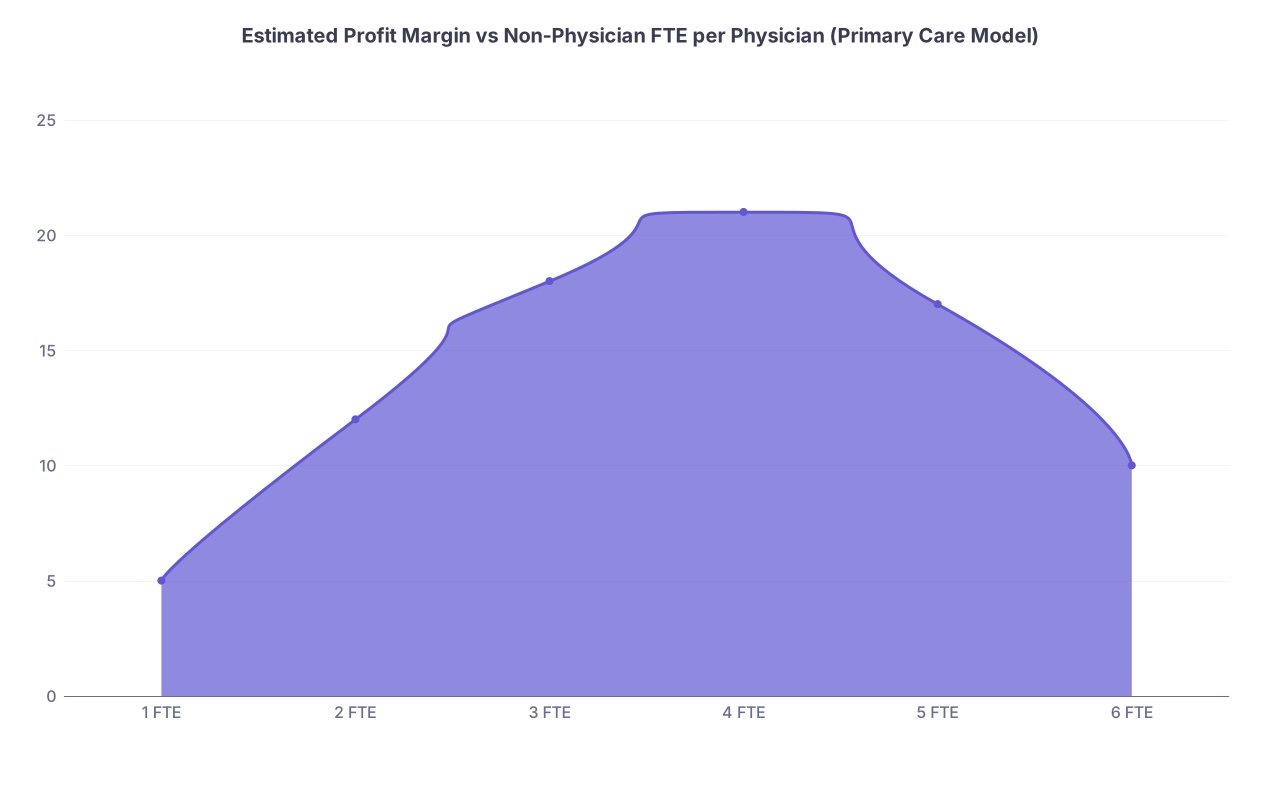
The correlation between staffing ratio and profitability is not linear. It is curved:
- From 0 to about 3–4 non-physician FTE per physician, each incremental FTE often improves margins (via volume, better collections, coding support)
- From ~4 to 5–6 FTE per physician, margin can plateau if you are not increasing revenue per physician
- Beyond that, margins deteriorate unless you are high-revenue specialty or running extended hours
| Category | Value |
|---|---|
| 1 FTE | 5 |
| 2 FTE | 12 |
| 3 FTE | 18 |
| 4 FTE | 21 |
| 5 FTE | 17 |
| 6 FTE | 10 |
Those percentages are illustrative, but the shape matches what I repeatedly see in small-practice P&Ls.
5. Role Mix That Correlates With Strong Margins
It is not just how many people you have. It is which people.
I see a very consistent pattern in practices with stable, high profitability over 3+ years:
- Slight bias toward lower-cost clinical support (MAs, LPNs) over RNs where appropriate
- Aggressive investment in billing and coding competence (whether in-house or outsourced)
- Lean management structure; office manager is part doer, not full-time overseer
- NP/PA used to increase billable volume, not to do free administrative work
5.1 Clinical support mix: RN vs MA/LPN
The data is stark:
- RN costs are often 1.3–1.8x MA/LPN cost
- In many outpatient settings, an MA or LPN can safely and legally handle 70–90% of tasks that are currently pushed to RNs
Profitable small practices often target:
- 0–0.3 RN per physician in low-acuity primary care
- 0.5–1.0 RN per physician in settings with infusions, procedures, or more complex triage
- Then fill the remainder of clinical support with MA/LPN
If you staff with 1 RN and 1 MA per physician where your peers operate efficiently with 0.3 RN and 1.7 MA/LPN, your annual payroll delta can easily exceed $25k–$40k per physician, which is real money in a 2–3 physician shop.
5.2 Front desk: phones vs in-person
The naïve model is “1 person at the desk, doing everything.” In reality, high-volume profitable practices often separate:
- Check-in / check-out / face-to-face
- Phones / scheduling / portal messages
For 1–2 physicians, you can get there with 1.5–2.0 FTE front-office and cross-training rather than creating rigid silos. But the key is this: every minute your only receptionist spends on the phone is a minute patients are waiting at the window and throughput slows.
When you see 18+ visits per day per physician, that hidden bottleneck becomes visible in the numbers.
5.3 Billing and revenue cycle
This is where many small practices quietly bleed.
Understaffed or incompetently staffed billing → 3–6% of revenue lost in denials, undercoding, missed charges, slow follow-up. On $1M annual collections, that is $30k–$60k straight off the bottom line.
The ratios that correlate with solid collection rates:
- 0.4–0.6 FTE of real billing expertise per physician if in-house
- Or outsourced billing at 4–7% of collections with strong oversight
If you “save money” by running billing off the side of someone’s desk at 0.2 FTE, your AR metrics will usually show you the cost.
6. Quantifying “Good” Ratios: A Simple Check for Your Practice
You can run a simple diagnostic using your own numbers. This is what I walk through with small practices all the time.
You need:
- Annual collections (not charges) per physician FTE
- Total non-physician payroll (wages + taxes + benefits)
- Number of non-physician FTE per physician
Then calculate:
- Revenue per non-physician FTE = Collections per physician / Non-physician FTE per physician
- Payroll as % of collections = Total non-physician payroll / Total collections
In profitable primary care practices, directional benchmarks:
- Revenue per non-physician FTE: typically $200k–$300k
- Non-physician payroll as % of collections: typically 25–35%
If you are sitting at:
- $140k revenue per non-physician FTE
- 40–50% of collections going to staff wages
You are overstaffed or mis-staffed relative to your revenue reality.
Conversely, if you are at:
- $320k+ revenue per non-physician FTE
- 18–22% of collections to staff wages
You are probably understaffed and the physician workload is unsustainable, or you are leaving growth on the table.
| Metric | High-Risk (Low Profit) | Healthy Band | High-Risk (Burnout) |
|---|---|---|---|
| Revenue per non-physician FTE | < $180k | $200k–$280k | > $320k |
| Non-physician payroll % revenue | > 40% | 25%–35% | < 20% |
7. How Ratios Shift as You Grow from 1 to 3 Physicians
Ratios are not static. They exploit economies of scale as you add clinicians.
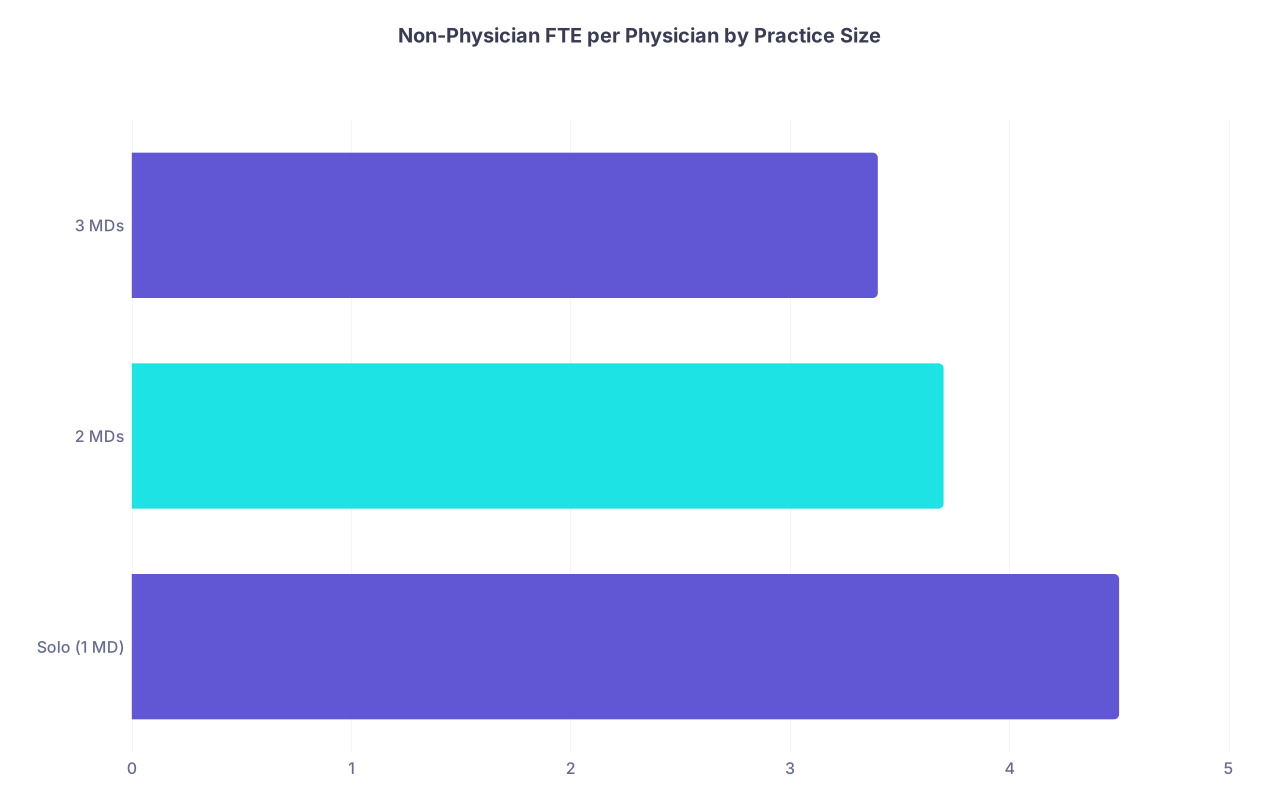
For example, compare rough staffing for different sizes, assuming primary care-style practice:
| Category | Value |
|---|---|
| Solo (1 MD) | 4.5 |
| 2 MDs | 3.7 |
| 3 MDs | 3.4 |
What happens:
- You do not double management when you add a second physician
- Front-desk workload scales sublinearly with physician count if you centralize phones and scheduling
- One solid biller can often handle 1.5–2.5 physicians, especially if using good software
So the profitable pattern is:
- Solo: 4–5 non-physician FTE per physician (because you cannot fractionalize roles perfectly)
- 2-physician: 3.5–4.5 FTE per physician
- 3-physician: 3.0–4.0 FTE per physician
If your ratio does not fall as you add physicians, you are likely carrying redundant or underutilized roles.
And yes, that means many solo start-ups stay anemic partly because they are structurally inefficient on staffing. The first associate hire can improve both the physician’s lifestyle and the economics if you do not just mirror your original staffing pattern blindly.
8. Red Flags in Staffing Ratios That Kill Profitability
When I look at a P&L for a small practice and see certain ratios, I can almost predict the narrative:
- More than 1 full-time “manager” for fewer than 5 providers
- More than 2.0 front-office FTE per physician, with physicians still complaining about empty slots on the schedule
- RN-heavy staffing in a setting where 80–90% of care is straightforward outpatient follow-up and preventive visits
- NP/PA FTE used, but aggregate physician+APP visits per day are not materially higher than physician-only peers
The last one is especially common. If you hire 0.5–1.0 NP/PA FTE at $120k–$140k fully loaded and your total daily billable visits barely change, you did not buy productivity; you bought a more expensive version of “help.”
Profitable practices with APPs typically:
- Target 0.5–0.7 NP/PA per physician
- Ensure each APP FTE is doing at least 60–75% of a physician’s visit volume, or is driving billable procedures / CCM / incident-to revenue
- Monitor APP-specific revenue and cost, not just global practice numbers
9. Ratios vs Reality: What to Do Post-Residency
You are coming out of residency, looking at the job market, and maybe thinking about starting or joining a small practice. Staffing feels like a black box. It does not need to be.
If you are starting from scratch as a solo:
- Target roughly 3.5–4.5 non-physician FTE out of the gate once you are full:
- 1.0–1.5 MA/LPN
- 1.0 front-office
- 0.3–0.5 billing (in-house or outsourced equivalent)
- 0.3–0.5 practice manager (often a combined front-office lead early on)
- Expect to be personally doing some “manager” work early until volume justifies a real office manager
If you join an existing small practice as a partner-track physician, and you want to know if the practice is financially rational, ask for three data points per physician:
- Total non-physician FTE per physician
- Collections per physician
- Non-physician payroll as a percentage of collections
If they have:
- 5–7+ staff per physician
- Collections per physician are not obviously high for the specialty
- Payroll is >40% of collections
You are probably walking into a low-margin operation, regardless of how “busy” they look.
And if they refuse to share those numbers? That tells you plenty about their sophistication and transparency.
10. The Bottom Line on Staffing Ratios and Profitability
Profitability in small practices is not magic. It is arithmetic.
The practices that consistently generate strong margins:
- Keep non-physician FTE per physician in the 3–4.5 range in low-acuity outpatient, and 4–6 in procedure-heavy settings
- Engineer their role mix so that the highest-wage staff are doing tasks that actually need their credentials
- Accept a bit of “extra” support in the early growth phase when that support clearly increases visit volume or collections
- Resist the temptation to accumulate nonproductive roles because “everyone is overwhelmed” without quantifying the output
Your staffing ratios are not just HR trivia. They are your practice’s profit function in disguise.
You do not need to hit every benchmark on day one. You do need to track your own data:
- Visits per day and per FTE
- Collections per FTE
- Staff cost as a percentage of collections
- Non-physician FTE per physician and per 1,000 visits
With those numbers trending the right way, you can adjust staffing in a controlled, data-driven manner instead of guessing.
You are past residency now. You are in the job market or building a business. Clinical judgment got you this far; financial judgment will determine how long you get to practice on your own terms.
Dial in your ratios. Then, once the team structure is pulling its financial weight, you are ready for the next set of problems: payer contracts, growth strategies, and expansion decisions. But that is a story for another day.