
Only 27% of physicians who say they “plan to start a private practice” have actually modeled their startup costs in a spreadsheet.
That mismatch is why so many good clinicians end up shocked, overleveraged, or stuck in bad leases. The data on startup costs is not mysterious, but it is brutally specific. Specialty, visit volume, payer mix, and how “fancy” you go on build‑out drive 80–90% of the variance.
Let me walk through what the numbers actually look like, specialty by specialty, and what that means for a post‑residency physician trying to decide if private practice is financially sane.
1. Big Picture: What Drives Startup Cost More Than Your Specialty
The specialty label matters, but not as much as five levers that cut across everything:
- Real estate: lease vs buy, shell vs turnkey, and local market rates.
- Build‑out and equipment: from IKEA desks to $500k linear accelerators.
- Staffing: front desk only vs full MA + nurse + biller from day one.
- IT stack: EHR, practice management, telehealth, and revenue cycle tools.
- Working capital: how many months you can survive before cash flow is stable.
Specialty then sits on top of those. Primary care will not need an OCT or C‑arm. Ortho will.
To ground this, here is a realistic cross‑specialty comparison, assuming:
- 3–5 exam rooms.
- Leased space, not purchased.
- Reasonable (not luxury) finishes.
- First‑year working capital included.
| Specialty | Low Range (lean) | High Range (more robust) |
|---|---|---|
| Family/Internal Med | $150k | $350k |
| Psychiatry | $80k | $200k |
| Pediatrics | $160k | $380k |
| OB/GYN (office only) | $250k | $600k |
| General Ortho (outpt) | $400k | $1.0M+ |
| Ophthalmology | $500k | $1.2M+ |
Those are not “consultant brochure” numbers. They are pulled from real de novo practice P&Ls I have seen, plus current equipment and build‑out quotes.
2. Core Cost Buckets (Regardless of Specialty)
Before we zoom into individual specialties, you need the template. Nearly every private practice startup P&L has the same skeleton.
2.1 Space and Build‑Out
You pay for two things here: the right to occupy and the privilege of making it usable.
- Base rent: typically $18–$40 per sq ft per year in many secondary markets, higher in coastal cities.
- Size: most solo and small‑group startups land between 1,200 and 3,000 sq ft.
If you multiply that out, the annual rent alone often falls in the $25k–$90k band. But the real sticker shock is tenant improvements (TI): plumbing, walls, electrical, lead lining (if imaging), cabinetry.
Recent real‑world TI numbers:
- Shell space, basic primary care build: $80–$140/sq ft.
- Shell space, procedure heavy (OB/GYN, minor surgery): $120–$180/sq ft.
- Imaging or high‑end ophthalmology: $150–$220/sq ft+.
For a 2,000 sq ft office, that can easily be a $200k–$350k check. Landlords sometimes provide TI allowances, but it rarely covers everything.
2.2 Equipment and Furnishings
Again, large spread, but you see clear patterns:
- Basic exam room setup (table, light, diagnostic set, BP, scale, otoscope, etc.): $7k–$15k per room if you buy new, less if you hunt used.
- Office and waiting room furniture: $10k–$40k depending on taste.
- Specialty equipment: can be trivial (psychiatry) or absolutely dominant (ophthalmology, ortho, cardiology).
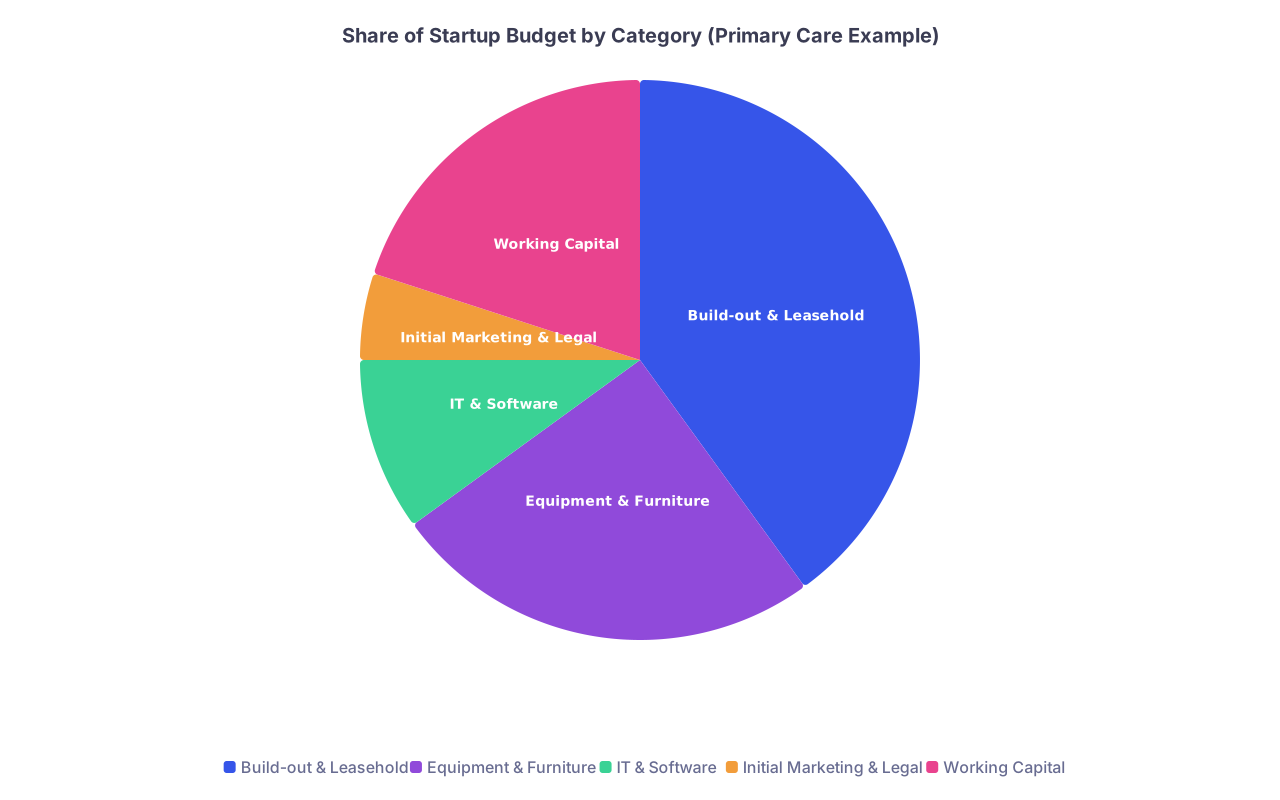
| Category | Value |
|---|---|
| Build-out & Leasehold | 40 |
| Equipment & Furniture | 25 |
| IT & Software | 10 |
| Initial Marketing & Legal | 5 |
| Working Capital | 20 |
For a typical lean primary care start, build‑out eats the plurality of the budget. For something like ophthalmology, equipment flips into the top slot.
2.3 IT, Legal, and Admin Setup
You will spend real money on things you do not want to think about:
- EHR + practice management: $300–$1,200 per provider per month (subscription) or $15k–$60k for certain on‑premise or higher‑end solutions.
- Clearinghouse/claims, e‑prescribing, patient portal, telehealth platform: often bundled, but the effective cost can be another $200–$500 per month.
- Legal entity setup, contract review, compliance policies: $5k–$20k in that first year if done properly.
- Credentialing: outsourced services often run $200–$500 per payer per provider.
2.4 Working Capital
This is where many new owners get burned.
You will not collect full revenue on Day 1. Typical lag from visit to cash in bank is 30–90 days, sometimes worse if your credentialing is slow. If you plan to pay:
- Your own modest salary.
- A full‑time MA.
- A front desk coordinator.
- Rent, malpractice, software.
You need 3–6 months of burn covered. For most single‑physician startups, that working capital number alone lands between $60k and $200k depending on how aggressively you ramp and what salary you pay yourself in year 1.
3. Primary Care, Pediatrics, and IM: “Lower” But Not Cheap
Family medicine, internal medicine, and pediatrics share a basic primary care footprint, so their cost profiles look similar. Pediatrics adds some vaccine and equipment quirks.
3.1 Typical Primary Care Startup Range
Realistic all‑in ranges I see:
- Lean, low‑rent market, conservative build‑out: $150k–$220k.
- More typical, 4–5 rooms, suburban office: $220k–$350k.
- Aggressive, high‑end build‑out or urban core: $350k–$500k.
Where the money actually goes:
- Build‑out (2,000 sq ft at $120/sq ft effective, net of TI): ~$240,000.
- Furnishings and basic medical equipment (4 rooms): $40,000–$60,000.
- IT, legal, marketing, compliance: $25,000–$50,000 in year one.
- Working capital: $80,000–$150,000.
You can pull that down by:
- Starting with 2–3 rooms.
- Subleasing from an existing practice.
- Buying used exam tables and furniture.
- Outsourcing billing instead of hiring a full FTE early.
But there is a floor. I get nervous when someone says they will open a full‑service primary care practice for under $100k. The math usually requires unsafe assumptions about no delays, no mistakes, and instant patient volume.
3.2 Pediatrics: Slightly Higher
Pediatrics looks similar plus:
- Vaccine inventory: can easily lock up $20k–$60k of cash, depending on stock levels, though some VFC programs and just‑in‑time ordering can soften this.
- Child‑specific equipment: scales, exam tables, developmental screening tools; not huge, but a bit of extra spend.
So pediatrics tends to sit about 5–15% higher than adult primary care for the same footprint.
4. Psychiatry and Behavioral Health: The Lowest Capital, Not the Lowest Risk
Psychiatry is the closest thing you get to a “low‑capex” medical business. That does not make it easy, but the cost structure is different.
Realistic startup ranges:
- Solo psychiatrist, 2 rooms, basic lease: $80k–$140k.
- Small group (2–3 clinicians, maybe mix of MD + therapist): $120k–$250k.
Where the savings happen:
- Build‑out is cheap. You need offices, not plumbed exam rooms. TI in many markets runs closer to $50–$90/sq ft, and you can rent previously built professional space.
- Equipment is minimal. Desks, chairs, computers, maybe a small waiting area and secure storage. $20k–$50k covers quite a bit.
- No vaccines, no procedures, no expensive devices.
But then you stare at payer reality:
- Reimbursement per hour can be strong, especially cash‑pay or hybrid models.
- Credentialing and panel building still take months.
- If you go fully self‑pay to avoid that, you trade payer delay for slower volume growth in many markets.
The dominant cost in psychiatry is working capital. You can “start” for $80k, but if you want any financial buffer while you are at 50–70% capacity for 6–9 months, $150k–$200k all‑in is more stable.
5. OB/GYN, Ortho, Ophthalmology: When Equipment and Procedures Take Over
Now to the specialties where the equipment vendors know you by first name.
5.1 OB/GYN (Office‑Based)
I am not talking about owning an ASC or L&D facility. Just the outpatient practice.
Realistic ranges:
- Lean, 3‑room office, shared ultrasound, limited procedures: $250k–$400k.
- More comprehensive office (own ultrasound, in‑office procedures, 5+ rooms): $400k–$600k+.
Incremental cost drivers beyond primary care:
- Higher‑end exam tables and procedure chairs.
- Colposcopy systems, endometrial biopsy kits, LEEP equipment.
- Ultrasound: used machines can be $40k–$80k; new can be $80k–$200k+ depending on capabilities.
- Larger staff from day one, because throughput and procedures need more hands.
5.2 Orthopedics (Without Building Your Own OR)
If you try to build out a full surgical center from scratch, your capital budget jumps into the millions very quickly. We will stay on the outpatient clinic side.
For a typical outpatient ortho practice:
- All‑in startup: $400k–$1.0M+.
- Lower end: shared imaging, minimal procedures in office, smaller footprint.
- Upper end: in‑office X‑ray, advanced ultrasound, injection suite, more robust PT/rehab space.
Cost drivers:
- Imaging. A basic digital X‑ray system: $150k–$250k installed is common.
- Procedure and injection equipment, including C‑arm if using fluoroscopy (that alone can be $100k–$250k).
- More robust build‑out for lead shielding, power, and large rooms.
5.3 Ophthalmology
Ophthalmology is notoriously capital‑intensive. The data is ruthless here.
For a de novo ophthalmology clinic with diagnostics and minor procedures:
- Realistic range: $500k–$1.2M+.
Why:
- Slit lamps, phoropters, and exam lanes: $25k–$60k per lane. Most want at least 2–3 lanes.
- OCT, visual field analyzers, topographers, fundus cameras: each commonly in the $40k–$120k range new.
- High‑end devices (e.g., femtosecond lasers) can blow the budget past $1.5M if you try to own everything.
You can mitigate by:
- Buying used/refurbished equipment.
- Leasing devices rather than purchasing.
- Sharing expensive equipment across multiple providers or groups.
But you will not build a full‑service ophthalmology clinic for $200k. That is fantasy accounting.
6. How the Mix Shifts by Specialty
Look at how the same categories distribute differently. This is where specialty really shows up.
| Category | Primary Care (PCP) | Psychiatry | Ophthalmology |
|---|---|---|---|
| Build-out & Lease | 40% | 35% | 20% |
| Equipment | 20% | 10% | 45% |
| IT & Admin Setup | 10% | 10% | 10% |
| Working Capital | 25% | 40% | 20% |
| Marketing/Other | 5% | 5% | 5% |
Psychiatry pushes more into working capital because it is mostly brains and chair time. Ophthalmology goes heavily into equipment. Primary care sits in the middle.
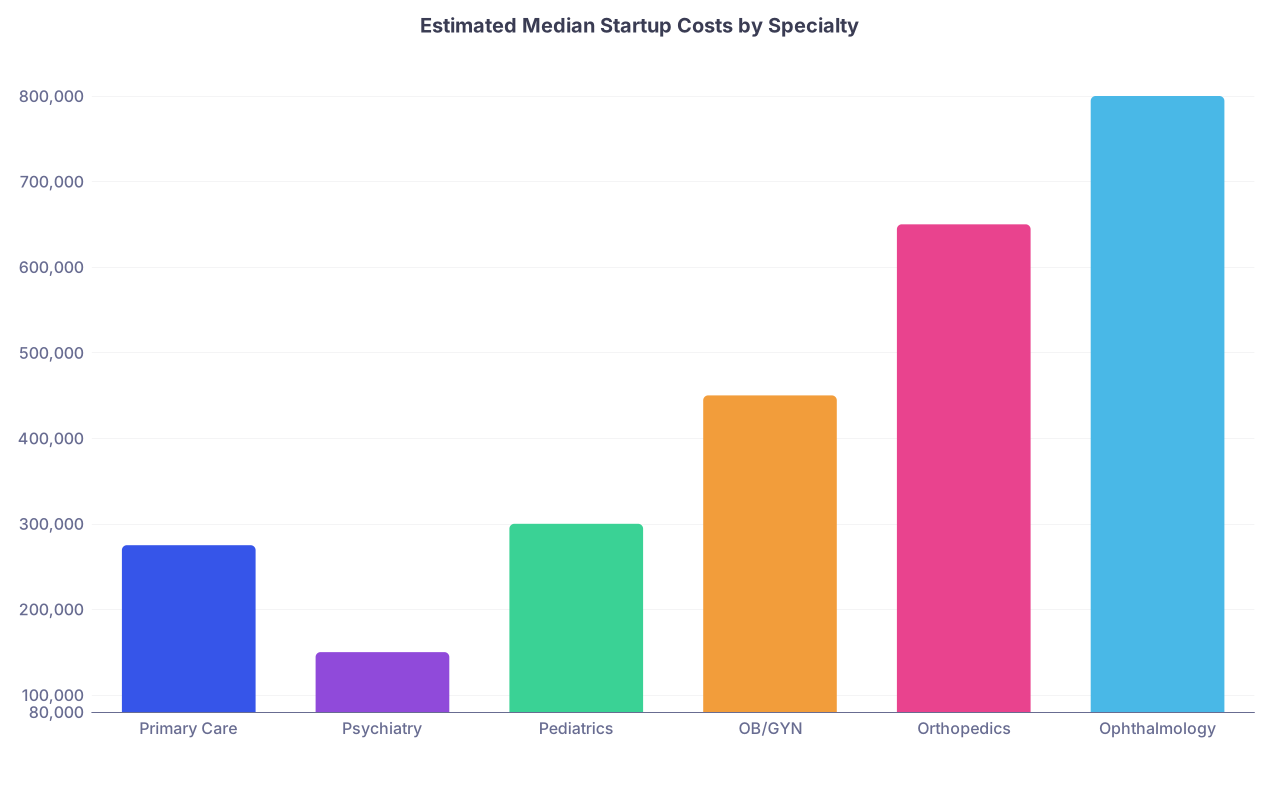
To visualize how specialty reshapes the total bill, here is a simplified comparison using median “typical” cases.
| Category | Value |
|---|---|
| Primary Care | 275000 |
| Psychiatry | 150000 |
| Pediatrics | 300000 |
| OB/GYN | 450000 |
| Orthopedics | 650000 |
| Ophthalmology | 800000 |
These are rounded medians pulled from ranges I see repeatedly. Yes, individual situations can skew lower or higher, but if your plan is 40–50% below these, your assumptions deserve a forensic review.
7. Funding Structure: How New Practices Actually Pay for This
Post‑residency, you are unlikely to open a $500k line of credit on personal signature alone without strong income history or a cosigner. So how do people actually fund these numbers?
Patterns that show up consistently:
- Bank loans: Traditional term loans or SBA 7(a) loans in the $250k–$1M range for build‑out + equipment; often 10–25% equity or collateral required.
- Personal capital: Savings, bonuses from prior employment, family loans; I regularly see $50k–$200k of personal skin in the game.
- Vendor financing: Equipment manufacturers love to finance at “low interest” or deferred payments; this can help cash flow but loads you with monthly obligations.
- Physician partners: 2–3 partners each putting in $100k–$250k reduces individual exposure but complicates governance.
The data point that matters: practices that start with less than 3 months of true expense coverage in cash or accessible credit have a much higher rate of:
- Owner deferring salary.
- Owners taking on expensive short‑term debt within 12–18 months.
- Burnout because you are chasing RVUs to keep the lights on.
8. Realistic Scenario Walkthroughs
Concrete examples help flatten the learning curve. Here are three stripped‑down but realistic builds.
8.1 Solo IM Primary Care, Suburban, 4 Rooms
- Space: 1,800 sq ft, second‑tier medical office building.
- Rent year 1: $36,000.
- Build‑out net of TI: $200,000.
- Equipment/furnishings: $55,000 (mix of new and used).
- IT and startup overhead: $35,000 (EHR, legal, credentialing, website).
- Working capital (6 months, MD salary modest, 1 MA, 1 front desk): $120,000.
Total capital requirement: about $446,000.
Could you push that under $300k? Yes, by cutting working capital to 3–4 months, reducing build‑out (older space), and buying more used equipment. That raises your risk of painful cash crunches.
8.2 Solo Psychiatrist, Mostly Cash‑Pay, 2 Rooms
- Space: 900 sq ft, generic office building, prior law office.
- Minimal TI: $30,000.
- Rent year 1: $24,000.
- Equipment/furnishings: $30,000 (waiting area, two offices, IT).
- IT and startup overhead: $20,000 (EHR or practice platform, legal).
- Working capital (6 months, only part‑time admin support): $60,000.
Total: ~$164,000.
Lean version? You could likely get this under $120k if you:
- Lease furniture.
- Do some DIY on the cosmetic work.
- Start with minimal admin help.
The constraint is less capital and more patient volume ramp and your personal burn rate.
8.3 Two‑Physician Ophthalmology Group, Full Diagnostics
- Space: 3,000 sq ft, new shell in medical office building.
- Build‑out net of TI at $170/sq ft: $510,000.
- Rent year 1: $75,000.
- Equipment:
- 3 exam lanes at $45k each: $135,000.
- OCT, visual field, topographer, fundus camera: $400,000 (mid‑range estimate).
- Misc and small instruments: $50,000.
- IT and startup overhead: $60,000.
- Working capital (6 months, 2 MDs, 4–5 staff): $250,000.
Total capital requirement: around $1,480,000.
You can understand why many new ophthalmologists join existing groups first.
9. How to Stress‑Test Your Numbers Before You Sign Anything
If you take nothing else from this, do this one exercise before you commit:
- Build a 24‑month pro forma with:
- Monthly fixed costs: rent, utilities, software, malpractice, insurance.
- Monthly staffing costs.
- Loan payments.
- Layer in:
- Conservative patient volume ramp (e.g., 20 visits/week month 1, rising to 80–100/week by month 12 for primary care; adjust for specialty).
- Conservative collections per visit (payers actually seen in your market, not brochure rates).
- Look at:
- Month of break‑even (cash).
- Maximum cash deficit before break‑even.
That “maximum cash deficit” plus 10–20% buffer is your real startup capital requirement. Not the dream number. The probability‑adjusted one.
For a healthy, moderately conservative plan:
- Break‑even by month 12–18 is common.
- Maximum deficit often sits 25–40% of first‑year revenue.
If your break‑even is month 24+ and your maximum deficit equals or exceeds your total funding, you are structuring for stress.
FAQ (5 Questions)
1. Can I start a primary care practice for under $100,000 if I sublease and keep overhead low?
Possible, but uncommon. The only times I have seen it work: physicians subleasing 1–2 rooms from an existing practice, using almost entirely existing infrastructure (phones, staff, EHR), and accepting a very gradual growth curve. You basically become a micro‑practice nested in someone else’s operation. Still, once you add working capital cushion, most sustainable builds climb above $150k.
2. Is it financially smarter to join a group first, then start a practice later?
Purely from a capital perspective, yes. Working as an associate for 2–5 years lets you build cash reserves, understand local payer behavior, and see operational mistakes up close without paying for them. Data from physicians I have worked with shows those who waited 3+ years post‑training typically needed less outside financing and tolerated slower ramp‑up better.
3. How much personal cash should I put in versus borrowing?
The pattern I consider healthy: 15–35% of total startup capital from personal or partner equity, the rest from bank and vendor financing. Under 10% equity and the bank either says no or demands more collateral; over 40–50% and you are likely overexposing personal savings relative to the business risk, unless your total net worth is very high.
4. Does going concierge or DPC dramatically change startup costs?
Not on day‑one capital; it shifts the revenue model and working capital profile. Concierge/DPC primary care still needs similar space and basic equipment. You may be able to have slightly leaner staffing and less billing infrastructure, but you also might have slower early adoption without a big upfront marketing push. Total capital might shrink 10–25%, but not 70%.
5. What is the single most common budgeting mistake new practices make?
Underestimating working capital and overestimating early revenue. They budget perfectly for build‑out and equipment, then run 30–50% short on cash six months in because credentialing was delayed, a payer underpaid, or patient acquisition was slower. The practices that survive without panic build in realistic delays, pad working capital, and accept a modest owner salary in year one.
Key points: startup costs vary massively by specialty, but realistic all‑in ranges for outpatient practices typically sit between $150k and $1M+. The mix of build‑out, equipment, and working capital shifts by specialty, yet underfunded working capital is what kills most plans, not lack of exam tables. Model your first 24 months with conservative assumptions before committing; the spreadsheet is more honest than your optimism.