
The biggest mistake new attendings make in private practice is guessing their revenue instead of measuring it. Reimbursement for common CPT codes in outpatient clinics is not random; it follows patterns that are brutally consistent once you look at the data.
If you are finishing residency and stepping into private practice, your income will be determined less by how “busy” you feel and more by how your CPT mix lines up against payer fee schedules. Feel busy with mostly 99213s? The numbers will show you are under-earning by design.
Let’s walk through the actual reimbursement patterns for bread‑and‑butter outpatient codes and what they mean for a new private practice.
1. The Core E/M Codes: Where Most of Your Revenue Actually Comes From
For most outpatient clinics—primary care, general neurology, psych, endo, rheum—the bulk of revenue comes from:
- New patient office visits: 99202–99205
- Established patient office visits: 99211–99215
Most physicians intellectually know this. Few actually run the numbers to see how each code contributes to their bottom line.
To keep this grounded, I will use approximate ranges based on 2024 Medicare Physician Fee Schedule (non-facility) and typical commercial multiples (120–160% of Medicare) in many markets. Local variation is large, but the relative pattern is stable.
| CPT Code | Description | RVUs (Total) | Medicare Allowable (USD) |
|---|---|---|---|
| 99202 | New pt, straightforward | ~1.4 | ~$60–$70 |
| 99203 | New pt, low complexity | ~2.3 | ~$90–$110 |
| 99204 | New pt, moderate complexity | ~3.3 | ~$140–$160 |
| 99205 | New pt, high complexity | ~3.8–4.0 | ~$190–$220 |
| 99213 | Est pt, low complexity | ~1.3 | ~$60–$80 |
| 99214 | Est pt, moderate complexity | ~1.9–2.0 | ~$90–$120 |
| 99215 | Est pt, high complexity | ~2.8–3.0 | ~$140–$170 |
Commercial payers often pay 1.2–1.6× Medicare in many markets. So that 99214 that Medicare pays at $100 might pay $120–$150 from a large commercial plan. Self-pay cash rates are often set even higher.
Now, here is the key pattern:
- Revenue per visit scales roughly with RVUs.
- Profit per hour depends more on how quickly and correctly you code and document than on squeezing in more low-level visits.
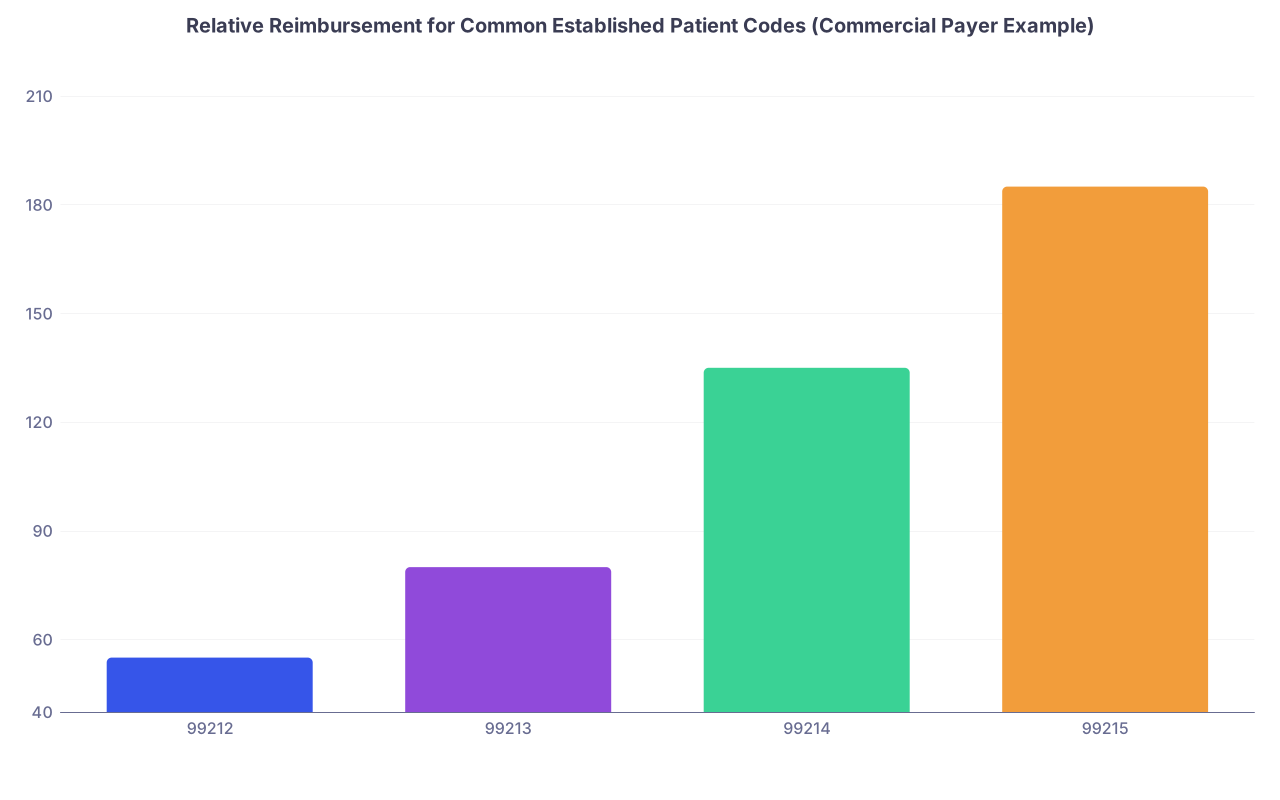
Let’s visualize a simple example: reimbursement comparison across three common follow-up codes.
| Category | Value |
|---|---|
| 99212 | 55 |
| 99213 | 80 |
| 99214 | 135 |
| 99215 | 185 |
This hypothetical commercial fee schedule shows the same pattern I see in actual billing data: 99214 and 99215 dramatically out-earn 99213. The gap is not a few dollars. It is often 50–100% more.
The data shows:
- A clinic that overuses 99213 “to be safe” will consistently underperform financially.
- Two clinics seeing the same number of patients per day can have a 30–50% revenue difference purely based on coding distribution.
If you are starting out, your first homework assignment is simple:
Audit your own distribution of 99212/99213/99214/99215 over a month. If 99214s are not at least equal to or greater than 99213s for a typical internal medicine/FP clinic, you probably have a documentation/coding problem, not a patient-mix problem.
2. New vs Established Visits: The Front-Loaded Revenue Spike
New patient codes (99202–99205) are disproportionately valuable. The RVUs jump significantly from 99203 to 99204 and 99205.
Typical pattern:
- 99203: roughly 2.3 RVUs, maybe ~$100 from Medicare, ~$140 commercial
- 99204: roughly 3.3 RVUs, maybe ~$150 from Medicare, ~$200+ commercial
- 99205: ~3.8–4.0 RVUs, ~$200 Medicare, $250–$320 commercial
For a new practice building a panel, your first year revenue is heavily influenced by:
- What percentage of your schedule you allocate to new visits
- How high you can legitimately code those new visits based on documentation (and real medical necessity)
This is also why many systems obsessively track “new patient slots.”
Here’s the catch: the new‑visit premium is temporary. Once the panel matures, your mix shifts heavily toward established follow‑ups. That is when undercoding follow-ups really starts to hurt.
I have seen clinicians start in year one with stellar revenue per visit because of a high new-patient load, then stagnate in year three when the mix swings towards 99213-heavy chronic care follow-ups that are coded too low.
New practice planning mistake I see repeatedly:
Physician builds a pro forma assuming “X visits per day” at a blended reimbursement that assumes a high percentage of new-patient codes. Reality in year 3: visit volume similar, but distribution has shifted and reimbursement per visit has quietly dropped 10–20%.
You need to explicitly model:
- Year 1: high new-patient ratio (maybe 25–35% of visits)
- Year 2–3: stabilized panel (new patients drop to 10–20% of volume, follow-ups dominate)
If your business plan does not include that shift in reimbursement patterns, your cash flow projections are fantasy.
3. Payer Mix: Why the Same CPT Code Has Four Different Values
Same CPT code. Four patients. Four payers. Four different allowed amounts.
That is daily reality.
A simple fictional but representative example for CPT 99214:
- Medicare: $100 allowed
- Major commercial A: $140 allowed
- Major commercial B: $120 allowed
- Medicaid: $60 allowed
- Self-pay: $175 cash rate (with possible discount plans)
Let’s lay this out as a quick comparison.
| Payer Type | Approx Allowed Amount (USD) | Relative to Medicare |
|---|---|---|
| Medicare | $100 | 1.0× |
| Commercial A | $140 | 1.4× |
| Commercial B | $120 | 1.2× |
| Medicaid | $60 | 0.6× |
| Self-pay | $150–$180 (before discount) | 1.5–1.8× |
The pattern is not subtle. In many markets:
- Medicare sits near the reference point.
- Large commercial plans pay 120–160% of Medicare.
- Medicaid often pays 40–70% of Medicare.
- Self-pay can be whatever you set, but collection rate and discount policies matter.
So, what does the data show when you combine CPT distribution with payer mix?
Let’s assume:
- Clinic A: 50% commercial, 30% Medicare, 20% Medicaid
- Clinic B: 20% commercial, 40% Medicare, 40% Medicaid
Both see the same number of 99214 visits. Clinic A will have a materially higher revenue line. By 20–30% or more, depending on contracts.
That is why when someone says “I see 18 patients a day,” it means nothing to me until I see:
- CPT distribution
- Payer mix
- No-show rate / denial rate
If you are starting a private practice, payer contracting is not just “sign up with everyone.” The reimbursement patterns for the same common codes will determine whether your clinic survives or just grinds you down for minimal margin.
4. Common Outpatient Codes Beyond E/M: Small Volume, Big Leverage
For many specialties, E/M is only half the story. Procedure and add‑on codes change the economics completely.
Some typical outpatient examples:
Mental health:
- 90791 (diagnostic eval)
- 90833/90836 (psychotherapy add‑on to E/M)
Primary care / internal medicine:
- 93000 (EKG with interpretation)
- 36415 (venipuncture)
- 99406/99407 (smoking cessation counseling)
Endocrinology / primary care:
- CGM interpretation codes, diabetes self-management education codes
Cardiology:
- 93306 (complete echo)
- 93224 (Holter monitoring)
Each of these has its own reimbursement pattern and its own bundling/edit rules. Some pay well. Some pay almost nothing. Some sound good in theory but collapse once you factor staff time and denial rates.
Take a simple primary care add-on: tobacco cessation 99406/99407.
- 99406 (3–10 minutes): Medicare around $15–$20
- 99407 (>10 minutes): Medicare around $25–$30
For a busy primary care clinic, capturing that code 5–10 times per day, properly documented and billed, adds a real increment. But only if:
- The documentation meets requirements
- Staff and physician consistently remember to add it
- Your payers actually reimburse it (some bundle, some deny)
Same story with care management codes (e.g., 99490 for chronic care management). On paper, they look fantastic. In real practices I have reviewed, they either:
- Add a six-figure revenue line when implemented rigorously with dedicated staff and workflows
- Or generate a trickle of revenue with a massive administrative burden and poor capture rate
The pattern you care about as a new practice owner is not “what codes exist,” but:
- Which codes you can integrate into your actual workflow
- Which codes have reliable reimbursement from your payer mix
- Which codes have high denial rates unless documentation is perfect
You do not need a menu of 50 CPTs. You need a short, prioritized list of 5–10 non-E/M codes that fit your clinic’s services and pay reliably.
5. Time-Based vs Complexity-Based Coding: How Patterns Shift After 2021
The 2021 E/M guideline changes shifted office/outpatient visits (99202–99215) to be based mainly on:
- Medical decision making (MDM), or
- Total time on the date of the encounter
This has changed reimbursement patterns in a predictable way:
- High‑complexity cognitive specialties (psych, rheum, complex IM) can legitimately justify more 99214/99215 and 99204/99205 codes using total time or MDM.
- Physicians who are overly conservative or stuck in pre‑2021 mindset still undercode, leaving 15–30% revenue on the table.
Typical pattern in data I have seen:
- Pre‑2021: Many doctors had a heavy 99213 distribution.
- Post‑2021 in optimized practices: Shift toward more 99214 for legitimately complex chronic care or high total time.
The risk is not “audits if you code 99214.” The real risk is inconsistent documentation. If your note says “simple, stable chronic issue, 5 minutes” and you code 99214 repeatedly, then yes, the pattern looks suspicious. If your notes clearly show multiple chronic conditions, medication management, risk discussions, and 30+ minutes of work, 99214/99215 becomes entirely defensible.
New private practice reality: your EHR templates and workflows must be aligned to support either:
- MDM-based coding documentation (problems, data, risk), or
- Time-based coding (total time on the day, with all qualifying activities)
Whichever you use, you want reproducible patterns that reflect your true cognitive work, not physician anxiety.
6. Denials, Downcoding, and Net Realization: The Dark Side of the Pattern
Gross charges are meaningless. What you care about is:
- Allowed amount (after contract adjustments)
- Collected amount (after denials, patient non-payments, write-offs)
Here is where CPT code patterns get uglier. I regularly see:
- High initial coding (e.g., lots of 99215)
- But a significant fraction downcoded by payers or lost in denials
- Resulting in net revenue that looks more like a 99213 practice than a 99214/99215 practice
To quantify it, you should be tracking at least:
- Denial rate per CPT code
- Downcode rate (billed × vs paid as y)
- Net collection rate per code (collected ÷ allowed)
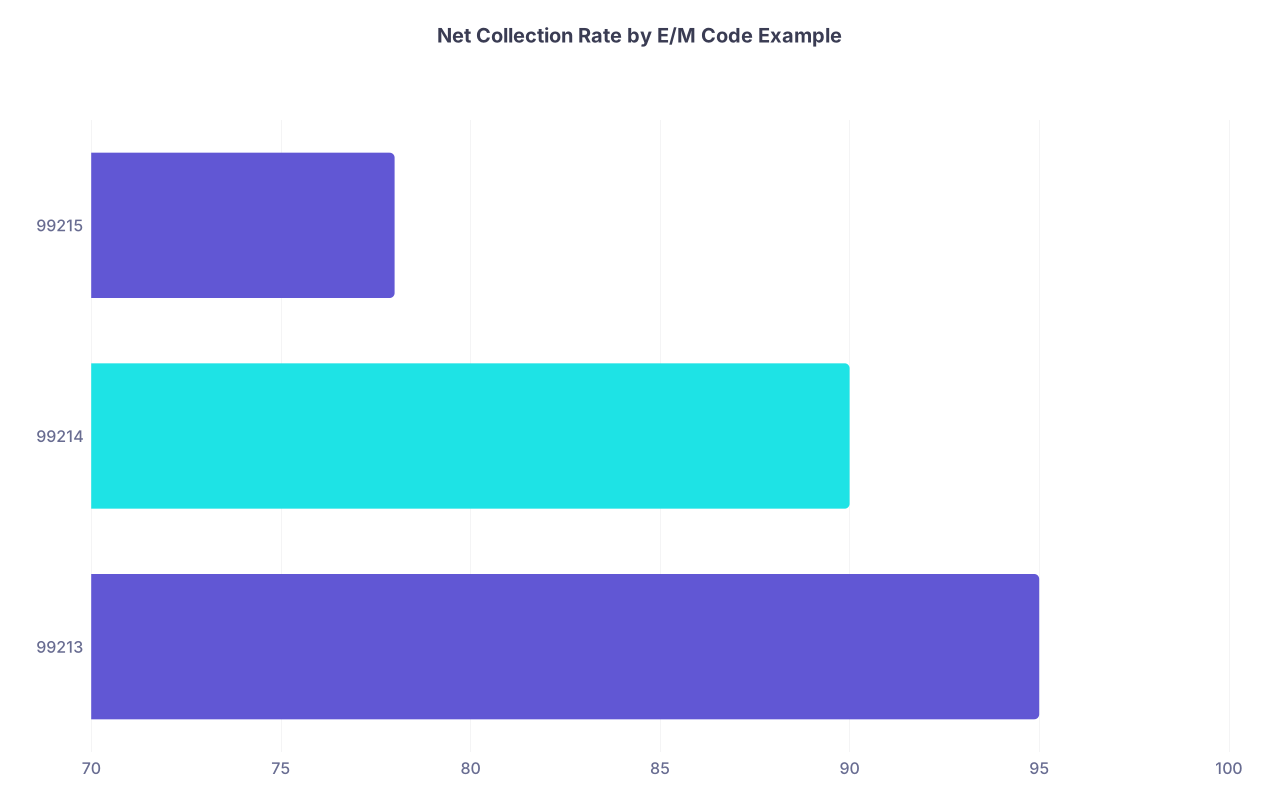
Let’s illustrate with a very simplified example for a high-complexity clinic:
| Category | Value |
|---|---|
| 99213 | 95 |
| 99214 | 90 |
| 99215 | 78 |
Hypothetical but realistic scenario:
- 99213: 95% net collection (few denials, low scrutiny)
- 99214: 90% net collection (occasional documentation issues)
- 99215: 75–80% net collection (frequent downcoding or extra audit attention)
Even after accounting for a lower collection rate, 99215 still out-earns 99214 in absolute dollars if used appropriately. But if your documentation is weak and 25% of 99215s are downgraded to 99214 or 99213, the pattern changes. You do more work, but the revenue pattern collapses.
For a new private practice, you want a “clean” pattern:
- High first-pass payment rate
- Low denial rate
- Minimal downcoding
That usually means:
- Good coding education early
- Tight feedback loop with your billing company or in-house billers
- Regular code-level reporting, not just top-line revenue
7. Building Your Own Reimbursement Dashboard When You Start Practice
If you want to run a private practice like a business, you need data, not vibes. At minimum, your monthly reporting should break down:
- Top 10 CPT codes by volume
- Top 10 CPT codes by revenue
- Average reimbursement per CPT, by payer
- Coding distribution for key E/M codes (99213 vs 99214 vs 99215; 99203–99205 for new)
- Denial rates by CPT code and top denial reasons
This is not rocket science, but most small practices never set it up. They run on “total collections” and maybe RVUs if they are lucky. That is blunt. You want granular.
What you are looking for in the patterns:
- Are you underusing higher codes where documentation supports them?
- Are some payers systematically underpaying a code relative to contract?
- Are some adjunct codes (e.g., EKG, smoking cessation, psychotherapy add-ons) undercaptured?
Even in year one of private practice, a simple monthly Excel extract from your billing system with:
- CPT
- Payer
- Charge
- Allowed amount
- Paid amount
- Denial code
…can tell you more truth than any anecdote from colleagues.
8. Strategic Implications for a New Private Practice
Let me be blunt. Starting a private outpatient clinic post‑residency without understanding reimbursement patterns is financial Russian roulette.
Your strategy should align with the patterns we have covered:
Panel building and scheduling
Reserve real new-patient capacity in year 1–2 to capitalize on higher new-visit reimbursement. But build realistic projections that assume a shift toward established follow-ups in later years.Coding culture from day one
Do not “fix coding later.” If you start with chronic undercoding, you build bad habits, and your financial baseline becomes artificially low. That is harder to correct once your lifestyle and clinic overhead adapt to that lower revenue.Payer selection and contracting
Run basic math. If Medicaid in your state pays 40–50% of Medicare and your overhead is not ultra-lean, a high Medicaid panel will crush your margin. Some practices accept this by mission. That is fine. But do not pretend the pattern does not exist.Service line decisions
Before you add a “new service”—say in-office testing, minor procedures, group visits—get actual fee schedule data for the relevant CPTs from your top payers. Half of the “great ideas” I see for added services collapse once you put real reimbursement numbers against staff and equipment costs.Guardrails on complexity creep
Chasing higher-level codes without infrastructure (good notes, pre-visit planning, MA support) leads to burnout. Better strategy: optimize workflows so that legitimate higher-complexity visits are fully captured, while lower-complexity visits run efficiently rather than bloated.
FAQ (4 Questions)
1. How many patients per day do I need in private practice to be financially viable?
The answer depends far more on your CPT and payer mix than the raw number. A clinic seeing 14–16 patients per day with a heavy 99214/99205 mix and mostly commercial/Medicare can out-earn a clinic seeing 22–24 patients per day dominated by 99213 and Medicaid. Run a simple model: multiply expected visit counts by realistic allowed amounts for your main codes and payers. That will tell you far more than any generic “patients per day” target.
2. Should I ever intentionally undercode to avoid audit risk?
Systematic undercoding is a slow financial bleed. You essentially give insurers a discount that was never requested. Audit risk comes from patterns that are inconsistent with your documentation and peers, not from accurately coding complex visits as complex. A better strategy is to align your documentation, templates, and workflows to support the level you are legitimately providing and periodically audit your own charts.
3. Is it worth building chronic care management or other care coordination services in a small startup practice?
Only if you are willing to commit operational resources. The codes (like 99490) look attractive on paper, but they require structured workflows, staff time, and meticulous documentation. In a solo or micro-practice with minimal staff, they often underperform. The data I see shows they work best in practices that dedicate specific staff and time to them rather than trying to “bolt them on” casually.
4. How often should I review my CPT reimbursement data once my practice is open?
Monthly, at minimum, during the first 1–2 years. Early on, patterns change quickly: you add payers, adjust scheduling, and refine coding habits. A monthly review of CPT-level revenue, payer mix, and denial patterns lets you correct course before small leaks become chronic losses. Once stable, quarterly deep dives are usually enough, with monthly top-line monitoring.
Two final points.
First, reimbursement patterns for common outpatient CPT codes are not mysterious. They are measurable, repeatable, and heavily influenced by your own choices—coding, scheduling, payer mix, and service design.
Second, if you want your private practice to survive past the enthusiasm phase, treat those patterns like vital signs. Track them. Question them. Adjust based on what the data shows, not what you hope is happening.