
It’s March 31st, 4:30 PM.
Your last day as an employed physician at a large hospital system. HR already took your badge. You got the awkward goodbye cake. Tomorrow, your dream starts: opening your own private practice.
You walk to your car, relieved. “At least I do not have to worry about malpractice,” you think. “The hospital always took care of that.”
That thought right there is how people get destroyed.
Because while you’re thinking about lease negotiations, EHR vendors, and credentialing… the malpractice coverage you think you have may quietly evaporate underneath you. And six months later, a letter arrives: Request for medical records in anticipation of litigation. From a patient you saw two years ago as an employee.
Now you find out—in the worst possible way—what “claims-made” and “tail coverage” actually mean.
Let me walk you through the traps I’ve seen physicians fall into when they jump from employed to private. These aren’t hypothetical. I’ve watched people write six‑figure checks because they didn’t read a single line in their contract. Don’t be that person.
1. Assuming “I’m Covered Because I Was Employed”
This is the most common and most expensive mistake.
You think:
“I was an employee. The hospital carried malpractice. So if I get sued for something that happened back then, it’s their problem.”
Sometimes you’re right.
Sometimes you’re very wrong.
Here’s what trips people up:
- Many employed positions use claims-made malpractice coverage.
- Claims-made = the policy only covers you if:
- The incident happened while the policy was active and
- The claim is filed while the policy (or tail) is still active.
When you leave?
- The policy ends.
- New claims from your employed period aren’t automatically covered.
- Unless there’s tail coverage (or you roll into a compatible prior-acts policy).
Red flags you’re missing
Go look at your employment contract. If you see any of these phrases and don’t fully understand them, that’s a problem:
- “Claims-made policy”
- “Provider responsible for purchase of tail coverage upon termination”
- “Tail coverage contingent upon completion of X years of service”
- “Occurrence coverage” vs “claims-made coverage”
If your attitude has been, “They handle that,” you’re setting yourself up for a blindside. Employers handle what’s in their interest, not your future exposure once you leave.
2. Not Understanding Claims-Made vs Occurrence (Before You Sign Anything)
You’re about to leave your employed job and buy your own coverage for your new private practice. This is where confusion multiplies.
You must understand one thing cold: claims-made vs occurrence. If you gloss this over, the insurance broker will happily sell you something that leaves a lethal gap.
| Feature | Claims-Made Policy | Occurrence Policy |
|---|---|---|
| Trigger for coverage | Date the claim is **made** | Date the incident **occurred** |
| Need tail? | Yes, when you leave/switch policies | No, tail not required |
| Typical cost early | Lower first year, increases over time | Higher from day one |
| Risk when leaving | High if tail not purchased | Low, coverage stays with incident date |
Where people screw this up
Scenario I’ve seen too many times:
- Your employer’s policy = claims-made.
- You leave and buy your own occurrence policy for your new private practice.
- You wrongly assume: “I have malpractice now, so I’m fine.”
No. You’re only covered for new incidents after that policy starts.
You are not covered for:
- Past charts from your employed job
- Old complications that haven’t surfaced yet
- Anything where the care occurred before your new policy start date
If your employer doesn’t give you tail (or you don’t buy it yourself), you’re walking around with years of uncovered exposure.
3. Counting on Employer-Paid Tail Without Reading the Fine Print
You heard in orientation: “We cover malpractice; you don’t need to worry.” You think that includes tail coverage.
Sometimes it does. But usually with strings attached.
Common booby traps buried in contracts:
- Tail coverage only if:
- You complete the full term (e.g., 3 or 5 years)
- You’re not terminated “for cause”
- You don’t voluntarily resign before a certain date
- You don’t go work for a competing entity within X miles
So what happens?
- You leave at 2 years and 11 months.
- Or you move across town to start a direct competitor solo practice.
- Or your contract is “non-renewed” for fuzzy “performance” reasons.
Now you learn: you owe $60,000–$120,000 for tail. Today. In one big, ugly payment.
Do not gloss over this
Pull your contract and look for a section titled:
- “Professional Liability Insurance”
- “Malpractice Coverage”
- “Tail Coverage”
- “Extended Reporting Endorsement”
Look for specific language about:
- Who pays for tail (you vs employer)
- Under what conditions
- What happens if you resign vs they terminate you
If that language isn’t crystal clear, assume the worst and negotiate before you ever sign… not the month you’re trying to open your practice.
4. Creating a Dangerous Coverage Gap During the Transition
There’s a quiet, deadly period during your move from employed to private: the coverage gap.
It happens like this:
- Your employed policy ends on your last day.
- Your new private practice policy starts on your first day seeing patients in the new practice.
- But you’re still:
- Covering call
- Giving phone advice
- Refilling prescriptions
- Reviewing labs
- Seeing patients at a side location, locums, or moonlighting
If any of that clinical activity happens in a period where:
- Old policy ended, and
- New policy not yet active
…those encounters may be completely uninsured.
And yes, plaintiffs’ attorneys will absolutely argue that your “casual” refill or phone advice contributed to harm.
The ugly in-between days
Watch out for these setups:
- You technically stop employment March 31, but:
- HR “forgets” to tell you your policy cancels that same day.
- You keep messaging with old patients “as a courtesy” for a few weeks.
- You haven’t started your new policy yet because “I’m not really open yet.”
Or:
- You start “soft opening” the private practice:
- A few buddies and family, a couple of cash visits.
- You think, “I’ll turn on formal coverage once volume is higher.”
That is reckless. One complication, one bad outcome, and you’re personally exposed.
5. Buying New Coverage Without Securing Your Prior Acts
Here’s another trap: you rush to buy a new malpractice policy for your brand‑new private practice… and never talk about prior acts.
If your previous job used a claims-made policy and no tail is being provided, you have two real options:
- Buy tail on the old policy, or
- Get your new insurer to cover your prior acts (aka “nose coverage”).
Physicians skip this step constantly. They call a broker, say “I’m starting a practice, need malpractice,” and the broker sets up a straightforward policy starting on Day 1 of your new practice. No prior acts. No tail conversation.
Result:
- Years of your career (all those charts, all those procedures) — totally uncovered once that employer policy ends.

| Category | Value |
|---|---|
| First-Year Premium | 25000 |
| Tail Coverage | 80000 |
| Prior Acts Surcharge | 15000 |
| Risk Management Discount | -5000 |
Numbers vary by specialty and state, but the pattern is consistent: tail/prior-acts decisions are where you get crushed financially if you don’t plan.
Questions you must ask your new carrier
- “Can you provide prior-acts coverage back to my first date of practice in this state?”
- “Will you pick up prior acts from my employed position with XYZ Health?”
- “What documentation do you need from my old carrier?”
- “What date are you willing to set as the retroactive date?”
If the answer is effectively “No, we’ll just start fresh,” then you know you also need to handle tail on your old policy. Or accept a massive uncovered risk (bad idea).
6. Ignoring “Retroactive Date” and Thinking It’s Just Legalese
There’s one almost throwaway-looking line in every malpractice policy: the retroactive date.
You either understand this, or you get burned.
In a claims-made policy, the retroactive date =
The earliest date back in time that this policy will cover incidents from, as long as the claim is made while the policy is active (or tail is in place).
If your retroactive date is:
- 07/01/2021, then:
- Incident in 2020? Not covered.
- Incident in August 2021? Covered (if claim is made while policy active).
Physicians screw this up when:
- They switch carriers and don’t make sure the new carrier keeps the old retroactive date.
- They let coverage lapse, then re‑start later, resetting the retro date.
- They change states/specialties and assume prior acts automatically carry over (they don’t always).
So when you move from:
- Hospital-employed → private practice, or
- One private job → your own practice
You must lock down your retro date like your life depends on it. Because someday, it might.
7. Overlooking Shared Limits and Corporate Coverage Issues
Another subtle landmine: who actually owns the policy and the limits at your old job?
At many hospital systems:
- You’re insured under a shared limits policy with:
- The hospital
- The group
- Maybe dozens of other physicians
That’s fine while you’re there. But when you leave:
- The coverage may not follow you individually.
- The entity may still control defense decisions.
- There may be zero incentive for them to prioritize your reputation over the hospital’s.
Also, if you had any side work (moonlighting, part-time locums, med director roles) and assumed they were covered under your employer policy? Big assumption. Frequently wrong.
When a claim shows up later, you might find:
- The old employer’s insurer says, “This wasn’t within the scope of your employment.”
- Or, “We’ll defend the hospital. Your individual exposure is separate.”
You do not want to be sorting this out after service of process.
8. Letting HR or Admin “Explain” Coverage Instead of Reading the Actual Policy
Another classic mistake: you let HR or a practice manager summarize your coverage.
You hear lines like:
- “We’re fully covered; we have claims-made with tail.”
- “Don’t worry, you’re on our system’s policy.”
- “We’ve never had an issue with this.”
Translation: they’ve never read the policy either.
You need:
- The certificate of insurance with:
- Claims-made vs occurrence
- Retroactive date
- Limits of liability
- The section of your employment contract on malpractice
- If possible, at least the relevant pages of the actual policy or summary plan documents
Then you—or your own attorney—review:
- Who is the named insured (you or the entity)?
- Who pays for tail, under what conditions?
- What practice locations and activities are covered?
- Is there any exclusion that’s relevant to your new work?
Nice people in HR are not your risk managers. They’re not going to be sued personally. You are.
9. Failing to Synchronize Coverage with Credentialing, Hospital Privileges, and Contracts
Here’s another way physicians create coverage gaps: they treat malpractice as a checkbox instead of a timeline.
Common mess:
- You’re credentialing with multiple hospitals and payers for your new private practice.
- Each one has:
- Different start dates.
- Different requirements for proof of coverage.
- You start seeing patients at your office before you’re fully credentialed everywhere.
- Your malpractice start date doesn’t match when you actually started providing care.
Or, with locums/part‑time while building your practice:
- You assume the locums company covers you for everything at that site.
- But your separate private practice entity isn’t covered under that policy.
- Now you’ve got procedures done in one place, follow-ups in your office, and a confused web of who’s covering what.
You want crystal clear lines:
- Which policy covers which setting?
- What are the exact start dates?
- Where do the retro dates sit?
If your malpractice agent shrugs and says, “You’re probably fine,” that’s your cue to slow down and get it in writing.
10. Underestimating the Financial Punch of Tail (and Not Planning for It)
This one hits people who are otherwise careful: they don’t budget for tail.
Typical ballpark (varies by specialty, state, claims history):
- Tail coverage often costs 150%–300% of your annual claims-made premium.
- High-risk specialties (OB, neurosurg, interventional anything) can see:
- $60,000–$150,000+ tail bills.
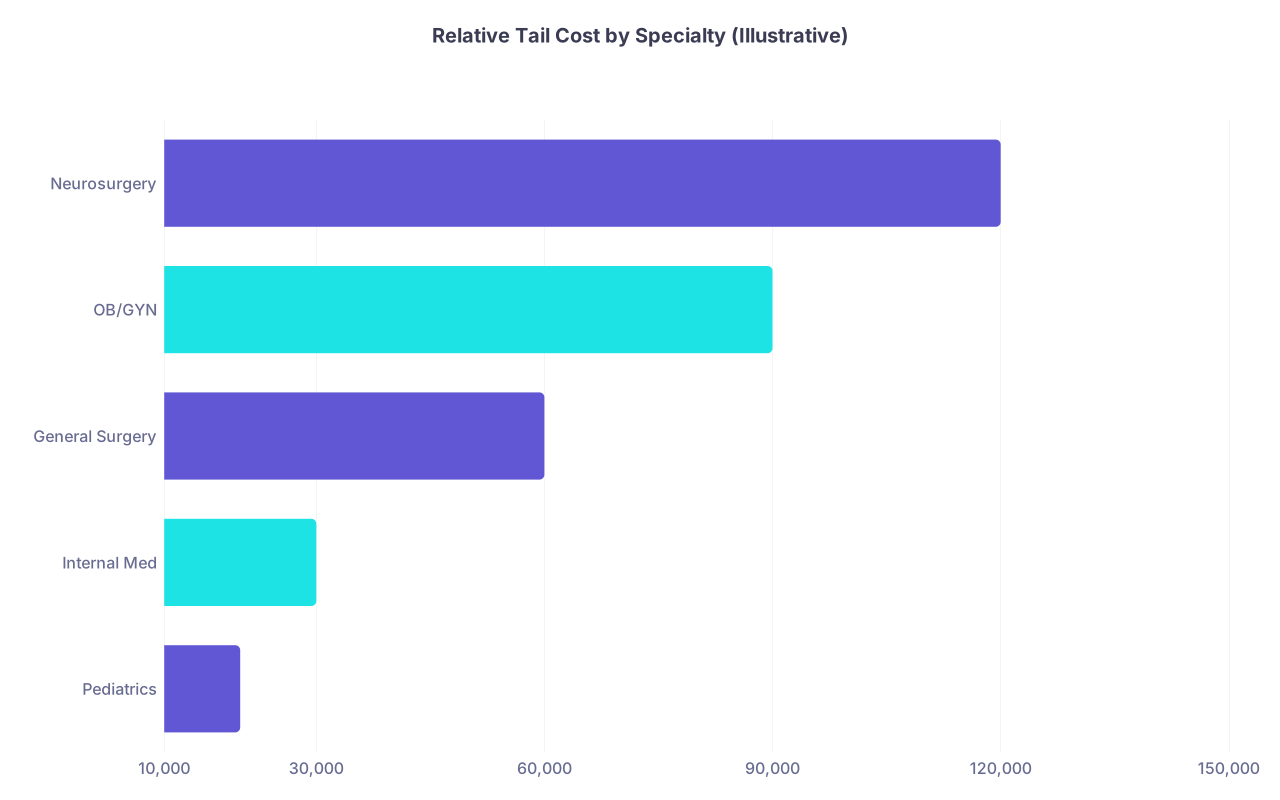
| Category | Value |
|---|---|
| Pediatrics | 20000 |
| Internal Med | 30000 |
| General Surgery | 60000 |
| OB/GYN | 90000 |
| Neurosurgery | 120000 |
If you walk away from a job to start a practice without understanding:
- When tail is due
- How much it will be
- Whether you can pay over time (usually no)
- Whether a new carrier could pick up prior acts more cheaply
…you can cripple your new practice before it opens.
I’ve seen people:
- Take out personal loans
- Burn through retirement accounts
- Delay opening for a year
All because they didn’t solve tail coverage strategically before resigning.
11. Concrete Steps to Avoid Getting Burned
Let’s cut the theory and get practical. Here’s the sequence you should follow when planning your jump from employed to private practice.

| Step | Description |
|---|---|
| Step 1 | Decide to leave employed job |
| Step 2 | Pull contract and COI |
| Step 3 | Identify claims type and retro date |
| Step 4 | Confirm conditions in writing |
| Step 5 | Get tail quotes and prior acts options |
| Step 6 | Engage malpractice broker |
| Step 7 | Align new policy start and retro date |
| Step 8 | Confirm no coverage gaps |
| Step 9 | Then resign and start practice |
| Step 10 | Who pays tail? |
Step-by-step (don’t skip these)
Get your documents
- Employment contract
- Any amendments
- Latest certificate of insurance
- Any communication from risk management about coverage
Clarify your current situation
- Claims-made or occurrence?
- Current retroactive date?
- Who is responsible for tail in your contract, and in what scenarios?
Talk to your current employer’s risk management in writing
- “On separation, will the organization provide tail coverage for my prior acts?”
- “Under what circumstances would I be responsible for tail?”
- “What event triggers termination of my coverage—last day worked, last day on payroll, or other?”
Engage your own malpractice broker or attorney
- Not the broker who only works for the hospital or group.
- Someone who will walk through:
- Tail vs prior-acts options
- Cost projections
- Impact on your new policy’s retroactive date
Price out all scenarios before you resign
- Tail cost if you leave at X date
- Cost of new policy with prior acts coverage
- What happens if there is a short coverage gap (hint: don’t allow one)
Align the timing
- Make your last day with the employer and first day of your new policy seamless, no gap.
- If you’re taking a break from practicing, consider a part‑time or suspension option, not just “no coverage.”
Lock all understandings in writing
- Email from risk management confirming tail terms
- Binder/quote from new insurer with:
- Retro date clearly stated
- Confirmation of prior acts, if provided
FAQs
1. If my former employer says they’ll “take care of malpractice,” do I still need to buy tail?
Maybe, maybe not. That phrase means nothing legally. You need explicit confirmation that:
- They maintain a claims-made policy that includes your prior acts, and
- They will provide tail at separation, regardless of reason, or maintain coverage for incidents during your employment, even after you leave.
If that’s not spelled out in your contract or written policy documents, assume you may need your own tail or prior-acts coverage.
2. Can my new private practice malpractice policy cover my old employed work?
Sometimes yes, if the new carrier agrees to provide prior-acts coverage back to your original retro date. That usually costs extra and requires underwriting and documentation from your prior carrier. If they refuse, you’ll still need tail on the old policy. Never assume prior acts is automatic—get it in writing from the new insurer.
3. What if I’m taking 6–12 months off between jobs—do I really need coverage then if I’m not seeing patients?
If you had a claims-made policy and new claims could arise from that prior period, yes, you need ongoing protection via:
- Tail on the old policy, and/or
- A new policy that assumes prior acts.
Even if you’re not actively practicing, lawsuits can be filed for care you provided years ago. The clock for malpractice isn’t tied to your current work status; it’s tied to when the claim is made and what coverage is active at that time.
4. Is occurrence coverage always better than claims-made?
Not always. Occurrence is simpler (no tail needed), but:
- It’s usually more expensive up front.
- It may not be available in all markets or specialties.
- If you’re in a group that only uses claims-made, you may not have a real choice.
The “best” approach is whatever gives you continuous coverage (no gaps), reasonable cost, and a clear plan for what happens when you eventually leave that job or retire.
Key takeaways:
- Do not leave an employed job for private practice until you know exactly who is covering your prior acts, what your retro date is, and whether you need tail.
- Do not allow even a single uncovered day between your old policy ending and your new policy (or tail/prior acts) beginning.
- Do not trust verbal assurances—get coverage terms, tail responsibility, and dates in writing before you hand in your resignation.