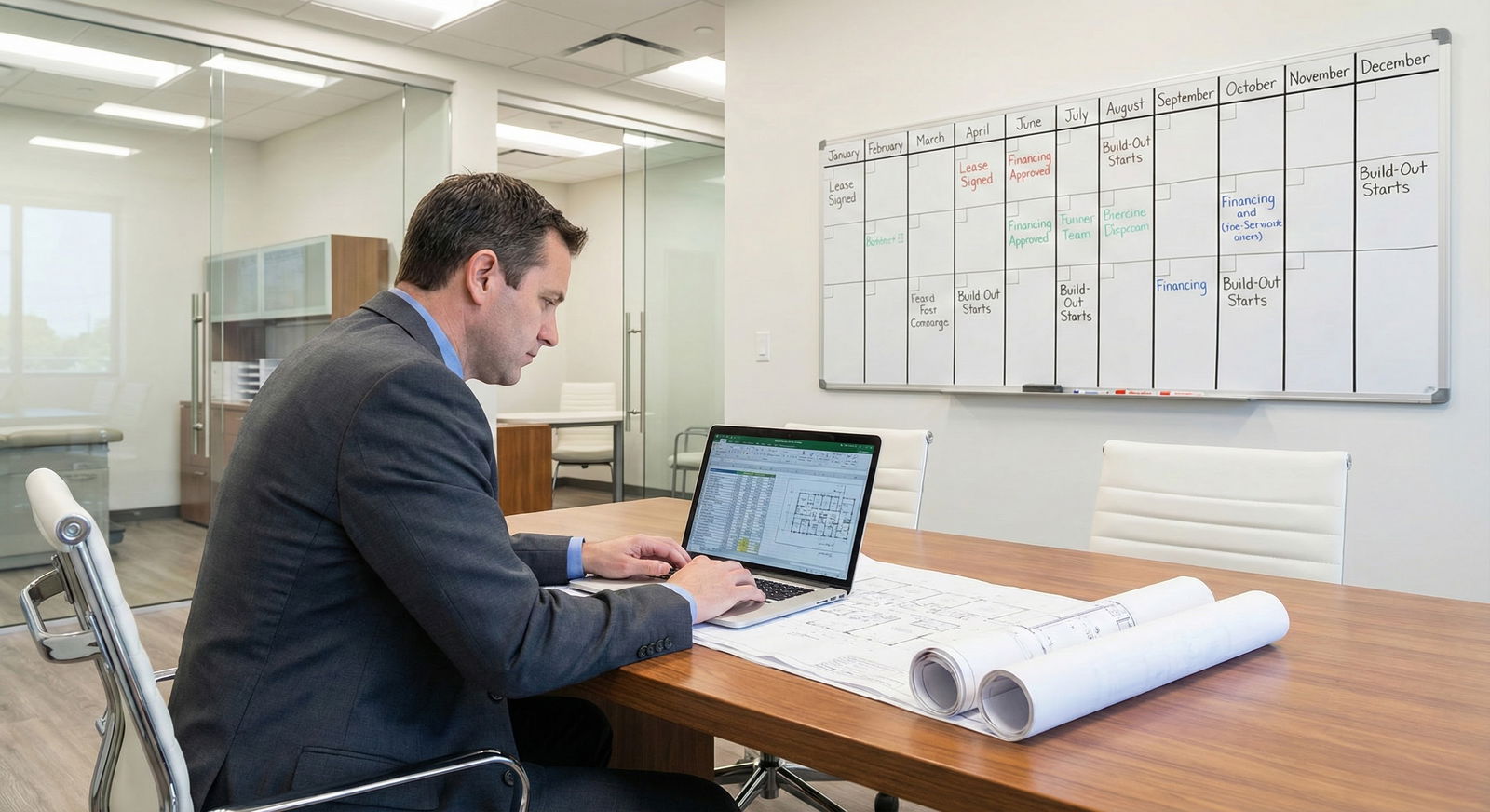
The magical “three exam rooms per doctor” rule is wrong for most modern clinics.
You do not start with a number. You start with how you actually practice, then back into the room count with math and brutal honesty about your habits.
Let’s walk through it like someone who has to sign the lease and pay the build‑out.
The Short Answer: Use This Formula First
Here’s the core framework I use with physicians planning outpatient space:
Exam rooms needed per provider ≈
(Visits per hour × Visit length mix factor × Buffer) ÷ Room utilization
In plain English:
- Decide how many patients you actually want to see per hour.
- Look at how long your typical visits really take.
- Add a realistic buffer for no‑shows, late patients, and small delays.
- Accept that no room is used 100% of the time. Apply a reasonable utilization rate (usually 0.65–0.8).
You’ll almost always land between 2 and 4 exam rooms per full-time provider, depending on specialty and style.
But instead of hand‑waving, let’s plug numbers into real scenarios.
Step 1: Define Your Target Clinic Throughput
Start with your visit volume goals. Not what the hospitalist told you. Your real target.
Most new outpatient docs fall into one of these camps:
| Practice Style | Visits/Day | Visits/Hour (8-hr day) |
|---|---|---|
| Concierge/Direct Primary | 8–12 | 1–2 |
| Relationship-Heavy IM/FM | 14–18 | 2–2.5 |
| Standard Primary Care | 18–24 | 2.5–3.5 |
| Procedure-Heavy Specialty | 12–18 | 1.5–2.5 |
| High-Throughput Urgent | 28–40 | 4–5 |
Pick your lane. If you do not consciously choose, the math will choose for you—and you will hate it.
Let’s say you’re starting an outpatient internal medicine practice and your target is 18 patients/day over 8 hours.
That’s about 2.25 patients/hour. Round to 2–3/hour for planning.
Now we layer in visit lengths.
Step 2: Be Honest About Visit Lengths
Most “15‑minute visits” are fiction.
Count from when the MA brings the patient back to the moment you walk out ready for the next patient. Not just your face‑time.
Typical patterns:
- New visit: 30–45 minutes of room occupancy
- Established follow‑up: 15–20 minutes
- Simple acute visit: 10–15 minutes
- Procedure: 20–45+ minutes (sometimes with nurse time before/after)
Assume this realistic mix for a general adult primary care clinic:
- 20% new: 35 minutes
- 60% standard follow‑up: 20 minutes
- 20% quick visits: 12 minutes
Weighted average exam room time:
(0.2 × 35) + (0.6 × 20) + (0.2 × 12)
= 7 + 12 + 2.4
= 21.4 minutes per visit of room time
Now we know: each visit occupies a room for about 21 minutes.
Step 3: Convert That into Room Demand Per Hour
Now tie it to your throughput target. Using the example:
- 2.5 visits/hour × 21 minutes/visit ≈ 52.5 minutes of room time needed per hour.
One room only gives you 60 minutes/hour.
So:
- With 1 room: you’re at 52.5/60 = 87.5% utilization
- With 2 rooms: 52.5/120 = 44% utilization
Both extremes are bad.
87.5% utilization is fantasy in healthcare. One late patient and the whole morning is toast.
44% utilization suggests you might be leasing more space than you need.
For outpatient, a room utilization of 65–80% is the sweet spot. That usually means:
- Primary care / standard outpatient: 3 rooms per full-time provider
- Procedure‑heavy or slower‑paced: 2–3 rooms per provider
- High‑throughput urgent care: 3–4 rooms per provider
Let’s put that in a clean comparison.
| Clinic Type | Visits/Hr | Avg Room Time/Visit | Rooms/Provider |
|---|---|---|---|
| Concierge/DPC | 1–2 | 30–40 min | 1–2 |
| Standard Primary Care | 2–3 | 18–22 min | 2–3 |
| High-Throughput Primary | 3–4 | 12–18 min | 3–4 |
| Procedure-Heavy | 1.5–2.5 | 25–35 min | 2–3 |
| Urgent Care | 4–5 | 10–15 min | 3–4 |
Step 4: Factor in MAs, Nurses, and Workflow (This Changes the Math)
The number of rooms you “need” is only half the equation. The other half is how many staff you have to move patients through those rooms.
If you have:
- 1 MA for 1 doctor: you can support about 2 rooms efficiently
- 2 MAs for 1 doctor (or 1 MA + 0.5 RN): you can often support 3–4 rooms
Why? Because of what actually happens:
- MA is rooming Patient A in Room 1
- You’re seeing Patient B in Room 2
- Patient C is checking in or waiting to be roomed
- The MA is also doing vitals, prior auths, cleaning rooms, giving vaccines
More rooms only help if staff can keep them turning over.
I’ve seen this mistake repeatedly:
Doc builds 4 exam rooms “for growth,” hires 1 MA, and wonders why clinic still bottlenecks. The bottleneck is staff, not rooms.
So tie room count to staffing:
- 1 MA per provider → plan for 2 exam rooms/provider to start
- 1.5–2 MA equivalents per provider → 3 exam rooms/provider
- Highly efficient urgent care with scribes + 2 MAs → 3–4 rooms/provider
Visual: How Rooms Change Your Hourly Capacity
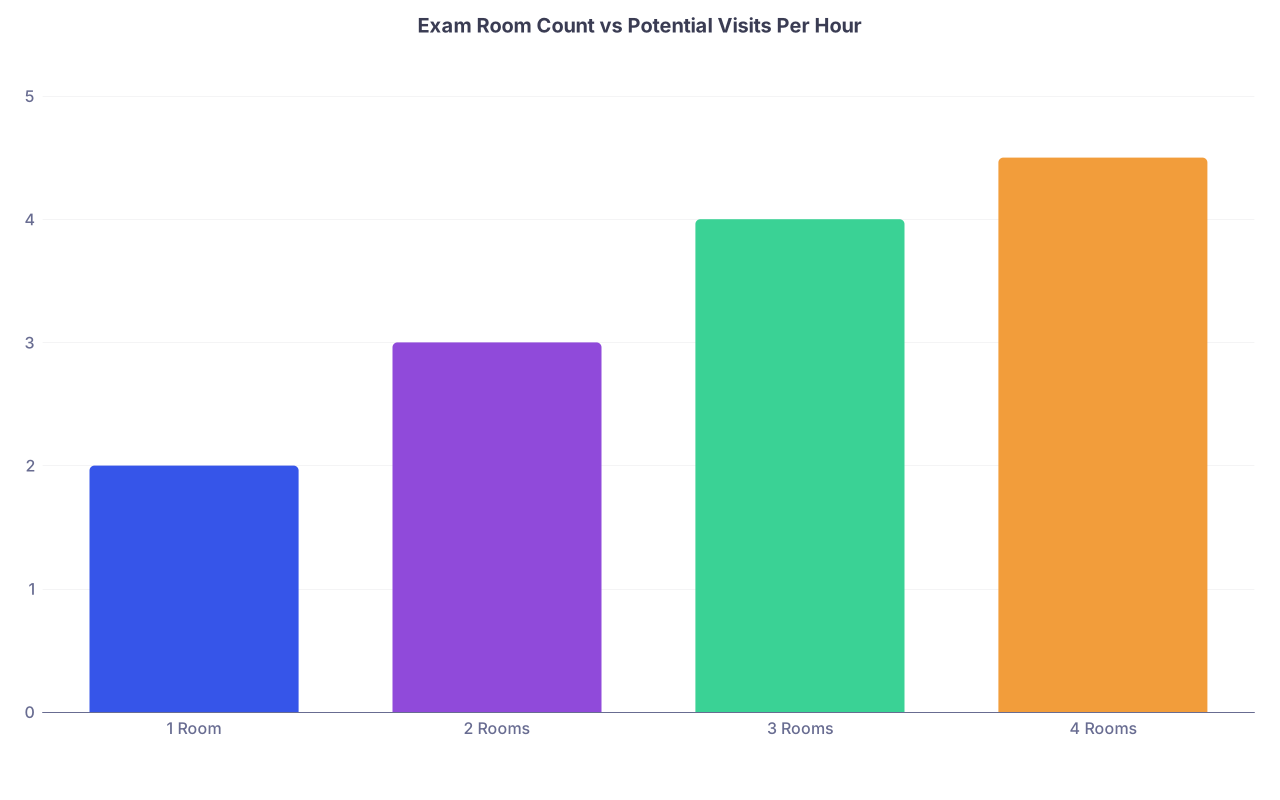
| Category | Value |
|---|---|
| 1 Room | 2 |
| 2 Rooms | 3 |
| 3 Rooms | 4 |
| 4 Rooms | 4.5 |
This assumes efficient staffing and a mix of 12–20 minute visits. You hit diminishing returns after 3–4 rooms per provider in most outpatient settings.
Step 5: Scale Up – Total Rooms for a Multi‑Provider Clinic
Once you know rooms per provider, multiplying up is straightforward. The trap? Assuming every provider is full‑time and always in clinic.
Look at:
- How many days each provider is actually in clinic
- Shared rooms vs dedicated rooms
- Staggered schedules (am/pm, certain days off, procedure blocks)
Example: 2‑physician primary care clinic
- Each works 4 days/week
- Each in clinic 32 hours/week
- Practice style: standard primary care, 2.5–3 visits/hour
- You want 3 rooms per full‑time equivalent
Total FTE: 2 providers
Baseline: 2 FTE × 3 rooms = 6 exam rooms
Could you get away with 5? Maybe, if:
- One physician does procedures in a dedicated procedure room part‑time
- Your MA ratio is strong (2 MAs/provider)
- You’re okay occasionally waiting on rooms during peaks
If you’re designing for sanity and growth, 6 exam rooms for 2 busy primary care docs is reasonable.
Now compare that to a small specialty office: 1 full‑time specialist + 1 NP, with slower visits.
They might be comfortable with:
- 2 rooms for the physician
- 2 rooms for the NP
- Occasional flex/shared use
Total: 4 exam rooms.
Special Cases: Where the “Standard” Numbers Fail
1. Concierge / Direct Primary Care
Here the limiting factor is you, not the rooms.
- 6–10 patients/day, lots of talk, complex chronic cases
- You can function beautifully with 1–2 exam rooms
- A third room is usually a luxury, not a necessity
2. Procedure‑Heavy Clinics
Derm, pain, GI procedures, office‑based ortho, etc.
You often want:
- At least 1 dedicated procedure room
- 1–2 standard exam rooms for consults and follow‑ups
So a solo doc might land at:
- 2 normal exam rooms + 1 procedure room = 3 total clinical rooms
- Or 3 exam rooms + 1 procedure room if you’re doing high volume
3. Urgent Care / Walk‑In
Here throughput is king.
- Target 3–5+ patients/hour per provider
- Shorter visits but heavy variability
A solid model:
- 3–4 exam rooms per provider, high MA staffing
- 6–8 exam rooms for 2‑provider urgent care
Room Size and Layout: Why 6 Small Rooms Beat 4 Huge Ones
You do not get paid for how big the room is. You get paid for how many usable treatment stations you have.
Priorities:
- Keep exam rooms standard sized and simple (8x10 or 9x10 is common)
- Put a team workroom in the center with line of sight to all rooms
- Keep supply storage standardized in each room to reduce hunting time
Larger “showpiece” rooms are mostly ego tax unless you’re doing lots of in‑room procedures or family conferences.
Workflow Diagrams: What Actually Happens with 3 Rooms
Here’s what an efficient 3‑room flow looks like for one provider and 1.5–2 MA equivalents:

| Step | Description |
|---|---|
| Step 1 | Check in |
| Step 2 | Room 1 - Vitals |
| Step 3 | Room 2 - Vitals |
| Step 4 | Room 3 - Waiting |
| Step 5 | Provider in Room 1 |
| Step 6 | Provider in Room 2 |
| Step 7 | Room 3 Next Patient |
| Step 8 | MA cleanup Room 1 |
| Step 9 | MA cleanup Room 2 |
| Step 10 | Provider in Room 3 |
The key: there is always a “next patient” ready or nearly ready. You are not wandering the hallway looking for the MA.
Common Mistakes I See (And How Many Rooms They Actually Needed)
Overbuilding “for growth”
- New solo doc builds 6–8 rooms. Uses 2. Pays overhead on 6.
- Reality: should have started with 3 exam rooms + 1 procedure/overflow.
Underbuilding due to lease costs
- Two providers, 4 rooms total. Constant bottlenecks.
- Reality: 5–6 rooms would allow them to hit their RVU and income targets faster and with less stress.
Ignoring staff ratios
- 4 rooms per provider, 1 MA. Rooms sit empty; doc does vitals.
- Reality: with that staffing, 2–3 rooms are the maximum usable.
Copying hospital clinic layouts
- Big health systems often design clinics around “pods” with 6–8 rooms and 2–3 providers sharing.
- In private practice, you need to be more ruthless with space and build what you can staff and fill.
A Simple Decision Table You Can Use Today
Grab your practice plan and plug yourself into this:
| Your Situation | Start With This Many Rooms |
|---|---|
| Solo concierge/DPC | 1–2 |
| Solo primary care, moderate pace | 3 |
| Solo primary care, high throughput | 3–4 |
| Solo specialist, some procedures | 3–4 (incl. 1 procedure) |
| 2 PCPs, both 4 days/week | 5–6 |
| 1 PCP + 1 NP/PA (lighter schedule) | 4–5 |
| 2 urgent care providers per shift | 6–8 |
Could you deviate from this? Sure. But now you know what you’re trading off.
Financial Angle: Rooms vs Revenue
One more harsh truth: slightly “too many” rooms is usually less costly than too few.
Why?
- One extra room might add, say, $200–400/month in rent and build‑out cost amortization.
- But if that extra room lets you see even 1 more patient/day at $120 net revenue, that’s ~$2,400/month.
So being under‑roomed is often the more expensive mistake long‑term.
Here’s a rough revenue visualization:
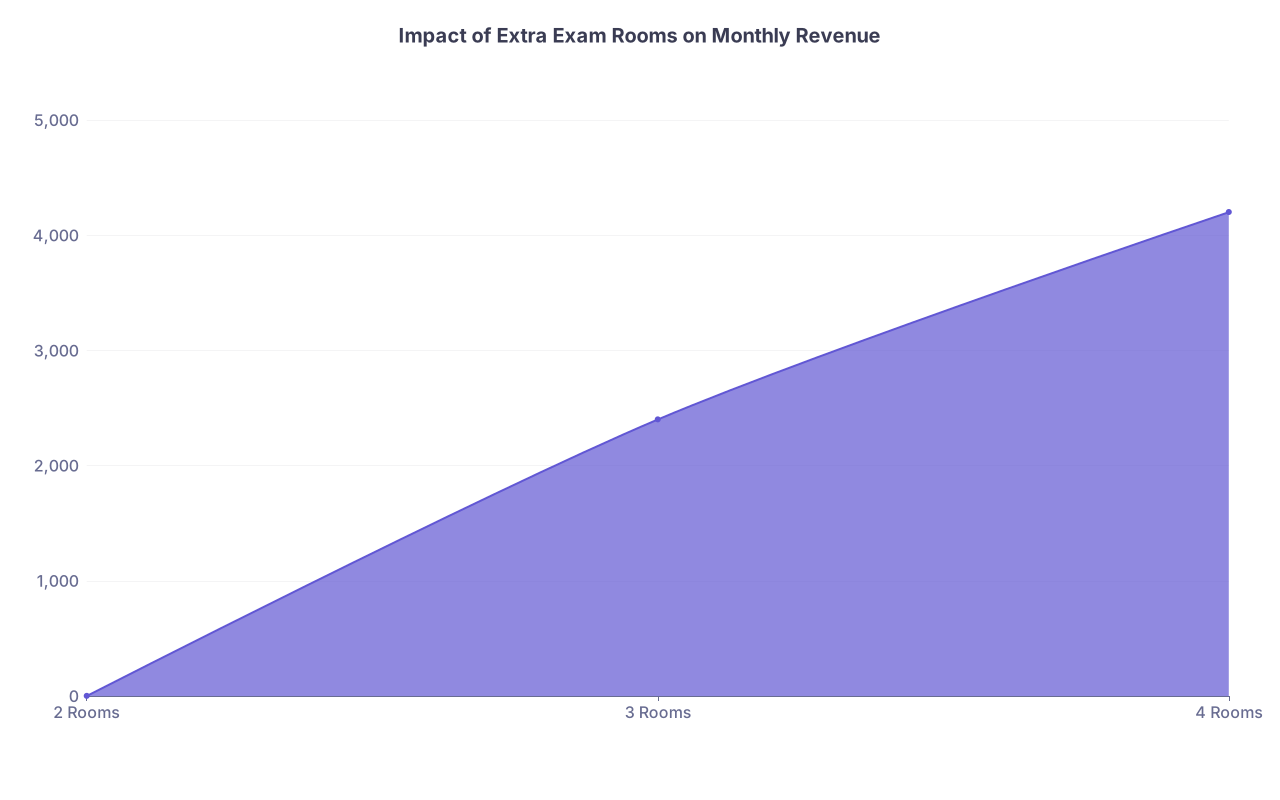
| Category | Value |
|---|---|
| 2 Rooms | 0 |
| 3 Rooms | 2400 |
| 4 Rooms | 4200 |
Assumptions: each added room, when properly staffed, enables an extra 1–2 patients/day per provider.
How to Sanity-Check Your Plan Before You Build
Before you sign anything:
Simulate one half‑day on paper
- Write out a 4‑hour schedule with realistic visit types.
- Assign each visit to a room and time block.
- See where you run out of rooms.
Walk the flow physically
- In an empty space or even at home, mark “rooms” with tape.
- Pretend to be MA, patient, and provider.
- You’ll quickly feel where the bottlenecks are.
Ask your future MA or nurse
- They know where rooms get jammed up in their current clinics.
- They’ll tell you if 2 rooms feels suffocating for your visit style.
Plan for year 3, not month 3
- Design enough rooms that, with proper staffing, you can hit your intended mature volume.
- You can always grow staffing and schedule into the space. Adding rooms later is harder.
FAQ: Exam Room Count for New Private Practices
What’s the absolute minimum number of exam rooms for a new solo primary care clinic?
Technically, you can function with 2 exam rooms, but you’ll feel cramped as soon as your schedule fills. If you have any ambition to see more than 10–12 patients/day, 3 rooms is the realistic minimum for efficient flow.If I start with fewer rooms, can I just add more later?
Maybe, but it is rarely as simple as knocking down a wall. You’ll often be constrained by your lease footprint, plumbing, and building codes. Easier and cheaper to build one extra room now than to attempt a mid‑lease expansion with construction, downtime, and re‑inspection.Should midlevels (NP/PA) get the same number of rooms as physicians?
It depends on their schedule and complexity. If an NP is seeing a similar visit mix and volume as a physician, they’ll usually need the same room count (2–3). If they’re part‑time or doing mainly chronic care management with longer visits, 2 rooms may be enough.Do telehealth visits change how many exam rooms I need?
Only if you commit to meaningful telehealth volume. If 20–30% of your visits are truly telehealth and scheduled that way, you can sometimes get by with one fewer room per provider. But most clinics overestimate telehealth and end up needing the standard 2–3 rooms anyway.How many rooms do I need if I’m mostly doing procedures?
You need at least one dedicated procedure room plus 1–2 regular exam rooms for consults and follow‑ups. So a procedure‑heavy solo practice realistically lands at 3–4 clinical rooms total, depending on whether you batch procedures on certain days.What if I can’t afford the ideal number of rooms right now?
Then design your schedule and business model around that reality. With fewer rooms, you must accept either lower volume, longer days, or a slower growth curve. In that scenario, focus on higher‑value visits, consider membership/retainer models (like DPC), and plan a clear path to expanding room count in your next lease.
Open your draft floor plan or clinic wishlist right now and write a hard number at the top: “X exam rooms per full‑time provider.” If it says fewer than 2 or more than 4, rework your staffing and visit volume assumptions until the math—and your sanity—line up.