The fastest way to kill a brand‑new medical practice is to offer everything at once.
If you just finished residency and you’re building your first practice, you don’t need a “full-service clinic.” You need a focused, profitable core service that’s dead simple to deliver, easy to schedule, and pays reliably.
Let’s walk through exactly which services to offer first, which to delay, and how to make those calls without guessing.
Step 1: Decide Your Core Service Line (One Main Thing)
You start a practice with one primary engine of revenue and patient flow. Not five. Not “a little of everything.”
Your first service line should be:
- High demand in your local area
- Reimbursed reliably (by payers your patients actually have)
- Operationally simple (minimal staff, equipment, and prior auth chaos)
- Closely aligned with what you did all day in residency
Here’s what that looks like by specialty.
| Specialty | First Core Service |
|---|---|
| Family Medicine | Chronic disease follow ups |
| Internal Med | Complex adult medical management |
| Pediatrics | Well child + vaccine visits |
| Psychiatry | Med management (30 min) |
| OB/GYN | Outpatient gyn care + prenatal |
| Ortho | New consults + basic injections |
| Neurology | Headache/neuropathy clinics |
If your gut response is “I want to do all of that plus procedures,” slow down. You’re opening a business, not a training program.
How to pick your core service in 20 minutes
Grab a notepad and answer:
- What did I do most often in my last year of residency/fellowship that I can do fast and safely on my own?
- In my city, what are primary care docs begging for in consults/referrals? (Ask two you know.)
- What do local hospital discharge planners constantly need follow‑up for?
Now cross out anything that:
- Requires large capital (C‑arm, endoscopy, lasers, etc.)
- Is dominated by massive local groups with locked-in contracts
- Is a documentation nightmare you already hate
You’ll be left with 1–2 realistic options. Pick ONE as the main service your website and referrals talk about.
Step 2: Anchor Around High‑Value Visit Types
Your first six months should be built around a small menu of visit types. Not a giant drop‑down in your EMR with 49 visit reasons.
Think like this:
- 2–3 bread‑and‑butter visits that drive volume
- 1–2 higher-paying or longer visits that justify your expertise
- A clear pathway for follow‑ups
Here’s a practical template you can adapt.
| Visit Type | Description | Typical Time |
|---|---|---|
| New Patient | Comprehensive intake | 40–60 min |
| Established Short | Simple follow up | 15–20 min |
| Established Long | Multiple issues/complex | 25–30 min |
| Procedure/Other | Only 1–2 key procedures | 20–30+ min |
For most physicians, the smartest starting services are:
- New patient evaluations
- Follow‑ups for chronic conditions
- Med management
- One or two simple, high‑yield procedures you can do in your sleep (e.g., joint injections, biopsies, IUDs, skin procedures, etc.)
Don’t start with:
- Complex multi‑hour procedures
- High‑risk, high‑liability services you’ve never billed independently
- “Concierge plus insurance plus telehealth plus weight loss plus aesthetics” all at once
You can expand later. For now, you want flow.
Step 3: Make It Boringly Billable (Insurance vs Cash)
I’ve seen too many brand‑new practices try to build a cash‑only boutique clinic in a market that clearly doesn’t support it. Or the opposite: signing every insurance contract under the sun and drowning in denials.
Here’s a clean way to structure your first service mix.
If you’re starting insurance‑based
Your first services should be ones that:
- Use common CPT codes payers know and pay well
- Have low prior authorization friction
- Have clear documentation rules you already understand
Examples:
- Primary care: 99203–99215 office visits, chronic care, AWVs
- Psych: 90792, 99213 + 90833, etc.
- Ortho: New/established consults + basic injections (20610 + J‑codes)
Avoid “billing experiments” your first months. Get really good at a small CPT set, build templates, and have your staff trained on those codes only.
If you’re starting cash‑based
Your first services should be:
- Easy to explain to patients (“$X per visit, here’s what it includes”)
- Not dependent on labs/imaging contracts you don’t have yet
- Clearly valuable to your target patient group
Examples:
- Simple membership model (primary care access, telehealth, in‑office visits)
- Flat‑fee new consults + follow‑ups (psych, functional medicine, fertility counseling)
- Discrete packages (e.g., “migraine evaluation + 1 month follow‑up” for neuro)
Don’t start with underpriced “all‑you‑can‑eat” memberships. Charge sustainably from day one, even if you feel guilty. That guilt is how doctors lose money.
Step 4: Pick “First Add‑On” Services Strategically
After you define your core service, your early add‑ons should do one of two things:
- Increase revenue per existing patient
- Deepen loyalty and retention (so patients never leave your funnel)
Here’s how that looks in practice.
Smart early add‑ons by specialty
- Family med / IM: basic in‑office procedures (skin biopsies, joint injections), simple weight management counseling, vaccines
- Peds: vision/hearing screening, behavioral consult blocks, sports physicals
- Psych: therapy partnerships (not you doing it; you coordinating), group visits, structured ADHD evaluations
- OB/GYN: in‑office ultrasounds (as volume grows), colposcopy, contraceptive procedures
- Ortho: ultrasound‑guided injections (once volume and skill justify equipment), bracing partnerships
Notice the pattern: these aren’t “cool toys,” they’re natural extensions of things you’re already doing. They use the same patient base and clinical flow.
Step 5: Avoid the Big Three Traps for New Practices
Three things consistently sink new practices in their first year. They all come back to choosing the wrong services too early.
Trap 1: Equipment‑heavy services before you have volume
If your first instinct is to lease a C‑arm, laser, or in‑house lab analyzer before you’ve filled a week of clinic, stop.
You want:
- Services that use an exam table, a stethoscope, basic disposables, and maybe a small procedural kit
- Imaging, labs, PT, etc. outsourced to trusted local partners initially
You can always bring services in‑house once your schedule and revenue justify the overhead.
Trap 2: Complex, unpredictable scheduling
If your first month of services needs:
- 20 different appointment types
- 5 different length slots
- Constant reshuffling
- And a scheduler with psychic powers
…you’ve already lost.
Early on, simplify. For example:
- New patient: 60 minutes
- Established short: 20
- Procedure: 30
And 2–3 common visit reasons for each. That’s it. Let your EMR and biller catch up with reality, not fantasy.
Trap 3: Chasing every “profitable” niche people mention
You’ll hear a lot of unsolicited advice: “You should do DOT physicals. Or medical spa stuff. Or weight loss injections. Or occupational medicine.”
Maybe. But only if:
- Your core target patient population actually wants it
- It aligns with your training and malpractice coverage
- The math works in your specific market (real reimbursement, real demand)
“Other doctors say it’s lucrative” is the worst possible reason to add a service.
Step 6: Use Local Data, Not Vibes, to Choose Services
You’re not guessing here. There are straightforward ways to confirm what services to offer first.
Quick local reality check (do this over 1–2 weeks)
- Call 3–5 nearby primary care or referring docs. Ask:
- “What specialty access is hardest to get for your patients right now?”
- “How long is the wait for ___ (your field) in town?”
- Ask local hospitalists / discharge planners:
- “What outpatient follow‑ups are hardest to arrange after discharge?”
- Look at local job postings for your specialty:
- What do hospital groups advertise as “high need”?
Patterns will jump out. Example: every PCP says “We can’t get our patients in to see psych for months.” That’s your sign: initial core service = med management + new evals, not “comprehensive, integrative mental health center with 12 service lines.”
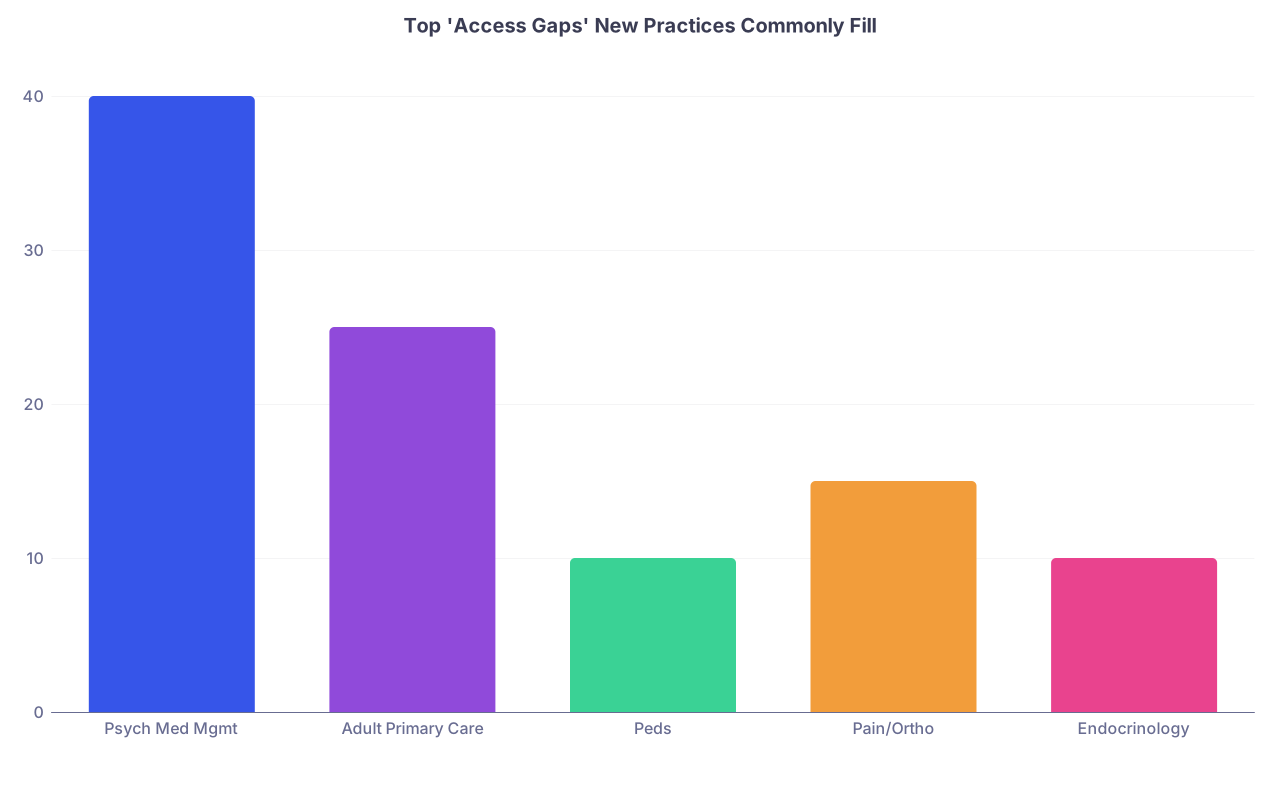
| Category | Value |
|---|---|
| Psych Med Mgmt | 40 |
| Adult Primary Care | 25 |
| Peds | 10 |
| Pain/Ortho | 15 |
| Endocrinology | 10 |
Use this data to ruthlessly cut your initial service ideas down to the ones people are actively begging for.
Step 7: Telehealth, Procedures, and “Extras” – When to Turn Them On
People get this backwards all the time. They start with telehealth for everyone, a full procedure menu, and fancy extras. Then they realize they can’t manage them operationally.
Here’s the order I recommend for most new outpatient practices:
- In‑person core visits (new + follow‑up)
- Limited telehealth for appropriate, established patients
- 1–2 simple in‑office procedures that fit your core patient base
- Extra revenue lines (cash programs, small niche services)
Telehealth: what services make sense first?
Telehealth is great for:
- Follow‑ups on stable chronic conditions
- Simple med refills with clear monitoring plans
- Brief check‑ins that don’t require an exam
Telehealth is not your first line for:
- Complex new patients
- High‑risk prescribing
- Anything documentation‑heavy where in‑person vitals and exam matter
Start with a small subset of your follow‑ups as telehealth and build from there.

| Step | Description |
|---|---|
| Step 1 | Launch core in person visits |
| Step 2 | Add telehealth follow ups |
| Step 3 | Add simple in office procedures |
| Step 4 | Add niche or cash programs |
Step 8: How Many Services Is “Enough” for Year One?
A realistic, sane year‑one service mix for a brand‑new practice looks something like this:
- 1 primary service line (e.g., outpatient psych, primary care, general ortho)
- 3–5 visit types total
- 1–3 simple procedures (or 0, if your field is pure cognitive work)
- Optional: 1 small, well‑defined cash or niche offering once volume is stable
If you can’t explain what you do in one short sentence, you’re offering too much:
- “We’re a new adult primary care clinic focused on chronic disease management and same‑week access.”
- “We’re an outpatient psychiatry practice specializing in med management for adults.”
- “We’re an orthopedic clinic focused on sports injuries and basic joint injections.”
That clarity is what drives referrals. Nobody refers to a practice that “does everything.”
Quick Service Planning Checklist
Use this to sanity‑check your initial service decisions:
- Can I describe my core service in one sentence a PCP would understand?
- Do I have 3–5 clear visit types with defined durations?
- Are my main CPT codes/fees simple and already known to payers (or simple flat cash)?
- Can I launch without buying any major equipment?
- Do at least 2–3 local docs confirm there’s a real access gap I’m filling?
- Could my front desk explain to a patient what we do in under 20 seconds?
If you’re saying “no” to multiple items, you’re overcomplicating things.

Example: Two Realistic Launch Models
To make this less abstract, here are two simple blueprints you can steal.
Example 1: New outpatient psychiatrist
Phase 1 (Months 1–3):
- Core service: adult med management
- Visits: new eval (60 min), follow‑up (30 min)
- Mix: in‑person + limited telehealth for stable patients
- No therapy by the physician; build a relationship with 1–2 therapists
Phase 2 (Months 4–12):
- Add structured ADHD diagnostic visits and standardized intake forms
- Small number of group visits (e.g., anxiety/depression skills groups)
- Consider a narrow cash service like “second opinion consults” at a premium rate
Example 2: New family medicine clinic
Phase 1 (Months 1–6):
- Core service: chronic disease and adult primary care
- Visits: new (60), established short (20), established long (30)
- Procedures: basic labs drawn on site (sent out), vaccines, blood pressure management, simple skin procedures you already perform confidently
Phase 2 (Months 6–12):
- Add structured Medicare annual wellness visits
- Start a basic, clearly priced weight‑management consult package
- Consider one higher‑skill procedure you already know well (joint injections, IUDs, etc.)
Notice what’s missing: no cosmetic services on day one, no “anything you want” menu, no complex in‑house lab or imaging.
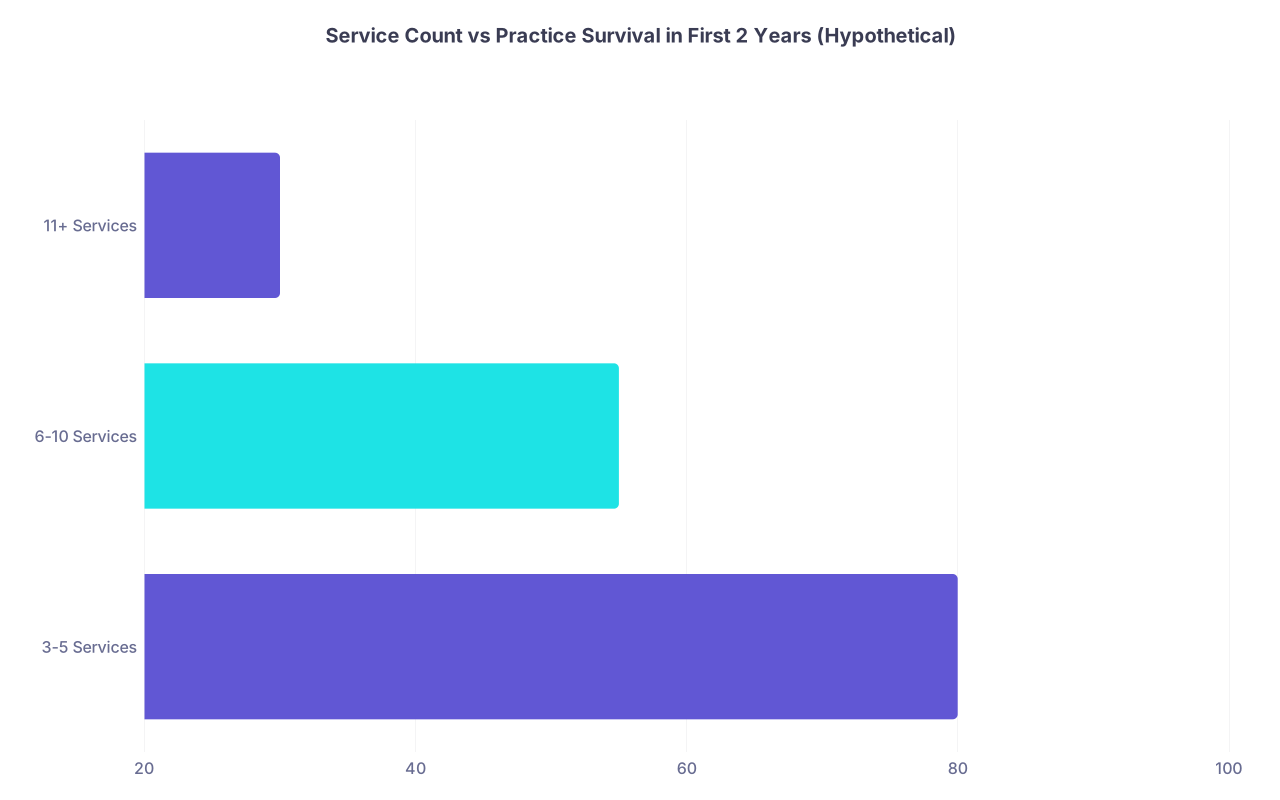
| Category | Value |
|---|---|
| 3-5 Services | 80 |
| 6-10 Services | 55 |
| 11+ Services | 30 |
FAQs
1. Should I offer urgent/same‑day visits right away?
Yes, but in a controlled way. Reserve a few short visit slots daily for urgent but appropriate issues inside your specialty. This helps fill your schedule early and makes you valuable to referring docs. Just don’t turn your entire practice into a walk‑in clinic unless that’s your intentional model.
2. How soon should I add procedures?
Once two things are true:
- Your schedule for core visits is consistently filling, and
- You’ve confirmed that procedure demand exists among your existing patients.
Start with simple procedures you’re already excellent at. Don’t use year one to “learn on patients” with complex new skills.
3. Is it a mistake to start as a cash‑only practice?
It depends entirely on your market. In affluent, urban areas with poor access to certain specialties (psych, derm, some IM subspecialties), a well‑priced, clearly defined cash model can work very well. In lower‑income or highly insured communities, going pure cash as a generalist is usually a bad idea. Talk to at least three local clinicians and one healthcare‑savvy accountant before deciding.
4. How many different CPT codes should I bill in the first six months?
As few as realistically possible. For most outpatient practices, that means: new visit codes, established visit codes, and maybe a couple of procedure codes. Get your documentation, workflows, and billing clean for those before adding complexity. Each new code is another place for payers to deny or underpay you.
5. What if I picked the wrong core service at first?
You’re not stuck. Practices pivot all the time. Watch your numbers: new patient volume, referral sources, collections per visit, no‑show rates. If after 6–9 months you’re consistently struggling, use that data to shift emphasis—maybe toward a narrower niche inside your specialty, a different payer mix, or a different patient population. The worst move isn’t choosing “wrong”; it’s stubbornly clinging to a failing service mix for years.
Open a blank page and write one sentence: “Our practice primarily exists to help [specific patient type] with [specific problems] through [specific core service].”
Then look at every service idea you’ve written down. If it doesn’t directly support that sentence, park it in a “Year 2+” column and launch without it.