What actually happens to your lifestyle, income, and autonomy if you choose solo practice over joining a group in your first job out of residency?
Let me save you some pain: this decision shapes the next 5–10 years of your life. And most residents are making it based on vibes, hearsay in the workroom, and whatever their attendings did 20 years ago.
I’ll walk you through it the way I’d talk to a PGY-3 in my office trying to sort this out.
First: Who Should Not Go Solo Right Away
Before we compare, let’s be blunt.
You probably should not start solo right out of residency if:
- You have no cash cushion and are already stressed about loan payments
- You hate business, numbers, and decisions more than you hate prior auths
- You need predictable income in the first 6–12 months (new baby, mortgage, etc.)
- You have zero interest in managing staff, leases, or vendors
- You’re in a saturated urban market where nobody knows you yet
Can you still make solo work? Yes. But you’re choosing “hard mode” on purpose. Don’t do that accidentally.
On the other hand, if you’re already obsessively tracking RVUs, asking how contracts are structured, and dreaming about building “your” clinic… solo might be exactly right. Just not in the naive, “I’ll hang a shingle and they will come” way.
Core Tradeoffs: Solo vs Group at a Glance
Here’s the real comparison people gloss over during job fairs.
| Factor | Solo Practice | Group Practice |
|---|---|---|
| Upfront Risk | High | Low to moderate |
| Income First 1–2y | Lower, less predictable | More stable, often guaranteed |
| Long-term Upside | Higher if you build well | Good but capped by structure |
| Autonomy | Maximum | Shared / limited |
| Admin Burden | Heavy (you own it) | Shared or centralized |
| Lifestyle Early | Unpredictable, heavy lift | More structured |
| Negotiating Power | You vs payers/hospitals alone | Group leverage |
If you remember nothing else: solo is freedom + risk + work. Group is stability + compromise + politics.
Step 1: Be Honest About Your Risk Tolerance and Runway
Start with two questions:
- How many months of living expenses do you have in cash (or very safe savings)?
- How much stress can you handle seeing $0 paychecks for a while?
For solo practice, especially insurance-based:
- You may have 3–6 months of low or negative cash flow
- Insurance credentialing can take 3–6 months
- Patient volume builds slower than you think
For group practice:
- You’ll usually see a paycheck within 2–4 weeks of starting
- Many have salary guarantees for 1–2 years
- You’ll plug into an existing patient panel and referral stream
If your financial runway is less than 3–4 months and you don’t have someone else’s income backing you up, going solo right away is tough. Not impossible. But you’re going to feel every delay and denial.
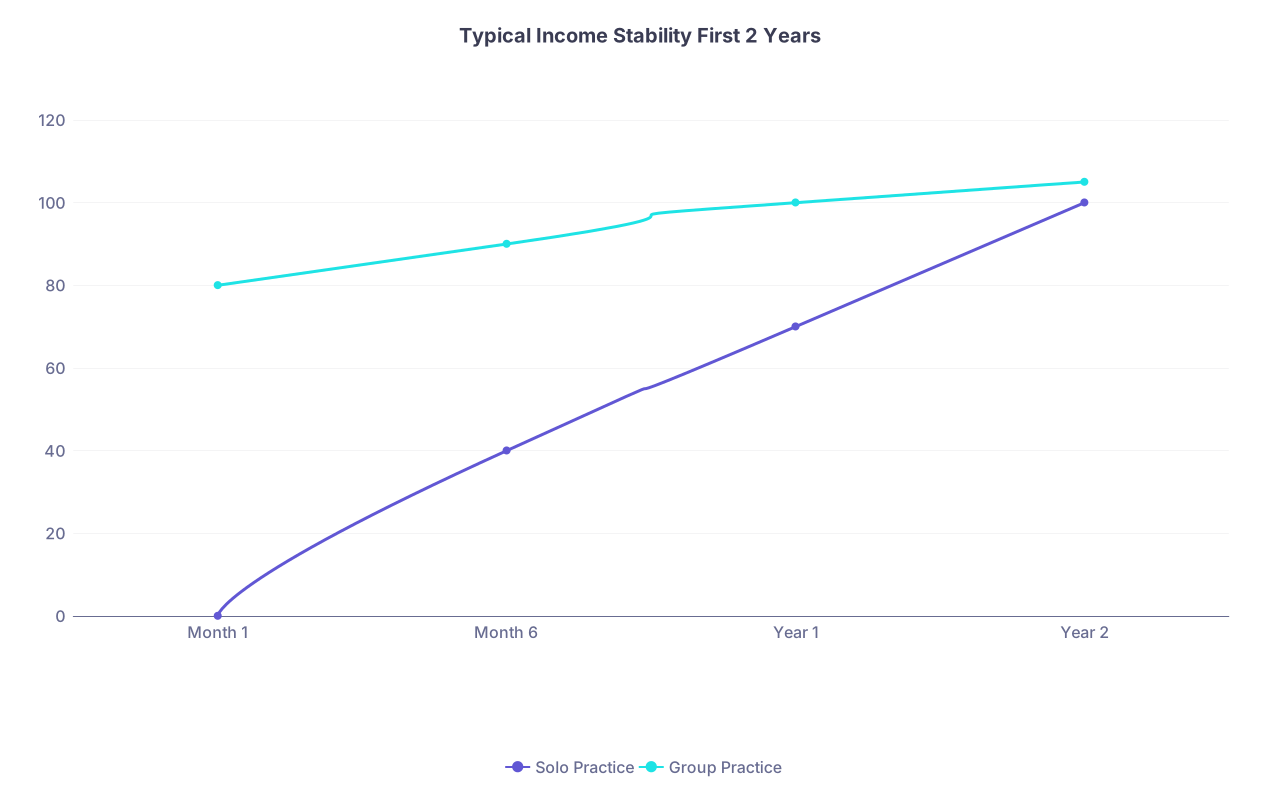
| Category | Solo Practice | Group Practice |
|---|---|---|
| Month 1 | 0 | 80 |
| Month 6 | 40 | 90 |
| Year 1 | 70 | 100 |
| Year 2 | 100 | 105 |
Interpret that: group gives more stable early income; solo catches up and can surpass if built well.
Rule of thumb:
If you’re anxious about money already, start in a group or employed model, learn, save aggressively, then reconsider solo in 2–5 years.
Step 2: Decide How Much Autonomy You Actually Want
Everyone says they want autonomy. Until it’s 10 p.m. and you’re reviewing QuickBooks and payroll instead of being off.
Here’s what autonomy really means in each setting.
Solo Practice Autonomy
You control:
- Schedule template (visit length, days, telehealth vs in-person)
- Staff hiring and firing
- Which EHR and billing system you use
- Which payers you take (or if you go direct pay)
- Clinic culture, policies, and how patients are treated
But you also own:
- HR drama and staff underperformance
- Vendor negotiations and IT disasters
- Compliance headaches and audits
- Every major decision about growth, contracts, expansion
Group Practice Autonomy
You often don’t control:
- EHR choice
- Overall clinic hours
- Call structure
- MA/ RN staffing ratios
- Compensation formula details
But you also don’t carry:
- Lease obligations
- Practice-level overhead risk
- Full responsibility for staffing gaps
- Direct payer contracting battles (usually)
Here’s how I’d frame it:
If you feel a physical reaction when you hear, “We’re changing your template to fit system standards,” and you’re already drafting alternate workflows in your head, you’re wired for a lot of autonomy.
If your response is, “Whatever, just tell me how I get paid,” you’ll probably do fine (and be happier) in a group or employment model.
Step 3: Income Reality Check – Not the Fantasy
Residents get sold two lies:
- Lie 1: “Solo practice is dead; you’ll go broke.”
- Lie 2: “Solo practice will make you rich and free in 1–2 years.”
Both are garbage.
Here’s a rough, conservative picture for outpatient specialties (FM, IM, psych, some subspecialties) in many U.S. markets:
| Year | Solo Practice (Take-home) | Group Practice (W2/Share) |
|---|---|---|
| 1 | $80–180k | $220–280k |
| 2 | $150–250k | $230–320k |
| 5+ | $250–450k+ (wide range) | $260–380k (depends on group) |
These are broad ranges. Some solo docs clear $500k+. Some can’t get past $180k because they won’t address overhead or systems. Some group partners do extremely well; some employees are capped.
The more important question:
How much volatility are you okay with if the upside comes later?
If you need predictable money now, group. If you’re okay with a lean Year 1–2 for much higher control and possible upside, solo might be worth it.
Step 4: Look at Your Market, Not Just Your Feelings
I’ve seen residents pick solo in:
- Ultra-saturated city neighborhoods where 15 clinics already fight over the same commercial plans
- Health-system-dominant regions where independent referral patterns are almost dead
Then they’re shocked it’s hard.
On the flip side, I’ve seen people crush it in:
- Secondary cities with growing populations and not enough primary care
- Suburbs where big systems are bloated and patients want something personal
- Psych and behavioral health deserts where waitlists are 6–9 months long
Do some basic due diligence:
- How many independent practices of your specialty exist nearby?
- Are health systems buying everything, or are independents surviving?
- What’s the payer mix like? Heavy Medicaid? Mixed commercial?
- How long is the wait list for new patients in your field? Call and ask as a “patient.”
If your market is hostile to independents and you have no differentiation (e.g., niche service, language skills, specific patient population), a group practice or employment start makes more sense. Get your footing. Build a reputation. Then revisit.
Step 5: Use a Simple Decision Framework
Let’s stop hand-waving and make this concrete. Here’s a quick framework.
You probably should start in a group/employed model if:
- You have <3–4 months of expenses saved
- You want predictable schedule and income for the next few years
- You don’t care deeply about owning the business side
- You’re in a dense urban / health-system-dominant market
- You’re not sure where you want to live long-term yet
And you can still:
- Learn how billing, RVUs, and contracts work
- Watch how your group manages staff, overhead, and growth
- Build your name, referral relationships, and patient base
- Save aggressively so solo is an actual option later
You should seriously consider solo (or micro-group) practice early if:
- You have 6–12 months of runway or a solid secondary household income
- You care a lot about how care is delivered, not just about salary
- You’re in a market with clear unmet demand
- You’re willing to learn basic business, billing, and operations
- You’d rather own headaches than be told what to do
If that’s you, solo can be incredibly rewarding. But do it with eyes open and a concrete plan, not vibes and a logo on Canva.
Step 6: Consider a Hybrid Path (That Most Residents Ignore)
People think the choice is binary: solo vs big group.
There are at least three hybrid paths that are often smarter:
Start employed, then spin off.
Work for a hospital or large group for 2–4 years:- Pay down high-interest debt
- Save a real runway
- Learn systems, contracts, and payer games
Then open your own shop with less fear and more leverage.
Join a small group with real partnership track.
Not all groups are “mini-hospitals.” Some are genuinely physician-owned with transparent partnership. You get:- Shared risk
- Shared overhead
- Mentorship
- Eventual equity and governance voice
Start micro-solo with low overhead.
For some specialties (especially psych, therapy-heavy fields, some consultative practices), you can:- Start with subleased space or part-time office
- Use lean tech stacks (EHR + telehealth + simple billing)
- Build slowly without hiring a huge team on day one

| Step | Description |
|---|---|
| Step 1 | Finish Residency |
| Step 2 | Employed or Group Job |
| Step 3 | Solo or Micro-Solo Start |
| Step 4 | Partner in Group |
| Step 5 | Later Open Solo Practice |
| Step 6 | Grow to Small Group |
| Step 7 | Join Larger Group Later |
You don’t have to marry your first job choice. But it will shape your options.
Step 7: Non-money Factors That Actually Matter Long Term
Money and autonomy always dominate this conversation. But burnout and lifestyle often come from other things.
Ask yourself:
Do I want colleagues around daily?
Solo can be isolating. Some people love the quiet. Some get depressed.How much do I value mentorship?
First few years out, having senior partners to bounce off is incredibly useful. In solo, you’re building your own informal advisory network.How do I handle responsibility?
In solo, when your front desk quits, that’s your problem. When your server goes down, also your problem. Some people thrive on that; some absolutely don’t.Am I okay learning through mistakes that directly hit my wallet?
Wrong hire, bad lease, poor payer mix—those are expensive lessons. In a group, you’re shielded from many of those early.

| Category | Value |
|---|---|
| Loss of control | 80 |
| Admin overload | 70 |
| Income stress | 60 |
| Isolation | 50 |
Solo often amplifies control and admin load. Groups often amplify loss of control and system friction. Pick your poison.
If You’re Leaning Group: How to Avoid Getting Screwed
If you’re going group/employed (which is what most should do initially), don’t just sign the first shiny offer.
Key things to scrutinize:
- Is there a clear, written path to partnership or is it “we’ll see”?
- How is compensation calculated after any guarantee period?
- Who owns ancillaries (imaging, labs, infusion, etc.)?
- Non-compete terms: radius + duration + realistic enforcement in your state
- Call burden and how it’s compensated (or not)
You’re trading equity and autonomy for stability and mentorship. Make sure the trade is fair, not lopsided in favor of the “founders” who stopped taking call 7 years ago.
If You’re Leaning Solo: Minimum Viable Plan
If you’re stubborn (or brave) enough to go solo early, don’t romanticize it. You need at least:
- A 12–24 month cash flow projection with conservative assumptions
- A realistic patient volume ramp (not “I’ll be full in 3 months”)
- Credentialing timeline mapped out before you open doors
- A basic marketing plan (website, Google presence, referral outreach)
- One or two mentors who’ve actually run a small practice, not just talked about it
And be ready to live frugally at first. Most solo success stories come from people who accepted a lean lifestyle for a couple of years while they built something valuable.

Quick Reality Snapshots by Specialty
Not exhaustive, but patterns I keep seeing:
- Psychiatry / mental health: Solo or micro-group is very viable. Telehealth, cash-pay, and hybrid models can work extremely well.
- Primary care (FM/IM): Solo can work, especially in underserved or suburban areas, but you need a strategy: DPC, value-based contracts, or very lean overhead. Group/employed is the common starter path.
- Procedural specialties (GI, cards, ortho, ENT): Starting truly solo day one is harder. Capital requirements, equipment, and OR / ASC relationships push you toward groups or employment initially.
- Hospital-based (anesthesia, radiology, EM): You’re usually joining a group or being employed by a system. “Solo” here often just means locums or 1099.

FAQs
1. Is it a bad idea to start solo immediately after residency?
Not automatically, but for most people, yes, it’s a high-risk move. If you don’t have savings, business curiosity, and a supportive market, it’s a rough road. The safer and usually smarter path is to work in a group/employed setting for a few years, learn the business, and build financial runway, then reassess.
2. How much money do I need saved to consider opening a solo practice?
Bare minimum, I’d want 6 months of personal living expenses plus practice startup costs (build-out, equipment, software, initial payroll, marketing) covered or financed with a clear repayment plan. More realistically, 9–12 months of personal runway makes the stress much more tolerable, especially with insurance-based models where cash flow is delayed.
3. Will I make more money in solo or group practice long term?
Long term, solo or small-group ownership typically has higher upside, but also higher variance. You can absolutely out-earn many employed peers if you build an efficient, well-run practice with good payer mix and volume. But you can also underperform a solid group-comp package if you mismanage overhead, staff, or contracts. There’s no guaranteed “richer path,” only different risk/return profiles.
4. What about joining a hospital system instead of a private group?
Hospital employment is basically a group practice with extra bureaucracy. Pros: strong benefits, predictable income, no ownership risk, sometimes loan repayment. Cons: more control from non-physician administrators, slower change, less entrepreneurial upside. Many people start there to stabilize and later move into independent group or solo models once they know what they want.
5. How long should I stay in my first group job before considering going solo?
Assuming it’s not toxic, aim for at least 2–3 years. That gives you time to: learn the local market, understand payer behavior, see how billing and collections actually work, and build a reputation. During that time, save aggressively, watch how your practice is run, and keep notes on what you’d do differently if it were yours.
6. What are red flags in a group practice offer?
Big ones: vague or unwritten partnership track, compensation formulas nobody can explain clearly, heavy non-competes that would block you from working nearby, call schedules that are “subject to change” without defined rules, and any culture where junior docs carry heavy volume while senior partners enjoy lighter loads with disproportionate pay. If partners are evasive when you ask specific questions, walk.
7. Can I switch from group practice to solo later without burning bridges?
Yes, if you’re intentional and professional. Don’t build your solo practice by poaching patients behind your group’s back. Give appropriate notice, follow your contract, avoid violating non-solicit and non-compete terms, and keep relationships cordial. You’d be surprised how many future referrals and collaborations come from former partners or colleagues if you exit like an adult instead of like a thief.
Bottom line:
- Group/employed is usually the safer first step; solo is higher risk and higher potential upside.
- Your personality, risk tolerance, and local market matter more than abstract “solo vs group” debates.
- You don’t have to pick forever—start somewhere, learn aggressively, and keep your options open.