The way most residents are told to pick between joining a group practice and starting their own is backwards.
You’re being sold “stability vs autonomy” like this is some personality quiz. That’s not what’s really driving the decision. Behind closed doors, this comes down to leverage, money flow, and how much hidden risk you’re quietly signing your name under in year one.
I’ve heard the conversations partners have about you when you leave the interview. You haven’t. That’s what we’re going to fix.
What actually happens when you join a group practice
Let me start with the thing attendings don’t say out loud: when a group hires you straight out of residency, they are doing one of three things.
They’re either:
- Buying future revenue at a discount.
- Renting your labor cheaply to cover an access problem.
- Grooming a future partner they actually want to keep.
Those are not the same. And they pay you very differently.
I’ve sat in meetings where partners debated offers for new grads like they were evaluating equipment leases. “If we give her 260 plus bonus, we’ll still clear X per RVU, and she’ll eat the call.” That’s the level of calculation they’re doing. You need to be operating at that level too.
Here’s what “joining a group” really looks like your first 3–5 years:
- Year 1–2: You’re a risk buffer. You protect partner incomes from volume swings, vacations, and burnout. You take more call, more new patients, more unassigned consults. Your base salary is the cost of that buffer.
- Year 3–5: You either become profitable enough that they start talking partnership—or they quietly start looking for your replacement.
Most groups will tell you about “mentorship” and “collaboration.” A few deliver. Many don’t. What almost all of them deliver is a system where your work subsidizes existing partners for a while.
That’s not inherently bad. That can be a fair trade. But only if you understand the contract you’re actually signing.
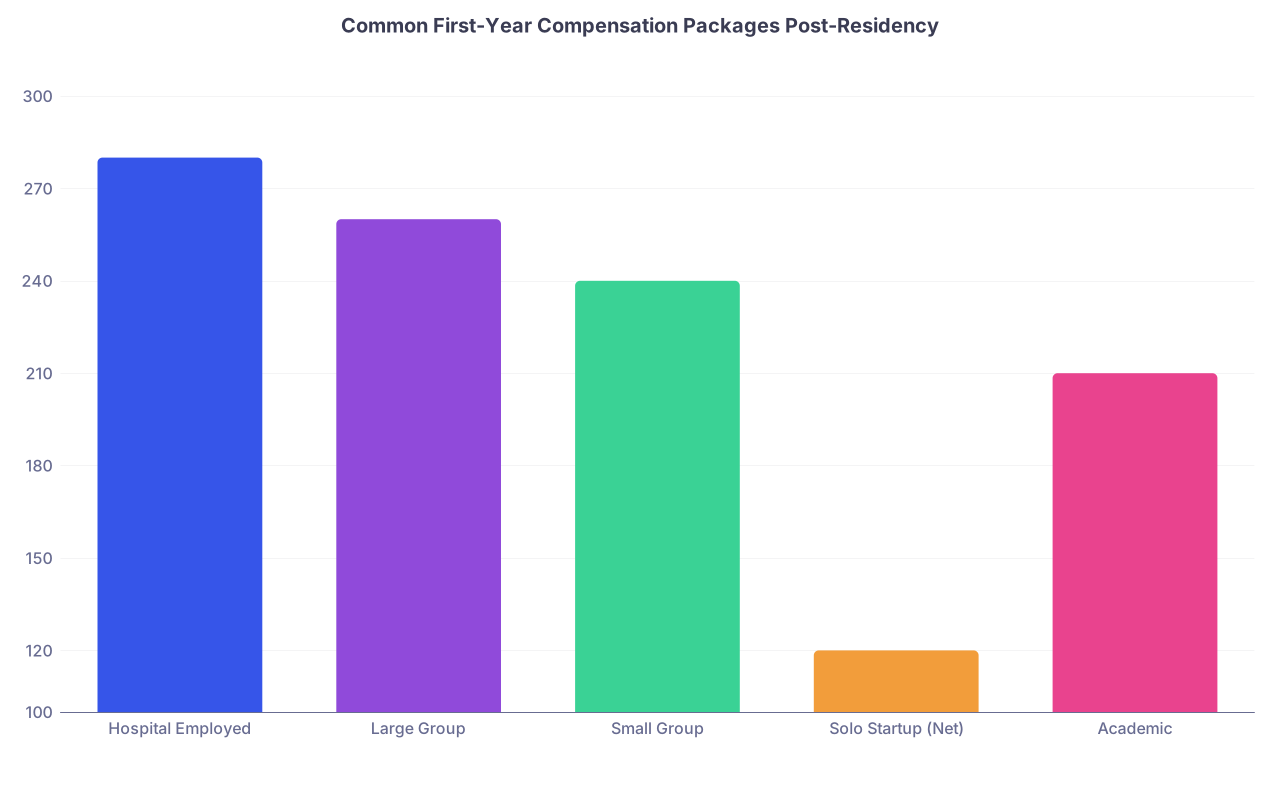
| Category | Value |
|---|---|
| Hospital Employed | 280 |
| Large Group | 260 |
| Small Group | 240 |
| Solo Startup (Net) | 120 |
| Academic | 210 |
The three “flavors” of group practice you’ll see
Not all groups are equal. Internally, we talk about them like this:
The “Factory” group
Typically 10+ physicians, often multi-site, sometimes PE-backed. Heavy on RVUs, advanced practice providers, templates for everything. They hire you to produce. Period. You’ll see 20–30+ patients a day (or equivalent cases) faster than you think.
Upside: smoother onboarding, marketing already built, referral streams established.
Downside: you’re a cog until you prove you’re a very profitable cog.The “Extended family” group
3–8 physicians, privately owned, usually one or two dominant senior partners. You’re stepping into a specific niche: overflow, new site, new service line.
Upside: real mentorship is actually possible here when done right.
Downside: politics. You’re joining a family where power and money have been settled for years. You’re not walking into a democracy.The “Two-doc startup” group
Essentially a small partnership trying to grow into something bigger. They want you to share their risk, but often without truly equal upside early on.
Upside: chances to shape workflows, branding, maybe future leadership.
Downside: if they miscalculated the market, you’re the one scrambling with them.
When you interview, everyone will swear they’re “collegial, supportive, and like a family.” I’ve never seen a group say, “We’re disorganized, territorial, and we underpay new grads.” But I’ve certainly seen that be true.
What you’re really deciding, if you join a group, is: whose machine do you want to plug into, and how fair is the exchange between what you generate and what you keep.
What actually happens if you start a practice right out of residency
Now the other side. Starting your own practice immediately sounds bold and “entrepreneurial.” Instagram loves this. Most faculty quietly think you’re insane.
They’re not entirely wrong—but they’re usually basing that on their own risk tolerance, not the actual data.
Here’s the honest sequence I’ve watched play out multiple times with new grads who went solo straight away:
Month 0–3:
You’re drowning in logistics. Credentialing, payer applications, EMR selection, lease negotiations, banking, entity setup, malpractice, equipment, marketing. You’re reading contracts at midnight you have no business reading alone. Your income is basically zero.
Month 4–12:
Patients start trickling in. The first month you see 2–5 patients a day, if that. By month 9–12, a strong launch might hit 10–15/day. If you’re procedural, you will be fighting for OR time and anesthesia coverage. Every cheque feels like a win. Every denial feels personal.
Year 2–3:
If you did your homework and the market wasn’t saturated, this is where it starts to hit. The referral network is stabilizing, online reviews exist, word of mouth is kicking in. I’ve watched people go from $0 to >$500k profit by Year 3 in good outpatient fields (GI, derm, ortho, psych, some primary care models). I’ve also watched others barely cover overhead in the same time frame.
Year 4+:
If you survive, you have something groups wish they had: a machine where you control the levers. You decide if you bring in an NP or another doc. You decide if you sell to private equity, stay independent, or merge with friends.
The dirty secret: most attendings discourage you from doing this not because it’s impossible, but because they cannot imagine doing it themselves. They were never taught how. They struggled even understanding their first contract. So of course it sounds suicidal.
Is it high-risk to start out of residency? Yes. Is it “impossible in today’s market”? No. That’s lazy thinking.
The real question is whether you’re willing to take a 1–3 year hit in income and sleep to own the thing everyone else ends up complaining about not owning.
The money they don’t show you on the PDF offer
You’re going to get dazzled (or disappointed) by one number: base salary. That’s a rookie mistake.
Here’s what experienced partners quietly look at when they size up your position:
- What’s the realistic annual collections you’ll generate at maturity?
- What percentage of that will you actually see in your pocket in years 1–3?
- What assets are being built in your name versus theirs?
In a group job, typical first-year math (using round numbers):
- You generate: $700k–$900k in collections once your panel is established.
- You’re paid: $230k–$320k (base + bonus).
- Overhead + admin bite: 40–60%.
- Profit to partners: whatever’s left after your comp and overhead. Often $100k–$300k per year off your back once you’re fully ramped.
They are absolutely allowed to make that money. They built the machine. But you need to walk in eyes open: your early attending years are their growth engine.
If you start your own:
- Year 1 collections: maybe $200k–$500k, depending on specialty and execution.
- Net to you: after overhead, loans, build-out—could be barely above zero or modest.
- Year 3 collections: could be $700k–$1.2M+.
- Net margin if you run lean: 40–50% is realistic in many outpatient practices.
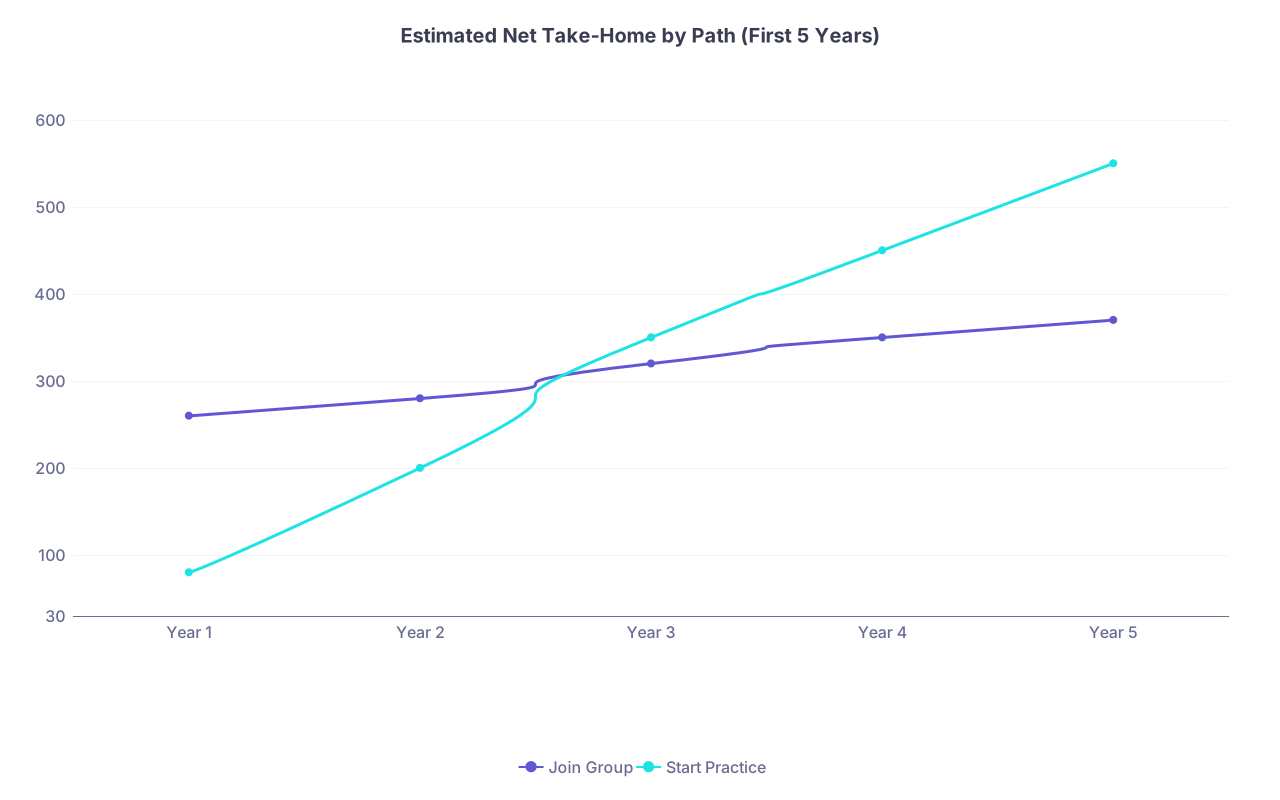
| Category | Join Group | Start Practice |
|---|---|---|
| Year 1 | 260 | 80 |
| Year 2 | 280 | 200 |
| Year 3 | 320 | 350 |
| Year 4 | 350 | 450 |
| Year 5 | 370 | 550 |
Look at that curve. Joining a group is front-loaded comfort, back-loaded regret if you care about ownership. Starting a practice is front-loaded pain, back-loaded leverage.
Will your actual numbers match that chart exactly? No. But the shape of the curve is very real.
Risk, debt, and the stuff that actually keeps you up at night
Here’s the part everyone dramatizes without understanding: risk.
Groups and conventional attendings make solo practice risk sound like a cliff. In reality, it’s more like a steep hill: dangerous if you barrel down blind, manageable if you walk it like a grown adult with a map.
You need to think about risk in three buckets:
Financial risk
- Joining a group: low immediate risk. Your check comes even if the schedule is light. But there’s hidden long-term risk: your income ceiling, your ability to walk away if they don’t offer partnership, being locked into a non-compete that makes your city off-limits.
- Starting a practice: high early cash flow risk. You may burn savings and take loans. If you underestimate overhead or overestimate demand, you can bleed.
Career trajectory risk
- Joining a group: your CV looks “normal.” But if you sit somewhere miserable for years because you feel trapped by your non-compete, that’s risk. I’ve seen people lose half a decade this way.
- Starting a practice: if it fails, you can absolutely still go get a job. I’ve watched this happen. Groups view that experience as neutral to mildly positive if you’re honest about what happened and what you learned.
Psychological risk
- Joining a group: you can feel like you’re back in residency, except now it’s about money and control instead of evaluations. You’re “protected” but also infantilized in some settings.
- Starting a practice: imposter syndrome on steroids. Every slow clinic day feels like proof you made a mistake. Every denial letter feels like a referendum on your worth. You need coping skills, not just spreadsheets.
Let me state something clearly: you do not “ruin” your career by trying to start a practice and pivoting later. That’s a myth pushed by people who never took that risk and need to believe they chose the only rational path.
When joining a group is the smarter move
Not everything is a hero story about building your own brand. Sometimes joining a group first is absolutely the right call.
Here are situations where I quietly tell residents: “Don’t start solo yet.”
You have no clue how money actually flows in medicine.
If you don’t understand collections, RVUs, payer mix, wRVU conversion factors, or basic P&L concepts, you’re walking into live fire unarmed. Go work in a halfway transparent group for 2–3 years and treat it like paid business school.You’re in a specialty with brutal capital or hospital gatekeeping.
Cardiology, interventional radiology, neurosurgery, many inpatient-heavy subspecialties—starting independent right out of the gate can be structurally very hard. Not impossible, but now you’re fighting hospital politics and capital needs, not just marketing.You’re carrying massive personal debt and have zero cushion.
If your margin of error is non-existent, rolling the dice on variable early income may be a terrible idea for your mental health. Stabilize first.You don’t actually want to run a business.
Some of you like patients and procedures and hate the idea of staff issues, marketing, negotiations. That’s okay. Forcing yourself into ownership because “Twitter says so” is idiotic.
In those cases, the smart play is targeted: pick a group that will actually show you the numbers and involve you in decisions, not just hand you a salary and say “trust us.”
When starting your own practice right away actually makes sense
I’ll tell you exactly when I’ve seen new grads pull this off and not regret it.
You’re in a specialty with outpatient leverage and relatively low capital needs.
Think psych, derm, GI (with rented time), EMG-heavy neurology, rheum, allergy, cash-pay primary care, some orthopedics with rented block time. You don’t need to own a cath lab week one.You already know the local market.
You trained there, your spouse is from there, or you’ve done the hard work of calling offices, checking wait times, analyzing payer mixes, and learning which groups people complain about. You’re not guessing; you’re exploiting known gaps.You have a modest but real runway.
This means savings, low fixed personal expenses, maybe a working partner, and access to a reasonable line of credit. Not infinite money. Just enough that every slow month doesn’t induce panic attacks.You actually want to be an owner, not just earn owner money.
Overheard from a partner once: “Everyone wants partner income. Very few want partner headaches.” If you’re one of the few who’s okay dealing with staff drama, EMR issues, negotiations, and the occasional lawsuit stress, then ownership makes sense.
The key is you don’t have to go from zero to mega-group. You can start small, deliberately, and grow only as far as your appetite for headaches allows.

| Step | Description |
|---|---|
| Step 1 | Finish Residency |
| Step 2 | Join Hospital or Large Group |
| Step 3 | Join Small Group with Partnership Track |
| Step 4 | Start Own Practice |
| Step 5 | Launch Solo or Microgroup |
| Step 6 | Comfort with Risk |
| Step 7 | Market Knowledge |
The real “gotchas” nobody explains clearly
Whether you join or start, there are several landmines most residents don’t see until they’ve already stepped on them.
Non-competes and geographic traps
Groups love hiring new grads who have “family in the area” because they know you’re sticky. Then they slap on a 10–25 mile non-compete that makes opening your own shop nearly impossible without moving your kids’ schools.
If you join a group but think you might eventually want your own practice, fight hard on:
- Non-compete radius and duration.
- Whether it applies if they terminate you without cause.
- Whether they define “competing practice” so broadly that you can’t even be telehealth-only.
I’ve seen brilliant future practice owners lose entire markets because they didn’t read one paragraph carefully.
The fake partnership track
Groups will tell you, “Everyone becomes partner in 2–3 years if they do well.” That’s sometimes true. It’s also sometimes complete fiction.
Red flags:
- No written criteria for partnership (just “we’ll see how it goes”).
- Previous hires never made partner, always “moved on for personal reasons.”
- Buy-in amount seems arbitrary or suspiciously high, with no transparent valuation.
If you’re essentially joining as “permanent junior labor,” that has to be worth it on cash alone. Don’t bank on a partnership carrot that keeps moving.
Overhead games
In groups, overhead can be a black box used to justify underpaying you. “Overhead is 65% here, so we can only pay you X.” Maybe. Or maybe the partners are running their Tesla leases through the practice and building out a new office on your shoulders.
You should push for:
- A clear definition of how overhead is calculated.
- Line-of-sight access to practice financials once you’re on a partnership track.
- Knowing whether ancillaries (imaging, PT, lab, ASC ownership) are siloed off from your comp.
If you start your own practice, this flips. Suddenly overhead games are your responsibility. The saving grace is you at least control the rules.
Exit options
Here’s something residents almost never think about: how do you leave?
Joining a group:
- Can you leave and keep your patients? Usually no.
- Are there buyouts, tail coverage costs, or legal fees waiting for you? Sometimes yes, and they can be nasty.
Starting a practice:
- Can you sell your charts, your brand, your space if you want out? Often yes, and in some markets, the multiples are insane.
- Is there a path to merge with other small practices if you get tired of admin? Usually.
Your exit flexibility is part of your compensation package, whether anyone labels it that way or not.
A brutally honest comparison
Let’s put the two paths side-by-side the way partners debate them when they’re being honest.
| Factor | Join Group Early | Start Practice Right Away |
|---|---|---|
| Years 1–2 Income | Higher, predictable | Lower, highly variable |
| Autonomy | Limited | Maximal |
| Admin Burden | Low–moderate | Very high |
| Learning Business | Passive, second-hand | Direct, steep |
| Long-term Upside | Capped unless partner | High if successful |
| Risk Type | Career/geographic trap | Financial/psychological |
Neither path is “right.” But they’re not equivalent experiences.
One is: get paid more now to help build someone else’s asset.
The other is: get paid less now to build your own.
The tragedy is when someone who should have built their own quietly spends 10 years doing the former because nobody ever explained the game this bluntly.
How to actually decide for yourself
You’re not a generic “new grad.” Your answer depends on a few very specific realities:
- Your specialty and local market saturation.
- Your tolerance for debt and variable income.
- Your family situation and geographic flexibility.
- Your actual interest in business, not the fantasy of being “the boss.”
Here’s the most practical advice I can give you:
Spend one month acting as if you’re going to start your own practice. Do the work: call payers, talk to vendors, research lease rates, map competitors, talk to front-office staff in other clinics (the ones who will actually tell you how busy they are).
If, after that month, you feel energized and more curious than when you started, you’re a legitimate candidate to launch early—either right after residency or after a very short employed stint while you finalize logistics.
If, after that month, you feel exhausted, bored, and repelled—go join a group. But now you’ll negotiate that contract differently, because you’ll understand what your labor is actually worth.
FAQ (exactly 4 questions)
1. Is it “too late” to start a practice if I join a group first?
No. I’ve watched plenty of physicians leave groups at 3–7 years and start extremely successful practices. The key is not getting trapped by a brutal non-compete and not letting golden handcuffs (big but capped salary, lifestyle creep) numb your ambition. Use group employment as paid reconnaissance: learn referral patterns, payer behavior, and what patients hate about existing options.
2. How much money do I realistically need to start a practice right out of residency?
For a lean outpatient setup, many have launched with $75k–$250k in total capital between savings and credit/loans, depending on specialty and local costs. You don’t need marble floors and three staff on day one. You need: a small but decent space, an EMR, malpractice, basic equipment, billing support, and one strong front-desk/MA hybrid. Everything else can scale as revenue grows.
3. Will starting my own practice hurt my chances of getting a hospital or group job later if I change my mind?
In practice, no—if you’re honest about why you pivoted and what you learned. Many medical directors quietly respect someone who’s dealt with payroll, credentialing, and operations, even if the business didn’t explode. What hurts you isn’t trying and adjusting; it’s burning bridges, hiding failures, or having quality/complaint issues.
4. What’s the biggest mistake new grads make when joining a group instead of starting a practice?
They treat the job like residency 2.0 and do not read the contract like a business owner would. They ignore non-competes, accept vague partnership promises, never ask to see financials once on the “track,” and underestimate how much revenue they’re actually generating for others. You can absolutely choose to join a group—but you should choose it with the same calculation you’d use to sign a lease or take a loan for your own clinic.
Key points, no fluff:
You’re either building your own asset or someone else’s.
Groups front-load comfort and back-load regret; solo practice front-loads pain and back-loads leverage.
If you understand that trade clearly and choose deliberately, you’re already ahead of most new attendings.