
The partnership agreement you don’t scrutinize now is the one that will blow up your practice later.
I’ve watched more physician partnerships implode over missing terms than over any dramatic betrayal. Not fraud. Not theft. Just sloppy, vague, or incomplete agreements written when everyone “trusted each other” and no one wanted to “make it awkward.”
If you’re starting or joining a private practice post-residency, you cannot afford these omissions. Once there’s money, reputation, referrals, and staff on the line, a bad agreement doesn’t just sting—it detonates.
Let’s walk through the most common things missing from medical partnership agreements that later fuel lawsuits, board complaints, and scorched-earth exits.
1. Vague Ownership and Capital Contribution Terms
The first landmine: nobody can clearly answer, “Who owns what, and who put in what?”
I’ve seen partnerships where:
- One doctor put in $250,000 in startup capital.
- Another contributed “sweat equity” and took a lower salary.
- They shook hands and said, “We’ll work it out later.”
They never worked it out. They litigated it.
Your agreement cannot just say, “Partners own the practice equally” or “as agreed from time to time.” That is legal mush.
You need, in writing:
- Initial ownership percentages: Down to the decimal. 50/50, 60/40, whatever. No “we’ll see how it goes.”
- How contributions are valued: Cash, equipment, existing patient panel, intellectual property (protocols, brand, etc.). Spell out how each type is valued.
- What counts as “sweat equity”: If someone is trading lower comp now for ownership later, define:
- How it accrues.
- When it vests.
- What happens if they leave early.
Leaving this out guarantees that when revenue starts rolling in, someone will say, “I built this practice. I deserve more,” and they’ll have no written basis or clear formula. That’s how you end up with partners hiring separate lawyers and combing through old emails like it’s a forensic investigation.
At minimum, your agreement should include:
| Issue | What Must Be Defined Clearly |
|---|---|
| Ownership percentages | Exact percentage each partner owns |
| Capital contributions | Dollar amount, timing, and source |
| Non-cash contributions | Method of valuation |
| Sweat equity | Formula, vesting, and conditions |
| Future capital calls | How much, when, and required approvals |
If you see your draft agreement gloss over any of those with a vague sentence or “per mutual agreement,” stop and fix it. That “mutual agreement” later becomes “mutual accusation.”
2. Sloppy Compensation and Distribution Formulas
Nothing turns nice colleagues into enemies faster than money distributions that feel unfair—especially when the rules weren’t clear on day one.
The common mistake: The agreement has a one-line compensation clause like, “Profits will be distributed equitably among the partners” or “according to productivity.” That language is a litigation starter kit.
You need specifics, not vibes.
Key omissions that cause trouble:
Definition of “productivity”
- Are you using:
- Collections?
- Work RVUs?
- Charges?
- What about no-shows, capitation, global fees, or bundled payments?
- If you think you’ll “figure it out later,” you’re already in trouble.
- Are you using:
Timing and mechanics of distributions
- Monthly? Quarterly? Yearly?
- Are there guaranteed draws?
- What happens if the practice has a thin cash month but high AR?
Overhead allocation
- Is overhead split equally or proportional to revenue?
- What about one partner who uses more staff, OR time, or expensive injectables?
- Are marketing costs shared or tied to the doc whose name is on the billboard?
Non-clinical work
- Who gets credit for:
- Being medical director.
- Managing staff.
- Handling compliance.
- Running committees or quality programs.
- If one partner feels they’re doing all the “invisible” work for equal pay, resentment builds quietly… until it doesn’t.
- Who gets credit for:
Here’s the pattern: In the early years, when everyone’s hustling and money is tight, nobody complains. Once the practice does well, people start asking, “Why am I getting the same as them?” If you don’t have a clear formula, that conversation won’t be rational. It’ll be emotional.
3. No Clear Buy-In and Buy-Out Terms
If your partnership agreement doesn’t have a detailed, unambiguous section about how someone joins and how someone leaves, you’re inviting a future war.
Two phases cause the most pain: buy-in and buy-out.
Buy-in mistakes
I’ve seen this play out over and over:
- New partner: “So what exactly am I buying?”
- Senior partner: “A share of goodwill, the existing patient base, our reputation.”
- Agreement: 2 sentences and a handshake.
Then someone goes to sell their share or a partner leaves, and suddenly:
- No one can agree on the practice’s value.
- The new partner feels they “overpaid.”
- The old partners feel they “gave it away.”
Your agreement must specify:
- Whether there is a buy-in.
- How the price is calculated (fixed formula or appraisal method).
- Over what time period it’s paid (lump sum vs. financed vs. salary reduction).
- Whether it includes accounts receivable, equipment, real estate, and goodwill, or excludes some of those.
Buy-out mistakes
This is even more dangerous. Because buy-outs usually happen when things are already tense:
- Retirement.
- Burnout.
- Partner conflict.
- Health issues.
- Performance problems.
If your agreement doesn’t answer exactly how a buy-out works, it will become a hostage situation. I’ve seen retiring partners unable to leave because the group can’t agree on a number—and I’ve seen groups gut themselves financially to pay a departing partner way more than the practice could handle.
You need clarity on:
- Events triggering a buy-out:
- Voluntary withdrawal.
- Forced termination.
- Death or disability.
- Valuation method:
- Fixed multiple of earnings.
- Book value plus goodwill formula.
- Independent valuation (with who pays the appraiser defined).
- Payment structure:
- Number of years.
- Interest rate.
- Security (personal guarantee vs. practice only).
- Differences in “good leaver” vs. “bad leaver”:
- A partner retired after 20 years should not get the same treatment as one terminated for cause.
Leaving buy-out terms to “to be negotiated at the time” is not neutral. It hands the future conflict a loaded weapon.
4. Missing or Toothless Exit and Termination Provisions
Let me be blunt: it is negligent to join a partnership without understanding precisely how you or any other partner can be shown the door—or walk out.
Huge, common omissions:
No clear “for cause” definition Most agreements vaguely state: “Partner may be terminated for cause, including but not limited to unprofessional conduct.” That phrase is begging for a lawsuit.
You need a non-exhaustive list, written tightly:
- Loss or restriction of license.
- Exclusion from Medicare/Medicaid.
- Hospital privileges revoked or restricted.
- Criminal conviction (specify type).
- Material breach of the agreement not cured in X days.
- Documented pattern of disruptive behavior consistent with defined practice policies.
No “without cause” mechanism This sounds harsh, but it’s reality: if a partner is a poor fit—ethically, clinically, or interpersonally—you need a way to part ways without having to accuse them of misconduct.
Your agreement should state:
- Whether partners can be terminated “without cause.”
- What vote is required (unanimous minus one, supermajority, etc.).
- What buy-out formula applies in that case.
Exit notice and transition Another mistake: no requirements around:
- How much notice is needed.
- Who informs patients and how.
- Who controls charts, phone numbers, and medical records access.
- What happens to staff allegiance.
Without clear exit language, every departure becomes a scramble. I’ve seen practices fighting over social media accounts, Google reviews, website domains, and even the practice name—because none of it was documented.
5. Non-Competes, Non-Solicits, and IP: Either Missing or Unenforceable
Physicians love to say, “We’re all professionals; we’d never do that to each other.” Then someone leaves and… does exactly that.
Your partnership agreement needs enforceable, reality-based protective covenants. Not wishful thinking. Not a paragraph copied from your friend’s dental office contract.
The biggest mistakes:
No non-compete or geographically absurd ones
- No non-compete at all: Partner leaves and opens an office 0.4 miles away, same phone number pattern, almost the same logo. Legally allowed because you “trusted each other.”
- Ridiculous non-compete: 50-mile radius in a dense metro area. Court throws it out. You effectively have no protection.
You need:
- A radius that would actually hold up in your state (talk to healthcare counsel, not Google).
- A reasonable time period (e.g., 1–2 years, depending on jurisdiction).
- Defined scope of services prohibited (type of practice).
No non-solicitation of patients or staff Even if your non-compete fails, a good non-solicit can still protect you. But only if it exists.
What happens without it:
- Departing partner texts “favorite” staff and patients with their new location.
- Suddenly 70% of your MA’s, front desk, and high-value patients vanish.
- You might have zero legal recourse.
Your agreement needs:
- A clear prohibition on soliciting:
- Patients of the practice.
- Employees and contractors.
- For a defined time period.
- With specific consequences for violation (injunctive relief, liquidated damages if appropriate under local law).
No ownership rules for intellectual property If a partner:
- Builds a protocol library.
- Creates branded patient education materials.
- Develops a practice-branded course or online program.
Who owns it? The individual or the entity?
If your agreement is silent:
- Everyone assumes they own it.
- Or everyone assumes someone else owns it.
- And no one really does until a judge decides.
6. Governance: Voting, Deadlocks, and Decision-Making Black Holes
Another classic omission: you have multiple partners, but the agreement doesn’t really say how decisions are made—or what happens when you disagree.
Early on, when the practice is small, partners make decisions by consensus. Easy. Once you’ve got more revenue, more staff, maybe a surgery center stake, and complex contracts, “consensus” disappears.
What’s usually missing:
Voting thresholds for different decisions Not all decisions should need the same approval level.
Your agreement should spell out:
- What requires:
- Simple majority.
- Supermajority (e.g., 67%, 75%).
- Unanimous consent.
- For example:
- Hiring another partner.
- Incurring debt above a threshold.
- Signing a long-term lease.
- Selling the practice.
- Bringing in private equity.
- What requires:
Deadlock resolution Two-doctor 50/50 partnerships are especially notorious for this.
What happens when:
- You have a major disagreement with no tie-breaker?
- You’re stuck in “we can’t agree so nothing happens” mode for months?
Good agreements often include:
- Tie-breaker mechanisms (rotating managing partner, external advisor).
- Buy-sell clauses triggered by deadlock.
- “Shotgun” clauses—dangerous if misused but better than permanent paralysis.
Defined roles Without formal roles, one partner becomes “the business person” by default, while others stay clinical-only and then later cry foul when they see how decisions were made.
You don’t want to realize you have no decision process the first time there’s a seven-figure opportunity—or a seven-figure problem.
7. No Detailed Call, Schedule, and Workload Provisions
You know what almost never gets enough attention in drafting but dominates daily resentment? Call and workload.
I’ve seen agreements with a single line: “Call will be shared equitably among the partners.” Sounds nice. Means nothing.
Common missed details:
- How call is allocated:
- Rotation method.
- Seniority vs. equal share.
- Adjustments for:
- Part-time partners.
- Partners with niche skills (e.g., procedures, OB, ICU).
- Extra comp (or not) for:
- Holiday call.
- High-volume weekends.
- Unusually heavy service lines.
Then there’s the clinic side:
- Clinic hours expectations.
- Minimum patient volume or sessions per week.
- Administrative time expectations—and whether it’s compensated.
If you don’t write it down, you’ll end up with:
- One partner doing a ton of call and burning out.
- Another partner cutting their schedule quietly.
- Everyone insisting their contribution is “fair.”
Once people have kids, aging parents, or burnout, call and scheduling get sensitive. A vague clause in your agreement will not save you.
8. Compliance, Risk, and Malpractice: Huge Blind Spots
You are not just running a business. You are running a regulated healthcare entity. That changes everything.
Too many partnership agreements say almost nothing about:
- Compliance responsibilities.
- Billing and coding standards.
- Who takes the fall when something goes wrong.
Here’s how that goes sideways:
- One partner is chronically sloppy with documentation and upcoding.
- Another partner flags it, wants changes.
- There’s no defined process.
- Medicare shows up, or payors start recoupments.
- Everyone suddenly cares a lot about who was responsible for what.
Your agreement should not dodge:
- Who serves as compliance officer (internal or external).
- How compliance policies are adopted and enforced.
- Consequences if a partner:
- Refuses to follow policies.
- Creates legal or regulatory exposure.
- Indemnification:
- When the practice covers a partner.
- When the partner is personally responsible.
Malpractice:
- Is coverage occurrence or claims-made?
- Who pays for tail coverage on exit—practice, partner, or shared? Under what conditions?
- What happens if a partner refuses to maintain minimum coverage?
Leaving all that out is malpractice-level naïve.
9. No Real Plan for Divorce, Death, Disability, or Sale
Everyone loves planning for growth. Nobody likes planning for disaster.
So they skip:
- Death provisions.
- Disability definitions.
- Involuntary exit rules.
- Practice sale and change-of-control rules.
Then when something serious happens, partners are stuck arguing while grieving or scrambling.
Your agreement must address:
- What happens if a partner dies:
- Does their estate get a buy-out?
- Using what formula?
- Over what timeframe?
- What counts as disability:
- Who decides?
- For how long?
- Full or partial buy-out?
- What if someone is alive but permanently unable to practice safely?
- You don’t want to litigate that question after a bad outcome and a news story.
On practice sale:
- Who can approve a sale or merger?
- Is there drag-along or tag-along protection?
- How are sale proceeds divided if ownership and compensation have been different?
You either decide this when everyone’s rational and calm—or a judge or buyer will decide it for you when you’re desperate.
10. The “We’ll Fix It Later” Fantasy
The last and most pervasive mistake: thinking the partnership agreement is a living suggestion, not a binding roadmap.
The story goes like this:
- “Let’s keep it simple to start.”
- “We can always amend it later when things settle.”
- Then things never “settle.” They get more complex. People get busier. Money gets bigger. And revisiting the agreement feels threatening:
“Why are you trying to change things now?” “What are you planning?” “Do you not trust me?”
So the flawed agreement stays. Until the moment you most need it. That’s usually when you least like each other.
If you’re signing a partnership agreement:
- Assume this is the document that will be used in a worst-case scenario.
- Draft for the fight you hope never happens, not the honeymoon you’re currently in.
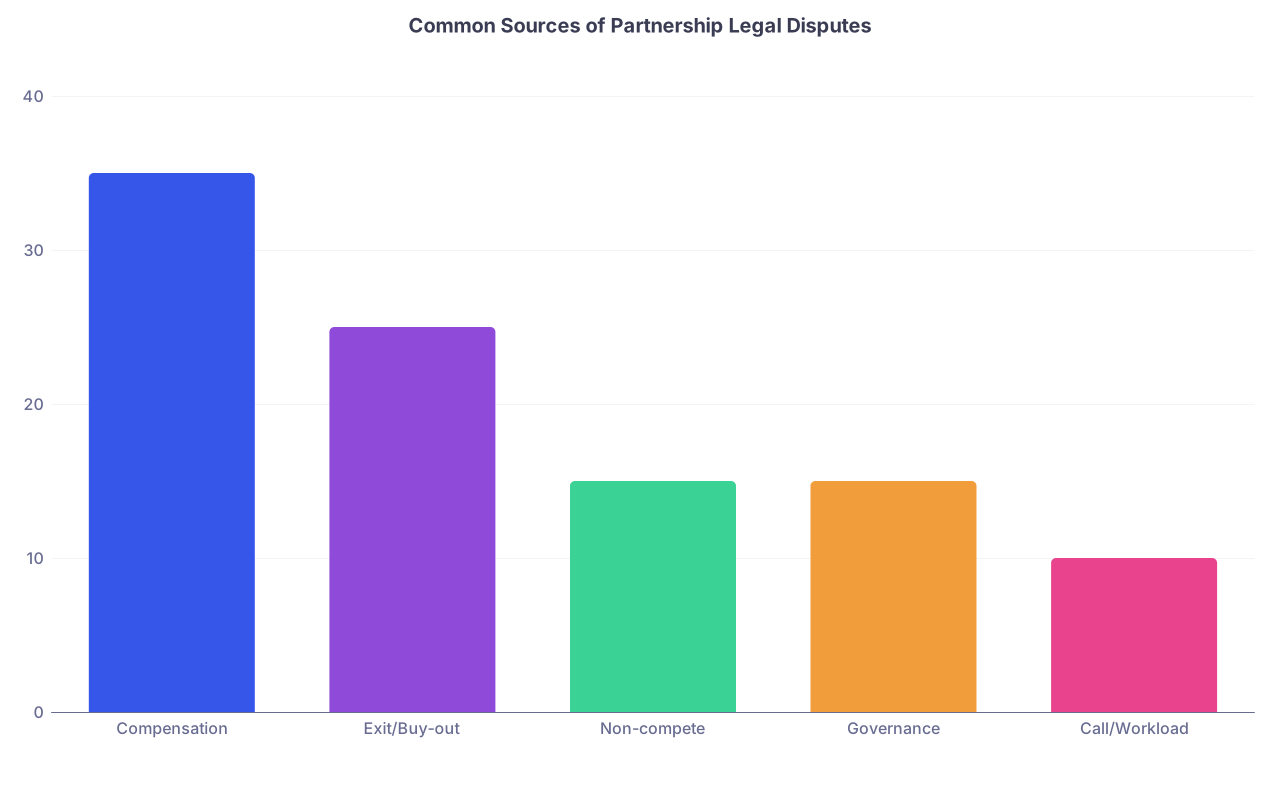
| Category | Value |
|---|---|
| Compensation | 35 |
| Exit/Buy-out | 25 |
| Non-compete | 15 |
| Governance | 15 |
| Call/Workload | 10 |

How to Not Be the Next Cautionary Tale
Here’s how you avoid becoming next year’s “our group blew up” gossip at the hospital:
Do not use a generic business partnership template.
- You’re in healthcare.
- You deal with licensure, payors, Stark, anti-kickback, malpractice.
- Get a healthcare attorney who drafts physician agreements regularly.
Force uncomfortable conversations now.
- Ownership.
- Money.
- Exit.
- Non-competes.
- Call.
- Decision-making. If you can’t have those talks before signing, you won’t survive real stress later.
Get every “we’ll just work that out later” translated into an actual paragraph. If you hear that phrase in a meeting, that’s your signal: this is exactly what you must lock down.
If you remember nothing else
Three points:
- Vague, feel-good language about “equity,” “fairness,” and “mutual agreement” is not protection. It’s a litigation starter.
- Every stage of the relationship—entry, daily work, conflict, and exit—needs clear, written rules that you’d be willing to live with even if you and your partners were on terrible terms.
- The time to fix your partnership agreement is before there’s money, conflict, or crisis. After that, you’re not “revising”—you’re negotiating under fire.
Do not sign something just because “everyone else did” or “this is what the practice has always used.” That’s how smart physicians end up in very dumb legal battles.