
The biggest myth about cash‑only clinics is that they always make more money per patient. The data says: not automatically. Revenue per visit depends on your fees, payer mix, and visit volume—and physicians who ignore the numbers often pick the wrong model for their market.
You are not choosing between “good” and “bad” here. You are choosing between two different revenue engines, with very different unit economics and operational friction. If you understand revenue per visit, you stop guessing and start modeling.
Let’s walk through the numbers the way an investor would, not the way a burned‑out attending vents in the doctors’ lounge.
1. Defining the Two Models in Financial Terms
Forget ideology. Strip it down to cash flows.
A visit in your clinic generates:
- Gross charge (what you bill or list as your fee)
- Net collections (what actually hits your bank account after adjustments, write‑offs, and uncollectible accounts)
- Cost per visit (staff time, billing overhead, credit card fees, platform fees, etc.)
Revenue per visit must be compared on a net, collected basis, not on “charges” or what someone’s friend “gets away with charging.”
Here is the core distinction:
Insurance‑based clinic
- Revenue per visit = Allowed amount (negotiated with payers) – denials – patient bad debt
- Overhead per visit includes billing staff, clearinghouse fees, software for RCM, credentialing time, audits, prior auth time (real cost).
Cash‑only clinic
- Revenue per visit = Posted fee – refunds – payment processor fees – occasional bad debt
- Overhead per visit smaller on the billing side, but you typically need higher marketing and patient communication to fill the schedule.
Most physicians underestimate the revenue compression from insurance contracts and the volume compression that can happen in cash‑only clinics.
So let us quantify.
2. Baseline Assumptions: Typical Primary Care Numbers
To compare apples to apples, I will use a common, straightforward scenario: outpatient adult primary care / family medicine in a mid‑cost U.S. metro area.
Reasonable averages from aggregated practice data, MGMA benchmarks, and typical payer contracts:
- Average commercial allowed amount for established visit (99213/99214 mix): $85–$120
- Blended payer mix for a typical insurance‑based clinic:
- 40% commercial
- 40% Medicare
- 20% Medicaid / exchange plans
- Collection rate (after denials, no‑shows without fees, uncollected copays, etc.): 92–96% of allowed amounts if RCM is competent
- Cash‑only primary care fee per routine visit commonly: $120–$200 (non‑concierge, per‑visit model)
- Payment processor fee: about 2.9% + $0.30 per transaction, call it 3% of revenue on average.
This is the baseline. From here, we can estimate net revenue per visit under each model.
3. Revenue per Visit: Insurance‑Based Clinic
Let me quantify a realistic “average allowed amount” using a blended payer mix.
Assume:
- Commercial allows $120/visit
- Medicare allows $90/visit
- Medicaid allows $60/visit
With payer mix: 40% commercial, 40% Medicare, 20% Medicaid.
Blended allowed per visit:
- (0.40 × 120) + (0.40 × 90) + (0.20 × 60)
- = 48 + 36 + 12
- = $96 allowed per visit
Now factor in collections. With reasonable RCM:
- Denials + unpaid deductibles + bad debt + small underpayments together: say 6% loss
Net collected per visit:
- 96 × 0.94 ≈ $90.24
This is your net collections per visit before overhead.
But insurance billing overhead is not zero. Assume:
- Billing team (or outsourced RCM): say 6–8% of collections
- Extra admin time for prior auths, coding, appeals, credentialing: easily another $5–$7 of time cost per visit if you cost out staff and physician time
Let us convert this roughly to a per‑visit overhead allocated to billing.
Typical small practice:
- Collections: $800,000/year
- Visits: 8,000–10,000/year → assume 9,000 visits → ~ $89/visit (in line with our estimate)
- Billing‑related costs:
- Billing staff / RCM fees: $60,000–$75,000
- Software / clearinghouse / credentialing costs: $10,000–$15,000
- Total: say $80,000–$90,000
Per visit billing overhead:
- $80,000–$90,000 / 9,000 visits ≈ $8.90–$10.00 per visit
Round to $9.50 per visit in billing overhead.
So your net revenue per visit after billing overhead is roughly:
- $90.24 – $9.50 ≈ $80.74
You still have rent, staff, malpractice, etc., but those are shared across both models. For comparison purposes, the key is:
- Insurance model: ~$81 net revenue per visit after direct billing overhead.
If your payer mix is more heavily Medicaid, that number drops fast. If you are 80% commercial, it goes up.
4. Revenue per Visit: Cash‑Only Clinic
Now take a simple cash‑only practice charging $150 per standard visit. Many markets will not tolerate much above that for non‑concierge primary care unless you have a high‑income niche or a membership model, but $150 is feasible in many metro areas.
Gross revenue per visit:
- Posted fee: $150
Payment processor / transaction fee: assume 3%.
- 150 × 0.97 = $145.50 collected
Bad debt is lower than in insurance models because you collect at time of service, but it is not zero. Let us assume:
- 1% loss to refunds, disputes, or failed payments:
- 145.50 × 0.99 ≈ $144.04
Billing overhead is lower:
- You do not have to chase payers, file appeals, manage EOBs, do complex coding for reimbursement optimization, or pay a 6–8% RCM fee.
- You still need a payment platform, some basic admin time, and possibly a simple EMR.
You might allocate:
- $10,000/year in payment / EMR admin cost dedicated to billing & payments
- 3,000 visits/year (smaller volume typical of cash practice)
Per visit billing overhead:
- 10,000 / 3,000 ≈ $3.33 per visit
Net revenue per visit after billing overhead:
- 144.04 – 3.33 ≈ $140.71
So:
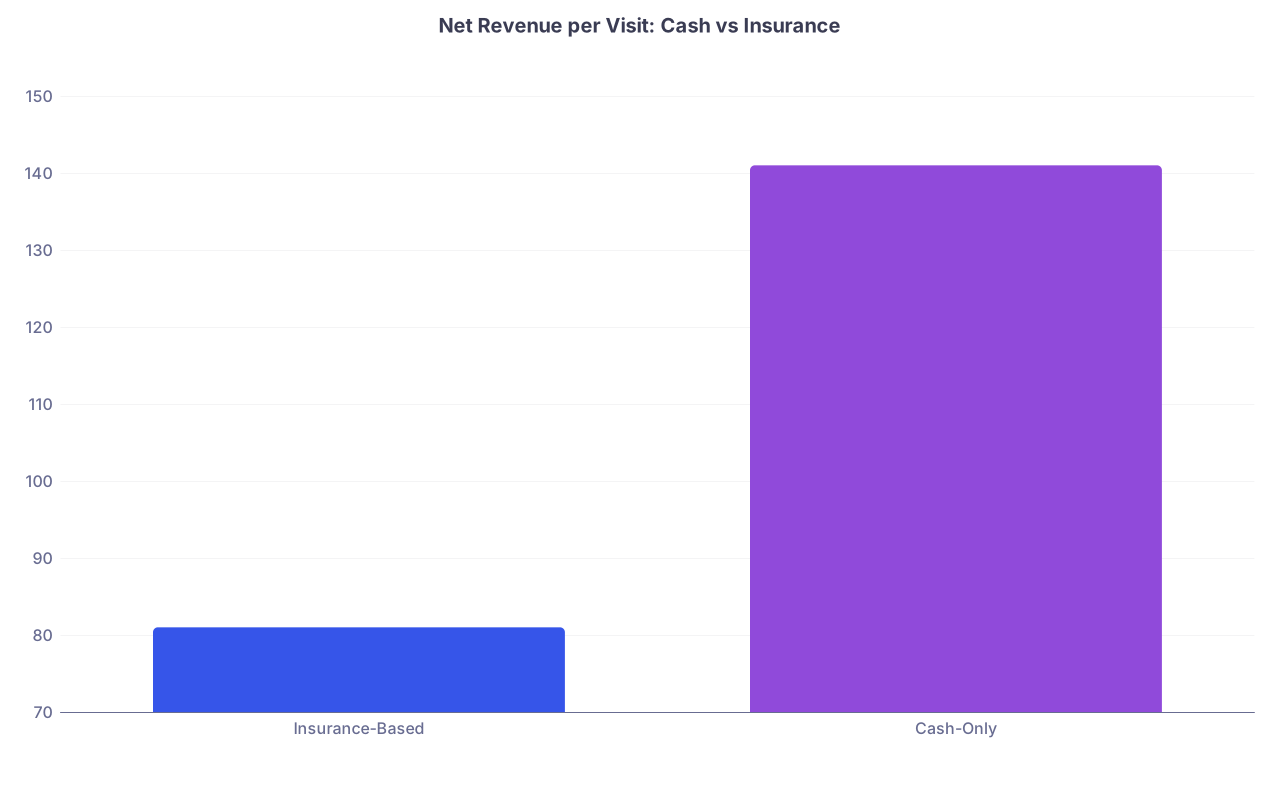
- Cash‑only model: ~$141 net revenue per visit
- Insurance model: ~$81 net revenue per visit
On a pure per‑visit basis, the cash‑only model is winning by roughly 74% higher net revenue per visit in this specific example.
But here is where people get misled: the volume assumption.
5. The Volume Reality: You Will Not See the Same Number of Visits
Insurance‑based clinics are volume machines. They must be.
A full‑time primary care physician in a traditional insurance model often sees:
- 18–24 patients/day, about
- 4–4.5 days/week of clinic,
- ~45–48 work weeks/year
That easily puts you in the 3,500–4,500 visits/year range, sometimes higher.
Cash‑only primary care that is not concierge typically sees:
- 8–14 patients/day early on,
- Maybe up to 16/day in a mature, well‑marketed practice
And many cash practices intentionally cap at a lower panel size for lifestyle and service reasons.
So a realistic comparison:
- Insurance‑based: 4,000 visits/year × $81 ≈ $324,000 net from professional fees (before shared overhead)
- Cash‑only: 2,500 visits/year × $141 ≈ $352,500 net from professional fees
Revenue per visit makes up for lower volume here.
But if your cash‑only clinic cannot get beyond, say, 1,500 visits/year, the math flips:
- 1,500 × 141 ≈ $211,500 net from visits
You are now behind the insurance model’s $324,000.
The data point: volume elasticity is where most cash‑only dreams break.
To make this more concrete:
| Category | Value |
|---|---|
| Insurance-Based | 81 |
| Cash-Only | 141 |
Unit revenue is better in cash. But if your market (or your marketing) cannot support enough visits, it does not matter.
6. Break‑Even Volume: How Many Cash Patients Equal One Insurance Panel?
Let us ask a useful question:
“How many cash‑only visits at $141 net equal the revenue of one insurance‑based visit at $81 net?”
This is trivial algebra but critical thinking:
- Insurance net per visit: 81
- Cash net per visit: 141
Ratio:
- 81 / 141 ≈ 0.57
That means 1 cash visit ≈ 1.74 insurance visits in net dollars, using our assumptions.
Or flipped:
To match the revenue of an insurance‑based panel at 4,000 visits/year, how many cash visits do you need?
- 4,000 insurance visits × 81 = $324,000
- Required cash visits = 324,000 / 141 ≈ 2,298 visits
So if you can get to roughly 2,300–2,500 cash visits/year, you match or beat the insurance‑based clinic revenue.
Per week, assuming 46 working weeks:
- 2,300 visits / 46 ≈ 50 visits/week
- At 4 days/week of clinic → 12–13 visits/day
That is a very workable daily volume for a cash primary care practice. This is why many physicians who successfully fill their cash panel do not go back to insurance—you get similar (or greater) income with less throughput pressure.
Where people fail:
- They underestimate how long it takes to reach 12–13 cash visits/day.
- They overprice in markets that are not ready to support their fee structure.
- They do zero serious marketing or rely on “word of mouth” with no base.
7. Sensitivity Analysis: Adjusting Key Variables
The real world is messier than the clean example. So let us pressure‑test the model by adjusting common variables:
- Lower market tolerance for cash prices
- Worse payer mix in insurance model
- Higher RCM efficiency
- Higher cash fees in affluent markets
Scenario A: Lower Cash Fee – $120 Instead of $150
New cash assumptions:
- Fee: $120
- Net after processor (3%): 120 × 0.97 = 116.40
- 1% other loss: 116.40 × 0.99 ≈ 115.24
- Billing overhead: still ~$3.33 per visit
Net per visit ≈ $111.91
Difference vs insurance ($81):
- 111.91 – 81 ≈ $30.91 more per visit (about 38% higher than insurance, not 74%).
To match insurance at 4,000 visits/year:
- Insurance revenue = 4,000 × 81 = 324,000
- Required cash visits = 324,000 / 111.91 ≈ 2,895 visits/year
Weekly volume:
- 2,895 / 46 ≈ 63 visits/week, or about 16 visits/day for 4 clinic days/week.
Still lower intensity than many insurance practices, but not by as much. If your market only supports $120 per cash visit and you only want to see 8–10 patients/day, your total income will likely lag the insurance panel.
Scenario B: Better Insurance Payer Mix (High Commercial)
Assume:
- 70% commercial at $120
- 20% Medicare at $90
- 10% Medicaid at $60
Blended allowed:
- (0.70 × 120) + (0.20 × 90) + (0.10 × 60)
- = 84 + 18 + 6 = $108
Assume strong collections (96%):
- 108 × 0.96 ≈ $103.68
Billing overhead still around $9.50 per visit.
Net per visit:
- 103.68 – 9.50 ≈ $94.18
Now insurance per visit is more competitive. Compare:
- Insurance: $94
- Cash (at $150 posted fee): $141
Difference: $47 more per cash visit (about 50% more, not 74%). Still higher, but the gap narrows in affluent, commercial‑heavy markets.
Scenario C: Ugly Payer Mix (Medicaid‑Heavy)
Assume:
- 30% commercial ($120)
- 30% Medicare ($90)
- 40% Medicaid ($60)
Blended allowed:
- (0.30 × 120) + (0.30 × 90) + (0.40 × 60)
- = 36 + 27 + 24 = $87
Collections 94%:
- 87 × 0.94 ≈ $81.78
Net after billing overhead (9.50):
- 81.78 – 9.50 ≈ $72.28
Now the gap is huge:
- Cash: $141
- Insurance (Medicaid‑heavy): $72
Almost 2x net revenue per visit.
This is the scenario where a physician often feels “crushed” by the system and where a cash transition—if the local demographics support it—makes the strongest financial sense.
8. Operational Friction: Time Cost per Dollar Collected
Revenue per visit is not just about dollars. Time matters. Unlike an abstract “burnout” metric, time can be treated as a cost per dollar collected.
A typical insurance visit has hidden time costs:
- Coding properly for maximized reimbursement and audit safety
- Documenting for payer requirements
- Handling prior auths
- Answering billing questions from confused patients about EOBs and surprise bills
A simple way to think:
If you or your staff spend 15 minutes of total non‑clinical time per insurance visit (scattered across front desk, back office, and indirect physician tasks) and the visit nets you $81, you are generating:
- $81 per 15 minutes administrative = $324 per admin hour (not including clinical time).
For a cash visit, if the admin load is more like 5 minutes per visit (simple collection, a clearer price, no insurance disputes):
- $141 per 5 minutes = $1,692 per admin hour
The ratio is dramatic. Yes, this is somewhat conceptual, but it captures why cash clinics often feel less chaotic, even if the income is comparable. Each minute of non‑clinical time produces more revenue.
9. Critical Comparison Table
Here is a compact summary under a realistic mid‑market scenario:
| Metric | Insurance-Based Clinic | Cash-Only Clinic |
|---|---|---|
| Blended allowed per visit | $96 | $150 (posted fee) |
| Net collections per visit | $90 | $144 |
| Billing overhead per visit | ~$9.50 | ~$3.30 |
| Net revenue per visit | ~$81 | ~$141 |
| Typical visits per year | ~4,000 | ~2,500 |
| Annual net from visits | ~$324,000 | ~$352,500 |
Again: change any assumption and the table shifts. But this is roughly where many actual practices land when they do the accounting properly.
10. Strategic Implications for a Post‑Residency Physician
If you are just finishing residency and facing the job market, your decision is not just “cash vs insurance.” It is:
- Do you start in a relatively safe insurance environment, learn operations, and then pivot?
- Or do you go straight to a higher‑risk, potentially higher‑reward cash‑only model that requires serious business skills from day one?
From the data above, you can extract a few hard conclusions:
Per visit, cash wins overwhelmingly in most realistic scenarios.
Even at lower fees ($120), the net revenue per visit is usually meaningfully higher than insurance unless you have an exceptionally favorable payer mix and contracts.Volume is the true choke point.
If you cannot hit roughly 12–16 visits/day in a cash clinic (depending on your fee), your total income may lag a conventional insurance job where you see 18–24/day.Insurance volume masks low unit economics.
Many physicians will say, “My practice is doing $800,000 in collections; I am doing fine,” but when you look at revenue per visit and admin time consumed, the model is fragile and heavily dependent on grinding volume.Geography and demographics override ideology.
In a Medicaid‑heavy, low‑income area, a pure cash model will struggle to fill the schedule, regardless of your spreadsheet. In a high‑income suburb with many high‑deductible plans, a transparent $150 visit looks more compelling.
A simple mental flowchart is helpful here:

| Step | Description |
|---|---|
| Step 1 | Assess Local Demographics |
| Step 2 | Model Cash-Only or Hybrid |
| Step 3 | Focus on Insurance-Based |
| Step 4 | Cash-Only Viable |
| Step 5 | Hybrid or Concierge Membership |
| Step 6 | Optimize Payer Mix and RCM |
| Step 7 | High Income and HDHP Common |
| Step 8 | Can Reach 12-15 Cash Visits per Day? |
HDHP = High Deductible Health Plan.
If your region is packed with people on $6,000 deductibles, paying $150 directly for a visit is not crazy to them. They were going to pay out of pocket up to the deductible anyway, and many prefer price certainty.
11. Hybrid Models: Where Many Real‑World Clinics Land
Very few practices are truly 100% cash or 100% insurance long‑term.
You often see:
- Insurance‑based practice with a sidecar of cash‑pay services (weight loss, hormone therapy, aesthetics, procedures not covered by insurance).
- “Direct primary care” (DPC) membership + limited insurance billing for specific procedures or in‑office tests.
- Out‑of‑network only: the clinic charges cash but gives superbills for patient reimbursement.
From a revenue per visit standpoint, hybrid models usually show:
- Higher revenue per visit for cash‑pay side services (e.g., $250+ net for a 30‑minute procedure)
- Baseline volume from insurance ensures fixed overhead is covered
- Effective overall revenue per clinical hour higher than either model alone, if executed well
A quick comparison for a hybrid day:
You see:
- 12 insurance visits @ $81 net = $972
- 4 cash‑pay procedures @ $200 net = $800
Total day revenue: $1,772 over 16 visits → $110.75 per visit average
Better than pure insurance, slightly below pure cash at $141/visit, but more stable volume.
12. What the Data Actually Tells You to Do
Let me strip away the noise.
If your priority is max revenue per visit and control over schedule, and your metro area has:
- Above‑average income
- Significant proportion of high‑deductible commercial plans
- Population accustomed to boutique services (cosmetic dentistry, aesthetics, etc.)
then the data strongly favors at least a cash‑heavy or hybrid model, provided you are willing to:
- Market aggressively
- Control your overhead
- Accept slower initial panel growth
If your priority is fast, predictable income and less business risk, and your region is:
- Medicaid‑heavy
- Lower income
- Accustomed to “I show my card and pay a $10 copay”
then starting insurance‑based and optimizing payer mix and RCM is rational. Your revenue per visit will be lower, but volume will be easier to obtain.
Use numbers, not vibes:
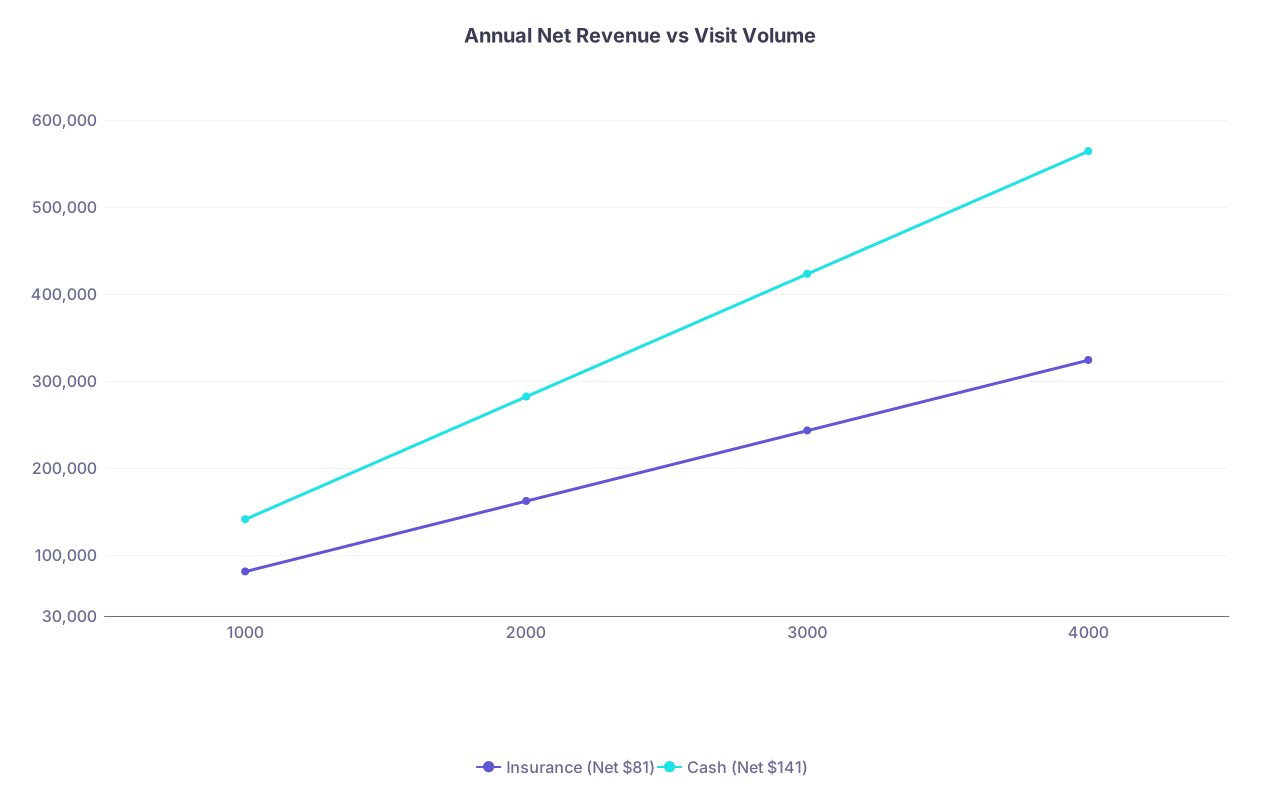
| Category | Insurance (Net $81) | Cash (Net $141) |
|---|---|---|
| 1000 | 81000 | 141000 |
| 2000 | 162000 | 282000 |
| 3000 | 243000 | 423000 |
| 4000 | 324000 | 564000 |
That chart is the entire argument in one picture. At equal volume, cash wins by a mile. But if your realistic volume in year 1 is 1,200 visits cash vs 3,500 visits insurance, you know exactly what your income will look like.
13. How to Run Your Own Numbers Before You Commit
Do not copy my assumptions blindly. Replace them with your own:
Get real payer contract data from local colleagues or a potential employer:
- Commercial allowed amounts for common CPTs
- Medicare rates in your region
- Expected payer mix
Decide your realistic cash fee for a standard visit:
- Look at local urgent care prices, telemedicine cash fees, and competitors.
Estimate:
- Insurance net per visit = (Blended allowed × Expected collection rate) – Billing overhead per visit
- Cash net per visit = (Posted fee × (1 – payment processor %) × (1 – bad debt %)) – Billing overhead per visit
Set target volumes:
- Year 1, Year 2, Year 3 for each model, and see where annual revenue lines cross.
Then you can build a simple break‑even table for yourself:
| Metric | Insurance Model | Cash Model |
|---|---|---|
| Net revenue per visit | $X | $Y |
| Realistic visits Year 1 | A | B |
| Annual net from visits Y1 | X×A | Y×B |
| Visits to match $300k net | 300000/X | 300000/Y |
Replace X, Y, A, B with your actual numbers. If you are not comfortable doing that math on paper, you are not ready to open a clinic yet, regardless of model.
The decision between cash‑only and insurance‑based practice is not philosophical. It is numerical. Revenue per visit, payer mix, and realistic visit volume drive everything. Once you have those three inputs modeled for your real local market, you can choose a path with your eyes open.
With that model in hand, you are ready for the next step: designing your clinic’s operations around the revenue engine you choose—scheduling, staffing, and services that actually match the math. That is where a theoretical spreadsheet becomes a functioning practice.